Likes
Comments
Share
@EVD420
Follow
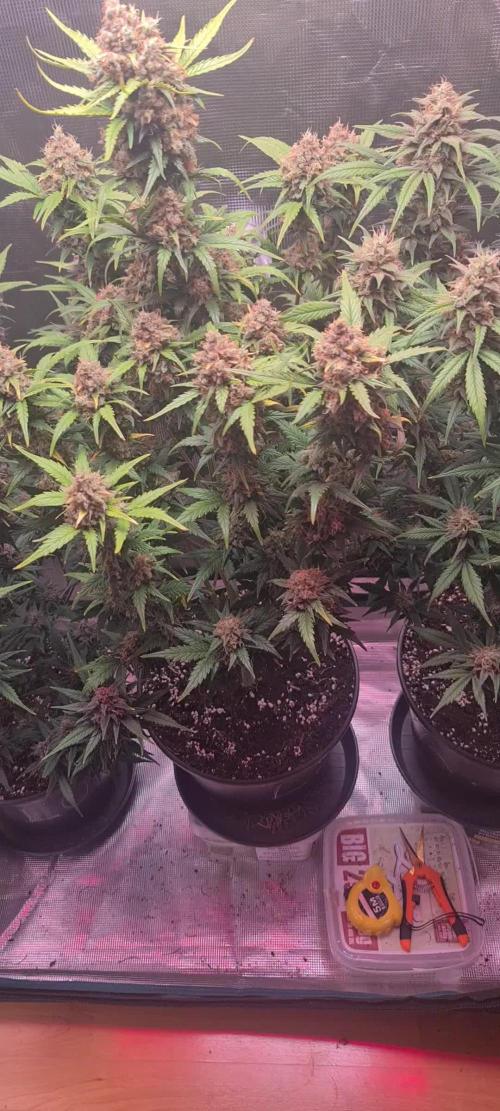
Hey people! ✌️✌️ So, at the time of this post, it's day 60 of flowering. 🌸🌸🌸 We're nearing the finish line. This week, the seeds started popping out in all directions. Feeding remains unchanged: AB 20ml/5L. Today, I noticed some scary numbers on the runoff, measuring at 2500ppm. Next watering, I'll give them plain water. I'll continue feeding until the very end. The taste of the buds isn't our focus in this grow, and what kind of buds can we expect anyway? I continue to train the big plant as it started leaning to one side. I've tied it to the pot for support. My bet is that in 2-3 weeks, we'll be harvesting, collecting seeds, and running some bubble hash. There's a new addition to the grow box. I added a Barney's LSD auto since it's outgrowing my small box. I also planted 7 no-name seeds that came my way by chance. Curious to see what comes out of them. Well, until next time, have a great time! ✌️✌️
Likes
7
Share
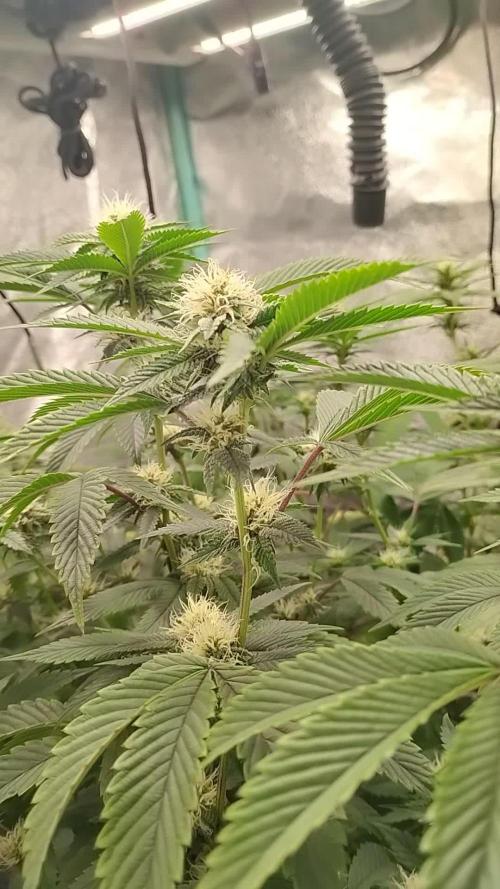
Entering in week 4 from seed. Plant doing amazing after transplant. Blumats dailed in and put the girls on auto pilot. Sprayed some pure crop one earlier in the week and will come back with some neem oil for continued IpM later this week. So far so good! Plants are growing extremely fast. topped the plant on day 25 and trim of the bottom most node.
Likes
16
Share
@LowzGrowz
Follow
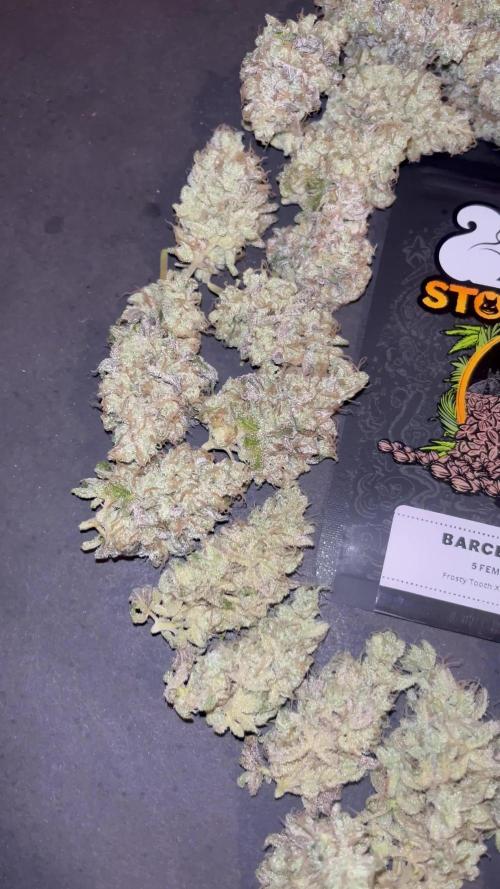
She got week or 2 left wonderful aromas Dense Nugs Great Fade
Likes
4
Share
@OlyGrower
Follow
Day 36, start of Week 6- Seeing good growth the last week. Had to get a new HPS bulb so stuck w the metal halide this last week till it gets here. All is good. Got a gorilla cookies that is growing uncharacteristically slowly so I decided to go a different way and run a Purple Lemonade FF in its place. Got no time for slow growers
Likes
61
Share
Hello growers and welcome to week 6. I expect Queen Citronella to gain a lot of height this week. I will be doing the measurements shortly, but first I wanted to share some news! Queen Citronella has a new home, she hasn't moved in yet, but I'm working on it today. I will also be rearranging all the other grows and starting some new things off! I am not sure if I have mentioned it anywhere but I am using a 1.2m x 1.2.m x 1.8m tent.. I have just got a 60cm x 60cm x 140cm tent and a 300w LED. Her Majesty I hope will enjoy her new quarters. Day 36: I have lowered the light to 30cm above the tallest plants. Day 37: It is done! Queen Citronella resides in her own palace, while the rest of the plebs squat together in the communal living area. I have reorganised and moved my 4x4, mounting the carbon filter and duct fan properly in the center. Setup a 2 x 2 with a 300w LED and put the lights for both tents on the same timer (for now). I will measure and photograph Her Majesty a little later, including photos of her new home. Day 37: Added media. Height: 31cm. Fertigated 2l. Day 37.5: Alright she is really stretching fast, she grew almost 5cm in a little over 30 hours, A thought has just occurred to me; I could, if I chose to, put the Queen on a flower cycle at this point. Now I did want to do a full grow of clones, however we're talking something like another 2 weeks of veg then 2 weeks for cuttings to root, then I'd want to veg them for a few more weeks, maybe 2, 3 or 4? So that's 6-10 weeks before I start flowering. Then at least ten weeks of flowering, A week to dry, and at least a fortnight to cure. We're talking 20-25 weeks before I get to smoke it, that's six months! I probably wont be able to grow in the summer due to the heat. Now I already have the one cutting which I am hoping will root soon, which I can take forward, but I also have two more seeds. So, regretfully, I think I will change my plans. I will flower queen Citronella, starting on day 43. I still intend to do a full tent of Super Lemon Haze clones, but I think I will postpone that adventure until September. So this is now the final week or final five days of veg, she will spend the bulk of her last week of veg under a different light. We wont get much data on vegging (unless there is a significant change this week) but it'll be a nice trial run flowering with an LED light for the first time. Exciting! I am still waiting for the Epislon F1 seeds from RQS. I set their pot up today, inoculated, fed, and sowed some Dark Opal (Purple) Greek Basil and a liberal sprinkling of chamomile. I am going to germinate all five seeds in jiffy pellets and then put them all in the same 40l Day 38: I have realised Her Majesty was too tall to flower in this little tent so I snapped her neck a bit. I installed a photometer app yesterday and discovered I was blasting Citronella with 75 DLI so I raised to light up until canopy level was 40 DLI. The LED is pretty good. The HPS Dual Spectrum bulb in the main tent must be on its last legs as output was around 40 DLI for optimally positioned plants and 30 least optionally positioned. I could do to buy a new bulb. Identical replacement is about fifteen bucks, best one is about fifty. For that I could get another one of those LEDs which seems like better value. At the moment though I really need the heat. So I am thinking identical replacement. 4 days to flower cycle! Day 38.5: Replaced crappy old Dutch barn reflector with a much nicer angel wing model. Installed a significantly larger carbon filter into the main tent which has significantly increased air flow. The main tent vents into the bottom of Queen Citronella's tent, and from there and unfiltered duct fan in the far top corner exhausts it out. The exhaust pipe goes up the chimney. Why have I reorganised and moved the tents again so soon is because I was wasting power heating the little tent with the LED light, but the main tent has excess heat. Well this setup is working a treat. Citronella is sitting in a balmy 23-24 degree wind tunnel. Check out the little video of the changes. Day 39: I think her majesty likes her new quarters. It's going to be weird seeing her square in a few more days. We are 2 days into a "dry spell" I'm simulating for all my plants. Day 40: Dry spell ended. Fertigated 6l. Day 41: Fertigated 3l. Citronella's penultimate day of veg, she is going 12/12 from lights out after next. Photos taken 10:00 9/2/23. Current lights out is Citronella's last 6 hour night! Day 42: Start: Have performed pre-flower LST, HST, and defoliation. 24 hours to flower cycle. Day 42: End: photographed immediately before first 12h night. End of week summary: Huge week for Citronella. I think this LED light is pretty good. Change of plans regarding the grow and preparing her for flower. Let's see how she does.
Likes
13
Share
No nutrients this last watering I did today. Flushing for 2 weeks then harvest time! I've done the last of my defoliating and looking forward to starting a new batch in a few short weeks.
Likes
Comments
Share
- Luz: Bestva Pro 1000W / 18 h/d -FloraNova Grow G.Hydroponics: 0.6ml/l - Armour SI G. Hydroponics 0.4ml/ - Rhizotonic Canna : 4 ml/l - Everest: 0.5 ml/l -Sustrato: 2 partes de JIFFY fino con perlita + 1 parte de sustrato universal FLORAGARD - Diatomea y aguande grifo
Processing
Likes
51
Share
2/1: I flushed the taller/skinnier Muscadine Wine and lightly fed everybody else. 2/4: I moved the taller/skinnier MW into the dark for a day...she and several other plants will be harvested tomorrow.
Likes
37
Share
During week 9 the flowering continued nicely and all plants developed nice flower crowns. Unfortunately I spotted some brown pistils on some plants and at this stage that only can mean they have been inseminated by pollen. Since I have no male plants around I thoroughly inspect the nodes of all plants from bottom to top. I am searching for hidden male pollen-sacks that have grown on my female plants and sure enough I find several ripe and open pollen sacks on three plants. This means those plants ARE HERMAPHRODITES, plants that have BOTH SEXES, they are female plants that also grow male pollensacks...my ABSOLUTE HORROR! The open pollen sacks have released pollen onto the female pistils around them and this turned the pistils brown. Where those fertilized pistils are, seeds will now start to grow inside the buds of my grow. 😢 After spraying water over the plants, in order to neutralize the free pollen inside, I carefully cut off the hermie-plants on the main stem right above the soil and immediately discard them far away from my grow-tent into the trash. Since I spotted the hermies early, I hope my grow will not be fully seeded, but only have a few seeds grow in some buds here and there. My fingers are crossed! My 'CHEESE'-plant from BIG BUDDHA SEEDS has turned a little yellow and developed some dark spots on the leaves, which I attribute to the plant standing alone in a tray now. She seems to be overfed a little and getting too much water to the roots. I therefore take her out of the water for a few days, in order to let the medium dry out a little and let the roots get some air. The SANlight EVO4-120 LED-lights work like a treat. They are now running at 100% dimm-level and are hung 30 cm above the top of the plants. The BIO NOVA nutrients are still given at half strength of the recommended dose and some plants seem to be overfed...I have to keep an eye on them.
Processing
Likes
12
Share
@BloodBath
Follow
Didn’t get too many pictures this time but they’re really starting to pack on resin now. They smell so good. Everything is going smoothly. Just gave them a flush with some SLF and Herculean Harvest. Runoff is already pretty significantly low. They’ll be getting the same flush again in a few days and then plain PH balanced water until they get chopped down. Planning on them fading super hard from this point on. All the buds are super dense. Can’t wait to try some sooner than later.
Likes
45
Share
My homework. Rubisco regeneration is intrinsically linked to nitrogen supply because Rubisco is a major sink for nitrogen in plants, typically accounting for 15% to over 25% of total leaf nitrogen. The regeneration phase itself consumes nitrogen through the synthesis of the Rubisco enzyme and associated proteins (like Rubisco activase), and overall nitrogen status heavily influences the efficiency of RuBP regeneration.Structural Component: Nitrogen is an essential building block for all proteins, and the sheer abundance of the Rubisco protein makes it the single largest storage of nitrogen in the leaf. Synthesis and Activity: Adequate nitrogen supply is crucial for the synthesis and maintenance of sufficient Rubisco enzyme and Rubisco activase (Rca), the regulatory protein responsible for maintaining Rubisco's active state. Nitrogen deficiency leads to a decrease in the content and activity of both Rubisco and Rca, which in turn limits the maximum carboxylation rate, Vmax, and the rate of RuBP regeneration Jmax, thus reducing overall photosynthetic capacity. Nitrogen Storage and Remobilization: Rubisco can act as a temporary nitrogen storage protein, which is degraded to remobilize nitrogen to other growing parts of the plant, especially under conditions of nitrogen deficiency or senescence. Nitrogen Use Efficiency (NUE): The allocation of nitrogen to Rubisco is a key determinant of a plant's photosynthetic nitrogen use efficiency (PNUE). In high-nitrogen conditions, plants may accumulate a surplus of Rubisco, which may not be fully activated, leading to a lower PNUE. Optimizing the amount and activity of Rubisco relative to nitrogen availability is a target for improving crop NUE. Photorespiration and Nitrogen Metabolism: Nitrogen metabolism is also linked to the photorespiration pathway (which competes with carboxylation at the Rubisco active site), particularly in the reassimilation of ammonia released during the process. To increase RuBisCO regeneration, which refers to the process of forming the CO2 acceptor molecule Ribulose-1,5-bisphosphate (RuBP) during photosynthesis, the primary methods involve optimizing the levels and activity of Rubisco activase (Rca) and enhancing the performance of other Calvin-Benson-Bassham (CBB) cycle enzymes. Biochemical and Environmental Approaches: Optimize Rubisco Activase (Rca) activity: Rca is a crucial chaperone protein that removes inhibitory sugar phosphates, such as CA1P (2-carboxy-D-arabinitol 1-phosphate), from the Rubisco active site, thus maintaining its catalytic competence. •Ensure optimal light conditions: Rca is light-activated via the chloroplast's redox status. Adequate light intensity ensures Rca can effectively maintain Rubisco in its active, carbamylated state. •Maintain optimal temperature: Rca is highly temperature-sensitive and can become unstable at moderately high temperatures (e.g., above 35°C/95F° in many C3 plants), which decreases its ability to activate Rubisco. Maintaining temperatures within the optimal range for a specific plant species is important. •Optimize Mg2+ concentration: Mg2+ is a key cofactor for both Rubisco carbamylation and Rca activity. In the light, Mg2+ concentration in the chloroplast stroma increases, promoting activation. •Manage ATP/ADP ratio: Rca activity depends on ATP hydrolysis and is inhibited by ADP. Conditions that maintain a high ATP/ADP ratio in the chloroplast stroma favor Rca activity. Enhance Calvin-Benson-Bassham (CBB) cycle enzyme activity: The overall rate of RuBP regeneration can be limited by other enzymes in the cycle. •Increase SBPase activity: Sedoheptulose-1,7-bisphosphatase (SBPase) is a key regulatory enzyme in the regeneration pathway, and increasing its activity can enhance RuBP regeneration and overall photosynthesis. •Optimize other enzymes: Overexpression of other CBB cycle enzymes such as fructose-1,6-bisphosphate aldolase (FBA) and triose phosphate isomerase (TPI) can also help to balance the metabolic flux and improve RuBP regeneration capacity. Magnesium ions, Mg2+, are specifically required for Rubisco activation because the cation plays a critical structural and chemical role in forming the active site: A specific lysine residue in the active site must be carbamylated by a CO2 molecule to activate the enzyme. The resulting negatively charged carbamyl group then facilitates the binding of the positively charged Mg2+ion. While other divalent metal ions like Mn2+ can bind to Rubisco, they alter the enzyme's substrate specificity and lead to dramatically lower activity or a higher rate of the non-productive oxygenation reaction compared to Mg2+, making them biologically unfavorable in the context of efficient carbon fixation. The concentration of Mg2+ in the chloroplast stroma naturally increases in the light due to ion potential balancing during ATP synthesis, providing a physiological mechanism to ensure the enzyme is activated when photosynthesis is possible. At the center of the porphyrin ring, nestled within its nitrogen atoms, is a Magnesium ion (Mg2+). This magnesium ion is crucial for the function of chlorophyll, and without it, the pigment cannot effectively capture and transfer light energy. Mg acts as a cofactor: Mg2+ binds to Rubisco after an activator CO2 molecule, forming a catalytically competent complex (Enzyme-CO2-Mg2+). High light + CO2) increases demand: Under high light (60 DLI is a very high intensity, potentially saturating) and high CO2, the plant's capacity for photosynthesis is high, and thus the demand for activated Rubisco and the necessary Mg2+ cofactor increases. Mg deficiency becomes limiting: If Mg2+ is deficient under these conditions, the higher levels of Rubisco and Rubisco activase produced cannot be fully activated, leading to lower photosynthetic rates and potential photo-oxidative damage. Optimal range: Studies show that adequate Mg2+ application can enhance Rubisco activation and stabilize net photosynthetic rates under stress conditions, but the required concentration is specific to the experimental setup. Monitoring is key: The most effective approach in a controlled environment is to monitor the plant's physiological responses e.g., leaf Mg2+ concentration, photosynthetic rate, Rubisco activation state, and adjust the nutrient solution/fertilizer to maintain adequate levels, rather than supplementing a fixed "extra" amount. In practice, this means ensuring that Mg2+ is not a limiting factor in the plant's standard nutrient solution when pushing the limits with high light and CO2. Applying Mg2+ through foliar spray is beneficial to Rubisco regeneration, particularly in alleviating the negative effects of magnesium (Mg) deficiency and high-temperature stress (HTS). While Mg can be leached from soil, within the plant it is considered a mobile nutrient, particularly in the phloem. Foliar-applied Mg is quickly absorbed by the leaves and can be translocate to other plant parts, including new growth and sink organs. Foliar application of: NATURES VERY OWN MgSO4 @ 15.0g L-1 in a spray bottle. Foliar sprays are often recommended as a rapid rescue measure for existing deficiencies or as a supplement during critical growth stages, when demand for Mg is high. Application in the early morning or late evening can improve absorption and prevent leaf burn. The starting point [of creativity] is curiosity: pondering why the default exists in the first place. We’re driven to question defaults when we experience vuja de, the opposite of déjà vu. Déjà vu occurs when we encounter something new, but it feels as if we’ve seen it before. Vuja de is the reverse—we face something familiar, but we see it with a fresh perspective that enables us to gain new insights into old problems.
Likes
1
Share
@Franco123
Follow
the chosen bell is well and this week I think it has settled into its new vase, even if this week the only one was not the best she is well, the same and the heads have settled and turned well and I hope that they all grow evenly and by doing so I think I will start managing her future height because being hemp sativa l./industrial hemp despite having been selected she will be ta
Likes
15
Share
Nutrition change today: 15ml Micro 15ml Gro 15ml Bloom in 3gal. tank Stepped-up to mild vegitative growth. Seedling is looking healthier and stronger every day.
Likes
2
Share
They get Alfa Boost from Growsartig. I love this Booster.
Likes
27
Share
@w33dhawk
Follow
Hi liebe growmies die Woche lief auch wieder gut das letzte mal für diesen Grow gab es Nährstoffe Anfang der Woche in Form von pk compost Tee von Bio tabs ansonsten war nur zu gucken und einmal am Ende der Woche reines Wasser ab jetzt gibt es auch nur noch Wasser denke mal das ich 2 wochen fertig bin und die angegeben Zeiten von Green house hin hauen werden. Bin echt begeistert was Bio tabs so leisten kann und werde definitiv einen nächsten Durchgang mit der Nährstoff Linie fahren um zu erfahren ob die Ergebnisse konstant auch auf anderen strain's funktionieren aber wie gesagt bin zufrieden mit dem was ich sehe und riechen kann. Euch noch ne schöne Woche und fette Glitzer Kugeln an euren Pflanzen wünsche ich euch. Bis dahin und bis nächste Woche ihr growmies und grow Kollegen
Likes
76
Share
Hey yall, Temps were high, but under control now. My girls were droopy despite having moist soil. After a good compost tea they bounced right back. Pistol hairs are showing, haven't grown this specific cultivar before so the bud structure is a but different than others I am familiar with. Let's see what she does moving forward. I am not a super fan of these genetics. Already have new seeds I am ready to start once these ladies are done. Over all the Strawberry Diesel from Beaver Seeds is not a noob grow, you need to have your grow dialed in. And really be careful with PM. I am keeping humidity as low as I cam while still maintaining a decent VPD. Challenges with this strain definitely turns me off. Looking forward to a new cultivar, already have some genetics from Michigan, those cats are really something else, they are hellbent on being better than the West coast. And they are in my humble opinion 😌 ☺️ Pure Michigan looks good, also Honey Sticks Genetics out of Maine is killing it, their Bananaconda 4 tested over 40% total cannabinoids. They want like 3k per cut, so that won't be my next, but looking forward to new genetics nonetheless. Anyways made some new ferments, remember to use equal parts organic sugar, Jaggery is best, that is the closest form of sugar to the sugar cane plant. Cover with paper towel, 2 to 3 days later let gravity give you all that juice, don't squeeze it to get more. Keep that juice in the fridge, that is your food. Then add water to the solids and keep at room temperature for 3 months to make a vinegar. That is your cleanser. Ask questions please 🙏 Love to see others trying KNF, or simply put Natural Farming methods.
Likes
7
Share
Watering just the first day no other in the first week
Likes
7
Share
@Grisly
Follow
Harvest 2024 Total Hash: 102g Total Kief: 95g Total Flower: 3868g/138oz/8.6lb Total Yield: 4065g/145oz/9lb/4kilo ———-/-////////—vs———-/////————/ Sugar Diesel #1: 117g Sugar Diesel #2: 313g White widow Clone: 14g Dual OG: 112g LA Affie North Field: 248g Granddaddy Purple N: 63g Black Raspberry Kush N: 210g ————————————————- Total North: 1077g/38oz/2.5lb ————————///——/—————-/ Fruity Pebbles: 184g Granddaddy Purp S H2: 54g Granddaddy Purp S H1: 275g Granddaddy Purp Total: 329g/12oz Black Rasp Kush S H1: 160g Black RaspKush S H3: 70g Black Rasp Kush S H2: 511g Black Rasp Kush S H4: 17g Black Rasp Kush S: 758g/27oz Blue Cheese S H1: 281g Blue Cheese S H3: 83g Blue Cheese S H2: 285g Blue Cheese Total: 649g/23oz Dr Grinspoon S H1: 485g —————————————————- Total South: 2405g/85oz/5.3lb ————————///——/—————-/ North Popcorn: 148g BC Popcorn: 100g GP Popcorn: 73g BRK Popcorn: 65g —————————————————- Total Popcorn : 386g/14oz/0.9lb ————————///——/—————-/ Trim: 8lb ————————————————— ————————///——/—————-/