


Likes
Comments
Share


@MiyaguiOkPolilla
Follow
Una semana final épica para el pequeño pastel de bodas.
Ahora solo queda esperar a que una vez curado nos dé sus notas 😍
💐💐💐 Saludos! 💐💐💐

Likes
10
Share


@RivenWaters
Follow
Starting 7 seeds, only six made it to the solo cups. ETHOS genetics seeds are ; Planet of the Grapes 55ind/45sat, Cotton Candy Grapes 70/30, Grape Diamonds 50/50, Apex Kush 90/10, and Skunk Hero x Afghgan Kush 100/0 ; DNA Genetics seed, Cataract Kush 99/1 Ind. dom.


Likes
Comments
Share


@Barzenegger
Follow
plants look mostly finished, except for the overfed center (A), but I decided to chop all of them, since I don't have the space to dry otherwise.
Likes
12
Share


@GrowBrosInc
Follow
Start of week 12! Christina is maturing a little faster than Destini but Destini has some big buds and just seem to be getting bigger. The cool nights have helped keep the temps in the high 70s so the plants should be packing of some sticky terps. Watering every other day and Ill keep feeding her this week but once Destini shows signs of maturity I will be only phed balanced water till harvest. Its just time now! But cant wait to see the final yields. Comments, Suggestions, and Questions are always welcome! Cheers


Likes
31
Share


@MadeInGermany
Follow
Hey everyone 😃.
We arrived last week and everything is going according to plan 👍.
It has now had enough time to use up its nutrients and will be in the darkroom for the next 2-3 days before it is harvested 👌.
The trichomes are 70% Milky and 30% amber 👍.
As always, a detailed harvest update will follow before the last update 👍.
Until then, I wish you all the best, stay healthy and let it grow 🍀
You can buy this Strain at
https://www.barneysfarm.com/blue-cheese-34
You can buy the fertilizer at
https://www.greenbuzzliquids.com/
Type:
Blue Cheese
☝️🏼
Genetics:
Blueberry
X
Original Cheese
👍
Vega lamp:
2 x Todogrow Led
Quantum Board 100 W
💡
Bloom Lamp :
2 x Todogrow Led
Cxb 3590 COB 3500 K 205W
💡💡☝️🏼
Soil :
Canna Coco Professional +
☝️🏼
Fertilizer:
Green Buzz Liquids :
Organic Grow Liquid
Organic Bloom Liquid
Organic more PK
More Roots
Fast Buds
Humic Acid Plus
Growzyme Big Fruits
Clean Fruits
Cal / Mag
Organic Ph - Pulver
☝️🏼🌱
Water:
Osmosis water mixed with normal water (24 hours stale that the chlorine evaporates) to 0.2 - 0.4 EC. Add Cal / Mag 2 ml per l water every 2 waterings . Ph with Organic Ph - Pulver to 5.8 .

Likes
15
Share


@Ronj5562
Follow
Having to increase cal/mag due to my led lights. Took me a while to figure it out but other than she’s looking good. Hoping she turns out great. Did some minor lower defoliation other than that don’t plan on cutting too much more off. No negative effects from it either. Didn’t skip a beat.

Likes
38
Share


@Ukfarmer420
Follow
Hi guys
Week 7 day 49 🌼 flower!
So last week the blue cheese recovered well with a emergency rinse now there all on a pk boost week starting today 😅 wish me luck.
Nugs are frosty and smell mental! The blue cheese smells like 2006. 💚
Cant wait for harvest.
Happy growing guys


Likes
17
Share

@420DeepGrow
Follow
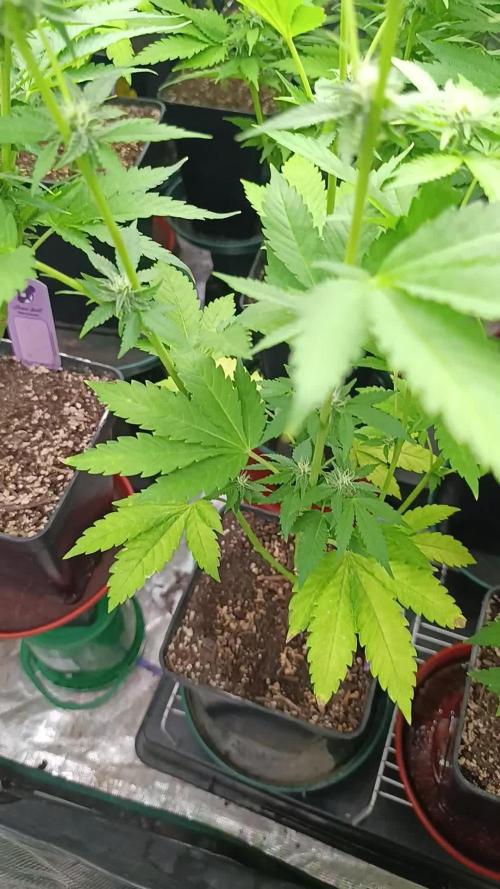
📆 Semana 4
El stretch finaliza y la planta concentra toda su energía en el desarrollo de los cogollos. Los sitios florales engordan rápidamente y comienzan a unirse a lo largo de las ramas, mientras la estructura ya completamente formada aprovecha al máximo la luz disponible.
El consumo de agua y nutrientes alcanza uno de sus puntos más altos, con una mayor demanda de fósforo y potasio para sostener el rápido crecimiento floral. Mantener una nutrición equilibrada será clave para evitar carencias y favorecer un desarrollo uniforme.
⚡ EC: 1.7–1.8
💧 pH: 6.2–6.5
🌡️ Agua: 20–22°C
🌫️ Humedad: 50–60%
💡 PPFD: 950–1050
🌡️ Temp ambiente: 24–27°C
🔥 Nota: Semana de máxima demanda nutricional. La estabilidad en el riego, el clima y la alimentación permitirá iniciar el engorde con fuerza y mantener un desarrollo homogéneo.
¡Seguimos creciendo fuerte 💪!

Likes
19
Share


@sirstickyfingers
Follow
Day 39 flower!!
Not a whole lot to report, just watering every 2-3 days ph 6.5 tap water
Top dressed with gaia green bloom 284 with about 2 tablespoons per gallon and then about 2 cups of worm castings. I didnt use All purpose this time around as Im trying to taper off the nitrogen. Hopefully that doesnt come back to bite me
Hopefully the girls are done come May is what im hoping for


Processing
Likes
12
Share


Likes
2
Share


@Tootiehobgoblin
Follow
Flush week,
Finally through the worst of a nasty heat wave, getting some cooler night temps just in time.
Trichomes are showing enough amber Im going to flush for a week or so.
These buds have me excited as they are dense and juicy!! The smell has been intoxicating to say the least.
Already calling this plant a %100 percent success regardless of issues or harvest or quality, simply based on the fact I just LOVED watching her grow and I swear, just being able to smell her on the daily for the last 6 weeks has really just been incredible…. Say what you want, hopefully she holds up on the smoke test but yea, that smell, I will miss it.
Likes
26
Share


@dataTwiiix
Follow
01/07/21: 3ème semaine de floraison. Les premiers boutons de buds se développe à leurs aises pour ma première expérience avec des graines non auto. Je suis conquis.
01/13: la troisième semaine de floraison se termine très bien :D


Likes
13
Share


@Chuckwaggon420
Follow
Starting to get strong smelling when you move them around. HANDS OFF lol. Will do tea next week coming along nice. Both the pie is was crystaly and #3 runtz is way crystaly! All runtz have big weight, all pie is about the same. Should have a decent harvest!!! Let me know what you guys think!!!
Likes
6
Share


@Green_Dream
Follow
Nice development this week. The girl in the back is keep getting taller, I’m impressed.
I’m slowly getting back on track with the uploads, I’ve been a bit behind.
Likes
229
Share


@Crashoverite
Follow
Week 7
Hi everyone 🙃
So far everything going well. Slower developed girl aka "Nuna" started slowly flowering couple days ago and hoping that under my best care she will catch up to the others.
Recently purchased small dehumidifier doing absolutely great job of keeping humidity on avg. 52% on 18h and avg. 65% on 6h of light schedule.
Will increase flowering nutrients in coming days and still trying to figure out when will be the best moment to apply my final nutrient - Green sensation from Plagron any advice very much welcome 😁
Will keep updating progress of this week every couple of days.
Peace ✌️
04/09 day 43
Started watering twice per day. Light power set on 90%
06/09 Day 45
Removed some of the larger fan leaves to improve light on the lower parts of the net. It's plenty little flowers there so better they get some of this warm bright light 😊
08/09 Day 47
No stress signs after removing some of the fan leaves yesterday but noticed some calcium and magnesium deficiency in of the girls couple days ago did started adding biobizz calmag. Watered pots yesterday with approximately 1.5l each 300-400ml dosage every 20-30min. Won't water today or tomorrow. This morning I haven't noticed any extra leaves with symptoms in her so hopefully will back on the right track now
09/09 Day 48
"Nuna" slowly progressing but she still growing up like crazy. Need to tied 2 tallest branches as already at the bulbs. removed few more leaves this morning.
10/09 Day 49
It's the end of the week 7
Stay tuned for more updates on following week.
Peace and love brothers and sisters✌️
Likes
15
Share


@Noob_quest
Follow
5th Grow started!!
Plan this time round is to improve on my soil / amendment / top dress technique.
The difference this time is I'm trying some genetics from Zamnesia. 3x Runtz autos to run alongside 3 autos from fastbuds.
It was a tricky decision due to fastbuds always delivering so far for me (to be fair only tried them & 1 other breeder).
But the Zamnesia grows I've seen on here generally seem good and want to see what's out there. Will be interesting seeing what performs best.
Only 8 days in. 100% germination. However the Runtz look a few days ahead right now.
Other than that just a week left on the last plants from grow 4 which are looking pretty good.
Thanks for reading have a great week 😊

Likes
167
Share


@Bloombuster
Follow
Цветение набирает силу, растение вытягивается, относительно равномерный рост, с виду - всё в порядке, растение выглядит здоровым и сильным. 💪

Likes
17
Share


@Salgeezi
Follow
All WAS well until I noticed severe foxtailing I guess you would call it on 2 of the girls :(. This leads me to believe it can be 3 possible reasons. My thermostat was mostly between 70-75 the past two weeks I'd say
I added a cheap heater BC my temps were steady in the mid to high 60s. Thermostat isnt the best and I opened the tent twice where the temp was at 86, for how long who knows. I check my tent several times a day tho.
Im running Bridgelux led strips which I brought up to 140watt last week at 15inches from canopy from the tallest branch. Doesn't seem like much at all for a 3x3 tent so I'm not sure about that. Brought it back down to 120W just in case
Not enough air flow. I had one computer fan (100cfm) running in one corner. That I had in my 2x2 tent which seemed to be sufficient. I forgot I was over doubling the space in the 3x3. Added another 2 fans.
From what I read there's no turning back from this issue. I hope I read wrong lol. Gave a nice heavy feeding of B52 aswell. Any comments would be greatly appreciated
