The Grow Awards 2026 🏆 









Likes
Comments
Share
@Hashy
Follow
Week 9
Light cycle=12/12
Light Power=180w
Extractor controller settings
High temp= 24c
Low temp= c
Temp step=0c
High Rh= 50%
Low Rh= %
Rh step=0%
Speed max=10
Speed min=1
Smart controller settings (during lights on).
Lights on=10.01-21.59
Radiator on= below 22.0c
Radiator off= above 23.0c
Dehumidifier on= not in use
Dehumidifier off= not in use
Smart controller settings (during lights off).
Lights off=22.00-10.00
Radiator on= below 18c
Radiator off= above 19c
Dehumidifier on= not in use
Dehumidifier off= not in use
Fri 16/2/24
💧💧💧💧💧💧💧💧💧💧💧💧💧💧💧💧
Method= automatic
Feed=bloom nutes.
Neutralise=0.1ml/L
Silicon=1.0ml/L
Calmag=0.75ml/L
Terra Bloom=4.0ml/L
Sumo Boost=2.0ml/L
Roots=0.2ml/L
Easy Ph down=0.11ml/L
Ec=1.85 PH=6.4/6.6
Time start=12.00pm
Finish time=13.45pm
(11×5 minute runs with 5 minute gaps)
Total flow rate=190ml/min
Flow rate per plant=47ml/min.
Total volume made=13L(13.5L)
Total volume left=3L
Total volume used=10.5L
Volume per plant=2.6L (Est)
Runoff.
Total runoff=1.2L
Ec=2.13 PH=6.1/6.3
💧💧💧💧💧💧💧💧💧💧💧💧💧💧💧💧
#3 (Day 57)(Day 19 flower)
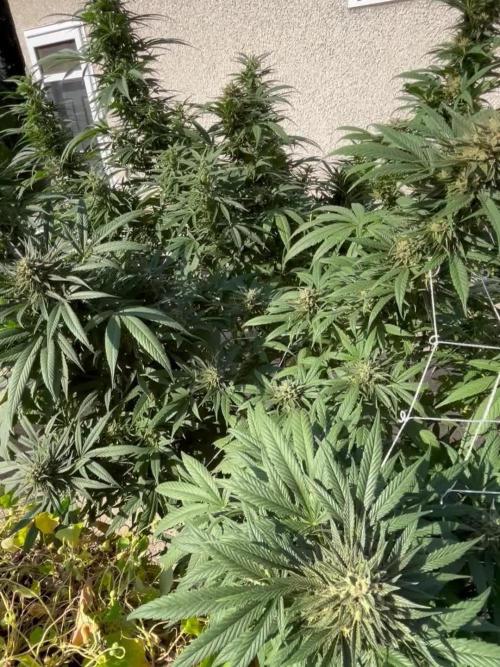
📋 Because this is quite a bit further away from the light then the rest of the grow she wasn't showing signs of light stress but because the others are i had to turn down the power from 180w to 170w. New DLi=35.0
Sat 17/2/24
#3 (Day 58)(Day 20 flower)
📋 H=74cm D=30cm DLI=37.0
Sun 18/2/24
#3 (Day 59)(Day 21 flower)
📋 Lowered light power again as they are showing a bit of stress from the light. Power was 170w now 160w. I'm going to have to have a think about my next grow, either I stick with this tent and hit the plants hard with light when I flip to flower to keep them small, or try and cram a slightly bigger tent in the space allocated for it. This tent is 61×76×150cm with the option to extend it to 173cm. Mine is configured to the 150cm height, but because its extendable the top 30cm is inaccessible at the best of times let alone when the plants reach a decent height. Extending this tent will be pointless because that's another 23cm of inaccessible space. Besides I only have a max head room for 160cm where the tent is.
Mon 19/2/24
#3 (Day 60)(Day 22 flower)
📋 H=75cm D=29cm DLI=37.0
Tue 20/2/24
💧💧💧💧💧💧💧💧💧💧💧💧💧💧💧💧
Method= automatic
Feed=water
Neutralise=0.1ml/L
Easy Ph down=0.01ml/L
Ec=0.2 PH=6.2/6.2
Time start=12.00pm
Finish time=13.45pm
(11×5 minute runs with 5 minute gaps)
Total flow rate=190ml/min
Flow rate per plant=47ml/min.
Total volume made=13L
Total volume left=2.4L
Total volume used=10.6L
Volume per plant=2.6L (Est)
Runoff.
Total runoff=1.25L
Ec=1.33 PH=6.4/6.4
💧💧💧💧💧💧💧💧💧💧💧💧💧💧💧💧
#3 (Day 61)(Day 23 flower)
📋
Wed 21/2/24
#3 (Day 62)(Day 24 flower)
📋
Thur 22/2/24
From today I'll have to pull out the front 2 plants to get any pictures of the back 2.
#3 (Day 63)(Day 25 flower)******
📋 H=80cm D=26cm DLI=37.0
Lowered runoff rack. Pots may be sat in runoff slightly.
Lowered light power from 160w to 150w.
H=80cm D=30m DLI=35.0
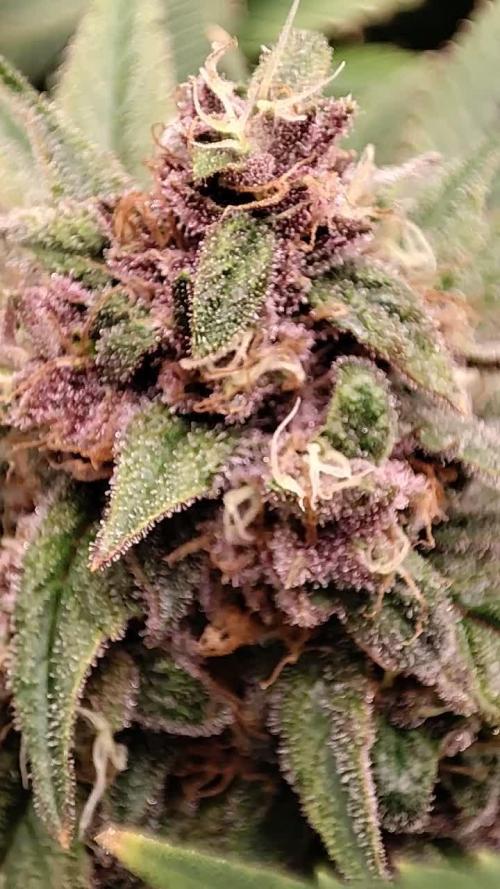
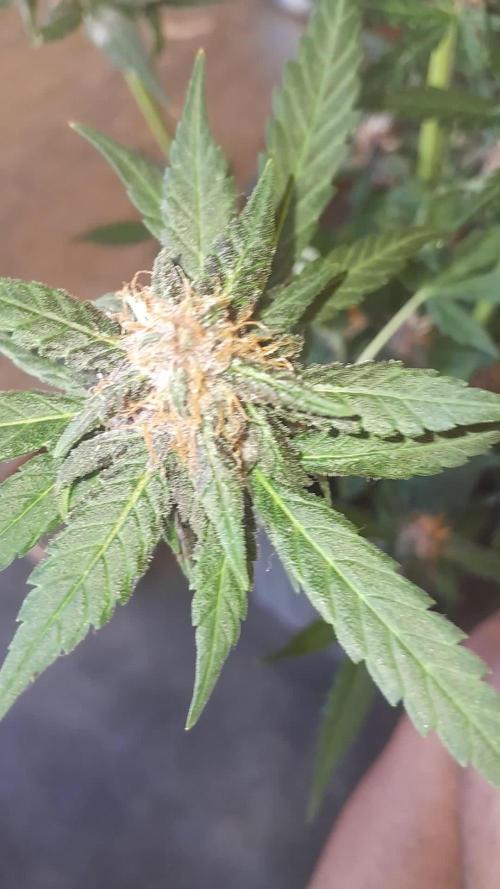
Even with the pot raised she is still quite a bit below the canopy, unlike the other plants she isn't showing any signs of light stress. She is coming along at a decent pace, maybe not quite as quick as the other 2 test strains.
Back soon.
Take it easy.


Likes
20
Share
@Northern_Ent
Follow
Aug 30: it’s still hot (too hot at peak for photosynthesis) so lots of water, watering outside of growbag, etc to cool things off a bit.
Sep 1: almost ready. Found a dried leaf and a spot of bud rot which was immediately removed. Main tops are almost ready and I’ll start harvesting this one later this week.
Sep 2: buds are looking pretty ready (at least the tops) and the pistils changed colour last night. Heatwave is now past and now we’re into a couple days of smoke from fires in the NWT. Sucks, but at least this is the first serious smoke here this year.
Sep 4: decided to do a chemical flush this year. Great buds last year but didn’t burn well because of excess P in late flowering. Considered another flush product but looking at the MSDS sheets that stuff had ‘editic acid’ which is an obscure but acceptable name for EDTA. That is a very strong chelating agent which will remove salts effectively but I’d rather avoid it. In contrast, Final Flush from Grotek has potassium sorbate (generally recognized as safe food additive) and good old citric acid which is a chelating agent but not as strong as EDTA. Similar products but citric acid is more gentle and the plant still gets some potassium.
Sep 5: don’t take flash pics of photoperiod plants unless you follow up with a far red light.

Likes
46
Share
@Drgreen13
Follow
Hi guys, so I think she's starting to flower. I can see tiny pistol hairs now. I shall be bringing her indoors in a few weeks when I have space because we will most certainly be having lots of rain here in the UK. Please check out my other diaries, and feel free to leave a like, maybe even a follow.
Drgreen13#6724 (discord)
Stay high, stay fly, #420everyday.

Likes
21
Share
@Bncgrower
Follow
Another week is coming to an end, everything is fine with this girl, she gets more beautiful every day. We are reaching the final weeks, so.. until next time. ✌️🌿🙏


Likes
11
Share
@adam_pawloski87
Follow
Pre98 Bubba , oh how I’ve missed you for so many years! These ones came out absolutely gorgeous! Loving the the purple phenos 😍 ! These ladies liked to stretch quite a bit so you’re gonna want to use some LST on em but I also recommend topping at least 6 times to get a better bang on your yield ! Expect nice tight purple buds with a tremendous amount of frost covering, some of the frostiest Bubba I’ve ever had! Over all I give it 10 stars an would definitely over an over run this strain!

Likes
8
Share
@Jardineiro_Br
Follow
Começou a janela de colheita das tres plantas a mais adiantada ja colhi as outras duas achonqie em uma semana mais poderei colher as duas uma esta bem robusta a outra ficou pequena .
Likes
4
Share
@AuthenticGrow
Follow
What’s up guys! First time growing and I will be growing an auto white widow. I started Germination 3/4/20 and dropped it in roots organic soil in a 3 gallon pot. Any recommendations on proper temperature and humidity levels for the next week or so. Along with proper water timings, I know it’s best when slightly dry but anybody got an average of hours on hand that work best? Thanks for tuning in and hope to see you guys follow along and help me grow !

Likes
15
Share
@YOZYY
Follow
Did some defoliation very light just made sure nothing is blocking the lower nodes to much but other than that been feeding heavy then watering with just cal mag for two waterings then heavy. Next watering will be a 900 to 950 ppm mix.


Likes
12
Share
@Siriuz
Follow
She is loaded right now very heavy and potent yielding plant oh yeah thanks 420 fastbuds I will be getting more of your seeds you rock
Guys im so happy I boughy fastbuds seeds
It was great to see this second seed pop an amazing grapefruit we did fiming and she eneded up with many colas and many flowers plus super frosty and smelly
Also turned purple all buds which to us was a surprise and did not expect that
Since last grapefruit was different than this
Thanks a lot for all your support
Imagine if we had a full spectrum light
I think we would be growing trees
Honestly we have more than we expected
COMING from an Indoor thats nearly located in a tropical climate of 30/33 degrees most of the year and with that said raising temps very hot sometimes very humid thats close to the equator
So we have to use A/C all times and maintain humidity levels by spraying all walls to keep it around 45/60% while ac is on remember droping temps so we have to make it as comfortable as possible and that its not easy in this side of the world
OR either you need a lot of money which I dont have yet to build a super setup and a separate ROOM with all of that temp and great humidity lvls so yeah we do what we can with our budget
We live somwhere where things are pretty much fckd up but it is what it is
Hey at least we are safe because it is illegal lol so yeah brothers we have hard times
And still with all risk we here doing our best
Showing all support
Showing im greatful
TO find a space like this where
We all can share like and Comment
And help each other grow better everyday
Blessings to you all
Keep EM buds coming
Happy growing
Processing
Likes
30
Share
@CBD_Sweden
Follow
2018-04-03 Week 14 Day 1
Not much to say, there isn't much drama going on in growroom 2, the only things I do is giving them water and nutes 2 - 3 times/week and making sure that the lamp don't burn the girls.
I gave them 4 liters today, and since they live in smartpots I can see when the pot gets wet when watering the girls, but you could hardly notice that. They are getting thirsty 😛
The flowers are developing very good, they look really healthy and their colors are fine.
Crazy Cookies nr 1 is 66 cm
Crazy Cookies nr2 is 52 cm
2018-04-04
Raised the lamp to it’s highest level and turned all girls 1/4 turn, it’s really hard to get in to the ladies in the back, I need to push the girls up against the walls on each side and crawl on the floor to be able to turn them and give them water/nutes.
Damn these plants, why do they have to grow and become so BIG?! 😆💪
Added a new video, enjoy my SoG 😄
-----------------------------------------------------------------------------------------------------------------------------------
Strain information:
The word synergy is a business term first quoted in the early eighties to describe mutual enhancement through interaction or cooperation, where the end result gained is greater than the sum of the parts used. What do synergy and the Crazy Cookies cannabis strain have to do with each other you may well ask?
The parents of the forthrightly indica Crazy Cookies are marijuana royalty. OG Kush and Girl Scout Cookies. These strains of contemporary legend have been combined to cerebrum shattering effect. The cured flowers deliver a mouth-watering and couchlocking 24% THC. The initial delectable spacey upbeat onrush compliments of the Durban Poison coursing through the genes of the Cookies soon becomes a lush and rich, inescapably delicious body flux.
There should be a picture of a Crazy Cookie nugget in the dictionary next to the word synergy. Crossing the OG back into the Cookies has amplified the psychoactive effects of the notorious lineage of both parents. This is an indica with a capital I.
As a breeder it would be fair to assume that injecting more OG into the Cookies would result in an OG-dominant Cookie, or even close to a pure OG, but something else has happened. Some long dormant genetic switch has been flipped and a standalone indica has emerged whose spicy notes and earthy tones, hints of grape and horny pheromone are an absolute pleasure.
Paying this breed some careful attention as it grows will reward you substantially, indoors or out. Typical hybrid vigour is shown throughout each grow phase. Stout plants to 80cm can be expected indoors and muscular examples with fluted stalks growing to two metres can be easily achieved outdoors. Good bracing is necessary as the flowers mature. With more than 500g at harvest per robust plant, colas can easily snap and twist branches.
--------------------------------------------------------------------------------------------------------------

Likes
111
Share
@DreamIT
Follow
🍋🥧🏎️ LEMON PIE AUTO BY FAST BUDS 🏎️🥧🍋
🍋 12.3 ...
🍋 13.3 I missed a week of update cause damn covid that is slowing down my every project. however the plant takes shape, I hope to be able to constantly resume updates
🍋 14.3
🍋 15.3
🍋 16.3
🍋 17.3
🍋 18.3
____________________________________________________________________________________
❌❓Not sure where to buy your seeds?
😮 Fast buds literally ships all over the world, check out their site!
http://bit.ly/FastBudsgood
__________________________________________________________________________________
📜 A look at the details of what I'm growing 📜
🍋🥧🏎️Lemon Pie Auto 🏎️🥧🍋
⚧ Gender
▪️ Feminised
➰ Genes
▪️ 50% Indica / 50% Sativa
🎄 Genetics
▪️ Lemon Pie X Autoflowering Genetics
🚜Harvest
▪️ 450 - 550 g / m²
🌱Vegetation
▪️30 - 35 days
🌷Flowering
▪️ 30-35 days
✨THC
▪️ 24.0%
✅CBD
▪️ 1.0%
🏡Room Type
▪️ Indoor
🌄Room Type
▪️ Outdoor
🕋Room Type
▪️ Greenhouse
🎂Release Year
▪️ 2020
__________________________________________________________________________
📷🥇 Follow the best photos on Instagram 🥇📷
https://www.instagram.com/dreamit420/
🔻🔻Leave a comment with your opinions if you pass by here🔻🔻
🤟🤗💚Thanks and Enjoy growth 💚🤗🤟
Likes
12
Share
@GrowMyMeds
Follow
Welcome!
Week 7 flower!
I'm dying in anticipation.
Part of me just wants to stare at it forever, because I'm pretty sure the color will get darker when its dried
Pistols are turning orange top, so getting closer.
I took a few videos this time. One shows the Mars Hydro lights, and my tents I'm using.
The other is the best I could do to capture the beauty of this plant. I wish I had a tent full of only her.
I cut way back on nutes, I only plan to feed one more time and will be checking the trichome color next week.
Overall I'm super happy 😄
If you have some colorful grows going let me know and I will check it out
Thanks for checking out my med grow, see you on week 8. Follow and subscribe if you like my content and want more
Peace


Likes
90
Share
@Herbalize
Follow
Hello folks 😎
7th week of flowering and the heat is still here 😔 I hope to have cooler temperatures quickly, otherwise, the drying phase will be complicated ...
Anyway the buds are not very big, but Wow this shit is frosty as fuck and the smell is strongly good !
at the beginning of this week, I gave her the last watering with nutrients ( about 430 ppm ) and in the middle of the week, I started the flush 👌
For the trichomes, many are milky but there is at least a week left on the announced time 😊
Good news, I will completely change my tent and my equipment for the next crop, bigger tent, better light etc. ( soon ™️)
But that's another story ! 😁
Stay tuned and see you next week guys 😘
I also have another diary with two Toxic from Ripperseeds if you want to see
Peace Love & Weed GD Fam😍👊
Likes
25
Share
@The_Lonely_Farmer
Follow
Overall a great strain too grow as grows with ease and seemingly without issues even with minimal care.
With care she can produce hefty buds, as kept mine small my flowers reflect but still produced great smelling powerfully buds 🌱
Cycle finished in time essentially with ease and I'd be happy too recomend this strain from fastbuds.
I will update with more images and videos upon timing complete and give dry weight ect, these girls wont bring much but smell absolute treat.
Atm I have tried 1 small nug but still not ready not long untill can trim up, great oils and taste just need a little cure up once finished.
Tried uploading longer videos but again says error 👎 have now added few extra videos
Likes
69
Share
@Crazyweedpt
Follow
Hello!
For this setup i´ll use Optic 1 XL in a 80cmx80cm tent, (indoor grow), with temperature, humidity and air flow controled... Have heard great things about Real Cookies and now it´s time to grow it!
Have successfully germinated 2 seeds out of 2 using the easy start kit from RQS, 100 % rate! (made a DIY box and used the wireless router to keep it warm) Notice this seeds have sprouted in less than 48h it´s a personal record to me!
I´m using Janeco light mix and prepared the soil with the the easy boost organic nutrition before reporting the seedlings... It´s time to turn on the lights and let the mother nature do the magic!
Likes
11
Share
@Eddjack
Follow
Yep growers finalmente e arrivato il nuovo giocattolo (prova) un bel led spettro completo che consuma 75w ha un rendimento come quello di un hps da 500, vediamo come si comporta in fioritura.
Dopo qualche giorno dal cambio luce la e dal supercrop la pianta ha sviluppato nuovi nodi ma ha rallentato di poco la crescita ...credo sia per per lo stress che ha subito. Comunque e sana e forte non vedo l'ora di iniziare a veder crescere belle gemme ! Dajeforte growers