The Grow Awards 2026 🏆
Likes
Comments
Share
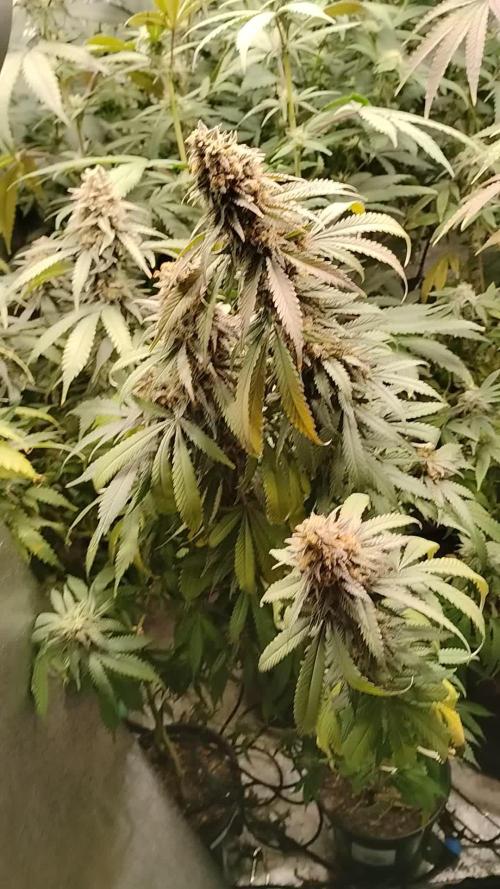
Plant at the front #3 has had slowed growth but buds are filling out pretty well now, pretty sure she is a Orange sherbet. Back 2 are on week 3 day 17!!! & Are going Awesome, buds stacking up & down every branch! Going to get some really good Cola's of them! They are loving the 730watts!’ of light, back left plant looks like a Tropicana Cookies, going to do some defoliation on her & tie branches down a bit to open up middle of plant to allow more light & air to lower bud sites.
Likes
22
Share
@GR0WER
Follow
New week starts. 🌞29.03 Both 'Gorillas' got their final topping today. 🌞30.03 I tightened my flowers too weak and they've straightened their brunches back. Now I will wait them to become thirsty to make LST again. 'Gorilla's leafs are too thick and curly, they need LST as fast as possible. I'll make it for two days. 'Critical' was healed already and it starts growing again. 'HulkBerry' is a biggest one. 🌞31.03 Clean water spraying. 'Critical' reaches 'Gorilla's size, it's fealing OK. But 'HulkBerry' is huge! It will cover all other plants from sun if I woldn't do nothing with it. So I decided to slow it's grow with HST training. When it become thirsty (this sunday) I'll break its upper brunches (second knot). Then I'll wait it to heal and will break the lowest ones. This should hold it's grow and will give more time to others. I'm really excited to do this, because it will be my first HST. 🌞01.04 Clean water spraying. My girls didn't receive watering for three days now. I'll do LST and defoliation tomorrow, then I'll feed them. I'm planning to do a Supercropping to my 'HulkBerry', specifically two brunches of an upper knot. It's main-lined and healed already, it is four week of vegetation so I decided the time has come. This procedure will slow it's growth and give more light to the lower crone. Upd: I didn't wait for tomorrow and made all trainings today. Supercropping of 'HulkBerry' turns the best, it looks like I've made it well. 'Critical' was topped for the second time (2x2 scheme). All plants got their first defoliation and were pulled by garden wire (LST). Now it's time to water them with their wery first 'GHE' nutrients in a 'first roots' doze. 🌱'RG'#1 - Defoliation + LST; 🌱'HB' - Defoliation + Supercropping + LST; 🌱'CR' - Defoliation + Topping + LST; 🌱''RG'#2 - Defoliation + LST. Upd_2: I took a photo in a 8hrs after all I've done. All girls are turned their leaves up, all looks great. 'HB' is big and hard, as if nothing happend. It's success! I'm happy with how it turned. It was a good day. 🌞02.04 'Critical' is growing too slow. I think this because it lost a half of its crone when I accidantly broke it. And then it had his topping after a few days. Now it is a smaller one. But it already got his final form, and new leaves starts to get bigger visually, so I think it's not a problem and it will take what it should. No procedures today, nor watering. Spraying with water as usual. I think about giving them 'GHE SeaWeed' in a form of a spray. 🌞03.04 I watered my babies with 'GHE' nutrients in minimum concentration and gave them a drop of a 'GHE Diamond Nectar' to try. Next watering will be in a 'First leaves' dose (Gro/Mic/Blo - 1/1/1ml per l. plus 1.5 ml/l of D.nectar). Mb I'm giving nutrients too slow, but I have time and patience and I don't want to overfeed them. Next watering will be on wednesday, the first day of a week. Next time they'll get full 'Vegetation' dose, but one time after one (nutrients-clean water-nutrients). I still remember few times when I overfed my plants. So this time I will be more accurate. I made LST today to all my girls and sprayed them. Also I deleted four biggest leaves from 'RG'#1. 🌞04.04 At the evening (For my plants. It's a morning for me) I defoliated all my girls except 'Critical'. Its because when I removed trays to sit them well - 'CR' pot had more waight in it. So 'Critical' drinks less then others and need bigger crone before I'll make transplantation into the large pots. Defoliation went successfully and they got LST after it. 'RG'#1 has asimetrical look, half of its brunches are smaller. I turned it around cos I think it's temperature fluctuations near the ventilation chanels fault. So here we are in the end of this week: 🌱'RG'#1 - LST, Defoliation; 🌱'HB' - LST, Defoliation; 🌱'CR' - Nothing today; 🌱'RG'#2 - Defoliation. _____________ Week ends.
Likes
12
Share
@Andres
Follow
it has stopped feeding with red guano. I'm waiting for the last of his flowering to be cut and enjoy
Likes
12
Share
@Bluemels
Follow
Tag 47: Wieder mal entlaubt und ein 2 Netz eingebaut 😀
Likes
17
Share
The papaya cream aroma on these is absolutely wonderful!
Likes
35
Share
21/06/2021 (F DAY 24) La flora viene muy bien! a seguir progresando. El sistema es totalmente autónomo y solo preparo dos riegos por semanas sin medir ph ni nada extraño! Solo bioestimulantes, lixiviado y buena comida en sustrato.
Likes
39
Share
The past 5 days she showed heavy deficiencies, Fan leafs started browning hectically. Ontop of that her growth isn't where I would like her to be especially in this stage. So researched , went through alot of podcasts lol.. Decided to purchase bottled nutrients for this run to see how she reacts aswell to tell the difference between organic and bottled nutes...for My own comparison. 5 days later after her first bottled feed...I must say damnnn!! She exploded and even started looking more healthier than when she first started.
Likes
1
Share
Switches to 12/12 a couple days ago, no signs of hairs but I think I’m abit eager if I’m expecting them this soon and tips on helping an organic soil flip to flower? I think I might be okay but any suggestions could help in case
Likes
10
Share
@McGrowin
Follow
Day 48: She's doing amazing. What explosive growth after a compost tea w/ gaia green power bloom and the stash blend and worm poop. Looking forward to seeing these nugs turn purple and foxtail possibly.
Likes
8
Share
@Kirsten
Follow
6.4.25: I watered with 2ltrs of dechlorinated water PH'd to 6.4 with the following nutrients;- ♡ 4ml Xpert Nutrients Cal-Mag amino acids ♡ .75g Ecothrive Biosys Total PPM 880. 6.4.25: FastBuds Mystery Seed #1: She has been topped twice and is looking pretty strong 💪 She has grown vertically, and leaves are always praying. Possibly too much light, so I have turned the dimmer down to about 90%. There are slight bleached tips on a couple of top leaves. I'm hoping to do the same LST with garden wire here very soon. Overall, the plant has nice big, fat leaves. Seemingly lush colour and vigorously growing since the double toppings. Very nice plant so far. 👌 I have made the fleece tabs, and attached them as on my Northern Lights plant. I have started LST using the wire shown in photos. As well as two of the LST clips. I watered beforehand with 2 litres PH'd to 6.5 with 1g Ecothrive Biosys. The plant is looking great. Nicely structured. I'm going to do my very best not to mess this up!! 🤞 Thanks for hanging out 🍃 ✌️ 💚 🙂
Likes
202
Share
Hello my beautiful friends 😊 😊 😊 2nd week arrived and he is here 💪 💪 💪 Girls looks very happy and I am happy with them 🙂 Day 9- like you can see on picture a humidifier was temporarily removed. I have to clean and maintain it, so humidity is low but tomorrow unit going back inside 😇 😇 😇 Please have a beautiful day and I wish you all to have a fantastic Christmas 🎄 ♥️ 🌲
Likes
18
Share
Boy I wish I had gotten a better start in the begining with this lady she has hard as rock nuggets .The pot was too small and the thing cracked from the roots massing up together .. The cooler temps in the end hurt her a lot now I'm thinking she will get the chop soon I'm starting the flush on this lady today and can't wait to see her buds drying ... She won't be a big yielding girl...
Likes
19
Share
Not much to report this week. Going well, 4 more male growths. These girls are on autopilot for the next 4 or 5 weeks. Finally done the last big defoliation. I am happy with the amount of tips, I dont mind sacrificing a little size and quality for a potentially much larger yeild. No real stretch to be seen, I guess the scrog is to blame for that. A side note, I may have a little bit of a micro nutrient deficiency, iron in particular. I know this is rare but I did miss the iron last week, long story. Its presenting from the top down with choloris near the leaf base moving outwards. I also think I have a slight k abundance at this stage but the plant should take care of that as it begins to demand more.
Likes
4
Share
Que pasa familia, vamos con la quinta semana de floracion de estas Rainbow Melon feminizadas de fastbuds. Vamos al lío, de las 3 plantas, me quede con 2 por espacio, siempre pongo alguna semilla de más por si no abriese alguna por no perder ese hueco del indoor. También se trasplantaron a su maceta definitiva, en este caso de 7 litros. Tenían algo de shock por el trasplante pero ya fue solucionado. El ph se controla en 6.2 , la temperatura la tenemos entre 20/22 grados y la humedad ronda el 50%. Las flores empiezas a formarse y progresan a buen ritmo. Hasta aquí todo, Buenos humos 💨💨💨
Processing
Likes
13
Share
@Meezer
Follow
Start of week 6, ended week 5 with a few only water feeds on the topped and natural girl as they showed some claw. New growth looks good and the HST girls are in their stretch...not much stretch with natural. Hopefully the stretch and node spacing continue as is and they continue to grow through this week. It is much better than my first run. Hope you all enjoy the photos and video and please chime in, like the grow or give me a follow. I am a sponge for information. One thing I have noticed is that all 3 girls droop hard at night, sometimes as early as 3hrs before dark...growth has seemed fine. Maybe they are tired from their daily stretch who knows.
Likes
33
Share
Video for herbies plants could talk competition , yes there all herbies , blueberry hill , gorilla glue auto and 2 zkittles autos , the autos were free seeds and blueberry i bought
Likes
16
Share
Seedling managing 93F 30%RH, around 20 DLI. Vpd is in the 3's. No I don't recommend. Signum Magnum. "A great sign appeared in the sky a woman clothed with the sun with the moon under her feet and on her head a crown of twelve stars. Sing ye to the Lord a new canticle: because He has done wonderful things. Glory to the Father, and to the Son, and to the Holy Spirit As it was in the beginning, and now, and ever shall be, world without end." The plant nutrient nitrogen exists in forms with both positive and negative charges. Ammonium (NH4+)(immobile in soil)(Cation) has a positive charge, while nitrate (NO3-) (highly mobile in soil)(Anion)has a negative charge. Nitrogen is unique among plant nutrients in that it can exist in both positively charged (ammonium, NH₄⁺) and negatively charged (nitrate, NO₃⁻) forms in the soil. This makes it a special nutrient. In that it is responsible for providing balance for reactionary trade offs when it comes to ph. Because ph itself in the medium will always slowly drift towards acidicity, such is nature. 80% of nitrogen should be nitrate and no more than 20% ammoniacal nitrogen. Ca, mg, and K are the big 3 cations related to soil composition, pH & base saturation. When nitrogen is in the form of ammonium, it can compete with calcium, magnesium, and potassium for absorption sites in the plant root. This competition can lead to a reduction in the uptake of these other essential nutrients. Nitrogen, particularly in its nitrate form (NO3-), can increase soil acidity, which can also affect the availability of calcium, magnesium, and potassium. The form of nitrogen applied (ammonium vs. nitrate) can influence its interactions with other nutrients. Ammonium nitrogen can have a more pronounced negative effect on the uptake of calcium, magnesium, and potassium compared to nitrate nitrogen. Common forms of ammonium nitrogen include ammonium ion (NH4+), urea, and ammonium compounds like ammonium nitrate, ammonium sulfate, and ammonium phosphate. Common forms of nitrate nitrogen include potassium nitrate (KNO3), sodium nitrate (NaNO3), calcium nitrate (Ca(NO3)2), and ammonium nitrate (NH4NO3). Phosphorus is an essential plant nutrient, and its availability in the soil is strongly linked to the presence of oxygen. Plants primarily absorb phosphorus as phosphate (PO4), and oxygen is a key component of this molecule. Furthermore, the availability of phosphorus in the soil can be impacted by factors like soil aeration and temperature, which in turn affect the oxygen supply to the roots. Phosphorus uptake in plants is most critical during the early stages of growth, particularly within the first few weeks of plant development. Young plants actively growing tissues have a high demand for phosphorus. They may absorb up to 75% of their total phosphorus requirements within the first few weeks of vegetative growth, with up to 51% of uptake happening overnight, primarily in the first few hours or early nightfall. ⑨Anaerobic root respiration, or respiration without oxygen, is detrimental to plants because it's less efficient and produces toxic byproducts, leading to reduced energy production, nutrient uptake issues, and ultimately, root damage and plant stress. ⑨Anaerobic respiration, unlike aerobic respiration, doesn't utilize oxygen as the final electron acceptor in the electron transport chain. This results in a significant drop in the amount of energy (ATP) produced, which is necessary for various plant functions, including growth, nutrient uptake, and maintenance of cellular processes. ⑨In the absence of oxygen, plants produce byproducts like ethanol and lactic acid during anaerobic fermentation. These byproducts can be toxic to the roots and inhibit their function, ⑨When oxygen is depleted in a medium, the pH tends to decrease (become more acidic) due to the production of metabolic byproducts. This is particularly relevant in biological systems where aerobic respiration relies on oxygen as the final electron acceptor. ⑨When oxygen is scarce, plants may switch to anaerobic respiration. This process produces carbon dioxide (CO2) as a byproduct. ⑨CO2 dissolves in water to form carbonic acid (H2CO3). This acid lowers the pH of the medium, making it more acidic. ⑨Anaerobic conditions can impair a plant's ability to regulate its internal pH, leading to a drop in cytoplasmic pH and potentially cellular acidosis. ⑨The change in pH can also affect the availability of certain nutrients to the plant, as pH influences the solubility of micronutrients like iron, manganese, zinc, copper, and boron. ⑨The lack of oxygen in the plant medium leads to a decrease in pH due to the production of carbon dioxide during anaerobic respiration and impaired pH regulation within the plant. In plant cells, cellular acidosis, a drop in the internal pH of the cytosol, is a significant stress response, particularly during conditions like flooding or hypoxia. This acidification can be triggered by a decrease in oxygen levels, leading to the production of metabolic byproducts like lactic acid and CO2. The plant's ability to tolerate and recover from these conditions depends on its cellular mechanisms to regulate pH and mitigate the effects of acidosis. When plants are subjected to low oxygen environments, such as those experienced during flooding, anaerobic metabolism, which produces lactic acid and ethanol, becomes the primary source of energy. This can lead to a build-up of these acidic metabolites in the cytosol, causing a drop in pH. OXYGEN Atomic oxygen (single oxygen atom, O) is the lightest form of oxygen, as it has the lowest mass of the oxygen molecules. Oxygen also exists as a diatomic molecule (O2) and an allotrope called ozone (O3), which have higher masses due to the number of oxygen atoms combined. Atomic Oxygen (O): This refers to a single oxygen atom, which is the most fundamental form of oxygen. Molecular Oxygen (O2): This is the common form of oxygen we breathe, consisting of two oxygen atoms bonded together. Ozone (O3): This is an allotrope of oxygen, meaning it's a different form of the same element, consisting of three oxygen atoms bonded together. Since atomic oxygen has the fewest oxygen atoms, it naturally has the lowest mass compared to O2 or O3. Ozone (O3) Lifespan: Ozone has a relatively long lifespan in the stratosphere, particularly at lower altitudes. For example, at 32 km in the middle latitudes during spring, ozone has a lifetime of about 2 months. Oxygen (O) Lifespan: Atomic oxygen, on the other hand, has a much shorter lifespan. At the same altitude, its lifetime is about 4/100ths of a second. Ozone-Oxygen Cycle: The ozone-oxygen cycle involves the rapid exchange between atomic oxygen (O) and ozone (O3). UV radiation can split molecular oxygen (O2) into atomic oxygen (O), which then reacts with O2 to form ozone (O3). Ozone can also be photolyzed by UV radiation, creating atomic oxygen again, which can then react with O3 to reform O2. Dominant Form: The partitioning of odd oxygen (Ox) between ozone and atomic oxygen favors ozone in the lower stratosphere. This means that a much larger proportion of odd oxygen exists as ozone than as atomic oxygen, especially in the lower stratosphere. Recombination: Atomic oxygen has a high energy and reactivity. When it encounters another oxygen atom, they can combine to form O2. This process releases energy, contributing to the heating of the atmosphere. Ozone Formation: Atomic oxygen can also react with molecular oxygen (O2) to form ozone (O3). Ozone plays a significant role in absorbing harmful UV radiation. Other Reactions: Atomic oxygen can react with various other molecules in the atmosphere, like nitrogen (N2), water (H2O), and carbon dioxide (CO2), forming different compounds. UV light below 240nm (peak 185nm) creates ozone (O₃) through a process called photolysis, where UV light breaks down dioxygen molecules (O₂) into single atomic oxygen atoms (O). These single oxygen atoms then react with other oxygen molecules to form ozone (O₃). Specifically, UV-C light with wavelengths shorter than 240 nm can cause this photolysis. UV light with wavelengths between 240-280 nm, (peak 254 nm) breaks down ozone (O₃) into dioxygen molecules (O₂) and atomic oxygen atoms (O). 280nm does not have the energy potential to break apart the stable bond of (O₂) into enough (O) to make (O₃) At ground level, atomic oxygen (single oxygen atoms) has a very short lifespan. This is because it's highly reactive and quickly combines with other molecules to form stable diatomic oxygen (O2) or other compounds. While the exact timeframe varies depending on the specific circumstances, its lifespan is typically measured in nanoseconds or picoseconds.
Likes
4
Share
60x60 cm tent in a 1920's peek-in-closet Oversized vent for silence High power DIY LED True SoG 12/12 from seed with 15 plants in 2L pots Watering all plants in bottom tray with 30% of total pot size (10L) WEEK 1 DAY 1 - Germinated in paper towel DAY 3 - Planted into pots + Lights ON at 125w DAY 5 - All plants have broken soil DAY 7 - Slight stretch - Light at 185w WEEK 2 Two of the Iced Out are lagging behind, others are on point - I'm trying to push light and nutes to the max. Extraction fan (AC infinity Cloudline T6) on level 2. DAY 13 - First full watering (10L) with 20 ml Canna Terra Vega DAY 14 - Circulation fan turned on (low) during lights on WEEK 3 Good growth, two Iced Out still lagging DAY 18 - Light at 225w, Extraction fan on level 3 during lights on DAY 20 - 2nd watering, 8L with 30ml Vega + Light at 250w DAY 21 - On point, mostly :) Could've pushed nutes a bit more from the go WEEK 4 DAY 24 - So far this week I'm just kicking back and watching them do their thing. The two lagging Iced Outs are trying to catch up. DAY 26 - Watering 10L with 50 ml Vega (one day too late...) + light on 300w (max) DAY 28 - 4 weeks from popping the seeds, looking good except for the two Iced Outs, one of them is trying to get with the program, the other... Well, some plants are just pricks. WEEK 5 I think this is the week we'll see them take off :) DAY 29 - Plants are starting to show sex, removed 2 Urkle Mints males, the other two are females, the rest are fems so we're down to 13 female plants total with only a single weakling DAY 29 - Watering 8L with 50ml Vega (shouldn't have been later than today!) DAY 33 - plants exploded over the last 4 days and most are stretching and starting to flower DAY 33 - Watering 10L with 60ml Vega (feeding Vega once or twice more then we switch to Flora) DAY 35 - Just cruisin' 😎 WEEK 6 Lots of stretch the past week, flowers are setting in, the laggy Iced Out was culled, 3 plants are a bit behind the others.. DAY 36 - Watering 10L with 50ml Vega DAY 39 - Watering 10L with 50ml Vega DAY 42 - Defoliation