The Grow Awards 2026 🏆
Likes
17
Share
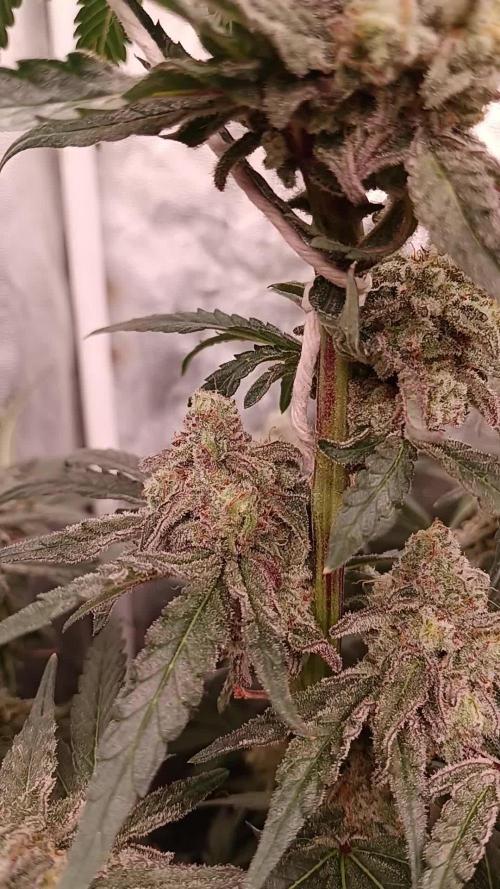
Week 18 of life and day 40 of flower. Tricomes look nice, buds are swelling and still lots of white. We are probably 3-4 weeks away from harvest.
Likes
16
Share
Oggi sono 21 giorni da quando ho messo il seme nella terra. Per non aver mai fatto crescere nessuna pianta in vita mia sono molto soddisfatto. Avevo letto tantissime cose prima di iniziare , e fino ad ora possa dire che più facile farlo che leggerlo, decine di siti tanto regole simili, ma tantissime regole contrapposte dai vari siti. 3 febbraio primo giorno terza settimana passato, solita situazione 4 piantine felici una ancora bloccata. Oggi mi sono divertito a silenziare gli estrattori. E come dicevo più facile farlo direttamente. Oggi fatto un esperimento di lst . La pianta dopo poche ore ha rialzato la testa. Stasera applicherò lst a tutti i piantini. 23 giorno dalla semina Approfitto del sole e della temperatura mite per fargli godere di un giorno di sole. 26 giorno ho alzato la lampada fino ad 80 cm, misurando con un fotometro mi sono reso conto che a quella distanza la mia lampada da 50000 lumen quasi. E quindi ho capito a cose erano dovute le bruciature dei giorni passati. Sto pensando di prendere una lampada meno potente. Però con questi accorgimenti le piante negli ultimi 4 giorni sono raddoppiate se non triplicate
Likes
16
Share
Seedling managing 93F 30%RH, around 20 DLI. Vpd is in the 3's. No I don't recommend. Signum Magnum. "A great sign appeared in the sky a woman clothed with the sun with the moon under her feet and on her head a crown of twelve stars. Sing ye to the Lord a new canticle: because He has done wonderful things. Glory to the Father, and to the Son, and to the Holy Spirit As it was in the beginning, and now, and ever shall be, world without end." The plant nutrient nitrogen exists in forms with both positive and negative charges. Ammonium (NH4+)(immobile in soil)(Cation) has a positive charge, while nitrate (NO3-) (highly mobile in soil)(Anion)has a negative charge. Nitrogen is unique among plant nutrients in that it can exist in both positively charged (ammonium, NH₄⁺) and negatively charged (nitrate, NO₃⁻) forms in the soil. This makes it a special nutrient. In that it is responsible for providing balance for reactionary trade offs when it comes to ph. Because ph itself in the medium will always slowly drift towards acidicity, such is nature. 80% of nitrogen should be nitrate and no more than 20% ammoniacal nitrogen. Ca, mg, and K are the big 3 cations related to soil composition, pH & base saturation. When nitrogen is in the form of ammonium, it can compete with calcium, magnesium, and potassium for absorption sites in the plant root. This competition can lead to a reduction in the uptake of these other essential nutrients. Nitrogen, particularly in its nitrate form (NO3-), can increase soil acidity, which can also affect the availability of calcium, magnesium, and potassium. The form of nitrogen applied (ammonium vs. nitrate) can influence its interactions with other nutrients. Ammonium nitrogen can have a more pronounced negative effect on the uptake of calcium, magnesium, and potassium compared to nitrate nitrogen. Common forms of ammonium nitrogen include ammonium ion (NH4+), urea, and ammonium compounds like ammonium nitrate, ammonium sulfate, and ammonium phosphate. Common forms of nitrate nitrogen include potassium nitrate (KNO3), sodium nitrate (NaNO3), calcium nitrate (Ca(NO3)2), and ammonium nitrate (NH4NO3). Phosphorus is an essential plant nutrient, and its availability in the soil is strongly linked to the presence of oxygen. Plants primarily absorb phosphorus as phosphate (PO4), and oxygen is a key component of this molecule. Furthermore, the availability of phosphorus in the soil can be impacted by factors like soil aeration and temperature, which in turn affect the oxygen supply to the roots. Phosphorus uptake in plants is most critical during the early stages of growth, particularly within the first few weeks of plant development. Young plants actively growing tissues have a high demand for phosphorus. They may absorb up to 75% of their total phosphorus requirements within the first few weeks of vegetative growth, with up to 51% of uptake happening overnight, primarily in the first few hours or early nightfall. ⑨Anaerobic root respiration, or respiration without oxygen, is detrimental to plants because it's less efficient and produces toxic byproducts, leading to reduced energy production, nutrient uptake issues, and ultimately, root damage and plant stress. ⑨Anaerobic respiration, unlike aerobic respiration, doesn't utilize oxygen as the final electron acceptor in the electron transport chain. This results in a significant drop in the amount of energy (ATP) produced, which is necessary for various plant functions, including growth, nutrient uptake, and maintenance of cellular processes. ⑨In the absence of oxygen, plants produce byproducts like ethanol and lactic acid during anaerobic fermentation. These byproducts can be toxic to the roots and inhibit their function, ⑨When oxygen is depleted in a medium, the pH tends to decrease (become more acidic) due to the production of metabolic byproducts. This is particularly relevant in biological systems where aerobic respiration relies on oxygen as the final electron acceptor. ⑨When oxygen is scarce, plants may switch to anaerobic respiration. This process produces carbon dioxide (CO2) as a byproduct. ⑨CO2 dissolves in water to form carbonic acid (H2CO3). This acid lowers the pH of the medium, making it more acidic. ⑨Anaerobic conditions can impair a plant's ability to regulate its internal pH, leading to a drop in cytoplasmic pH and potentially cellular acidosis. ⑨The change in pH can also affect the availability of certain nutrients to the plant, as pH influences the solubility of micronutrients like iron, manganese, zinc, copper, and boron. ⑨The lack of oxygen in the plant medium leads to a decrease in pH due to the production of carbon dioxide during anaerobic respiration and impaired pH regulation within the plant. In plant cells, cellular acidosis, a drop in the internal pH of the cytosol, is a significant stress response, particularly during conditions like flooding or hypoxia. This acidification can be triggered by a decrease in oxygen levels, leading to the production of metabolic byproducts like lactic acid and CO2. The plant's ability to tolerate and recover from these conditions depends on its cellular mechanisms to regulate pH and mitigate the effects of acidosis. When plants are subjected to low oxygen environments, such as those experienced during flooding, anaerobic metabolism, which produces lactic acid and ethanol, becomes the primary source of energy. This can lead to a build-up of these acidic metabolites in the cytosol, causing a drop in pH. OXYGEN Atomic oxygen (single oxygen atom, O) is the lightest form of oxygen, as it has the lowest mass of the oxygen molecules. Oxygen also exists as a diatomic molecule (O2) and an allotrope called ozone (O3), which have higher masses due to the number of oxygen atoms combined. Atomic Oxygen (O): This refers to a single oxygen atom, which is the most fundamental form of oxygen. Molecular Oxygen (O2): This is the common form of oxygen we breathe, consisting of two oxygen atoms bonded together. Ozone (O3): This is an allotrope of oxygen, meaning it's a different form of the same element, consisting of three oxygen atoms bonded together. Since atomic oxygen has the fewest oxygen atoms, it naturally has the lowest mass compared to O2 or O3. Ozone (O3) Lifespan: Ozone has a relatively long lifespan in the stratosphere, particularly at lower altitudes. For example, at 32 km in the middle latitudes during spring, ozone has a lifetime of about 2 months. Oxygen (O) Lifespan: Atomic oxygen, on the other hand, has a much shorter lifespan. At the same altitude, its lifetime is about 4/100ths of a second. Ozone-Oxygen Cycle: The ozone-oxygen cycle involves the rapid exchange between atomic oxygen (O) and ozone (O3). UV radiation can split molecular oxygen (O2) into atomic oxygen (O), which then reacts with O2 to form ozone (O3). Ozone can also be photolyzed by UV radiation, creating atomic oxygen again, which can then react with O3 to reform O2. Dominant Form: The partitioning of odd oxygen (Ox) between ozone and atomic oxygen favors ozone in the lower stratosphere. This means that a much larger proportion of odd oxygen exists as ozone than as atomic oxygen, especially in the lower stratosphere. Recombination: Atomic oxygen has a high energy and reactivity. When it encounters another oxygen atom, they can combine to form O2. This process releases energy, contributing to the heating of the atmosphere. Ozone Formation: Atomic oxygen can also react with molecular oxygen (O2) to form ozone (O3). Ozone plays a significant role in absorbing harmful UV radiation. Other Reactions: Atomic oxygen can react with various other molecules in the atmosphere, like nitrogen (N2), water (H2O), and carbon dioxide (CO2), forming different compounds. UV light below 240nm (peak 185nm) creates ozone (O₃) through a process called photolysis, where UV light breaks down dioxygen molecules (O₂) into single atomic oxygen atoms (O). These single oxygen atoms then react with other oxygen molecules to form ozone (O₃). Specifically, UV-C light with wavelengths shorter than 240 nm can cause this photolysis. UV light with wavelengths between 240-280 nm, (peak 254 nm) breaks down ozone (O₃) into dioxygen molecules (O₂) and atomic oxygen atoms (O). 280nm does not have the energy potential to break apart the stable bond of (O₂) into enough (O) to make (O₃) At ground level, atomic oxygen (single oxygen atoms) has a very short lifespan. This is because it's highly reactive and quickly combines with other molecules to form stable diatomic oxygen (O2) or other compounds. While the exact timeframe varies depending on the specific circumstances, its lifespan is typically measured in nanoseconds or picoseconds.
Likes
98
Share
I love growing its a big passion of mine , and the fact that GD exists makes everything so much better, one can interact with others and enjoy and learn from each others. Thank you all growers love and keep them green <3 <3 <3
Likes
2
Share
So I'm starting to think it's a male. But..... I do know it a photo and not a auto. So it may take a little longer to actually flower since it growing out side I can't control the light so I have to wait and see🤞🏾🤷‍♂️🏿
Likes
1
Share
📆 Semana 13 La A5 Chaze alcanza el final de su ciclo en plena madurez. Los tricomas se muestran mayoritariamente lechosos con ámbar bien presente en puntas, la resina es abundante y pegajosa, y el perfil terroso–especiado se expresa limpio y profundo. La cola principal mantiene su porte clásico, mientras las secundarias llegan compactas y bien cerradas. Corte realizado sin forzar, en el punto justo.
Likes
15
Share
8/3 Went over to treat the 10th planet that needed water with plant doctor around 10:30. I was in the garden at 6 but didn't have much time. That plant seems to be curled up or "droopy". It DID need water. I defoliated a few sep leaves off it but I didn't see any today. I guess I don't ever really see the leaves "up" or praying like I do with the rest of tge plants. It's starting to flower like the rest though. Today is the day everything is supposed to get its second or third plant doctor dose but I decided to wait until they need the water. I don't think 24hrs will mean much. I've been staying on top of defoliation but I'm seeing some pillar damage. I'd like to spray bt but what my buddy said about spraying with septoria is still in my head. Maybe I can use citric acid. That way it won't "wash away" spores it will just eat them. At least I think. And I hope lol. Birds get most of the pillars but I hand pick some too. I need to pick up nutes. Wondering if I should just get grow big again. I don't use much but plants are switching to flower and leaves are fading. I have big bloom and kool bloom bit neither have nitrogen. I still need some sort of nitrogen. Especially since that could be a deficiency. Not sure if it's the transition or a condition with the sep. I see some interior small leaves bleeding out and some dying. I'm wondering if what I thought was earwig damage years prior was really a combo of sep and they just ate the evidence. I'm super grateful though. I've got some resilient girls and they're doing well. The special kush in flower is gorgeous as well. Looks like I'll have an early plant. Short flowering time on this strain. Smells pungent. 8/4 Treated everything in the garden with plant doctor except the 10th planet I got yesterday. I need to take a closer look at that plant. It rarely looks "happy" like my others. I'll check it again later. 3tsp per gallon and 1gal a plant. The 10s got a half gallon. This seems to be working great. I have some defoliation to do on the tenth planet I was talking about earlier. Everything is in some form of flower. The flowers on that early special kush are getting bigger. I'll update this later. UPDATE: WENT BACK OVER AT NOON TO TAKE A LOOK AT THAT OTHER 10TH PLANET TO SEE IF IT PICKED UP AT ALL. IT DID. IM GLAD I CAME OVER TO CHECK THOUGH. MAKES ME FEEL BETTER. THE OTHER 10TH PLANET LOOKS HORRIBLE O. FILM FROM ONE ANGLE LOL BUT ITS REALLY A GREAT LOOKING PLANT AND IM USUALLY FILMING AT LIKE 6AM. JIST WANTED TO STICK UP FORCMY GIRL AND HER BAD HAIR DAY. ITS BEEN HIT AND A FEW OF HER LEAVES ARE TACOED. SHE GOT HER FIRST "PREVENTATIVE" DOSE OF PLANT DOCTOR WHICH WAS HALF A TSP/GALLON. IT REALLY SEEMS TO BE DOING SUBSTANTIALLY BETTER. EVERYTHING IS. IM HAVING TO LOOK HARDER AND AM HAVING TROUBLE FINDING LEAVES EFFECTED BY SEPTORIA. KNOCK ON WOOD. IM EXCITED. THIS IS GOING BETTER THAN I THOUGHT. IM STILL GOING TO BE MONITERING LIKE I USUALLY DO.
Processing
Likes
16
Share
Partimos esta nueva semana transplantando nuestras green gelato de Rqs a su maceta definitiva de 7lts. También subimos la dosis de nutrientes a 3ml de green grow y 2ml de gold sunshine de Quemanta Nutrientes. Aprovechando el estres del transplante quitamos los primeros internodos de abajo para generar la concentración de energía en los nuevos brotes.
Likes
16
Share
@Max1973
Follow
Day 100 - Mazar is lookin good.... she's into flower and the feeding has stabilized... it's almost bonzai size, haha Feeding her daily now, 1-2lts of nutrified/crystallic/particulates..... topped up, she's 6.2 PH / 1500 ppm, (the particulates are garden variety blood bone fertilizer, just add a little sprinkle in the tank) the neuts are same, nutrified, and impressed with the results of both the base set and the whole range, crystalic is unbelievable, it brings out a beautiful deep shiny green...... 👍👍
Likes
26
Share
SORRY TO EVERYONE WHO TRIES TALKING TO ME....I STILL CANT TALK TO ANYONE BECAUSE I TRIED CHANGING MY EMAIL ON HERE AND IT MESSED EVERYTHING UP. I CANT LIKE ANYTHING OR COMMENT ON ANYTHING. THE WORST IS I CANT JOIN CONTESTS😪😢😭 FINALLY STARTING ANOTHER GROW. MY BACK HAS BEEN FUCKED FOR MONTHS. CANT WAIT!!!! IM DOING 24 AUTOFLOWERS FOR THIS GROW AND IN 5 WEEKS IM STARTING ABOUT 20 FEMINISED PHOTOPERIODS IN MY 5X5 WITH A TSW2000 SO THEY CAN BE READY TO MOVE INTO THE 8X8 TENT AFTER THE AUTOFLOWERS ARE FINISHED. HOPE MY TIMING IS GOOD🤞🤞🤞🤞 LOL
Likes
7
Share
@sellem
Follow
13/12 in week 5 i started by adjusting LST mainly on the Blueberry a bit since she was getting real bushy. I will probably defoliate at least the first pair of leaves. the others i try tucking away but they keep overshadowing the two lower main nodes. Blueberry really started drinking now, her pot is getting really light. Afghan kush not so much, she is still sipping on the last watering. I hope Afghan Kush ramps up overnight by some miracle cause i really like to always water them both at the same time, rather than having to prepare nutes twice and them being on a different watering schedule. but oh well! Blueberry will get her dose tomorrow, we will se about the afghan. Not much happened until now, they slowly begin their stretch now. maybe we will see some proper early flowers by the end of this week! Judging by their grow rate, im guessing they will take their sweet time, 12-14 weeks or something. Which sucks cause i got brand new air pots i want to try! but you cant win every gamble with autos. 14/12 Watered them with 2 Liters after 7 Day Break. Blueberry picked up the pace, Afghan was "dry enough". Ususal nutrients, added some minor calmag as prevention for any future deficiencies. 18/12 Watered Blueberry with 2L, 2ml/l Grow, Activera and Rootjuice, and 0.2g/l Microbes. Defoliated both of them pretty good. Afghan is skipping watering until 20/12, which will be week 6, she is still a tad too heavy for my likings. 19/12 just some minor leaf tucking and defoliation of the lowest leaves on the afghan. Watering will still take place on 20/12. Will add timelapse for this week tomorrow!
Likes
10
Share
@AsNoriu
Follow
Day 90 since seed touched soil. Girl is on final stretch, took all nutes out last watering. Today gave 6.3 phed water for last time, maybe if few other girls will show signs of bulking, ill do one more watering. Last week installed dehumidifier, so all environment is way better. Most mature girl from all, youngest, but fastest to bulk up. Cant wait to take her out from scrog and see real beauty of her. Happy Growing !!!
Likes
5
Share
@420Hydro
Follow
Day 36 of flower. Just topped res running 4.5 grams masterblend 0 12 24 per gallon now dropped cal nit down a little
Likes
14
Share
@Loco11
Follow
Gebe noch 1 woche melasse dazu
Likes
53
Share
It looks terrible, but they are plants and resist a lot 😁😁😁 after 2 Days it looks better ... now its time for grow... Equipment: Controller AC Infinity Pro - connector for the external light control, RJ-12 - 2 plugs with which I can control dehumidifier and humidifier. - 2 fans run 24/7, 1 Oscillating from spider farmer Light - 18/6 h PPFD - 500-600 nmol DLI - 40-45 VPD - 0,9 - 1,0
Likes
23
Share
@Chubbs
Follow
This strain is as always a joy to grow. This time dropping the temps in flower really felt like it boosted the trich production. The colors are stunning with the smell going from a sweet fruit to a dessert. I chopped and harvested two for some fresh frozen live rosin. Looking forward to washing and pressing it in the upcoming weeks.
Likes
9
Share
@Mimi420
Follow
Day 42 — FLO | Mixed SCROG (120×80) Box smells unreal — sticky as hell. Buds are packing weight and the trichs are starting to turn milky in spots, but most are still crystal-clear so I’m letting them cook a bit longer. Canopy is fat, structure solid; loads of resin on every cola — fingers already gluey from checking. Night temps and RH still a pain (cold garage), so I’m watching for any mold hotspots and keeping airflow moving. Overall super happy with how this mixed run turned out so far. Quick state: Lights: 400W HPS + 300W LED (4000K) — plenty of punch. Media: 20 L smart pots, BioBizz soil + myco, organic feeds (BioBloom, TopMax, Green Sensation). Training: SCROG, LST/HST done, minimal tweaks now — mostly letting the flowers fatten. Trichomes: pockets of milky, majority still clear — not chop-ready yet, keep peeping with scope every 2–3 days. Plant-by-plant notes (position → short ID + what I see) Back-left — Wedding Cake (Portland) Very frosty, main colas are dense and sugary. Pistils starting to darken a bit, buds showing early signs of swelling. Trichome coverage is heavy — this one will likely be a resin monster. Watch for the classic sweet/creamy aroma to deepen. Back-center — Kush Crasher Properly turning purple and looking gorgeous. Leaves are showing that cool kush coloration and the colas are chunky and stout. Very sticky, strong nose developing (earthy / diesel kush). Keep temps stable so the purple stays and you don’t stress it too hard. Back-right — AK-47 Shorter, compact nodes but stacking nice little cola clusters. Classic AK structure — not the frostiest but reliable bud density and a punchy terp profile expected. Nice even development under the HPS. Front-left — Double Krush Buds forming tight clusters — a little leaner than the gassier strains but foxtailing less and stacking nicely. Shows vigour and is filling in under the canopy. Good candidate for chunky colas if you let it finish a touch longer. Front-center — Wappa Main cola is a beast — this one’s the show-stealer for bulk. Fat, chunky top cola, already showing awesome density and slight color shift. Expect a heavy, compact cola at chop. Loving how the Wappa is responding to your SCROG. Front-right — Detroit Runtz Longer, slightly looser colas compared to the others but super resinous. Shows those fruity/runts vibes — buds are coating in trichomes and the structure looks promising for aroma/density trade-off. Might finish a touch sooner or later depending on phenotype, keep an eye on the trichs. What I’d do next (short checklist): Keep scope-checking trichs — pockets of milk = start of the final swell. Most still clear → not ready yet. Hold off major defol or HST now; only small tidy-up if airflow spot is tight. Watch RH closely at night — lower if I can (dehumidifier or heater + intake trick). Mold is the enemy at this point. Last heavy feed flush plan: stay conservative — these look on the edge of finishing, so taper nutrients as trichs go 30–50% milky and pistils darken.