The Grow Awards 2026 🏆
Processing
Likes
Comments
Share
@Purkle
Follow
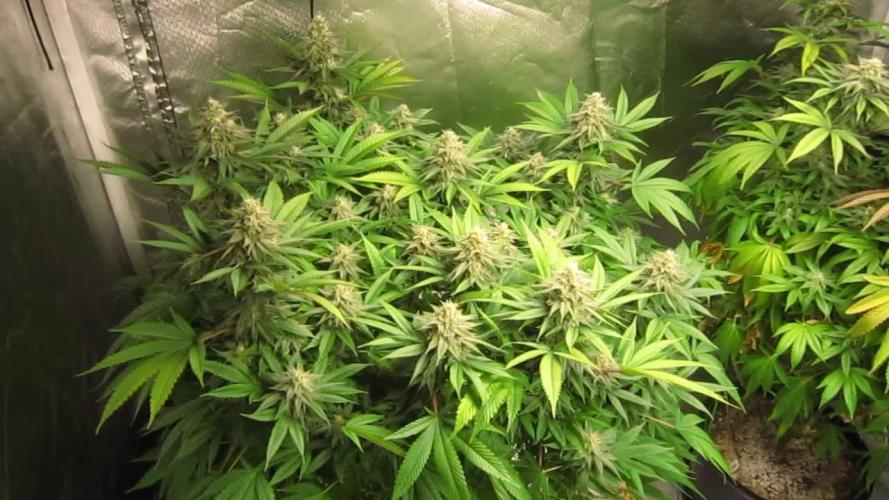
Things have been going well as I continued to train the stretching girls to the side of the pots, bending and adding ties where needed. Pheno 1 started showing signs of over watering showing droopy leaves as well as what I think is either nitrogen, magnesium or iron deficiency. I'm leaning towards a iron deficiency since the yellowing is on the newest growth at the top. I think this was caused from giving her too much top amendments in her last feed causing a pH imbalance. What I would usually do is just give her a little flush if this is the case but instead I decided to repot her and the other Pheno into their last 19 litre/4 gallong pots as both were drinking pretty quick and I wanted to avoid over watering again. The rootballs looked beautiful when I transplanted them so I was pretty happy with their progress! This round I've ditched the coco as I had way too many issues with it in the past, including knats and PH issues. In this round I've gone with Biobizz light soil which I added some fish blood and bone, earthworm castings, bat guano and then watered with water and liquid seaweed. I love organic growing :). I do intend on using Coco again but I'll need to do some research on some trusted brands. If anyone has any suggestions please let me know! Pheno 2 is showing signs of recovery but I'd love the input from others about what the deficiency could be? I got my new bubblebags today which is making me want to flip to flower so I can get to harvesting and making some bubble but I'm going to be super patient this round. I want these girls to fill up as much of my 4 x4 tent space as possible. Until next week! ✌️
Likes
30
Share
@Canadian
Follow
I use all 3 General hydroponic nutrients and they are two different pot sizes the Moby Dick is in 30 liter and the blue amnesia is in 18 liters has a very strong odor and blue amnesia is maturing at a faster rate then the Moby Dick. a scrog net is being used in order to give support to the upcoming buds. I am also actually on week 4 I just made a mistake calculating the week. this is my first grow ever. also I'm not sure if using the scroll net it's a good idea for support rather than tying those branches up . I am watering every two days feeding nutes every single time at 900 to 1000 PPM ph at 6.2 the plans have not show any signs of stress but I am worried if it is too much nutrients the plant seems to grow very fast after every watering and seems to be loving it. the blue Amnesia XXL Auto it's growing in soil with 30% Coco and the Moby Dick XXL auto it's growing in hydroponic soil. the seeds were germinated on jiffy's and 100% germination rate plus the genetics seems to me very resilient to heat and everything else including lots of nutrients. the moby Dick XXL auto are the two in the front closest to the camera the two farthest to the back of the tent are the two blue amnesiaXXL auto. today day 31 i did some pruning actually lots of pruning hopefully don't cause stress to the plants or even worse cause them not to bud that nicely regardless the scrog net seems to be working just fine helping them access more light and making it easy for cutting leaves that are no longer needed. 32 yesterday after watering and sleeping today they have show no signs of stress in fact they starting to stretch in the buds that we're not getting sufficient light have start to grow also yesterday from the 16 liters I prepare instead of 3 ml of grow formula I add 6 1/2 to compensate for stress and the need of healing and having new grow stretch. also temperature has dropped dramatically outside making my house cold down from 24 degrees C to 19° at night internal temperature is remaining the same from 30 to 26 C. Day 33 I have been raising the scrog net every day and the light everyday this plant is growing very fast I also notice that where the fan is hitting all the time that plant is bigger I have been moving the fan to other sections of the grow tent to see if any reaction happens and it looks like it makes the plant grow faster . I will not be moving the Scrog net any higher Rather I will introduce another one once they require more support . Day34 notice some of the top leaves are showing a curving down like over-watering without actually over water I think they're showing signs of too much nitrogen .for the next water session I will hold back on nitrogen until I see signs of a fully recovering meaning leafs pointing up. thank you for reading have a happy grow.
Likes
9
Share
@Joni2017
Follow
Hello everybody 👋🏻 today full moon 🌕. I put the seed in a tupper on top of the router where it gives a good temperature😊. I will put the led at half power (400W) during vegetation and at full power (800W) in flowering. Blue Cheese Auto Blue Cheese Auto from Barney's Farm is a variety classified as indica / autoflowering, it will take longer to make more than the other cars in the catalog but it will surprise us when we finish its cultivation for its incredible quality. In an interior it is a large producer and not only a central truncheon, but it will have multiple satellites surrounding it with bright and compact buds. Putting 4 plants per focus we will extract the maximum potential, which we will have to tutor so that they do not double the weight; get ready to see 500g dry when doing a manual job. In outdoor crops it is ideal for hot climates, where we will get the best harvests when there is the strongest summer sun. The size that usually reaches is good, up to the meter; production is also reflected in the high compaction of this genetics, up to 50-80g dry for each car. It has average resistance to the attacks of pests and fungi so it is better to perform biological preventive treatments during the first 20 days. Type: Feminised Photoperiod: Autoflowering Cultivation INTERIOR / EXTERIOR Genetics Blue Cheese x Ruderalis Indoor Productivity (g) 500 gr / m² Productivity Average (g) 500 Autoflowering Harvest Time from Seed (days) 70 - 75 Height (cm) 80 / 100cm Height in Interior (cm) 100cm % Indica 80% % Sativa 20% Indica / Sativa Mostly Indica Medical No Mold Resistance (5 = Maximum) 4 Resistance to Botrytis (5 = Maximum) 5 Resistance to the cold (5 = Maximum) 5 Oidium Resistance (5 = Maximum) 4 Resistance to Red Spider (5 = Maximum) 4 Warm weather % Stable Stability Difficulty of Growth (5 = Difficult) 1 Bio Tabs Now fertilizing your plants will be much easier; we only have to add the Bio Tabs and the other components that are included directly in the pot when we plant, and the rest of the crop will only add water to our pots. In the middle of the crop you have to apply an irrigation with Orgratrex and Bactrex to reinforce the biological activity and that's it. We will have plants as always, the most productive and tasty, totally organic and without having to worry about excess nutrients or fertilize them. Dosage and how to use the Starter Pack of Bio Tabs step by step: Fill our pots to about 3/4 and add 3g of Mycotrex for each pot, no matter the size. More or less are 3 tablespoons of coffee rasas. Then we add another 25g of Startrex (which comes to be 2 tablespoons) every 5L of soil, so if we have 10L of pot then 50g and so progressively. We stir well to mix with our substrate and just fill the pot of earth. Then we make the hole to transplant our plant to the final pot, and in that hole you have to throw another 2g of MycoTrex into the hole itself and we can now transplant our plants. Then we have to add your Bio Tabs tablets, every 5L of earth a tablet on the substrate, if we have 10L then two tablets ... You have to bury them closer to the edge of the pot than in the center. They are buried about 5 cm deep in the substrate and we will have our plants fertilized for weeks. We make a mixture with the last component that remains when we plant, Bactrex. Add 1g to a liter of water and give the first watering with that mixture. From now on, you only have to water with water until the 5th week. At the 5th week, we will have to contribute a new help to our plants, we will add 20ml of Orgatrex and 1g of Bactrex in 500ml of water and stir well. Water only with that half a liter a plant and only once. Add water until the end of the crop, that's that easy.😋👏🏻👏🏻 Biobizz light mix With Light Mix of BioBizz we will be 100% sure of having bought one of the best lands available for your seeds. Saving on the ground is one of the worst mistakes we can make, since we are starting a job that the final result is to seek the highest quality and production. To think that is where the plant will have to live all its days of life so it will have to be of the best possible quality. With Light Mix you will have an excellent substrate, as each land has a different formula and composition, we will find out who will best resist this substrate, according to the climatic conditions where we are going to plant. It is characterized by its high proportion of water / oxygen retention, this soil pulls more towards water retention so it will be perfect for all those who live in warmer areas avoiding having to water the pots so often, it retains a lot of humidity. We will have to be careful with the first days of our plants so as not to soil the land too much, otherwise the roots will not shoot as they should and you could even drown your plants, this advice is worth all the autoflowering genetics that are more sensitive to root problems and excess irrigation. This sack of earth comes very light of nutrients, so this substrate should provide practically nutrients in all phases of the crop from the second week. Composition: Peat moss Perlite Ec: 1.2 Ph: 6.2
Likes
321
Share
🏆The First Grow Cup Diary🏆 _____📅 Week 18 | 📅 Day 121 - 127 | 10.05 - 16.05 ______ last Days 🔸Everything looks great so far, I'm very happy with the look of the plants, they could have been a bit thicker buds, but I can't complain about the lights hehe.They all smell about the same but all look different in terms of bud shape. I'm curious to see how they will taste. 😍 🔸the last two times she was watered she only got tap water, I think for Runtz#3 it was too dry and too much light in the end, I haven't really checked and measured it for the last 2 weeks. I also let them dry out almost completely the last 2 times, Runtz 1 and 2 coped better. Doesn't look nice, of course, but shouldn't have any negative effects. 🔸I had invited friends for trimming and still had to take pictures...well they weren't helpful in any case haha :D:D But they did an excellent job with the trimming and help a lot 😇 🔸Harvest is complete and I will update my harvest report as soon as everything is dry __________________________________________________________________ 🌡️🔆= 25-26° 🌡️🌜= 18-19° 💨 Hum. = 50-55% 🔦 PPFD = 1000 umol 12/12 🔦⌚DLI = ~43 ___________________________________________________________________ Equipment: flowering 💡2 x 200 Watt Cosmos LED 💡2 x Glow80 Spider-Farmer (4x40Watt) 💡1 x SF-600 Spider-Farmer 💨 3 x Oscillating Clip Ventilator running 24/7 ⛺120 x 120 x 200 Tent (4 x 4 x 8) 🍯 18 liter pots
Likes
2
Share
Little babies are thriving, wish I would of did some lst on them but the stem is too hard now so just going to let them be and see what they can do on their own, they have been thirst lately so upped the watering on them all in all they are doing good
Likes
12
Share
Привет друзья. Моей растихе сегодня 60 дней. Начал применять LST технику на 19 дне и продалжаю применять её через день, а 18 августа добавил ДЕФОЛИЗАЦИЮ С 20.08 ДЕФОЛИЗАЦИЮ делаю каждые 3,4 дня С 20.08 LST технику делаю каждые 4.6 дней На сегодняшний день влажность 60% 15 дней назад заметил высокий Ph 7.9 С 48 дня Ph не ниже 5.8 На сегодняшний день Ph 6.0 Начал кормить с 60 дня Canna Terra Vega PPM 550 Погладитель влажности, выполняет свои функции. Посмотрю на динамику. Всем мира и добра! https://t.me/smail_seeds #Smail_Seeds
Likes
8
Share
Day 17 and she is growing nicely, but hope the side branching will pick up a bit for training. Keep freaking out thinking I have mites again but I don’t see them on my leaves. Plus I think I have grasshoppers nibbling on all my gals leaves. As of Saturday Fozzy Bear (we wanted it Fozzie but official paper work says otherwise) joined the family and his new big brother Buddy. He has already grown a few inches since we got him but god is he ever cute, and god bless Buddy for taking his playful shit since
Likes
2
Share
Que pasa familia, vamos con la primera segunda de vida de estas Gorilla Cookies Fast Flowering, de FastBuds. Agradezco a Agrobeta todos los kits obtenidos de ellos 🙏. Vamos al lío , las 3 plantas salieron con éxito se colocaron en macetas de 0.6 litros y asomaron 3. El ph se controla en 6.2 , la temperatura la tenemos entre 22/24 grados y la humedad ronda el 50%, esta semana seguro trasplantó a maceta definitiva que son 7 litros exactamente. Estás próximas semanas veremos cómo avanzan. Agrobeta: https://www.agrobeta.com/agrobetatiendaonline/36-abonos-canamo Hasta aquí todo, Buenos humos 💨💨💨
Likes
21
Share
@DMD26
Follow
Weather is getting hotter and hotter every day now and will be for another couple of months, so it's going to be a hot harvest... Temps getting close to 90°F now every day for a couple of hours... Plants seem pretty happy so far, taking the heat, hopefully they won't stress too much over that... Flowers getting FAT, QUICK. Need to get some sticks for support for the taller plant. Im feeding almost nothing this week, mostly just plain water. They did get a worm castings top dressing a week ago, along with some diatomaceous earth, and that should be kicking in about this week... My FoxFarm Trio is almost empty , so i will make it last until the end. Pretty happy with this grow, my best so far, and the easiest too... I do have better gear now though... Specially the dehumidifier.... Now im going into the weeks that always kill me with mold. The difference is, now i have a proper dehumidifier and mold should get under control, so i can really explore the 8th and 9th week in flower... Let's hope it works out well Plants smell and look awesome.
Likes
9
Share
I’m growing Purple Queen from Royal Queen Seeds, Citradelic Sunset & Zweet Inzanity from Ethos Genetics, and King Kong From Big Buddha Seeds. Germination happened within 24hrs on all but the Zweet Inzanity which took almost 48hrs and I planted the seeds straight into their pots. I’m using Redbud living soil with Cannaseur seed blend (Amazon find) which includes 13 different types of seeds for cover crops. Straw is being used as a top dressing/mulch. I’m growing under two Spectrum King 602GH LED lights. I have a 55gal reservoir with 2 adjustable drip emitters in each pot. I would not consider my living soil as perfect for planting at this point but I was eager to get started. I planted my seeds before fully establishing my cover crops. I have added red wigglers and nematodes. I breakdown some of this process in the video.
Likes
6
Share
DrUnderground UPink Kush es una indica de potencia muy elevada, no necesita demasiada comida, es bastante agradecida,tiene la particularidad de sacar estigmas de color rosa, e inclusofucsia, el envés de las hojas adquiere tonalidades entre rojizas ypúrpuras, estos caracteres son mas visibles en cultivos al exterior.La cantidad de resina es brutal, típico en las mejores Kush El aroma es una combinación entre kush original y diesel muy característico en estas lineas con un trasfondo a sal de frutas, pero lo mejor de U-Pink Kush es su efecto, con poco puede ser una delas mejores fumadas jamás conocidas, con mucho... puede arruinarte el día.La densidad de los cogollos es alta, las hojas mas cercanas a estosquedan bañadas en resina.Esta preciosidad termina su periodo de floración entre 8 y 9semanas. El hachís que se hace de su extracción es una exquisitez dealtísima calidad de fama mundial, con ciertos tonos rojizos y ocresproduce un burbujeo de otra galaxia
Likes
10
Share
She has crossed the line at 90 days from seed to harvest! She smells sweet and pungent, and so so sticky 😬 Gave her a rough trim and gunna finish with a dry trim ✂️ Will update with the weigh in and a few close ups 🔥
Likes
17
Share
@Changman
Follow
The island glues are going extremely slowly and the Amnesia Haze has just gone into Flower, she currently is about 70cm tall so very excited
Likes
14
Share
@EaRtH
Follow
11.5. - Entering new week with fattening buds and smelly growbox. I'm really excited for the harvest now, however still couple weeks left. Watered 💧 14.5. - Damn, all that high humidity made some damage. To be specific I'm having issues with rust fungi. Next time I have to lower the amount of plants in my box as I don't have enough space and airflow. Watered 💧 17.5. - Watered 💧 11.5. - 17.5.2024
Likes
41
Share
@Kmikaz420
Follow
Bonjour a toutes et à tous bon dimanche à vous. J ai juste vite mus quelques photos et vidéo pour faire un tour de tante (j ai malheureusement pas trop le temp cette semaine , je me fais opérer mercredi donc si tous ce passe bien ) je vous mettrez dès photos dès plantes en dehors de la tante histoire que vous voyez les différences entre les différentes souches..voilà voilà à très bientôt (enfin j espère;)
Likes
11
Share
@Chubbs
Follow
420Fastbuds FBT2304 Week 8 Week 8 update on these two beautiful girls. They both appear to be growing great even though they're different in size and structure. The flower sites are swelling up as nicely as one could expect. So will keep up the same routine of nutes every 3rd watering. All in all Happy Growing
Likes
11
Share
They both got dried out and showed different symptoms. I have just started a new job and havnt been able to be on top of them as much but the Alaskan Diesel is more angry with me I think showing brown spots on allbher leaves the SkyStomperSquanch looks to be fine now not gaining more yellow just turning purple towards end of flowering
Likes
25
Share
ANTHOCYANIN production is primarily controlled by the Cryptochrome (CR1) Photoreceptor ( !! UV and Blue Spectrums are primary drivers in the production of the pigment that replaces chlorophyll, isn't that awesome! 1. Diverse photoreceptors in plants Many civilizations, including the sun god of ancient Egypt, thought that the blessings of sunlight were the source of life. In fact, the survival of all life, including humans, is supported by the photosynthesis of plants that capture solar energy. Plants that perform photosynthesis have no means of transportation except for some algae. Therefore, it is necessary to monitor various changes in the external environment and respond appropriately to the place to survive. Among various environmental information, light is especially important information for plants that perform photosynthesis. In the process of evolution, plants acquired phytochrome, which mainly receives light in the red light region, and multiple blue light receptors, including his hytropin and phototropin, in order to sense the light environment. .. In addition to these, an ultraviolet light receptor named UVR8 was recently discovered. The latest image of the molecular structure and function of these various plant photoreceptors (Fig. 1), focusing on phytochrome and phototropin. Figure 1 Ultraviolet-visible absorption spectra of phytochrome, cryptochrome, phototropin, and UVR8. The dashed line represents each bioactive absorption spectrum. 2. Phytochrome; red-far red photoreversible molecular switch What is phytochrome? Phytochrome is a photochromic photoreceptor, and has two absorption types, a red light absorption type Pr (absorption maximum wavelength of about 665 nm) and a far-red light absorption type Pfr (730 nm). Reversible light conversion between the two by red light and far-red light, respectively(Fig. 1A, solid line and broken line). In general, Pfr is the active form that causes a physiological response. With some exceptions, phytochrome can be said to function as a photoreversible molecular switch. The background of the discovery is as follows. There are some types of plants that require light for germination (light seed germination). From that study, it was found that germination was induced by red light, the effect was inhibited by subsequent far-red light irradiation, and this could be repeated, and the existence of photoreceptors that reversibly photoconvert was predicted. In 1959, its existence was confirmed by the absorption spectrum measurement of the yellow sprout tissue, and it was named phytochrome. Why does the plant have a sensor to distinguish between such red light and far-red light? There is no big difference between the red and far-red light regions in the open-field spectrum of sunlight, but the proportion of red light is greatly reduced due to the absorption of chloroplasts in the shade of plants. Similar changes in light quality occur in the evening sunlight. Plants perceive this difference in light quality as the ratio of Pr and Pfr, recognize the light environment, and respond to it. Subsequent studies have revealed that it is responsible for various photomorphogenic reactions such as photoperiodic flowering induction, shade repellent, and deyellowing (greening). Furthermore, with the introduction of the model plant Arabidopsis thaliana (At) and the development of molecular biological analysis methods, research has progressed dramatically, and his five types of phytochromes (phyA-E) are present in Arabidopsis thaliana. all right. With the progress of the genome project, Fi’s tochrome-like photoreceptors were found in cyanobacteria, a photosynthetic prokaryotes other than plants. Furthermore, in non-photosynthetic bacteria, a homologue molecule called bacteriophytochrome photoreceptor (BphP) was found in Pseudomonas aeruginosa (Pa) and radiation-resistant bacteria (Deinococcus radiodurans, Dr). Domain structure of phytochrome molecule Phytochrome molecule can be roughly divided into N-terminal side and C-terminal side region. PAS (Per / Arndt / Sim: blue), GAF (cGMP phosphodiesterase / adenylyl cyclase / FhlA: green), PHY (phyto-chrome: purple) 3 in the N-terminal region of plant phytochrome (Fig. 2A) There are two domains and an N-terminal extension region (NTE: dark blue), and phytochromobilin (PΦB), which is one of the ring-opening tetrapyrroles, is thioether-bonded to the system stored in GAF as a chromophore. ing. PAS is a domain involved in the interaction between signal transduction-related proteins, and PHY is a phytochrome-specific domain. There are two PASs and her histidine kinase-related (HKR) domain (red) in the C-terminal region, but the histidine essential for kinase activity is not conserved. 3. Phototropin; photosynthetic efficiency optimized blue light receptor What is phototropin? Charles Darwin, who is famous for his theory of evolution, wrote in his book “The power of move-ment in plants” published in 1882 that plants bend toward blue light. Approximately 100 years later, the protein nph1 (nonphoto-tropic hypocotyl 1) encoded by one of the causative genes of Arabidopsis mutants causing phototropic abnormalities was identified as a blue photoreceptor. Later, another isotype npl1 was found and renamed phototropin 1 (phot1) and 2 (phot2), respectively. In addition to phototropism, phototropin is damaged by chloroplast photolocalization (chloroplasts move through the epidermal cells of the leaves and gather on the cell surface under appropriate light intensity for photosynthesis. As a photoreceptor for reactions such as escaping to the side of cells under dangerous strong light) and stomata (reactions that open stomata to optimize the uptake of carbon dioxide, which is the rate-determining process of photosynthetic reactions). It became clear that it worked. In this way, phototropin can be said to be a blue light receptor responsible for optimizing photosynthetic efficiency. Domain structure and LOV photoreaction of phototropin molecule Phototropin molecule has two photoreceptive domains (LOV1 and LOV2) called LOV (Light-Oxygen-Voltage sensing) on the N-terminal side, and serine / on the C-terminal side. It is a protein kinase that forms threonine kinase (STK) (Fig. 4Aa) and whose activity is regulated by light. LOV is one molecule as a chromophore, he binds FMN (flavin mononucleotide) non-covalently. The LOV forms an α/βfold, and the FMN is located on a β-sheet consisting of five antiparallel β-strands (Fig. 4B). The FMN in the ground state LOV shows the absorption spectrum of a typical oxidized flavin protein with a triplet oscillation structure and an absorption maximum wavelength of 450 nm, and is called D450 (Fig. 1C and Fig. 4E). After being excited to the singlet excited state by blue light, the FMN shifts to the triplet excited state (L660t *) due to intersystem crossing, and then the C4 (Fig. 4C) of the isoaroxazine ring of the FMN is conserved in the vicinity. It forms a transient accretionary prism with the tain (red part in Fig. 4B Eα) (S390I). When this cysteine is replaced with alanine (C / A substitution), the addition reaction does not occur. The effect of adduct formation propagates to the protein moiety, causing kinase activation (S390II). After that, the formed cysteine-flavin adduct spontaneously dissociates and returns to the original D450 (Fig. 4E, dark regression reaction). Phototropin kinase activity control mechanism by LOV2 Why does phototropin have two LOVs? Atphot1 was found as a protein that is rapidly autophosphorylated when irradiated with blue light. The effect of the above C / A substitution on this self-phosphorylation reaction and phototropism was investigated, and LOV2 is the main photomolecular switch in both self-phosphorylation and phototropism. It turns out that it functions as. After that, from experiments using artificial substrates, STK has a constitutive activity, LOV2 functions as an inhibitory domain of this activity, and the inhibition is eliminated by photoreaction, while LOV1 is kinase light. It was shown to modify the photosensitivity of the activation reaction. In addition to this, LOV1 was found to act as a dimerization site from the crystal structure and his SAXS. What kind of molecular mechanism does LOV2 use to photoregulate kinase activity? The following two modules play important roles in this intramolecular signal transduction. Figure 4 (A) Domain structure of LOV photoreceptors. a: Phototropin b: Neochrome c: FKF1 family protein d: Aureochrome (B) Crystal structure of auto barley phot1 LOV2. (C) Structure of FMN isoaroxazine ring. (D) Schematic diagram of the functional domain and module of Arabidopsis thaliana phot1. L, A’α, and Jα represent linker, A’α helix, and Jα helix, respectively. (E) LOV photoreaction. (F) Molecular structure model (mesh) of the LOV2-STK sample (black line) containing A’α of phot2 obtained based on SAXS under dark (top) and under bright (bottom). The yellow, red, and green space-filled models represent the crystal structures of LOV2-Jα, protein kinase A N-lobe, and C-robe, respectively, and black represents FMN. See the text for details. 1) Jα. LOV2 C of oat phot1-to α immediately after the terminus Rix (Jα) is present (Fig. 4D), which interacts with the β-sheet (Fig. 4B) that forms the FMN-bound scaffold of LOV2 in the dark, but unfolds and dissociates from the β-sheet with photoreaction. It was shown by NMR that it does. According to the crystal structure of LOV2-Jα, this Jα is located on the back surface of the β sheet and mainly has a hydrophobic interaction. The formation of S390II causes twisting of the isoaroxazine ring and protonation of N5 (Fig. 4C). As a result, the glutamine side chain present on his Iβ strand (Fig. 4B) in the β-sheet rotates to form a hydrogen bond with this protonated N5. Jα interacts with this his Iβ strand, and these changes are thought to cause the unfold-ing of Jα and dissociation from the β-sheet described above. Experiments such as amino acid substitution of Iβ strands revealed that kinases exhibit constitutive activity when this interaction is eliminated, and that Jα plays an important role in photoactivation of kinases. 2) A’α / Aβ gap. Recently, several results have been reported showing the involvement of amino acids near the A’α helix (Fig. 4D) located upstream of the N-terminal of LOV2 in kinase photoactivation. Therefore, he investigated the role of this A’α and its neighboring amino acids in kinase photoactivation, photoreaction, and Jα structural change for Atphot1. The LOV2-STK polypeptide (Fig. 4D, underlined in black) was used as a photocontrollable kinase for kinase activity analysis. As a result, it was found that the photoactivation of the kinase was abolished when amino acid substitution was introduced into the A’α / Aβ gap between A’α and Aβ of the LOV2 core. Interestingly, he had no effect on the structural changes in Jα examined on the peptide map due to the photoreaction of LOV2 or trypsin degradation. Therefore, the A’α / Aβ gap is considered to play an important role in intramolecular signal transduction after Jα. Structural changes detected by SAXS Structural changes of Jα have been detected by various biophysical methods other than NMR, but structural information on samples including up to STK is reported only by his results to his SAXS. Not. The SAXS measurement of the Atphot2 LOV2-STK polypeptide showed that the radius of inertia increased from 32.4 Å to 34.8 Å, and the molecular model (Fig. 4F) obtained by the ab initio modeling software GASBOR is that of LOV2 and STK. It was shown that the N lobes and C lobes lined up in tandem, and the relative position of LOV2 with respect to STK shifted by about 13 Å under light irradiation. The difference in the molecular model between the two is considered to reflect the structural changes that occur in the Jα and A’α / Aβ gaps mentioned above. Two phototropins with different photosensitivity In the phototropic reaction of Arabidopsis Arabidopsis, Arabidopsis responds to a very wide range of light intensities from 10–4 to 102 μmol photon / sec / m2. At that time, phot1 functions as an optical sensor in a wide range from low light to strong light, while phot2 reacts with light stronger than 1 μmol photon / sec / m2. What is the origin of these differences? As is well known, animal photoreceptors have a high photosensitivity due to the abundance of rhodopsin and the presence of biochemical amplification mechanisms. The exact abundance of phot1 and phot2 in vivo is unknown, but interesting results have been obtained in terms of amplification. The light intensity dependence of the photoactivation of the LOV2-STK polypeptide used in the above kinase analysis was investigated. It was found that phot1 was about 10 times more photosensitive than phot2. On the other hand, when the photochemical reactions of both were examined, it was found that the rate of the dark return reaction of phot1 was about 10 times slower than that of phot2. This result indicates that the longer the lifetime of S390II, which is in the kinase-activated state, the higher the photosensitivity of kinase activation. This correlation was further confirmed by extending the lifespan of her S390II with amino acid substitutions. This alone cannot explain the widespread differences in photosensitivity between phot1 and phot2, but it may explain some of them. Furthermore, it is necessary to investigate in detail protein modifications such as phosphorylation and the effects of phot interacting factors on photosensitivity. Other LOV photoreceptors Among fern plants and green algae, phytochrome ɾphotosensory module (PSM) on the N-terminal side and chimera photoreceptor with full-length phototropin on the C-terminal side, neochrome (Fig. There are types with 4Ab). It has been reported that some neochromes play a role in chloroplast photolocalization as a red light receiver. It is considered that fern plants have such a chimera photoreceptor in order to survive in a habitat such as undergrowth in a jungle where only red light reaches. In addition to this, plants have only one LOV domain, and three proteins involved in the degradation of photomorphogenesis-related proteins, FKF1 (Flavin-binding, Kelch repeat, F-box 1, ZTL (ZEITLUPE)), LKP2 ( There are LOV Kelch Protein2) (Fig. 4Ac) and aureochrome (Fig. 4Ad), which has a bZip domain on the N-terminal side of LOV and functions as a gene transcription factor. 4. Cryptochrome and UVR8 Cryptochrome is one of the blue photoreceptors and forms a superfamily with the DNA photoreceptor photolyase. It has FAD (flavin adenine dinucle-otide) as a chromophore and tetrahydrofolic acid, which is a condensing pigment. The ground state of FAD is considered to be the oxidized type, and the radical type (broken line in Fig. 1B) generated by blue light irradiation is considered to be the signaling state. The radical type also absorbs in the green to orange light region, and may widen the wavelength region of the plant morphogenesis reaction spectrum. Cryptochrome uses blue light to control physiological functions similar to phytochrome. It was identified as a photoreceptor from one of the causative genes of UVR8 Arabidopsis thaliana, and the chromophore is absorbed in the UVB region by a Trp triad consisting of three tryptophans (Fig. 1D). It is involved in the biosynthesis of flavonoids and anthocyanins that function as UV scavengers in plants. Conclusion It is thought that plants have acquired various photoreceptors necessary for their survival during a long evolutionary process. The photoreceptors that cover the existing far-red light to UVB mentioned here are considered to be some of them. More and more diverse photoreceptor genes are conserved in cyanobacteria and marine plankton. By examining these, it is thought that the understanding of plant photoreceptors will be further deepened.
Likes
18
Share
Harvest was done on a lovely summer day. Since summer was approaching, half of the harvest was hung upside down with the classic 60/60 and rest is stored in a wine cooler for drying. There’s also an oscillating fan below for airflow!