


Likes
Comments
Share


@MrJones
Follow
OSS Cheese XXL
🔹⊱╮🔹╰⊰🔹 GROW Started 03.10.24 INFORMATION 🔹╰⊰´🔹⊱╮🔹
🌞Environment - Maintaining 80F and 65%Humidity
🌾Training - These ladies are Pruned and Defoliated and ready for flower.
⚱️2-Gallon 📊6.2 PH
💧 Feeding - Using Horti Grow 8-11-21, Bloom 5-15-26, Late Bloom 0-24-26, Cal 12-0-0
🌞Medic Grow Smart 8 760 Watts
🕷️ IPM - CannControl from Mammoth and Mosquito Bits as needed
🔹⊱╮🔹╰⊰🔹 GROW Started 03.10.24 INFORMATION 🔹╰⊰´🔹⊱╮🔹
🌞Environment - Maintaining 80F and 65%Humidity
🌾Training - The girls are recovering from last week's Pruning and Defoliation,
⚱️2-Gallon 📊6.2 PH
💧 Feeding - Using Horti Bloom and Horti Cal 12-0-0
🌞Medic Grow Smart 8 760 Watts
🕷️ IPM - CannControl from Mammoth and Mosquito Bits as needed
🔹⊱╮🔹╰⊰🔹 PLANT UPDATES 🔹╰⊰´🔹⊱╮🔹
📝 Notes - I am still not getting the vertical growth that I want before I flip, so I changed my light cycle to 18/6 and will be doing another defoliation and pruning of a few side branching - remember I am looking for tall plants with little horizontal growth.
📝Fertigation injects fertilizers into an irrigation system to supply dissolved nutrients to crops.
🗓️04.20.24 Today, I flipped the ladies into flower. I Have let them veg out as much as I feel the grow space can handle. I am sure there will be a bit of pruning and super cropping in the near future. These girls will grow untouched other than the 2x daily fertilization, but I am switching out the Horti-Grow with the Horti-Bloom, feeding at Hort-Bloom @ 2.7 GRMS Per Gal and Horti-Cal @ 2.5 GRMS Per Gal.
🗓️04.21.24 Today fed with Hort-Bloom @ 2.7 GRMS Per Gal, and Horti-Cal @ 2.5 GRMS Per Gal.
🗓️04.22.24 Today fed with Hort-Bloom @ 2.7 GRMS Per Gal, and Horti-Cal @ 2.5 GRMS Per Gal.
🗓️04.23.24 Today fed with Hort-Bloom @ 2.7 GRMS Per Gal, and Horti-Cal @ 2.5 GRMS Per Gal.
🗓️04.24.24 Today fed with Hort-Bloom @ 2.7 GRMS Per Gal, and Horti-Cal @ 2.5 GRMS Per Gal.
🗓️04.25.24 Today fed with Hort-Bloom @ 2.7 GRMS Per Gal, and Horti-Cal @ 2.5 GRMS Per Gal.
🗓️04.26.24 Today fed with Hort-Bloom @ 2.7 GRMS Per Gal, and Horti-Cal @ 2.5 GRMS Per Gal.
╰⊰🔹╰⊰´🔹⊱╮🔹╰⊰🔹╰⊰🔹STRAIN INFORMATION🔹⊱╮🔹╰⊰🔹╰⊰🔹╰⊰🔹⊱╮
Cheese XXL cannabis seeds are a special blend of Afghan Kush x Super Skunk producing the most pungent dank weed. Cheese XXL is the third commercially available edition released by Original Sensible using and developing these Afghan and Skunk genetics. The first release of these genetics was their Skunk Afghani. The second improved version was Stinkin' Bishop which had an improved and more potent THC content and was more pungent in terms of smell. Now the third and improved release on a similar theme is this Cheese XXL which has a similar THC content but with an improved heavier yield. The smoke is incredible with an outstanding flavour of pungent skunk and spicy, extra strong mature cheese created by the dominant terpene myrcene with its strong earthy scent accompanied by caryophyllene and pinene which combine to create a peppery acrid cheesy odour. THC levels are exceptionally high in this Cheese strain and the effect is well-balanced creating mental and body relaxation with a remarkable alleviation of stress and depression.
The strong pungent aroma starts early in the flowering period, if you're growing Cheese XXL indoors you'll need plenty of ventilation to disperse the stinky "road kill" aroma of these babies! Cheese XXL is a Cheese strain particularly suited to indoor setups but also thriving well outdoors these feminised marijuana seeds are incredibly resistant to mould and disease and produce a substantial harvest that both the professional and amateur growers alike can easily achieve. These Cheese weed seeds are outstanding, break open the buds ready for use and you'll see why, the stench will make your eyes water!
Cheese XXL from Original Sensible Seeds is a great choice to break into the commercial market of growing cannabis so if you're looking to buy something special with extreme yield, potency and flavour then Cheese XXL cannabis seeds are simply the best choice

Likes
20
Share


@Basementganja
Follow
Day 35 - Light defoliation for this girl!
I'm thinking i'll put a bucket under her pot, to get the canopy closer to the light!
She's trained out nice and flat, and won't be getting much taller... I think she will benefit from being closer to the 1000PAR mark at this stage of flower!

Likes
67
Share


@GanjaReaper
Follow
Day 10:
The plants and the leafs grew a bit in size, they are still focusing on rooting.
Added some veg nutrients today to the feeding schedule, because I saw some green spots,
not to confuse with full green leafs, which is normal with new leafs and young plants or in later stage a (n)itrogen deficiency.
No this indicates that they need just a little bit nutrients.
Normaly this would not be the case with normal soil(it has nutrients in it for the first weeks), but again it can happen with cocos as a soil.
The leafs on the pictures are like that because the lights are off + the humidifier makes the leafs wet which results in it getting heavy😝.
Will update again this week,
Enjoy for now 🙏

Likes
2
Share

@00110001001001111O
Follow
Total days above ground: 63
Total flower nights: 24
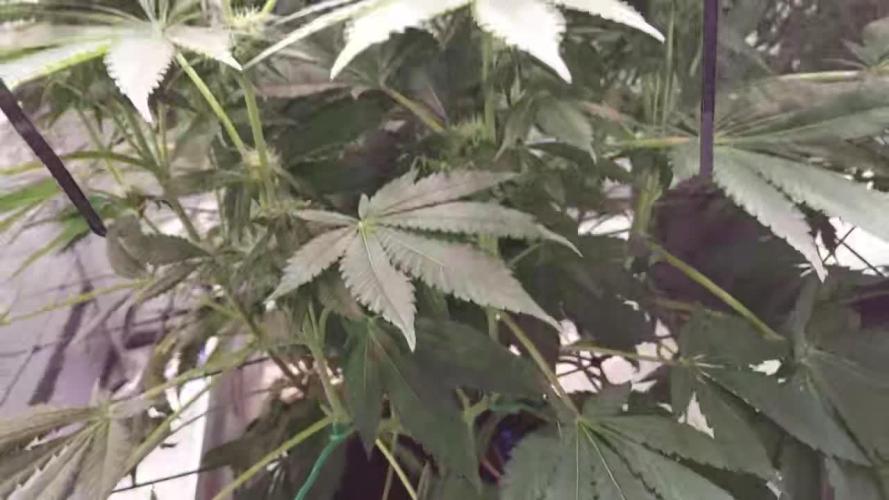
Just beyond 3 weeks into flower and the plants are showing their potential. Even the 2 smaller Kush Mints have really come on strong in flower. Can barely tell they were under-sized at this point. Still have a little more compact structure, but spreading it out with some garden wire really allowed it to power its growth. Yield should be in line with the others. The KM3 had a strong minty smell last week, but that's mellowed out a bit since.
All of the MSNL plants are robust and strong. Second grow with excellent results from this breeder. I did not pay for these seeds, but I am not a shill, either. If one of them grew all whacky like the mountaintop mint, I'd voice the same complaints. The clearly care about such traits in their selection process.
Overall the canopy has filled in nicely. I have a couple spots where light is wasted and I'll make some adjustments to the process to fix that for future grows. Now that I've settled on plant size and number of plants, improvements can be made each cycle until it's clockwork. I like the 12-cola vs 8 cola experiement. I've got a fairly long list of edits to make to various sections of my "bible," which means I liked the outcomes of most of my incremental adjustments. Continual, systematic improvement in action...
One other incremental change on the docket but not yet realized will be dropping nutrient concnetration once vegetative growth ends. Exact timing will be based on what I see in the foliage. I see some minor tip curl and its a bit darker than I want. So, it may come sooner than later. This'll be something I tweak over the next few grow cycles until I'm happy with the late-flower health.
I'll drop fertilizer concentration 10-15% on next refill and see how that plays out. It'll take a couple refills of reservoir to near 100% transition without draining it. If necessary, I'll drain and do a full refill for more pressing needs. A rez scrub before final stretch is coming, regardless.
Side note:
The impacts of VPD can be enormous. Last year (2025-2 diary) I had a humidifier wick get fouled and RH dropped while VPD spiked for more than a few days, thinking I could power through or that the canopy would soon provide more moisture. Nope, growth stalled in a significant way. By comparing day 34-42-49 of 2025-2 and day 38-42-49 of this diary, I can see a huge difference in growth at same point above ground. The consitency with which i do things makes it fairly certain it's the extende period with extremely high VPDs that caused the difference.
Also, interesting that it mostly catches back up by completion of third week of flower. The size difference is nearly undone by this point, though 2025-2 took 4 days longer vege phase to get there. Even so, I still think this grow is more than 4 days ahead of 2025-2 (the difference in vegetative phae duration). Time will tell if the development is ahead of the pace in 2025-2 or whether it's simply mostly an offset due to a less efficient vege phase for 2025-2.

Likes
52
Share


@kbloom
Follow
beginning of this was was day 50 from seed. Buds are starting to swell and fill out some. I might guessing I got about 3 weeks left. Dinafem lists them at 70 to 80 days but these plants are all on the short side. My canuk seeds cheese is going to take a bit longer. Also, I took some dead leaves and a few leaves blocking light and doesn’t appear to have affected them all.

Likes
8
Share


@Aleks555
Follow
We’ve officially entered week 7 with our FBA 2502 from 42Fast Buds, and the transformation is impressive—our girl is now in full bloom! After a smooth and steady vegetative phase, the flowering stage is progressing beautifully. The decision to experiment with a 12/12 light cycle for this autoflowering strain has proven to be an interesting choice, and so far, the results are encouraging.
The plant stands tall and strong in its 10-liter pot, with a well-structured shape thanks to early LST. The climate remains stable with daytime temperatures reaching up to 30°C and an average range of 27–28°C. Humidity levels are consistently between 60% and 65%, which has supported healthy growth throughout the cycle.
We continue to feed her with Xpert Nutrients, and the impact is clearly visible—dense flowering sites, vibrant foliage, and a healthy overall appearance. The aroma is starting to build, and the buds are forming with great structure and frost.
So far, this grow has been a pleasure, and week 7 marks a crucial point where everything starts coming together. We’re excited to see what the final weeks will bring!
Likes
10
Share


@Ultraviolet
Follow
Voltage, also known as electric pressure, electric tension, or (electric) potential difference, is the difference in electric potential between two points. In a static electric field, it corresponds to the work needed per unit of charge to move a test charge between the two points. In the International System of Units (SI), the derived unit for voltage is named volt.
The voltage between points can be caused by the build-up of electric charge (e.g., a capacitor), and from an electromotive force (e.g., electromagnetic induction in generators, inductors, and transformers). On a macroscopic scale, a potential difference can be caused by electrochemical processes (e.g., cells and batteries), the pressure-induced piezoelectric effect, and the thermoelectric effect. Since it is the difference in electric potential, it is a physical scalar quantity.
A voltmeter can be used to measure the voltage between two points in a system. Often a common reference potential such as the ground of the system is used as one of the points. A voltage can represent either a source of energy or the loss, dissipation, or storage of energy.
Dropping the temps will slightly raise the humidity, air holds less % water the colder it is. Lights on 25-35rh% the same water content will spike to 50rh% + at night just by dropping the temps.
At night all the juice photosynthesis has been storing up is mashed and mixed up to make all the goodies we need for bud, water is used to transport all these things everywhere, like little solvent transport devices, once a nutrient/protein has been delivered to destination the plant needs to get rid of all this excess water molecules it was using to transport. The only solution at night is to spit it back out into the air at night. During the peak of flower, this can catch a grower unaware, with a 4x4 full tent it can be a challenge to control all that moisture exhaust overnight especially if you're really pushing the limits.
We live in a water world, above or below, our misconception is we live on dry land, we don't live in less watery conditions than above or below. We fit into a very narrow band of moisture that just so happens to be full of lots of air and everything else required for life.
Got my first full whiff of the smell of purple lemonade, always surprises me how accurately the smell fits names, the dominant terpenes in the Purple Lemonade weed strain are carene, linalool, limonene, and myrcene. Carene gives this strain its sweet, citrus flavor and some woody notes, whereas the linalool I recognize so well from Granddaddy Purp. Myrcene has been shown to have sedative qualities while bringing musky, earthy elements to the flavor profile.
Trichome production started to ramp up, and the plant that grew taller/closer to UV showed noticeably thicker coatings. The taller plant shows slight yellowing of lower leaves, and the smaller plant is green and lush but the buds are slightly less progressed, interesting.
I super-cropped the main stem of the tall one just over a week ago (clean). I expected it to be the one slightly behind in development.
The plant has roughly 10-15% "Total resources" that it keeps in case emergencies arise. Reserves if you will.
My rationale behind breaking anything goes hand in hand with slowing things down as production is lost due to the time it takes to repair damage.
I recall watching a YouTube video, where a curly hair gentleman would super crop in a manner to damage but not disrupt using a twisting method, using fingers and thumbs placing them close together one goes clockwise other counter clock this varies a lot depending on the thickness of stem but what you wait for is a tiny snap, it may take several rolls to weaken if walls are tough I found. No snapping or bending of the stem, you want just to fracture it but not puncture this way the xylem and phloem channels remain flowing,the damage is repaired almost instantly and the 10-15% is dispatched with very little repair time. Everything in the general vicinity of the stress will now grow stronger so as to prevent further similar damage.
This is why I had expected the tall one to lag behind in development once I had cropped it but low and behold it worked and the tall one has slightly more developed buds.
The effects of birdsong on plant life may at first glance be far-fetched. Nigh on ten years ago an article appeared in Nexus Magazine on the discovery or invention of a method of growing plants using bird sounds. Christopher Bird and Peter Tompkins describe the development of Dan Carlson’s Sonic Bloom in their book The Secret Life of Plants. Many others have, it seems, recognized the role of birdsong in the growth of plants, and influenced or directly helped Carlson to develop his invention.
Dan Carlson’s desire to see that no one need be hungry through shortage of food sought to understand the optimum growth of plants. He discovered that plants also feed from ‘the top down’ as well as the roots. Underneath all leaves are pores called stomata which open to take in nutrients and moisture from the air. Carlson’s observation that the more bird life there is on the farm, the more abundant is plant life, has been echoed by farmers throughout history, except in modern times. Where there is little bird life, plants are stunted, and dwarfed. Nature has the birds sing at dawn and dusk, which dilates the stomata, and so feeds the plants. One can immediately see the importance of trees.
The development of Sonic Bloom was to create birdsong, which is played to the plants, while a foliar nutrient is sprayed onto the plants at the same time as they are being stimulated by the sound, to enhance their growth. This method produced fantastic results in the amount of abundantly nutritious produce from one plant, often in poor soils and in drought conditions. Carlson showed that the breathing leaves of plants are the source of the nutrient intake for growth. This of course is also true for humans—the breath is food. We shall discourse on this on another occasion. Plants transfer nutrients to the soil via this breathing, and Carlson showed that his plants improved the soil and helped earthworms proliferate.
The secret of Sonic Bloom was the development of the music of the same frequency as the dawn chorus of the birds. With the help of a Minneapolis music teacher, Michael Holtz, a cassette was prepared. It seems that both birds and plants found Indian melodies called ragas delightfully suitable. This is actually quite profound, although the American farmers, especially women, who had to endure this music whilst it was played to the plants, found it irritating. Holtz found the “Spring” movement of Vivaldi’s The Four Seasons appropriate and concludes: “I realized that Vivaldi, in his day, must have known all about birdsong, which he tried to imitate in his long violin passages.
Holtz, it is related by the authors Bird and Tompkins, also realized that the violin music dominant in “Spring” reflected Johann Sebastian Bach’s violin sonatas broadcast by the Ottawa University researchers to a wheat field, which had obtained remarkable crops with 66 percent greater yield than average, with larger and heavier seeds. Accordingly, Holtz selected Bach’s E-major concerto for violin for inclusion on the tape. “I chose that particular concerto,” explained Holtz, “because it has many repetitions but varying notes. Bach was such a musical genius he could change his harmonic rhythm at nearly every other beat, with his chords going from E to B to G-sharp and so on, whereas Vivaldi would frequently keep to one chord for as long as four measures. That is why Bach is considered the greatest composer that ever lived. I chose Bach’s string concerto, rather than his more popular organ music, because the timbre of the violin, and its harmonic structure, is far richer than that of the organ.
Birdsong has long been loved but also studied with reference to the musical scale and harmonics. As Holtz deepened his study he said, “I began to feel that God had created the birds for more than just freely flying about and warbling. Their very singing must somehow be intimately linked to the mysteries of seed germination and plant growth.
The spring season down on the farms is much more silent than ever before. DDT killed off many birds and others never seem to have taken their place. Who knows what magical effect a bird like the wood thrush might have on its environment, singing three separate notes all at the same time, warbling two of them and sustaining the others.
Tree and bird life are essential to Earth's existence, which Carlson, Holtz, and others have shown, but indeed others see and feel. “Plants”, says Steiner, “can only be understood when considered in connection with all that is circling, weaving, and living around them. In spring and autumn, when swallows produce vibrations as they flock in a body of air, causing currents with their wing beats, these and birdsong, have a powerful effect on the flowering and fruiting of plants. Remove the winged creatures, Steiner warns, and there would be stunting of vegetation. Nothing more needs to be added here.
It has been said that you cannot hurt the humblest creature or disturb the smallest pebble without your action having a reaction upon something else...You cannot think of an evil thought, no matter how private, without it having an effect upon somebody else. Whatsoever you do in life sets up some form of resonance.
When I say the morning chorus of the birds awakens the earth I mean that the characteristic song of the birds sets in motion a series of vibrations which react upon other forms of life. Remember, the soil of the earth is full of living microorganisms. The plants are also living organisms. You, yourselves, are living organisms. Now, this is the beauty and wonder of it all—when one aspect of nature has been moved into a state of resonance it immediately relays its vibrational motion to something else.
So when I say the dawn chorus awakens the earth I literally mean what I say. I do not suggest that the earth would come to a standstill without the bird song, but I do mean that life on earth would be sluggish and ineffectual without that first instigating outburst of vibrational power poured forth at just the right pitch and tone to set off a chain effect.
I know some of you will say, what happens in those parts of the world where there are no birds? Well, what does happen? Very little, I assure you. The hot deserts and the polar regions where there are few, if any, birds are not renowned for their wonders of nature. It is as though they are asleep. Nothing grows, few things live. Little resonates and there is a great stillness over everything.
You see, that outburst of sound just before dawn is like the little lever that works the bigger lever which turns the wheel which moves the machine…and so on. Never underestimate small things.
Animals are blessed with instantaneous and unthought-out wisdom. They are in direct contact with God and they act and live as though they are fully aware of it. Men are also in contact with God, but most of them act as though they have never heard of God because they are largely veiled from their divine center by their own thinking minds of which they are so proud.

Likes
26
Share


@THC123
Follow
Day 78 (September 2): Still just regular waterings with 25ml per 10L of FloraBloom to try and help with the Potassium Deficiency.
Day 81: Another feeding again today. Everything is looking very healthy. Some yellowing from the nitrogen cut off but I expected that.
Day 83: Another watering. These girls are drinking heavy right now! Looking fantastic.

Likes
6
Share


@RDWCGrowing
Follow
This brings the Journal up to speed. So going to start the 48 hour FLush this upcoming Sunday as well as going to move it to 48 hours of light insted of 48 hours of darkness. Then straight into the Freeze dryer to bring it down to 60% humidity in the bud and then to the curing jars. Going to be Timber 2 days into Week 9 of FLower.
1/20/2023
Week 8 (Day 5)- Flower- Day 107 overall
T - 2 days until start 48 hour Flush
T - 2 days until Start 48 hours of Light
T - 4 days until TIMBER!!!
1/22/2023
Week 8 (Day 7) -FLower- Day 109 Overall
Flush Day and 48 hours of Light. I subscibe to Dr. Bruce Bugbee's suggestion that production is under light instead of under darkness so I no longer do 48 hours of Darkness, I go 48 hours of light before Chop, sending my plants on a marathon run before I Cut. Here is Dr. Bruce on basics of lighting https://www.youtube.com/watch?v=ID9rE5JewVg
T-2 days until TIMBER

Processing
Likes
8
Share


@Bossman
Follow
I'm just winging it out to see what's going to happen but so far so good I think.

Likes
4
Share


@Dameon0803
Follow
Almost a week late making this update. Thankfully, during my negligence to this, the plant still recieved the care it needed. Knowing this genetic with the heat I have, it'll surely foxtail with some bleaching. I truly need a new camera setup with a better angle. For now, ill need to remember to take pictures myself. Been busy setting up a new area to go bigger. Temps were a battle, but something I'll wait to address in the future set up. Night time humidity levels are also a challenge. Did a bit of a defol, that'll be it, unless I decide to do a heavy strip prior to harvest.

Likes
2
Share


@L8bloomr1008
Follow
Finally made it to flower. Did a supercrop on one of the Mr big runtz x Gary Payton. Both Pablo’s revenges are smaller with tighter nodal spacing so far. Let’s see what they do.
Likes
6
Share
@Punkndrublic187
Follow
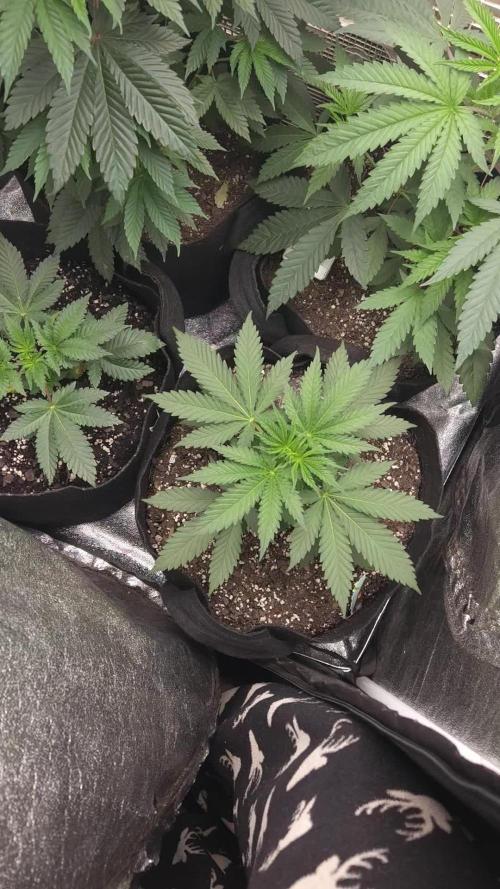
Flipped the flower Tent March 22nd. The big Charmz Slushie & the PBBF4 are female sadly the end one is a male. Veg Tent chugging along the other PBBF4 is gonna be joining the flower Tent and give the Space Peaches some room


Likes
12
Share


@valiotoro
Follow
Hello everyone week 3 of flower has passed for this LSD-25 auto 🎢
Same feeding schedule
Mars hydro FC-E6500 75%
have a great day and wish you all happy growing 😎👨🌾🏻
Likes
Comments
Share



Likes
146
Share


@Natrona
Follow
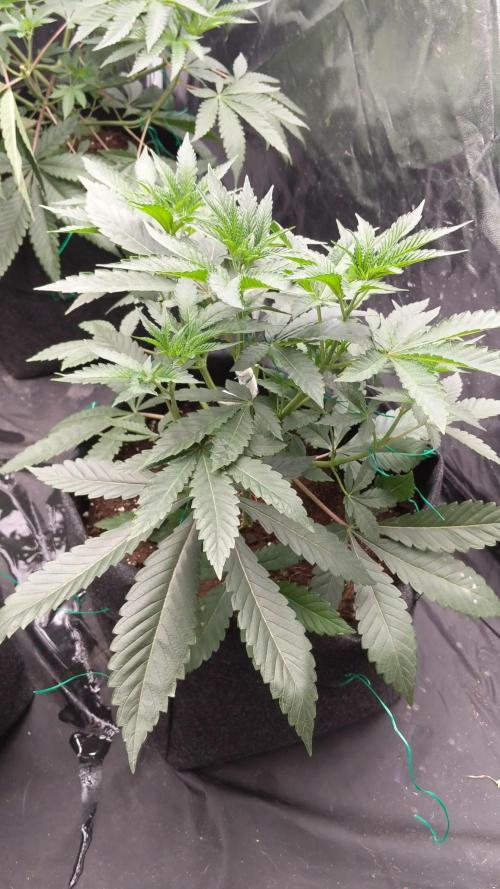
I increased feed to 1 gal when watering. I water 2 liters let her absorb that and 30 minutes or so later i give her anothet 2 liters. The small amount of run off is absorbed by the following morning. Historically my plants have drank 2 liters and yielded 57 smokaeble grams. They say the amount of consumption is an indication of estimate yield. If my hypotheses holds true, Apollo should yield about 113 grams (4oz), twice what I've accomplished in the previous grows. Fingers crossed.
Fragrance in the tent is Sweet citrus diesel smell. Gently pushing the stems down and out, my hands, arms, and fingers are sticky.
RQS says harvest at 70-75 days from seed. I think within 2 weeks for harvest. Based on 9/14 pop soil, my calendar indicates it's gonna be around the 20th. So before Thanksgiving.

Likes
11
Share


@Growing420Dreams
Follow
A principios de semana se aplico poda apical en las 6 plantas y ayer defoliación.
Likes
3
Share


Likes
9
Share


@Skinnytalls420
Follow
Day 1-12/12/21 I put the seed in glass of water for 24hours! Day 2-13/12/21 I placed seed on paper towel! Day 4-15/12/21 seed is in soil!!! Day 6-17/12/21 seed has popped out soil!!!!

Likes
17
Share


@DETOX
Follow
12ª semana día 82 - 8ª semana de floración día 58.
Llegamos a su fin, ahora a secar y curar.
Es todo, nos vemos en la próxima.
Felices humos.
