Likes
Comments
Share
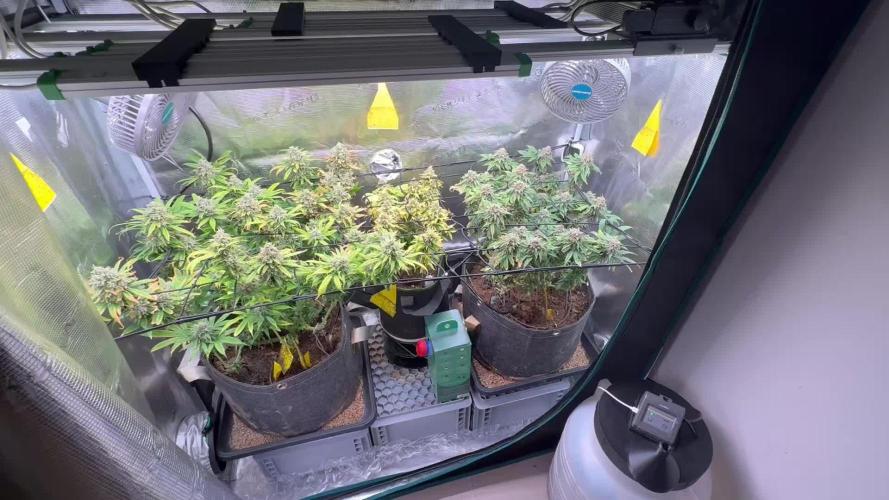
Gracias al equipo de Sweet Seeds, Marshydro, XpertNutrients y Trolmaster, sin ellos esto no sería posible. 💐🍁: Big Devil Fast Version: Atendiendo a las peticiones de nuestros amigos y clientes, presentamos la versión feminizada y fotodependiente de nuestra apreciada variedad Big Devil Auto (SWS15). Para el desarrollo de esta variedad utilizamos nuestras mejores cepas seleccionadas de Big Devil Auto. Hemos eliminado el carácter autofloreciente de la Big Devil Auto hibridando estas cepas seleccionadas con un clon élite de características muy semejantes a la Big Devil Auto original. El resultado es una planta muy vigorosa, de gran porte y de muy alta producción, con cogollos muy densos y repletos de resina. Desarrolla un fuerte tallo principal y largas ramas laterales. Conserva el aroma y sabor de nuestra Big Devil Auto original, muy dulce e inciensado. 💡TS-3000 + TS-1000: se usaran dos de las lámparas de la serie TS de Marshydro, para cubrir todas las necesidades de las plantas durante el ciclo de cultivo, uso las dos lámparas en floracion para llegar a toda la carpa de 1.50 x 1.50 x 1.80. https://marshydro.eu/products/mars-hydro-ts-3000-led-grow-light/ 🏠 : Marshydro 1.50 x 1.50 x 1.80, carpa 100% estanca con ventanas laterales para llegar a todos los lugares durante el grow https://marshydro.eu/products/diy-150x150x200cm-grow-tent-kit 🌬️💨 Marshydro 6inch + filtro carbon para evitar olores indeseables. https://marshydro.eu/products/ifresh-smart-6inch-filter-kits/ 💻 Trolmaster Tent-X TCS-1 como controlador de luz, optimiza tu cultivo con la última tecnología del mercado, desde donde puedes controlar todos los parametros. https://www.trolmaster.com/Products/Details/TCS-1 🍣🍦🌴 Xpert Nutrients es una empresa especializada en la producción y comercialización de fertilizantes líquidos y tierras, que garantizan excelentes cosechas y un crecimiento activo para sus plantas durante todas las fases de cultivo. Consigue aqui tus Nutrientes: https://xpertnutrients.com/es/shop/ 📆 Semana 4: Aparecieron un monton de erizos esta semana, el temporal ha hecho algo de mella en la carpa al bajar las temperaturas aunque todo sigue correcto. Continuamos con las dosis de nutrientes recomendadas por el fabricante.
Likes
5
Share
02/26 start of week 8 last week I harvested a branch off each got to taste em now #4 and #1 are omg good after the other 2 are ok but nothing special seeds on all of em mature seeds to harvesting fresh frozen 200 grams each plant on Saturday. Waiting one more week after that to chop and hang the rest
Likes
23
Share
Last week. Big buds, and rockhard. starting to get really sticky in the last 2 weeks, prior that it was not sticky at all like other plants most of the time do. Doesn't smell too strong, smells a bit sweet,sour,candy like.
Likes
Comments
Share
I have had to bend over quite a few far reaching branches with this sativa girl. It's funny, I used to worry about bending and breaking a branch. 8/23 they just keep stacking Jesus chroist. 8/24 sensizym, budcandy, microbes feed. Kiyomi ecs are way high at 7 in the res. I diluted the res half way with tap and the chocs are still eating big time they're at 3.5ec or so. Think I'll just cut feed to the kiyomi at this point. 8/27 been feeding an ph perfect at .8 ec, got everyone down to around 3.0. I think I'll continue with this feed and observe runoff. Once I get around 2 I may give another salt feed depending on what week I'm at. I don't think the kiyomi is going to need another.
Likes
7
Share
@Melacolas
Follow
Les plants renfort tuteurs ,defoliations ,rincage des plants sans engrais l epuisement des feuilles place aux fleurs rincage peut etre du the de compost ou banane naturel les ravageurs nada netoyage aspirateurt froter le projecteur extra tourne h 24 mise en place d un ventillo mais les chaleurs font monter a 30 degrer les plants je surveille a la loupe d eventuel hermaprodite le stress l eaux tout 2 a 3 jours defoliation deux sessions enfin le run suit sont cours
Likes
16
Share
Week 10 flushing plant this week and next week before harvest!! Fast Buds White Widow has been really easy to grow the plant is strong genetically and can handle some stress and recover if your a beginner I highly suggest you give this lady a try. She smells sweet, looks beautiful with her purple hues in her buds and the trichomes just glistening from every angle even the leaves remind you of fall as she's in her final stage. I hope this motivates and encourages others to grow their own medication!!!
Likes
14
Share
@SkunkyDog
Follow
Hallo zusammen 🤙 Sie wächst sehr schön und macht keine Probleme.
Likes
1
Share
So it's time to harvest Russian machine guns. The plants were high because we pulled them with a lamp and did not use LST. The final product was removed on the shelf of the refrigerator.00
Likes
9
Share
Likes
Comments
Share
Vamos familia, actualizamos la octava semana de floración y última de estas Forbidden Mochi fast de Seedstockers, Aplicamos varios productos de Agrobeta, que son increíbles para aportar una buena alimentación a las plantas. Temperatura y humedad dentro de los rangos correctos en la etapa de floración. La tierra utilizada es al mix top crop, por cambiar. De 5 ejemplares seleccioné 4 para completar el indoor, se ven bien sanas las plantas tienen un buen color, progresan a muy buen ritmo, ya maduraron las flores y han tricomado mucho, cogieron unos tonos púrpuras rosáceos, están increíbles, ya queda el machetazo, el secado y pasarlas a bolsa TerpLoc , GROVE BAGS, para curarla algún mes. Agrobeta: https://www.agrobeta.com/agrobetatiendaonline/36-abonos-canamo Hasta aquí todo, Buenos humos 💨💨💨
Processing
Likes
9
Share
Another good week! Continued LST. Ph stayed between 6-6.5. It was a muggy week here, and the indoor temps hung between 75-85. Looks like I have lots of flowers to look forward to!
Likes
34
Share
Oct 20 Starting Well Water 0.9EC or 450PPM (Hard Water) @ 19 Degrees Inputs : EC 2.0. PH 6.4 Temp 19-21 2 Gallons each Runoffs: EC 2.0, 2.1, 2.2 & 2.3 Goal is to Grow High Brix 12-15% better than the medical grade cannabis to help with a myeloproliferative neoplasm😧 as well as for fun😎. Any tips, working knowledge or suggestions towards this goal is greatly welcomed and would be played forward. Just read that if a plant has a BRIX of 12% or higher that some insects won't lunch on it! Loving this plant😀 Flavonoids and Cannaflavins are phytonutrients and along with carotenoids are responsible for colours. They are anti-mutagenic, anti-cancer, antioxidant, antiviral, anti-inflammatory, immuno-protective .. Maybe better than aspirin for inflammation trial is still out😉. Catechins are anti-proliferative, cardio-protective and reduce cholesterol. More medical studies need to be done on this plant😶 Some plants are showing signs of a deficiency. I believe I have locked out calcium. I watered yesterday with 2 Gal each of Dutch Nutrient Diamond which has amino acids, humic and fulvic ,kelp (has b vitamins and amino acids in it). Green Planet Terpinator for the 4% Sulphate of Potash (SOP) or potassium sulfate...I saw a Video with the awesome Dr. Harley Smith and wrote 7 pages of full scape and he mentions to use amino acids to help plants uptake calcium. These products contained them and I had them on hand...hope it helps.
Likes
29
Share
Today is the harvest day for Red hot cookies. To be honest they were ready to chop after 7 weeks of 12/12. One green poison and one gorilla girl which is more indica leaning are also ready and I think I ll chop them too. Two gorilla girls and two green poisons still have some days to fully mature, bu its a week tops. One of the Red Hot cookies showed these beautiful dark purple, orange, yellow combination on its leaves which I always dreamed of having in my garden. Im super happy :) Combined with the ridiculous frostiness in the middle, she's definitely one of the most beautiful plants I've had so far. Cheers everyone.
Likes
16
Share
@1juan420
Follow
All pictures were taken on day 57 Buds are stacking up and her smell intensified a lot this week😸I am impressed by the size of her buds🙀I have not seen such a big headbud outdoor after such short flowering💪 I gave her about 4L with 0.7ml/l Top-Max & Bio-Bloom this week and 0.4ml/l Bio-Grow More lower leaves are getting yellowish but it should be fine with current feeding✊
Likes
2
Share
Remember that, however you are played, or by whom, your soul is in your keeping alone. Even though those who presume to play you be kings or men of power, when you stand before God, you cannot say, 'But I was told by others to do thus,' or that virtue was not convenient at the time. This will not suffice. Remember that. Day:18 84°F and 65% RH (VPD) for the vegetative stage. Approximately 1.15kPa(assuming leaf temperature is about 2°F cooler than the air), which falls right into the ideal vegetative sweet spot (0.8kPa to 1.2kPa). At 1.15kPa, plants can draw water and nutrients efficiently without risking stress or wilting. It keeps the leaf pores (stomata) open, allowing for ideal carbon dioxide intake and maximizing vegetative growth. VPD is determined by the leaf's temperature, not just the ambient air. Because leaves usually run 1° to 3°F cooler than room air under bright grow lights, my actual VPD will be slightly lower, closer to the 1.0kPa mark. As she transitions from vegetative growth to flowering, one can gradually lower the humidity (to around 45–60%) and drop temperatures slightly to prevent disease from settling inside dense buds when they appear. Night:6 At 70°F and 60% relative humidity, Vapor Pressure Deficit (VPD) is 0.86 kPa. This is right on the cusp of whats optimal for the vegetative stage. During the nighttime, plants generally close their stomata and undergo cellular respiration rather than photosynthesis. Transpiration slows to a near stop, making VPD less critical at night than during the day. However, maintaining a nighttime VPD between 0.8 and 1.0 kPa is highly beneficial in that it ensures the air is dry enough to prevent powdery mildew or bud rot, but moist enough to keep the plant from undergoing unnecessary stress. This range keeps the environment comfortable for cellular processes and prevents large atmospheric swings. Keeping it all flowing. (Not pushing them yet, these are photoperiods) The optimal soil (root zone) temperature for cellular root respiration and nutrient uptake in cannabis is between 68F & 72F This narrow range balances biological energy production (cellular respiration) with the dissolved oxygen levels in the soil, maximizing plant growth and health. Warmer soils hold significantly less dissolved oxygen. When soil temperature exceeds 74F oxygen depletion occurs, inhibiting cellular respiration almost entirely, At 68-72F root cells generate optimal adenosine triphosphate (ATP) via respiration to power root-tip elongation and the active transport of water and nutrients. Too Hot (Above 78F) Root respiration increases, demanding more oxygen, while the water's oxygen-carrying capacity drops. This creates a prime environment for anaerobic pathogens and Pythium (root rot). Too Cold (Below 60F) Root metabolism and cellular respiration slow to a crawl. This severely impairs nutrient and water absorption, leading to yellowing, wilting, and phosphorus deficiencies. A lot depends on whether it's automatic or photoperiod; with photoperiod, there is not as much of a need to push "hard" as the real countdown only begins once the flower is initiated. Automatics, on the other hand, the chronological "clock" begins ticking the moment the seed germinates. It is of critical importance that the seedling growth gets off to the races, understanding that early growth is like compound interest, which will pay off come harvest. This reality is why getting autoflowers "off to the races" early on yields such exponential benefits. The "compound interest" is directly related to the surface area of the leaves. Larger, faster-growing seedlings process more light and build bigger root networks early on, which translates into an explosion of vertical and lateral growth during their short vegetative window. The margins for error are so thin with autoflowers; this early-stage momentum depends on several critical practices. Seedlings exposed to increased atmospheric CO2 levels early in life will develop at an increased rate. To effectively "extend" or optimize the capacity of Photosystem II (PSII) for increased photosynthetic efficiency. In standard oxygenic photosynthesis, Photosystem II (PSII) is naturally limited to the red-light spectrum, peaking at 680nm. Extending its light-harvesting capacity past 700nm into the far-red region requires bypassing the natural limits of standard chlorophyll a. Adding 730 nm (far-red) LEDs alongside standard red/blue lights has been shown to increase canopy photosynthesis by 20–30% in several crops by acting synergistically with shorter wavelengths. However, the limitation is that excessive, pure IR/Far-red light (without accompanying red light) can trigger the "shade avoidance response," causing plants to grow tall, weak, and spindly rather than robust. Utilizing infrared light (specifically the 700-750 nm far-red range) is a viable method to boost photosynthetic efficiency. It acts as a bridge to allow PSII to utilize a broader spectrum of light, breaking the traditional 700 nm barrier. UVR8-mediated signaling (often in conjunction with CRY proteins) triggers protective mechanisms that maintain the stability of the photosynthetic apparatus (including LHCII and reaction center proteins), thus ensuring that the efficiency of Photosystem II remains higher in UV-B-exposed plants compared to plants lacking this receptor. ΦPSII indictates the rate of electron transfer from water to plastoquinone, which drives the production of ATP and NADPH. There is a close link between ΦPSII and the true rate of CO2 fixation (Φ*co2). ETR stands for Electron Transport Rate. It measures the speed at which electrons are moved through the thylakoid membranes in a plant's chloroplasts during the light-dependent reactions of photosynthesis. Infrared light (particularly Near-Infrared or NIR) improves cellular energy by interacting directly with the electron transport chain (ETC) in mitochondria. This process boosts adenosine triphosphate production, which acts as a metabolic coefficient multiplier by accelerating enzyme activity dramatically. Extend then multiply. Far-Red photons interact with plant photoreceptors to accelerate the plant’s biological "clock" or trigger a shade-avoidance response. Autoflowers don't use the plant's biological clock, although the IR will initiate a shade avoidance and make them stretchy. You can just add equal measures of 660nm-680nm to negate the shade avoidance effect. Replacing nights' "darkness" with a combination of IR+ and 660nm. Because autoflowers don't require a dark period to flower, many growers just blast them with light. 18/6 24/0. However, this ignores the plant's metabolic rhythms, where daytime photosynthesis (light reactions) must be perfectly balanced with nighttime carbon fixation and assimilation (Calvin cycle) to avoid bottlenecking plant development. Cellular respiration is a 24/7 process, but it can only function while the plant has the free oxidative capacity to do so. A 100% photosynthetically active leaf cannot perform cellular respiration. The viral trend of defoliation of every leaf that isn't "getting enough light" is of great detriment overall, putting 100% of the cellular respiratory "workload" and responsibility on the 0/4/6 hours of darkness in sub-optimal conditions for enzymatic activity. Photosynthesis captures nearly 100% of the initial energy as carbon, while cellular respiration is the process that unlocks 90% of that captured energy into usable ATP so the plant can use it. Respiration is considered only roughly 30% to 40% efficient. It captures enough of the potential energy in glucose to synthesize around 30 to 38 ATP molecules per glucose molecule. The remaining 60% to 70% of the energy in the sugar is not captured in ATP; instead, it naturally escapes into the environment as heat, which helps regulate plant temperature. In plants, the primary enzymes of the Electron Transport Chain (ETC) and the ATP synthase complexes are typically adapted to function optimally in warmer temperatures (roughly 77°F to 95°F, depending on the specific plant strain). As temperatures rise within this physiological range, molecular collisions increase, speeding up respiration and ATP production. The cannabis plant has a branched respiratory pathway. During heat or cold stress, plants activate Alternative Oxidase (AOX). AOX burns sugars to dissipate energy as heat rather than coupling it to ATP production. This pathway actually functions optimally at elevated temperatures to help protect the cell from the damaging build-up of Reactive Oxygen Species (ROS) during heat stress. Enzyme activity generally scales with heat; there is a strict biological limit. If canopy temperatures in a grow room exceed 104°F, the enzymes and their supporting lipid membranes lose stability. Not saying you need to go crazy, just optimize nights the same as we optimize days. Phosphorus is the driving force behind early seedling development. It acts as the "energy hub" of the plant, directly driving cell division, robust root growth, and the creation of DNA. Without an adequate, easily accessible supply early on, the plant's overall growth potential and final yield can suffer permanently.
Likes
20
Share
@Hashy
Follow
Week 5 Light cycle=18/6 Light Power=120w Extractor controller settings High temp= 25c Low temp= c Temp step=0c High Rh= 58% Low Rh= % Rh step=0% Speed max=7 Speed min=1 Smart controller settings (during lights on). Lights on=06.00am Radiator on= below 21c Radiator off= above 22c Smart controller settings (during lights off). Lights off=00.00am Radiator on= below 18c Radiator off= above 19c VPD aim=0.6-1.3 DLI aim=28-34 EC aim=1.7 PH aim=6.3 Thur 25/1/24 💧💧💧💧💧💧💧💧💧💧💧💧💧💧💧💧 Method= automatic Feed=water Neutralise=0.1ml/L Roots=0.2ml/L Easy Ph down=0ml/L Ec=0.25 PH=6.4/6.6 Time start=12.00pm Finish time=13.05pm (7×5 minute runs with 5 minute gaps) Total flow rate=200ml/min Flow rate per plant=50ml/min. Total volume made=12L Total volume left=5.5L Total volume used=6.5L Volume per plant=1.6L (Est) Runoff. Total runoff=0L Ec= PH=/ Did not work properly so need to sort it out. Total flow rate=185ml/min Flow rate per plant=46ml/min. Ran for an extra 15 mins while sorting out system. Should be about 200ml/min now (50ml/min each plant). 💧💧💧💧💧💧💧💧💧💧💧💧💧💧💧💧 #2 (Day 29) 📋 didn't quite get the amount of water it was supposed to. Extractor controller settings High temp= 25c Low temp= c Temp step=0c High Rh= 56% Low Rh= % Rh step=0% Speed max=8 Speed min=2 Smart controller settings (during lights on). Lights on=06.00am Radiator on= below 21c Radiator off= above 22c Humidifier on= not in use. Humidifier off= not in use. Dehumidifier on= not in use Dehumidifier off= not in use Smart controller settings (during lights off). Lights off=00.00am Radiator on= below 18c Radiator off= above 19c Humidifier on= not in use Humidifier off= not in use Dehumidifier on= not in use Dehumidifier off= not in use VPD aim=0.6-1.4 DLI aim=35-40 EC aim=1.9 PH aim=6.2 Fri 26/1/24 #2 (Day 30) 📋 defoliate lower leaves that hardly get any light. Sat 27/1/24 #2 (Day 31) 📋 H=44cm D=38cm DLI=33.5 Raised light about 10cm Increased light power to 140w H=44cm D=47cm DLI=29.5 Sun 28/1/24 I have decided today is going to be the last day of veg before I flip to flower. Lights will have come on today at 6.00am and go off at 10.00pm, they will get 14hrs light today and tomorrow will be day 1 of 12/12. 💧💧💧💧💧💧💧💧💧💧💧💧💧💧💧💧 Method= automatic Feed=Veg nutes. Neutralise=0.1ml/L Silicon=1.0ml/L Calmag=1.0ml/L Terra grow=4.0ml/L Roots=0.2ml/L Easy Ph down=0.125ml/L Ec= 2.05 PH=6.1/6.3 Time start=12.00pm Finish time=13.45pm (11×5 minute runs with 5 minute gaps) Total flow rate=181ml/min Flow rate per plant=45ml/min. Total volume made=12L Total volume left=2L Total volume used=10L Volume per plant=2.5L (Est) Runoff. Total runoff=1L Ec=2.7 PH=6.1/6.3 💧💧💧💧💧💧💧💧💧💧💧💧💧💧💧💧 #2 (Day 32) 📋 With no information for flower time I'm going to have to guess she will be finished in 45-60 days. I removed quite a few lower nodes that probably won't break through the canopy, they where ideal candidates for clones. Light cycle=12/12 Light Power=140w 58% Extractor controller settings High temp= 25c Low temp= c Temp step=0c High Rh= 56% Low Rh= % Rh step=0% Speed max=8 Speed min=2 Smart controller settings (during lights on). Lights on=10.01-21.59 Radiator on= below 21.5c Radiator off= above 22.5c Smart controller settings (during lights off). Lights off=22.00-10.00 Radiator on= below 18c Radiator off= above 19c Mon 29/1/24 Lights on at 10.00am off at 22.00pm #2 (Day 33)(Day 1 flower) 📋 H=49cm D=42cm DLI=23.0 At 9.00pm increased light to 150w H=49cm D=42cm DLI=24.0 Tue 30/1/24 #2 (Day 34)(Day 2 flower) 📋 Wed 31/1/24 #2 (Day 35)(Day 3 flower)**** 📋 H=54cm D=37cm DLI=27.0 🚿 foliar sprayed (Sumo Boost 2ml/L). She got flipped into flower on day 32, has caught up to the others in height and even overtook one plant. The cola I stuck back on is a lot shorter then the other 4. Back soon. Take it easy.