


Likes
Comments
Share


@Earthsower
Follow
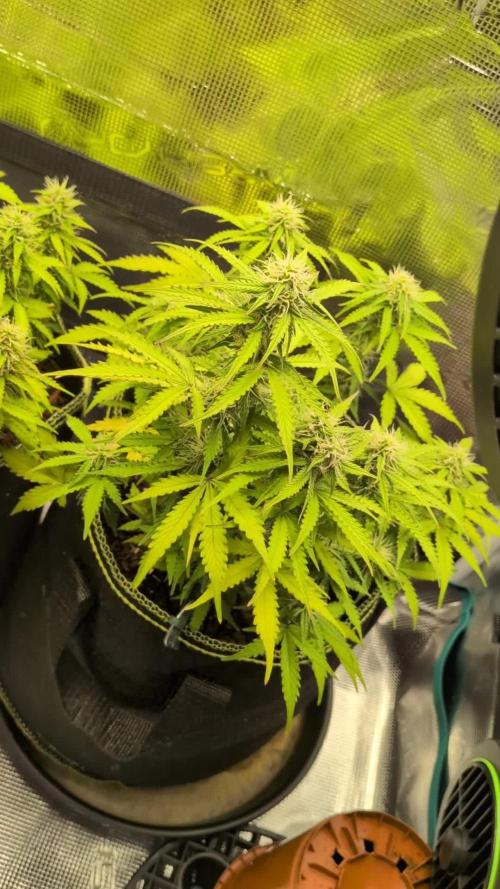
She has received a bit of heat stress from last week but she seems stable. She has not been fead anything this week all she has had is just pure natural sunlight. The pot is not light enough to feed her so I will wait until tbefore I feed her and continue to keep her in the natural sunlight

Likes
5
Share


Likes
18
Share


@CRK00
Follow
12th Week Report 02/01/20 - 09/01/20
I was away from home for 1 week and everything was done on 07/01/20.
07/01/20
Luckly there is no mold and humidity now is stable at 55%.
There is more or less half reservoir and I'm waiting to fill it, probably CMXL is almost ready to be flushed.
Now CMXL is just fattening.
As "planned" LSD got the final cut and from her undeveloped branches were trimmed just leaves without any pollen. When she will be dry, she will be used for making Hash/Butter.
Last Update 07/01/20
See you guys ;)


Likes
51
Share


@MadeInGermany
Follow
Info:
Unfortunately, I had to find out that my account is used for fake pages in social media.
I am only active here on growdiaries.
I am not on facebook instagram twitter etc All accounts except this one are fake.
Flowering day 1
since time change
to 12/12 h.
Hi guys :-) .
The time has finally come 👍
You have been switched to 12/12 hrs and are ready to flower.
Of course, cuttings were cut beforehand to keep the genetics.
For 4 days now she has also been getting Fast Buds from GreenBuzzLiquids.
They were also sprayed again with GBL Fast Plant spray.
She is very healthy and I am excited to see how she gets going again in bloom :-).
This week it was poured twice with 1.2 l each time (for nutrients, see nutrient table above).
Then I filled canisters with fresh osmosis water for the next few weeks 👍.
The tent was cleaned and every plant was checked for health.
At the moment I am tinkering with the ventilation because there are currently 4 fans with 4 activated carbon filters running, which I want to make more efficient by putting a hose through 2 tents.
These are the things about which you desperately at the beginning but learned from them in the end.
I wish you all a nice week.
Stay healthy 🙏🏻
You can buy this Nutrients at :
https://greenbuzzliquids.com/en/shop/
With the discount code: Made_in_Germany you get a discount of 15% on all products from an order value of 100 euros.
You can buy this Strain at :
https://www.exoticseed.eu/
Type:
Herz Og
☝️🏼
Genetics:
Larry OG X Kosher Kush
Indica 60 % / Sativa 40 %
👍
Vega lamp:
2 x Todogrow Led
Quantum Board 100 W
💡
Bloom Lamp :
2 x Todogrow Led
Cxb 3590 COB 3500 K 205W
💡💡☝️🏼
Soil :
Canna Coco Professional +
☝️🏼
Nutrients :
Green Buzz Liquids :
Organic Grow Liquid
Organic Bloom Liquid
Organic more PK
More Roots
Fast Buds
Humic Acid Plus
Growzyme Big Fruits
Clean Fruits
Cal / Mag
Organic Ph - Pulver
☝️🏼🌱
Water: Osmosis water mixed with normal water (24 hours stale that the chlorine evaporates) to 0.2 EC. Add Cal / Mag to 0.4 Ec Ph with Organic Ph - to 5.8


Processing
Likes
3
Share


@Ogbangbang2981
Follow
this week was a lil challenging, had to get out of LST due to the fact that I broke a branch and that just tripped me off and I took off all my ties , apart from that i started giving her bloom products because I noticed a few hairs. I started applying tiresias mist to one of my branches so I can get pollen sacks to produce my own fem seeds, as I plan on crossing my fortune cookies autoflower with my ak48 autoflower and creating a new strain called "DRAKO" AUTOFLOWER well till next update . O.G. Bang Bang !! out.....

Likes
1
Share

@therealgrowmie
Follow
An intense heatwave has been rolling through the grow environment, making it tough to dial in the VPD.
The air is very dry, and since I don’t have a humidifier (yet), mitigating the high temperatures has me stuck between a rock and a hard place.
Fortunately, I’ve reached flower, so a drier environment isn’t the worst thing in the world. But it’s definitely been a challenge!
---
Quick rundown on everything else:
Watering: 1500ml every third day
Fertilizer: According to the BioBizz schedule
Light intensity: ~1000 PPFD
VPD: Around 2.23 kPa
Temperature: ~30°C
Relative humidity: ~40%
Likes
8
Share


@Hippity
Follow
The girls look healthy, happy, and smell delicious, kinda sweet citrusy. I'm overall satisfied so far. They have some crystals forming on them as well. I feel like it's gonna be a successful grow. But don't think I'm gonna use Green-O-Matic again, it's not as short as I wanted it to be, and it has unstable phenotype. I hope the effects are nice and relaxing though.

Likes
10
Share


@StickyFingah420
Follow
Ganadora del primer lugar en la categoría autofloreciente de la copa Litoral de Los Poetas en Chile.🏆🥇
Definitivamente en mi top 5 de preferencias ⭐️⭐️⭐️⭐️⭐️
Una genética muy estable, ya que es segunda vez que germino de estas semillas y se expresa exactamente el mismo fenotipo; tonalidades hermosas y caractericas, frutos muy apretados y macizos cubiertos de una capa de tricomas lo que le da una visual espectacular.
El aroma en frasco es una mezcla de frutilla ácida y tierra con un fondo dulce 🤤 es realmente exquisito. En la fumada se repiten gran parte de los aromas pero menos dulce y más cremoso y especioso, detodas formas es un humo genial que querrás fumar todo el día..

Likes
26
Share


@HowtoBubatz
Follow
The second week of vegetation is over and watching the plant grow is a rewarding experience for me.
Now that the plant is well-established, it is time to begin training it. This involves LST to ensure it reaches its full potential in this case.
I look forward to discovering what this plant will become 😋😊
Likes
9
Share


@Lazuli
Follow
2 weeks max then its time, the colours are fading now.
This plant is in an autopot i only fill up the reservoir. I do see she drinks way less now. After this water i feed with only ripen in it lol. I cant believe how easy this was i havent touched the plant once or waterings


Likes
28
Share


@HydroHerb420
Follow
Still going well. Drained and refilled both tanks at the beginning of the week. Usually add PK week 5 flower but they didn’t quite look ready. Starting to smell nice in there now too.
Likes
3
Share


@julian100614
Follow
Empezamos otra semana de vegetación y la pequeña banana 🍌 ya se va haciendo mayor 😃
Las hojas estan creciendo grandes y sanas mientras que el tallo se esta poniendo gordo y fuerte 💪😉
Camos a seguir con los nutrienes de canna que le estan llendo muy bien 👍

Likes
3
Share


@CaptonianMoneymaker
Follow
Looks like buds r going slow super cheese is on track nice rop colas
Likes
3
Share


@Philippovic
Follow
Die Lady wird am Wochenende erlöst, die Mängel konnte ich nicht beheben, weder calmag, Calcium oder bittersalz konnten helfen.
Vermutlich sind in der einen Woche vor der Blüte einige Wurzeln verfault, als sie 6-8 Tage zu viel gegossen wurde.
Processing
Likes
17
Share


@Gator_grows
Follow
Man I’ll say my first auto flower and my first grow it was intense and I loved every moment I was so excited and almost couldn’t wait but I did and I’m so happy I did wait. I Highly recommend the strand!!! To any one
Likes
5
Share


@Nebula
Follow
Happy this seed was successful to germinate! This is an organic run with Green Gro in Ocean Forest. Trying some new air pots at my local grow shop, $7 vs $30. Nothing exciting yet. Looking forward to sharing the progress.
Likes
6
Share


@k0nz1
Follow
Already there
5 days till harvest
No more watering - let them dry out in the pot
Hervested after 10 weeks bloom


