Likes
Comments
Share
@OslyDabs
Follow
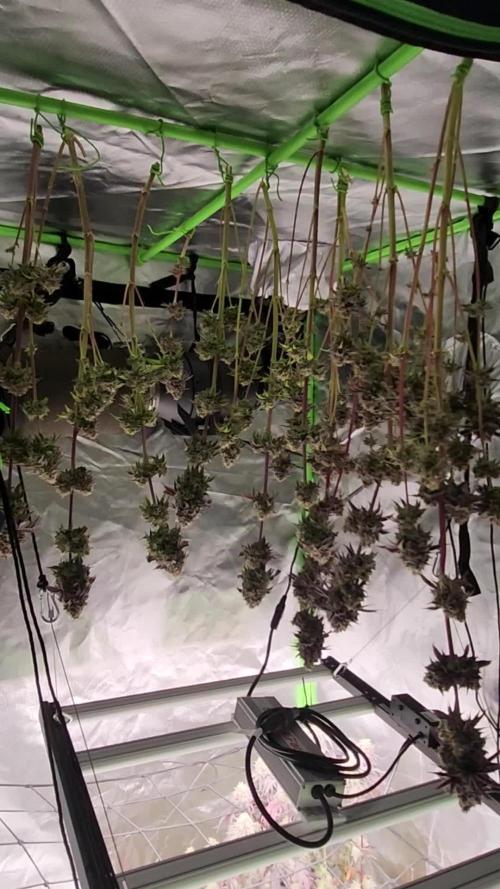
Ya va cogiendo forma los cogollos y empieza a desprender un fuerte olor a moby dick de pueblo. Siento haberme saltado algunas semanas de floración pero estuve un poco disperso. Buenos humos familia.
Likes
89
Share
@nonick123
Follow
Día 47 (03/03) Las señoras siguen su imparable Stretch. Solo mirarlas y disfrutar 😍😍😍🎉🎉🎉 Día 48 (04/03) Riego 1,25 Litro H20 + Wholly Base 2,5 ml/l + Solid Green 1,5 ml/l + Early Flower 0,75 ml/l de Gen1:11 TDS 960 PPMs - pH 6,26 Día 49 (05/03) Se empiezan a formar los erizos! 😍😍😍 Día 51 (07/03) Riego 1,25 Litro H20 + Wholly Base 2,5 ml/l + Solid Green 1,5 ml/l + Early Flower 0,75 ml/l de Gen1:11 TDS 950 PPMs - pH 6,37 Día 52 (08/03) Purple Lemonade FF y Wedding Cheesecake FF están mostrando una pequeña deficiencia de CalMag... Siguiendo las recomendaciones de Marco de GenOneEleven, aplico foliarmente 1 ml/l de Solid Green Día 53 (09/03) Parece que el stretch se frena un poco... 💦Nutrients by Gen1:11 - www.genoneeleven.com 🌱Substrate PRO-MIX HP BACILLUS + MYCORRHIZAE - www.pthorticulture.com/en/products/pro-mix-hp-biostimulant-plus-mycorrhizae 🎚️Controlled by TrolMaster TCS-1 Tent-X System Main Controller - https://www.trolmaster.com/Products/Details/TCS-1
Likes
5
Share
I started the spring with the experimental "Black Mamba 42," and here are my impressions. The plant spent 108 days indoors. Roots appeared on day two, and the seedlings shed their seed shells on day four. The plant stretches significantly in height; I managed to fit it into a 130 cm tall grow box by topping it and training the branches outward with plastic clips. At day 108, the buds were still a bit small; they could have easily gone another 2–4 weeks. The scent was moderately intense—nothing overpowering. Visually, the buds turned out to have medium density. The maximum wet weight for the two plants combined was 300g; I expect to harvest a solid 50g dry. We’ll know the exact figure in seven days—I don't like weighing wet material with the stems attached. As for issues: one plant suffered from acidification around day 15 (due to a faulty meter), which severely stunted its growth. Towards the end, the grow box was hit by spider mites. I also left it on an auto-watering system (using a 15L jug) for a week, and it dried out a bit. I had another plant from an international seed bank in the same group for comparison, and it handled the identical conditions perfectly. This strain isn't the easiest to grow and is a bit finicky. It requires a 2-meter-tall indoor grow space; in a one-meter space, without bending or training, the tops will get burned by the light around day 30–40 from seed. Bottom line: I didn't love the strain, though I’ll give it another shot later with the remaining seed. I plan to try seeds from two other banks. I recommend this strain to anyone with a 2-meter grow box who enjoys long grow cycles and cultivating massive Sativa monsters—and to anyone wanting to support our local breeders. Thanks for the experience! See you in future reports.
Likes
2
Share
Que pasa familia, vamos con la primera semana de floración de estas Gorilla Cookies Fast Flowering, de FastBuds. Agradezco a Agrobeta todos los kits obtenidos de ellos 🙏. Vamos al lío, el ph se controla en 6.2 , la temperatura la tenemos entre 22/24 grados y la humedad ronda el 50%.Llevan una semana con el fotoperiodo a 12-12 desde que actualizó esta semana. Estás próximas semanas veremos cómo avanzan. Agrobeta: https://www.agrobeta.com/agrobetatiendaonline/36-abonos-canamo Hasta aquí todo, Buenos humos 💨💨💨
Likes
14
Share
The Black Runtz scared me to death because one didn't germinate, a big insult for a stubborn person like me. Two days of fear but we already have two plants and maybe a third is on the way. That's why they're still in the biodegradable pot but we're only talking about a few days late, no problem. They're cute and in great shape. For now I've put in fertilizer to root and special enzymes that transform the residues of previous plants into nourishment....perfect I'd say to renew the soil as best as possible. Never stop at the first good results guys, always improve and it's fuel for the next day, to keep the passion alive and have results. Growing Projects -----In this case we were a little late and I planted two plants together. Giving up Main Cola is always a big sacrifice. To avoid depression and to give a better vision to our super trusted breeder, home breeder and Zamnesia heart breeder we make a plant in topping x16 and a straight one preserving the main cola. The first week went only with Power Roots 1 Ml/l and Pure Zym 1ml/l from now on we start with ALga Grow. The plants were transplanted shortly after germination because the biodegradable pots were very small. The soil is Plagron Pro Mix 100% organic renewed with 30% new soil and 20% Perlite added. (Pro mix don't have perlite but is airy we added anyway) Plagron fertilizers are available on Zamnesia in convenient Pack formats for all growing styles. I used this with a simple search you can find the other products. ---- https://www.zamnesia.io/en/12119-plagron-top-grow-box-100-natural.html Try a seed of this strain that drives us crazy... ---- https://www.zamnesia.io/en/11159-zamnesia-seeds-black-runtz.html Zamnesia Description // Black Runtz comes from a truly legendary genetic pool. Our breeders used three modern classics from the United States to create this strain: Zkittlez, Gelato, and Runtz. With 20% THC and flavors of grapes and berries, Zkittlez passed on her delicious flavors and relaxing effects. Gelato contributed to Black Runtz's immense flavor profile by passing on high concentrations of the terpenes limonene and humulene. Finally, Black Runtz inherited the high potency of the original Runtz, a strain with a respectable 21% THC. The end result of this 3-way cross is a strain with 55% indica genetics and 45% sativa. Black Runtz boasts rapid flowering times, high potency, and contrasting yet balanced terpenes that support its delicious flavor profile. Growbox and Air System - Secret Jardin DS120w + fans + Exhaust fans and filters DF16 kit ---- https://www.secretjardin.com All the best that mother nature has to offer is on ----www.zamnesia.com Call for collaboration: I am available for collaborations with companies of Lights and various equipment for growing (No Seeds and Nuts company please) I would like to renovate my 120x120 space that has slightly obsolete lights, and I would like to try some controllers. If you have proposals available.
Likes
18
Share
Привет друзья. Моей растихе сегодня 80 дней. Растение хорошими темпами приходит в себя. Через неделю буду переводить на цвет. Начал применять LST технику на 19 дне и продалжаю применять её через день, а 18 августа добавил ДЕФОЛИЗАЦИЮ С 20.08 ДЕФОЛИЗАЦИЮ делаю каждые 3,4 дня С 20.08 LST технику делаю каждые 4.6 дней На сегодняшний день влажность 54% 5.09.2023 заметил высокий Ph 7.9 С 48 дня Ph не ниже 5.8 На сегодняшний день Ph 6.0 Начал кормить с 60 дня Canna Terra Vega PPM 550 Погладитель влажности хорошо справляется со своей задачей. Рекомендую Всем мира и добра! Не забудь поставить лайк❤️, если понравилась как прошла неделя И читайте наш TELEGRAM: https://t.me/smail_seeds #Smail_Seeds 😀
Processing
Likes
5
Share
Likes
Comments
Share
We planted this seed directly in the medium and in 2 days it has sprouted up fully. We are growing this in a 1 gallon pot alongside our other jack herer auto which is being grown in a 3 gallon pot.
Likes
29
Share
Added a touch more KoolBloom into the mix. All is looking great, I think B2 is nearing its time to flush although B1 is a week or two behind. Buds are continuing to swell up nicely and have an insane amount of frost all the way up some fan leaves. Hopefully these will be down by late December or early January.
Likes
5
Share
Transplanted and separated into a 4x8 and 5x5 started to get deficiencies I think either cal or mag maybe even a little of both I flushed the soil in case ph was off in the soil then a couple had nitrogen deficiency so I gave them a tea last night will see how they look tonight when I’m off work once they are healthy I’ll flip to flower
Likes
4
Share
@iamdiddy
Follow
It so special for me this strain !!! me and dutch passion ones again... wish for dia grill healty and good luck.. much tank ,@dutchpassionseeds
Processing
Likes
6
Share
topped previous weeks, this week was spent training plants out to get ready to flip to flowering light cycle next week. left platinum yeti number 4 alone it is smallest weakest growth so i'm doing less to it than the training wise.
Likes
Comments
Share

More heavy defoliation more pony railing tops as they grow out . Before there were 11 tops tied now there were 18 tops tied . Overall she probably looks the exact same as 4 weeks ago but she has been doing a lot of leg work for the the grow to come . I’m still waiting to see these top dressed nutes start becoming available to her . I’m also curious to see what response , if any, she gives to the worm castings I topped dressed her with . She’ll be going to a 6 gal pot in about 3-3&1/2 once it’s time to feed her again . At the exact End of this week I’ve just untied all her tops . Give us a like .
Likes
Comments
Share
RQS propagator doing its job. Golden GOAT was the first strain to show her stem. Was recommended by a friend who smoked it before and loved the taste!
Likes
25
Share
Red gorilla auto/left back-7 weeks Red gorilla auto/right back-6 weeks Purple punch og/ front-4 weeks
Likes
2
Share
We become aware at such times of man's wonderful ability to bring seemingly unrelated elements into harmonic balance, and receive a glimpse into a world where everything exists in conscious sympathetic attunement to everything else. When we listen to a piece of music that seems to strike a beautiful chord somewhere inside us, or view a painting that simply glows with harmonic awareness well executed, we probably do not spare much time to contemplate the wonderfully intricate combination of vibrations that our sensors make it possible for us to perceive. We tend to appreciate the relationship between the parts of something by an awareness of the harmony or dissonance of the whole. This ability enables us to say "what a beautiful house!" instead of "analysis has proven that this collection of building materials exhibits certain elements of harmonic proportion." While this ability to instinctively appreciate the beauty of true harmony has an important role to play in evolution, a more analytical understanding of the laws involved can be most useful. This is especially so if we wish to create works of art where each part exists in true harmony, not only with the other part of that particular whole, but with the universe within which the creator and the created exist. Everything vibrates. From the most dense matter to the most subtle cosmic rays, everything which our senses allow our thoughts to become aware of, can be specified in terms of wavelength or frequency of vibration. These two terms define the same thing, but from different points of view. The following are the approximate wavelengths of various energy carriers: Cosmic rays 0.000,000,001 mm Gamma rays 0.000,000,1 mm X rays 0.000,500 mm Ultraviolet rays 0.003 mm Visible light 0.006 mm Infrared 0.01 mm Sound waves 1 meter Radio waves 300 meters Violet light 400 nm to 450 nm Blue light 450 nm to 500 nm Green light 500 nm to 570 nm Yellow light 570 nm to 590 nm Orange light 590 nm to 610 nm Red light 610 to 700 nm 1 nanometer (nm) = 0.000,000,1 cm = 1/10,000,000 cm If a guitar string is plucked and we hear a sound, it is not too difficult for the human mind to associate this sound with the vibration of the guitar string. With color it is quite different. It is difficult for us to conceive that the color of a substance is not an inherent property of the substance itself, but an indication picked up by our senses of that substance's ability to absorb or reflect the light which happens to be shining on it at that moment. Neither the matter nor the light is colored. What happens is that the brain learns to differentiate between the frequencies reflected or transmitted by the substance the eyes are focused on. The same thing happens with sound. When we say "Oh! Listen, they're playing my favorite song," what we really mean is: "My brain has stored within it a particular pattern of frequencies. I have compared the new information being received with this stored pattern and have deduced the answer that the two patterns are similar within certain specified tolerances." The 'pleasure' involved could have something to do with our running the pre-recorded pattern at the same time, in 'sympathy' with the new pattern as it is received. The word sympathy describes very well our ability to appreciate color and sound. It also describes the reason behind certain elements of harmony. For instance, if a substance vibrating at 100 cycles per second (tone 1) is in the proximity of another substance vibrating at 200 cycles per second (tone 2), we could perceive, if we had the right equipment, a certain sympathetic relationship between the two. We will see from this that there is a uniform doubling of the first tone seen in the second. At various points along the waves, the two are the same in amplitude. At other points, they are at opposite poles to each other. This doubled frequency has more points of similarity to the original than any other frequency except the original itself. If the equipment we had available for measuring these two frequencies was a soundboard amplifier and a pair of ears, then we would hear what would sound to us like one tone. If we had the opportunity to hear one at a time, we would hear that although they sound the same, one is higher in pitch than the other. This characteristic of 'the same but different in pitch', musicians have called the octave. Any two tones produced where one has exactly doubled the frequency of the other is called an octave. Speaking in ratios, an octave would appear then as the ratio 2:1 or 1:2, depending on whether we are talking of an octave up or down. A single note produced by almost any instrument will contain more than one wavelength or frequency. It will have a dominant frequency, the wavelength of which we would call the note's 'fundamental' or 1st harmonic. It will also have a varying number of upper harmonics, gradually fading in intensity into infinity or silence. Natural harmonics always have the same pattern of intervals between them. The interval between the 1st and 2nd harmonic is a perfect octave; between the 2nd and 3rd a perfect fifth; between the 3rd and 4th a perfect 4th; and so on, the intervals becoming smaller and smaller until they lose any relationship with the western 12 tone scale as it exists at the moment. Just as an octave has certain elements of sympathy with its fundamental, so some intervals have been noted to be more perfectly in sympathy with the fundamental than others. The ratio of the 'perfect 5th' or interval of 7 semitones, as it occurs in the harmonic series, is 3:2 or 2:3, while that of the 'perfect fourth" is 4:3 or 3:4. All the tones in the western 12 tone scale can be expressed in terms of the ratio between the upper tone and its fundamental. This would seem to be an ideal way of generating a scale from any given fundamental and several attempts have been made to do this, the Pythagorean system being probably the most well known. Although when working with a single tone instrument playing on its own, the Pythagorean formula works wonderfully well, if we had several instruments tuned this way together and asked them to play almost any western music, we would find that at times they sounded quite out of tune to each other. The lack of flexibility of the various scale systems based on the harmonic series has led to what is known as the 'tempered' scale. This uses as its primary unit of interval the ratio of the octave or 2:1. It then proceeds to divide the interval between any fundamental and its upper octave into 12 smaller intervals by applying the ratio: two to the one-twelfth power, to one (21/12:1). This equals 1.059463094, so by multiplying any frequency by this number, we will obtain the tempered semitone next up from our fundamental. We will also find that any tone twelve semitones up from any other tone, in a scale generated in this way, will have exactly double the frequency. If we took the note middle C on a piano and halved the wavelength, we would have the note C one octave above. If we halved this, we would have the C above, and so on. However, within about 6 octaves, we would find that although a 'sound' was being produced, no human ear could perceive it. If we kept on going, halving and producing upper octaves of our fundamental C, we would proceed through the infrared band, into the visible light spectrum. If we happened to be outside during the day, we would, for one octave only, see the note C with our eyes. The next octave above would already be in the ultraviolet band, and outside the eye's sensitivity range. If we can think of color as being an indication of a substance's vibratory rate or wavelength, we may begin to see a relationship that could exist between the color and sound spectrums. The logical extension of what has so far been said is that there exists a scale in the color spectrum that corresponds exactly to the scale in the sound spectrum, each color tone being an octave of the equivalent note in the sound range. This is not the end of the story but only the beginning. If we can for the moment accept that any wavelength in one band has upper and lower octave stretching out to infinity, then the next question is 'fine, but what shall we use as our fundamental? A particular color? A particular sound frequency?' The musicians among us will probably say 'A 440'. This means that the note A should vibrate at 440 Hertz, or 440 times per second. They would tell us that this is standard pitch has been adopted by most orchestras around the world; pianos are tuned to it, instruments are constructed to formulas based on it, and so to them it would probably seem the most appropriate place to begin. Some of these musicians may know of the battle that is still raging with regards to this being the standard, but few would know why A = 440 Hz was chosen except that it worked when it was set to be a suitable compromise between the many different pitches in use at the time. 432 Hz is said to be mathematically consistent with the patterns of the universe. Studies reveal that 432 Hz tuning vibrates with the universe’s golden mean PHI and unifies the properties of light, time, space, matter, gravity, and magnetism with biology, the DNA code, and consciousness. When our atoms and DNA start to resonate in harmony with the spiraling pattern of nature, our sense of connection to nature is said to be magnified. Another interesting factor to consider is that the A=432 Hz tuning correlates with the color spectrum, while the A=440 Hz is off. Audiophiles have also stated that A = 432 Hz music seems to be non-local and can fill an entire room, whereas A=440 Hz can be perceived as directional or linear in sound propagation. Once you adopt the idea that sound (or vibration in general) can have an equalizing and harmonizing effect (as well as a disturbing effect), the science of harmony can be applied to bring greater harmony into one's life or tune to specific energies. There is a form of absolute and relative harmony. Absolute harmony can, for example, be determined by the tuning of an instrument. The ancients tuned their instruments at an A of 432 Hz instead of 440 Hz - and for a good reason. There are plenty of music examples on the internet that you can listen to in order to establish the difference for yourself. Attuning the instrument to 432 Hz results in a more relaxing sound, while 440 Hz slightly tenses up the body. This is because 440 Hz is out of tune with both macro and micro cosmos. On the contrary, 432 Hz is in tune. To give an example of how this is manifested microcosmically: our breath (0,3 Hz) and our pulse (1,2 Hz) relate to the frequency of the lower octave of an A of 432 Hz (108 Hz) as 1:360 and 1:90. It is interesting to note that 432 Hz was the standard pitch of many old instruments and that it was only recently (19th and 20th century) the standard pitch was increased. This was done in order to be able to play for bigger audiences. Bigger audiences (more bodies) absorb more of the lower frequencies, so the higher pitch was more likely to “cut through”. One of the oldest instruments of the world is the bell ensemble of Yi Zeng (dated 423 BC), tuned to a standard F4 of 345 Hz, which gives an A= 432 Hz. The frequency of 345 Hz is that of the platonic year! Similarly, many old organs are tuned in A=432 as well; for example, St. Peter’s Capella Gregoriana, St. Peter’s Capella Giulia, S. Maria Maggiore in Rome. Maria Renold’s book “Intervals Scales Tones and the Concert Pitch C=128 Hz” claims conclusive evidence that 440 Hz and raising concert pitch above scientific “C” Prime=128 Hz (Concert A=432 Hz) disassociates the connection of consciousness to the body and creates anti-social conditions in humanity. The difference between concert pitch A=440 Hz and Concert A=432 Hz is only 8 cycles per second, but it is a perceptible difference of awareness in the human consciousness experience of the dream we share called existence.
Likes
1
Share
@Fyno_TH
Follow
The plant is now focusing 100% on bud development and trichome production