


Likes
Comments
Share


@HegauHillsFarmers_M11
Follow
Tag 49 - Beginn der 8 Woche.
Die Buds sind dick und eisig und duften herrlich. Die ersten Stigmen vertrocknen langsam und werden orange. Die Pflanze geht in den Reifeprozess über.
Beschnitten oder entlaubt wurde nichts mehr.
Gedüngt wurde an Tag 44 der letzten Woche. Der Dünger „Big Bud“ wurde durch „Overdrive“ ersetzt um die Buds zu härten.
Nährstofflösung:
1 ml/l - Overdrive Advanced Nutrients
1 ml/l - Bud Candy Advanced Nutrients.
1 ml/l - B-52 Advanced Nutrients.
2 ml/l - pH Perfect Sensi Bloom Part A.
2 ml/l - pH Perfect Sensi Bloom Part B.

Likes
18
Share


@Cannibalgardens
Follow
The whole grow was full of ups and downs I neglected her basic needs from the get go but she did recover and push along with me.. the growing conditions were not prime and fir that she did me proud .. The buds are tight and have a very nice smell to them .. If I had grown this lady in a bigger pit with warmer temps she would have been amazing ... I'm excited to try her again sometime in the spring hopefully .. the buds I tried a little but of were not bad tasted smooth and cash was white when burned ..

Likes
41
Share


@Kmikaz420
Follow
Bonjour a toutes et à tous bon dimanche à vous.
J ai juste vite mus quelques photos et vidéo pour faire un tour de tante (j ai malheureusement pas trop le temp cette semaine , je me fais opérer mercredi donc si tous ce passe bien ) je vous mettrez dès photos dès plantes en dehors de la tante histoire que vous voyez les différences entre les différentes souches..voilà voilà à très bientôt (enfin j espère;)

Likes
82
Share


@Harukisan
Follow
Hello fellow growers,
Week 2 for the Double Grape and once again there is nothing much to report. No issues as of now, it's growing nicely.
I just take care of the watering (mixed with HESI nutrients), otherwise I sit back and I enjoy the show. I think I might top it next week, not sure yet. We'll see how it goes.
Thanks for stopping by! Happy growing and see you next week 👍

Likes
15
Share


@Messypies
Follow
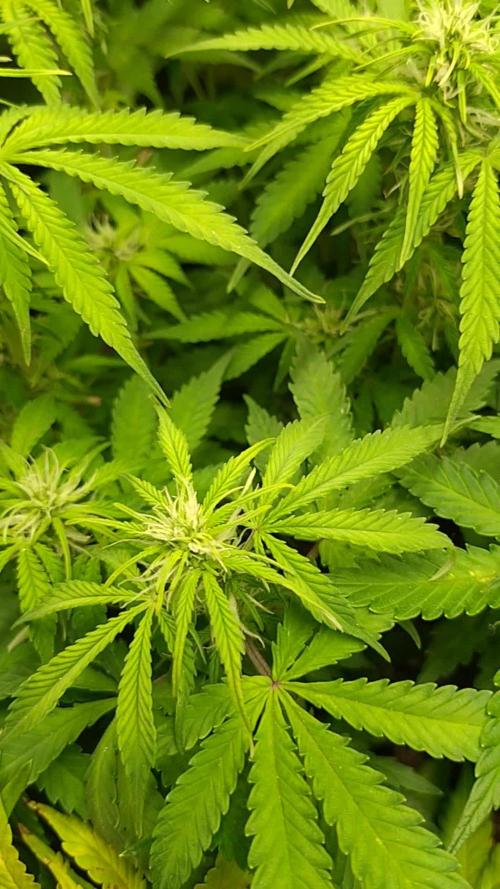
13/07/2020 - growth looking good. Highered lights to try to get plant to stretch
14/07/2020 - plants green and seems to be responding well to nutrients.
15/07/2020 - all looking good





Likes
3
Share


@MicroHidroGrow
Follow
Día 26. Estamos en la 4ta semana. Por ahora mantengo la solución y la planta sigue creciendo pero ya está casi para cortar los esquejes. La semana que viene seguro estoy cortando, y ya tengo que preaparar todo para pasar al otro modulo del infoor.
Decidi dejar de aplicar HST y apliqué una recnica con colgantes que bajan las ramas y las mantienen perpendiculares al piso. De esta forma las ramas laterales empiezan a subir. Está técnica me ha dado muy buenos resultados anteriormente.
El crecimiento ha sido acelerado y las ramas estan bastante gruesas.
Mañana voy a cambiar la solución. Vengo realmente contento con los resultados. Este experimento me va a permitir saber cuanto puedo llegar a sacar de este espacio y ver si me permite armar un ciclo para poder llegar a la próxima cosecha con remanente para poder ir guardando variedades diferentes. De paso ya tengo una referencia de cuantas semanas toma hasta poder cortar esquejes, y así saber en que momento poner la próxima semilla.
Puse unas semillas bastardas que tenía, y las pienso mandar a la terraza a florecer directamente en el invierno. Otra experiencia que si bien no ha dado grandes resultados, ha sumado al stock. La semana pasada no llegué a subir mucho. Pero mañana hago un update de cómo se han movido las ramas bajas. En el último video se muestran bien las ramas que pretendo convertir en esquejes. Seguro saque varios, así que habrá para regalar si logramos que enraizen varios.
De por cierto las manchas blancad que se ven, es tierra de distomeas que ha quedado desde la aplicación en 2da semana.
Día 28. Termina la 4ta semana de crecimiento con un muy buen ritmo. Hoy cambié la solución y mantuve la formulación anterior (1g/L de feeding grow y 0,5g/L de green jungle bioestimulante de crecimiento). La planta está fuerte y ramificada. Sostengo que los esquejes se van a cortar un poco antes de lo previsto. Calculando que son 5 semanas de crecimiento y 1 semana de enraizamiento de esquejes, voy a tomar 6 semanas para preparar la próxima madre. Así que siendo esta variedad de unas 10/11 semanas de flora, voy a poner a crecer la nueva madre en la 4ta semana de floración. La planta tiene distancia internodal corta/media por lo que observo, así que es un detalle a tener en cuenta. Ya me empieza a dar la ansiedad de ver que todo va saliendo y quiero ya poder pasar a floración. Va a ser jna nueva experiencia hacer una planta desde semilla en hidroponía, ya que siempre hacía sólo esquejes y la madre la pasaba a tierra a florar en otro lado, debido a que por las raíces no podía sacarla del sistema que tengo ahora. Pero resolví eso y voy a ver por primera vez la potencia de la hidroponia en una planta desde semilla. Le hice corte apical a las dos ramas más largas esperando ver una mayor ramificación, ya que tengo un espacio de 1,2m x 0,55m por llenar y administrar. Espero que todo siga en marcha. Nos vemos en la 5ta semana desde mañana.
Likes
2
Share


@Dsant
Follow
Explosive growth this week, specially R. Cheese #1 and N. Lights #1.
But both #2’s are also growing strongly and looking great.
Mixed a 15L solution at full strength, will be looking for any deficiencies in the next few days.


Likes
10
Share


@CANNASIM
Follow
A lot of rain and wind, continuously. Temps have dropped as well.
I’m reading another week or two to chop this plants.
Sativa dominant hybrids did the best, the Fastberry and the banana purple punch did not really develop as the other two.
In specifics the cbd crack developed sizable buds, and the blue dream as well, the flowers are not as developed tight and dense as in the indoor grow. A bit of fox-tailing nothing too expressive.
Minimal work, as per the setup chosen, an no extra nutes this week.

Likes
15
Share


@Dico29
Follow
week 6, i removed all the Internodes on the 5.5(I will mark the photos which is which) and lst on the 3 gallon pot(now four main colas).
Temperature is the current temp outside, I do it by day just cause.
There was a big storm and my plants loved it surprisingly, so tomorrow I’m going to drench the 3 gallon,which is dry again, in water to see if any more surge in growth happens.
3 gallon shows heavy prefñower I guess with pistils and the 5 gallon is alright

Likes
459
Share


@Ju_Bps
Follow
Hello my friends 👨🌾👩🌾,
This week was good,
The #1 and #2 grow very well, I've topped them.
The #3 continues to grow, but I don't know yet if I'll keep her, because too in late for the scrog, we'll see in several weeks, I've saved 3 nodes on the #1 and #2 in case...
💦 I give water each 2 or 3 days
250/300 ml/plant
Water + Rhyzo
Water + Cannazym + Rhyzo
Water + Rhyzo
PH@6
Lamp is 100%
Thanks community for follow, likes, comments, always a pleasure 👩🌾👨🌾❤️🌲
Mars Hydro - TS 1000
https://www.mars-hydro.com/ts-1000-led-grow-light
Mars Hydro - FC3000
https://www.mars-hydro.com/fc-3000-samsung-lm301b-led-grow-light
Mars Hydro - SP3000
https://www.mars-hydro.com/sp-3000-samsung-lm301b-greenhouse-led-grow-light
The High Chameleon - Vannila T
https://www.thehighchameleon.com/shop/vanilla-t-5

Likes
2
Share


@ao_grows1978
Follow
Week 4 in the books. She started throwing pistils this week. Cruising along and handling the training like a champ. She's drinking about a cup of water daily and her roots are thriving in the runoff caught in the 2nd cup, which gets dumped before each new watering. Strong structure and starting to get a little smell. She smelled like celery leaves up to this point. I've raised her closer to the light to increase light intensity.
Likes
107
Share


@XII_XII_MrGreen
Follow
I'm gonna jump right in..👨🌾
The high stress technique I have used a couple days ago called super cropping, I (tried more or less) to keep the canopy under control and more even. This also allow lower bud sites to rise to the top and slow down the 'stretching'.
🌲🌲🌲🌲🌞🌞🌞🌞
The trade in doing it at this stage, is that the plant is also focusing more on healing the stems instead of total focus on the buds. But I'm probably early enough in the flower stage they will make it up by having more strong stems in the end. That's because the points they are broken now are gonna heal back more strong.💪💪💪
I've added some nutrients to help them heal.
Aptus is working great with my organic soil👍😎💚 🌊💦
🌞🌞🌞🌞🌞🌞🌞🌞🌞
As you maybe have seen I've added some extra lights. This are Mars Hydro's new Adlite's.
Here is some info about them in my own words.👨🌾
-IR 15,
is a infrared light that is promoting extra photosynthesis.
Basically long wave length of lights that will penetrate leaves and hit the stems, so the idea is stems will be more strong and be able to carry bigger buds.
-UV 30,
is a ultraviolet light that will try to mimic the radiation that comes of the sun.
A little explanation about what this does to the plant in nature is that the plant will make it's own sunblock oil in the form of trichomes. So by adding this light the idea is that the plant is gonna work more to block this 'radiation'.
-Deep Red 30,
is like the title maybe already explained a red light booster.
In nature the spectrum of the sun changes with the season, so it's easy to explain the sun will get more intense and contains more red in the summer. The wavelength of red is also pretty long like the 'infrared' these will sometimes penetrate leaves and hit stems and lower buds.
The idea is more photosynthesis.

Likes
2
Share


Likes
4
Share

@Drtomb
Follow
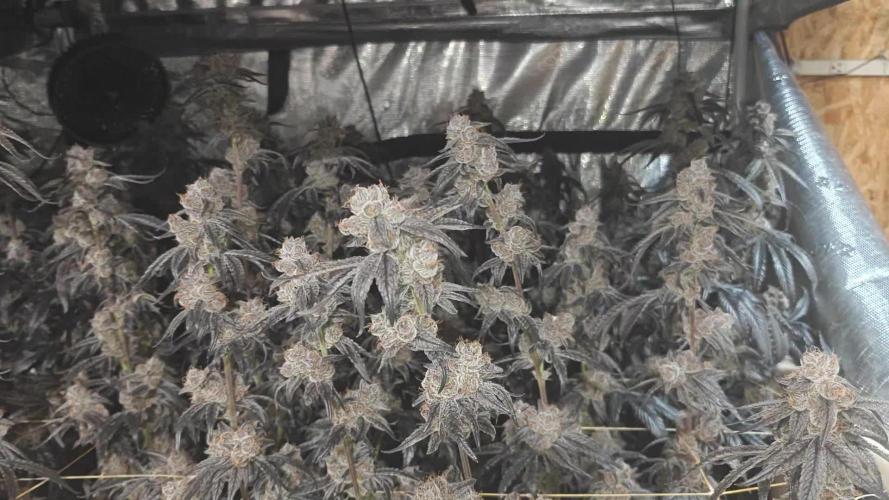
Pictures are the day before harvesting. They were flushed for 2 weeks. Plants are dark purple in color and a very fruity unique smell.
Ill harvest and have numbers shortly.
Likes
45
Share


@Ultraviolet
Follow
2nd net is up. Early bud formations are promising. holding up to the extremes pretty well, some leaves taking minor damage, but overall, she is holding up, gave her 1 night at 50F see how she would react, stressful. Not advised as it messes with her metabolism, but I want to see if it triggers any anthocyanin response. Love to see her purp up but no signs yet.
My homework.
Rubisco regeneration is intrinsically linked to nitrogen supply because Rubisco is a major sink for nitrogen in plants, typically accounting for 15% to over 25% of total leaf nitrogen. The regeneration phase itself consumes nitrogen through the synthesis of the Rubisco enzyme and associated proteins (like Rubisco activase), and overall nitrogen status heavily influences the efficiency of RuBP regeneration.Structural Component: Nitrogen is an essential building block for all proteins, and the sheer abundance of the Rubisco protein makes it the single largest storage of nitrogen in the leaf.
Synthesis and Activity: Adequate nitrogen supply is crucial for the synthesis and maintenance of sufficient Rubisco enzyme and Rubisco activase (Rca), the regulatory protein responsible for maintaining Rubisco's active state. Nitrogen deficiency leads to a decrease in the content and activity of both Rubisco and Rca, which in turn limits the maximum carboxylation rate, Vmax, and the rate of RuBP regeneration Jmax, thus reducing overall photosynthetic capacity.
Nitrogen Storage and Remobilization: Rubisco can act as a temporary nitrogen storage protein, which is degraded to remobilize nitrogen to other growing parts of the plant, especially under conditions of nitrogen deficiency or senescence.
Nitrogen Use Efficiency (NUE): The allocation of nitrogen to Rubisco is a key determinant of a plant's photosynthetic nitrogen use efficiency (PNUE). In high-nitrogen conditions, plants may accumulate a surplus of Rubisco, which may not be fully activated, leading to a lower PNUE. Optimizing the amount and activity of Rubisco relative to nitrogen availability is a target for improving crop NUE.
Photorespiration and Nitrogen Metabolism: Nitrogen metabolism is also linked to the photorespiration pathway (which competes with carboxylation at the Rubisco active site), particularly in the reassimilation of ammonia released during the process.
To increase RuBisCO regeneration, which refers to the process of forming the CO2 acceptor molecule Ribulose-1,5-bisphosphate (RuBP) during photosynthesis, the primary methods involve optimizing the levels and activity of Rubisco activase (Rca) and enhancing the performance of other Calvin-Benson-Bassham (CBB) cycle enzymes.
Biochemical and Environmental Approaches:
Optimize Rubisco Activase (Rca) activity: Rca is a crucial chaperone protein that removes inhibitory sugar phosphates, such as CA1P (2-carboxy-D-arabinitol 1-phosphate), from the Rubisco active site, thus maintaining its catalytic competence.
•Ensure optimal light conditions: Rca is light-activated via the chloroplast's redox status. Adequate light intensity ensures Rca can effectively maintain Rubisco in its active, carbamylated state.
•Maintain optimal temperature: Rca is highly temperature-sensitive and can become unstable at moderately high temperatures (e.g., above 35°C/95F° in many C3 plants), which decreases its ability to activate Rubisco. Maintaining temperatures within the optimal range for a specific plant species is important.
•Optimize Mg2+ concentration: Mg2+ is a key cofactor for both Rubisco carbamylation and Rca activity. In the light, Mg2+ concentration in the chloroplast stroma increases, promoting activation.
•Manage ATP/ADP ratio: Rca activity depends on ATP hydrolysis and is inhibited by ADP. Conditions that maintain a high ATP/ADP ratio in the chloroplast stroma favor Rca activity.
Enhance Calvin-Benson-Bassham (CBB) cycle enzyme activity: The overall rate of RuBP regeneration can be limited by other enzymes in the cycle.
•Increase SBPase activity: Sedoheptulose-1,7-bisphosphatase (SBPase) is a key regulatory enzyme in the regeneration pathway, and increasing its activity can enhance RuBP regeneration and overall photosynthesis.
•Optimize other enzymes: Overexpression of other CBB cycle enzymes such as fructose-1,6-bisphosphate aldolase (FBA) and triose phosphate isomerase (TPI) can also help to balance the metabolic flux and improve RuBP regeneration capacity.
Magnesium ions, Mg2+, are specifically required for Rubisco activation because the cation plays a critical structural and chemical role in forming the active site: A specific lysine residue in the active site must be carbamylated by a CO2 molecule to activate the enzyme. The resulting negatively charged carbamyl group then facilitates the binding of the positively charged Mg2+ion. While other divalent metal ions like Mn2+ can bind to Rubisco, they alter the enzyme's substrate specificity and lead to dramatically lower activity or a higher rate of the non-productive oxygenation reaction compared to Mg2+, making them biologically unfavorable in the context of efficient carbon fixation. The concentration of Mg2+ in the chloroplast stroma naturally increases in the light due to ion potential balancing during ATP synthesis, providing a physiological mechanism to ensure the enzyme is activated when photosynthesis is possible. At the center of the porphyrin ring, nestled within its nitrogen atoms, is a Magnesium ion (Mg2+). This magnesium ion is crucial for the function of chlorophyll, and without it, the pigment cannot effectively capture and transfer light energy.
Mg acts as a cofactor: Mg2+ binds to Rubisco after an activator CO2 molecule, forming a catalytically competent complex (Enzyme-CO2-Mg2+). High light + CO2) increases demand: Under high light (60 DLI is a very high intensity, potentially saturating) and high CO2, the plant's capacity for photosynthesis is high, and thus the demand for activated Rubisco and the necessary Mg2+ cofactor increases. Mg deficiency becomes limiting: If Mg2+ is deficient under these conditions, the higher levels of Rubisco and Rubisco activase produced cannot be fully activated, leading to lower photosynthetic rates and potential photo-oxidative damage.
Optimal range: Studies show that adequate Mg2+ application can enhance Rubisco activation and stabilize net photosynthetic rates under stress conditions, but the required concentration is specific to the experimental setup.
Monitoring is key: The most effective approach in a controlled environment is to monitor the plant's physiological responses e.g., leaf Mg2+ concentration, photosynthetic rate, Rubisco activation state, and adjust the nutrient solution/fertilizer to maintain adequate levels, rather than supplementing a fixed "extra" amount.
In practice, this means ensuring that Mg2+ is not a limiting factor in the plant's standard nutrient solution when pushing the limits with high light and CO2.
Applying Mg2+ through foliar spray is beneficial to Rubisco regeneration, particularly in alleviating the negative effects of magnesium (Mg) deficiency and high-temperature stress (HTS). While Mg can be leached from soil, within the plant it is considered a mobile nutrient, particularly in the phloem. Foliar-applied Mg is quickly absorbed by the leaves and can be translocate to other plant parts, including new growth and sink organs.
Foliar application of: NATURES VERY OWN MgSO4 @ 15.0g L-1 in a spray bottle.
Foliar sprays are often recommended as a rapid rescue measure for existing deficiencies or as a supplement during critical growth stages, when demand for Mg is high. Application in the early morning or late evening can improve absorption and prevent leaf burn.
The starting point [of creativity] is curiosity: pondering why the default exists in the first place. We’re driven to question defaults when we experience vuja de, the opposite of déjà vu. Déjà vu occurs when we encounter something new, but it feels as if we’ve seen it before. Vuja de is the reverse—we face something familiar, but we see it with a fresh perspective that enables us to gain new insights into old problems. Come walk in the enchanted forest.
Likes
4
Share


@Dankgrowz786
Follow
Fire 🔥 she smoked nice. Smooth and got a sexy taste. Overall a easy grown and will try again

Likes
17
Share

@CCSAUTOVGROW
Follow
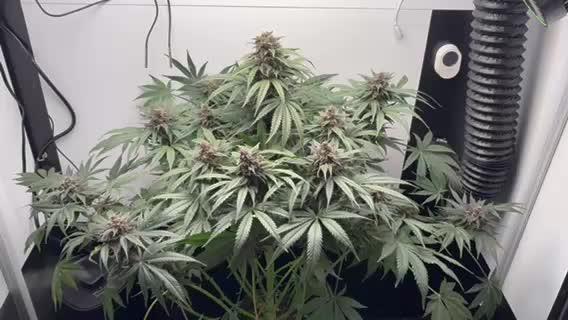
Purple Pheno!!!!!!!!!!!!!!!!!!!!!
Ripening nicely. She is super smelly. Smells like fruity gape. Have 2 carbon filters going and it doesn't even touch the smell. Noticed a little burn on the tips of the leaves so backed off a little on the nutes. Coasting toward the finish line. Maybe three weeks?😁
