


Likes
Comments
Share


@HanfConnoisseur
Follow
Week 4: Late Flowering Stage
Welcome to the eighth weekly update of our cannabis cultivation journey in Germany! As we enter the fourth week of flowering, our strains—Pulp Friction, Cookies Haze, Eleven Roses, Poddy Mouth, Critical Lemon Kush, and OG Kush—are approaching their final stages of development with impressive bud growth and resin production.
Key Developments:
1. Bud Maturation:
- The buds have continued to swell and mature, becoming dense and resinous.
- Trichomes are now fully developed, with milky-white heads and some turning amber, indicating the approaching harvest window.
2. Environmental Management:
- Maintained stable environmental conditions with temperatures between 20-26 degrees Celsius and humidity levels around 40-50%.
- Continued to ensure adequate ventilation to prevent mold and maintain airflow around the plants.
3. Nutrient and Watering Management:
- Adjusted nutrient levels to support late-stage flowering and maximize resin production.
- Monitored soil moisture carefully, maintaining optimal hydration levels for the plants’ roots.
4. Final Care and Maintenance:
- Continued to support the plants’ structure with stakes and ties to prevent branches from bending under the weight of mature buds.
- Removed any remaining yellowing or dead leaves to promote airflow and redirect energy towards bud development.
Growing Medium and Setup:
- The plants have thrived in a blend of living soil, coco coir, perlite, and clay pebbles, enriched with mycorrhizal fungi cultures for enhanced nutrient absorption.
Next Steps:
- Monitor trichome development closely to determine the ideal harvest time based on desired effects (clear, cloudy, or amber trichomes).
- Prepare for harvest by gathering necessary tools and supplies, such as trimming scissors, drying racks, and storage containers.
- Stay vigilant for any signs of pests or diseases as the plants near maturity.
Stay tuned for next week’s final update, where we’ll discuss harvest preparations and the culmination of our cannabis cultivation journey. Feel free to ask any questions or share your experiences in the comments below!




Likes
7
Share


@Growstopher
Follow
5.8.25.
1st week of flower just started! I had some issues during 3rd week of veg. I was doing the tie down method but wasn’t going so good seemed to be stressing plant out to much. I stopped tying down took all ties off and now is putting on nice healthy growth! Full steam ahead!
Thanks for checking out grow! Have great week! !

Likes
25
Share


@Jessemon1106
Follow
She is a great strain thus far. My tent has been getting a bit hotter in the summer. Just a bit of issue though. Can't wait to try this one. Such a sweet candy smell.

Likes
11
Share


@merchandise91
Follow
Just on day 22 now the video taken this morning had few issues very strong through week one, then week 2 I believe nitrogen toxicity as iv done lots and lots of research.... started watering twice in between each feed.. showing pistils now.. plants were tied down day 14.. I am happy with progress overall any tips welcome
Pic of individual plant seems to be behind and leaf curling going to give water today and hopefully that will sort it out
Day 23 - decided to do some defoliation as the growth since yesterday is very noticeable and starting to see signs of budlets at apex.. going to feed them tomorrow 8th strength grow, 8th strength bloom then by day 30 ish just quarter strength bloom is the plan then continue to up dose until half strength bloom at which point I’ll also add some boost.. any pointers appreciated 👌
Likes
283
Share


@love_2_grow
Follow
D53 - It's been a few days since my last entry, but I had the opportunity to spend a long weekend in Amsterdam, and who can say no to that?
It's a mission to hook up the automatic drip irrigation for only a few days of travel, so I watered the girls thoroughly before leaving.
Sure, they were thirsty when I came back but weren't drooping.
The trichomes still show a bunch of clear, so chop day is still a bit off.
The girls STINK! Or rather, they smell amazing but smell A LOT. It's that bad that I'm replacing the old carbon filter tomorrow. I was initially planning on replacing the filter after this grow, but my girlfriend starts to grumble a bit, so I better get to it...
D56 - We're at the end of the eighth week of flower, and it is all a waiting game. I still see many clear trichomes, so that it will be another week or two before the chop.
I'm a bit concerned, though, as we have had a lot of rain lately, and the general humidity is relatively high. This increases the humidity in the tent as well, and it is currently in the low 60s even though I have a small dehumidifier running. That is high this late in flower, and I'm worried about botrytis.


Likes
Comments
Share

@destroytek
Follow
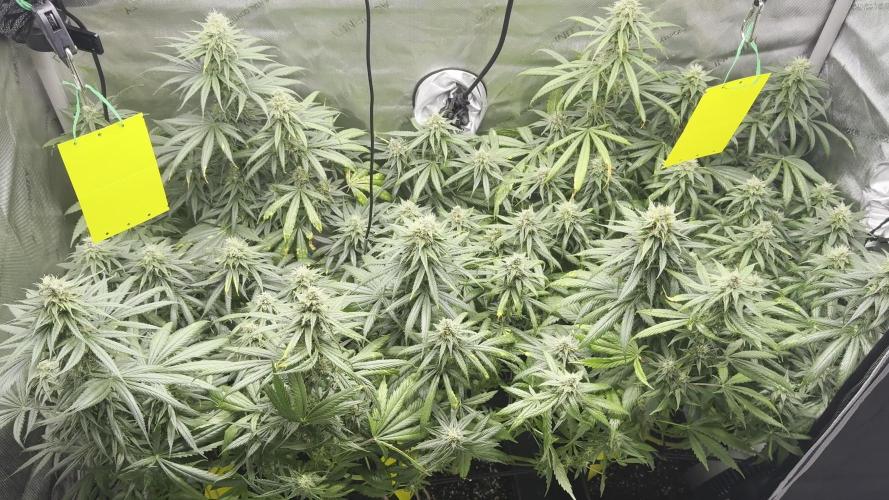
Flowering Week 6 – Fading Leaves, Persistent Flies
The sixth week of flowering brought a mix of progress and persistent problems.
The whitefly issue unfortunately hasn’t gone away. I replaced both yellow sticky traps at the end of the week, and within minutes, two new whiteflies were already spotted on the fresh left trap. The old one had four additional flies on the back. This pest pressure remains a concern, but I’ve decided to hold off on further neem oil sprays for now, given how far along we are in flowering. I’ll keep monitoring closely.
Nutrient-wise, I stayed cautious this week due to ongoing signs of overfeeding. Leaf tips are still showing yellowing and some burn, especially on the lower leaves. Many leaves have pronounced yellow spots and curled tips — a clear sign of excess nutrients earlier on. To reduce stress, I watered with plain pH-adjusted water (5.5–6.0). Total watering volume was approximately 29 liters
This week I also did a second round of lollipopping, focusing on removing all small popcorn buds and lower growth under the net that wouldn’t develop well.
Despite the nutrient stress and the ongoing whitefly presence, the plants are still developing well. Buds are getting chunkier, trichome production is visibly increasing, and the overall structure is solid. Still, I’ll be keeping a close eye on both leaf health and pest activity in the coming days.
⸻
TL;DR – Week 6:
• New whiteflies still showing up – 7 total seen this week. Both sticky traps replaced.
• Additional lollipopping done: removed popcorn buds and shaded growth under SCROG.
• Leaf symptoms (tip burn, spotting) persist – watered with plain pH water, once with half HESI dose.
• Watered 3x this week: 9.5 L (pH only)
• Light stayed at intensity level 7

Likes
7
Share


@A1420
Follow
Really happy with this plant so far, surprised how big she is and she is still stretching away nicely too.
Wasnt really sure on my timings here with training as first time scrogging an autoflower and wasn't entirely sure it would even work but pleasantly surprised so far.

Likes
5
Share


@Bluemels
Follow
Tag 35: Den Pflanzen geht es prächtig, wir hatten viel Regen und es ist nicht mehr so warm. Beide Pflanzen haben das LST ung scroggen gut überstanden. Teilweise ist mir dabei eine Pflanze gebrochen und sie ist trotzdem normal weitergewachsen.

Likes
5
Share


@AestheticGenetix
Follow
5/27 this may be the last week?
5/31 the lowest branch has a thick lollipop nug on it. This plants starting to explode
Likes
1
Share


@Algar
Follow
Wanted to keep her growing until the end of the month but, mother nature had other plans. Woke up this morning and the buds where almost touching the ground. Still have 1/2 the plant left, will cut fown later today if more rain. Don’t have room to cure all at one time. Normally I cure outside, for now they’re in my bathroom and dressing room.😬Don’t know the wet weight for now since only cut 1/2 of the plant, but probably a good 4 or more kilos!😳
Finally, the sun has returned. Not hot though, but nice and sunny. Moved curing to outside for now. Last night we stayed high just from the aroma in the house. More to come when she dries.😍 Last plant totalled 2,005grams. 3 plant total 3,340 grams 😎
Likes
37
Share


@OrganicPower
Follow
Temps and humidity are getting up there and harder to control. Equipment is working harder to keep cool. Heatwave forecasted for next week:( Got old lights switched out for new Mars TS series:) Ladies might need to be watered everyday soon as they are taking a lot more every other day. Don’t want them to dry out to much. Added some mulch to help with the top layer from drying right out between waterings. Want to keep the top alive and not die off as the sides of the pot also dry up and really only the centre stays healthy between waterings. That’s why I have now decided in future grows that I’ll being going with large pots, like 30-45 gallon and fewer plants, maybe 1-2 and grow longer for bigger roots!

Likes
7
Share


@Hightable420
Follow
This Pheno produces lovely phat calyx’s. Introduced bloombastic so watch them fatten up soon!
Likes
10
Share


@little_Boncannasai
Follow
🌱 Dulræntgosas kleines großes Reiseabenteuer 🌱
Hallo ihr feurigen Abenteurer.
Vielleicht hat der ein oder andere gedacht, "Dass wird sie niemals schaffen!" Nun, was soll ich sagen, mir geht es den Umständen entsprechend eigentlich ganz gut. 😁
Ja es ist noch eine Herausforderung und es strengt auch sehr an. Aber meine Wasserspenderin kümmert sich rührend um mich.
Der besondere Zaubertrank für meine Wurzeln und die andere Zutat fürs Wachsen, sind sooooo lecker.
Und das lässt sich wirklich sehen. Wie ein wilder Drache sprieße ich langsam in die Höhe. Meine Wurzeln bahnen sich sichtbar ihren Weg durch die Erde. Groß und stark, kann ich meinen Schatz bewachen.
Und seit heute, bin ich wild!
Ja, ihr habt richtig gelesen. Mit meinen zarten 17 Tagen, stehe ich nun endlich unter der grellen brennenden Scheibe am Himmel. Die Zeiten in meiner Drachenhöhle sind vorbei.
Ich bin frei, wild und mutig für das neue Abenteuer!
Monstergeschichten machen mir keine Angst. Im Gegenteil, sie fordern mich gerade zu heraus. Sollen sie kommen, die Fraßlinge aus den dunklen Schatten, in der Nacht. Denn meine Wasserspenderin wird sich was einfallen lassen!
Viel mehr gibt es zur Zeit noch nicht zu erzählen. Aber bleibt gespannt, das Abenteuer wird mit Sicherheit noch aufregend werden.
Liebe Grüße eure Dulræntgosa
"die Drachen-Lady"
Processing
Likes
3
Share


@Dico29
Follow
Day 128 it’s good smells sweet and every time I walk into my room it smells like gas
Even though quantity is lower then I expected, the trichomes are crazy

Likes
7
Share


@Rele99
Follow
This past week has been a struggle. I keep my plants on the balcony during the day and in the grow box during night and I inspect every single of their leaves everytime I move them in or out. A few days ago I noticed some kind of microscopic egg on one of her flowers and then some sort of parasites under her leaves.
Since then: panic. I searched for the name of the parasite (acarus) and bought some neem oil which I applied manually on every leaf (to prevent it from going on the flowers) and onto the ground.
Since then the parasites are almost gone. But now she has these "sad" leaves, with their points bent down and the margins as well.. I've read different explanations, but I think in my it might be the high temperature and the overwatering, together with the dammed fungus flies. I'll keep going with the neem oil and diminish the water.
Apart from all this, her flowers are still growing and producing so much resin🤤
Likes
235
Share


@SlowpokeFuegobud
Follow
Lebby was harvested! 🙏
After 5 days drying in a very dry and warm room, I had 65% to 62% in the jars. Ugh.
Not opening themfor too long now. 😬
I love smoking the weed already hehehe. 🖤 It's great! 🙏
I think I harvested just in time, there are no seeds to smell when the weed is burned. Without the nanas I would've waited one more week. But there are really nanas all over. 🍌 My fault, my pH pen broke and I didn't recognize how much pH minus I used.. Also I forgot to water once when I had the flu. 😰
But I got a much better pH and EC pen now. 🎉 🎊
This lady needs a bit of dedication during veg and during stretch, but then she pretty much dances on her own. 😍 💃
Thanks to all of you, to SSSC, to the Gods and to the predatory mites! 💚 I'm just the tool. 😉😇
Look at the seeds, they are super beautiful, little miracles. 😍 Each holding so much potential, ready to burst into existence. ✨
____________________________________________________
SPECIAL DIARY CONTENTS:
Week 1: Collecting pollen 🙈+ adding mycorrhizae 🍄
Week 4: Applying LST :👉
Week 7: Emergency supercropping 💪
Week 8: Pollination 🐝
Week 12: my emotional reaction to spidermites 🕷️ 😱
Week 13: my actual reaction to spidermites 🔫
_______________________________________
About Black Lebanon cannabis seeds:
Black Lebanon is a real treat for the true connoisseur of old school strains. This is the original Black Lebanon dating back from the 1980's, a true Hash plant. The producer has been busy with this strain since 2008 and selected the best mothers out of hundreds of plants. This strain is made from two original Black Lebanon landraces, a crossed between Lebanon #1 and Lebanon #5. Of course we took into account our desires towards quality, potency, taste, effect and of course a good yield. 😊 😇😍🧞♂️ 💫
We are very pleased and proud with the successful breeding results. Black Lebanon is one of the strongest landrace strains from Lebanon. She is naturally very resistant to high temperatures and dry climates thanks to the Lebanese landrace genetics.
The plants are very dark green with some leaves showing purple colourations. Some can look almost black. This makes these plants a real treat for the eye. The spectacular appearance is enhanced by the glittering white resinous trichomes which really stand out against the dark foliage of the plant.
The taste is a little fruiter than the original Black Lebanon, more flavoursome with less of an earthy taste. The production levels are medium to high, depending on the growers skills and lights used. We recommend a minimum of 600W per m2 of HPS, or perhaps around 400W/m2 of quality LED. In optimum conditions 500 gram per m2 is possible.
She grows between 80cm and 1.50 m tall and is also very suited to the SOG grow technique. SCROG is possible but takes longer because she isn't the stretchiest of strains. Black Lebanon is very sticky and resinous with THC levels reaching in between 16% and 22%
The indoor flower period is around 60-65 days. Outdoors she can be harvested around the middle of October. Indoors, she is very resistant to stress and high temperatures. The genetic background is very strong and the team were surprised and impressed with the resin levels, terpene profile and bud production. It's not very common to see a plant this vigorous with such growth speed.
So if you want to impress yourself and your stoner friends try it out now and enjoy the relaxing vibes and old school memories from the 1980's.
get it here:
https://supersativaseedclub.com/cannabis-seeds/black-lebanon.html#/26-seeds-3_feminized_seeds

Likes
14
Share


@BudXs
Follow
CRAZY NIGHT (continued)
So apparently frontdeskgirl is pissed that NX left and is saying shes coming back to the hotel (she knows which rooms he has booked) Im just trying to eat breakfast and watch naked waitresses serve the bacon, and now we gotta race back to the hotel whilst calming down frontdeskgirl. We settle up, leave generous tips, and cab back to home base. We arrive to find Jon and Stephanie 2 missing, Stephanie 1 still passed out. The other 2 werent missing long, we found them fucking in the nearby stairwell. Under a security camera, so that was nice. They didnt have a key to get back in the room once they had left to smoke a joint, so they just fucked in the hallway. Got em in the room, and it wasnt 5 minutes before a knock at the door : "security!" Never good at 6am in a hotel room
DIARY STUFF
Coming in strong this week, these fast finishing photos are on the final stretch. Various percentages of amber coning out daily, waiting till about 30% Nutes are eliminated, running straight ph'd water and the fall colors are coming about. Looking forward to a chop very soon, and the harvest reports to follow.


Likes
26
Share


@Rock_n_Roll_Randy
Follow
FINALLY STARTING ANOTHER GROW. MY BACK HAS BEEN FUCKED FOR MONTHS. CANT WAIT!!!! IM DOING 24 AUTOFLOWERS FOR THIS GROW AND IN 5 WEEKS IM STARTING ABOUT 20 FEMINISED PHOTOPERIODS IN MY 5X5 WITH A TSW2000 SO THEY CAN BE READY TO MOVE INTO THE 8X8 TENT AFTER THE AUTOFLOWERS ARE FINISHED. HOPE MY TIMING IS GOOD🤞🤞🤞🤞 LOL