


Likes
Comments
Share


@Hashy
Follow
This is the 2nd MSNL strain I have tried and the genetics are great. She got the longest time in the tent as she is a standard photoperiod and the rest of the grow where fast flowering photoperiods.
I trimmed her after 16 days of drying and got 35g of decent buds and 9g of ok buds.
Power used for whole grow in 114 days.
Lights=201.7Kw (201.7×0.25)(=£50.42)
Rad=212.23kw (212.23×0.25)(=£53.05)
201.7÷114=1.769kw per day light average.
Average 100w for veg
Average 150w for flower.
Light average for grow 125w.
Stats for the grow.
FFNA2410=42g
FFNA2411=45g
FFNA2412=43g
Acapulco Gold=44g
Expected hash from trim 28g
Total=174g
174÷125=1.39g/W


Processing
Likes
15
Share


@LongJohn420
Follow
3rd veg week was done 6.9 and steady healthy grow. Later germinated The New seems to get along just fine. Meaning no big size difference 👌 Germinated in water glass 36h and nice tail then straight to soil and about 50h after putting that seed to water glass it broke soil. Nice 👌
Little sings of nutriens defs but I won't worry about that. It'll fix when they get in their final homes after couple days. Next weeks they in cleaned tent and in bigger pots 🙏
That's all folks!! Stay high, till next week!
Happy growing!''
"Fuck the humbe laws, I rather have a violent win""
-Ras Kass -


Likes
2
Share


@High_Grade_Dadli
Follow
Transplant dem girl also things been a bit rocky with climate change n want not got another pheno of the mcm ....jus keep pushing fittest of the fittest

Likes
25
Share


@JonnyKush
Follow
wow! friends my tent 100cm x 100cm x 200cm is completely full! it is my first experience with photoperiod and I was not very prepared for it! They look great with a nice green color. I hope for the best and will continue to work hard! like and leave tips!


Likes
2
Share

@DerEkstaseHase
Follow
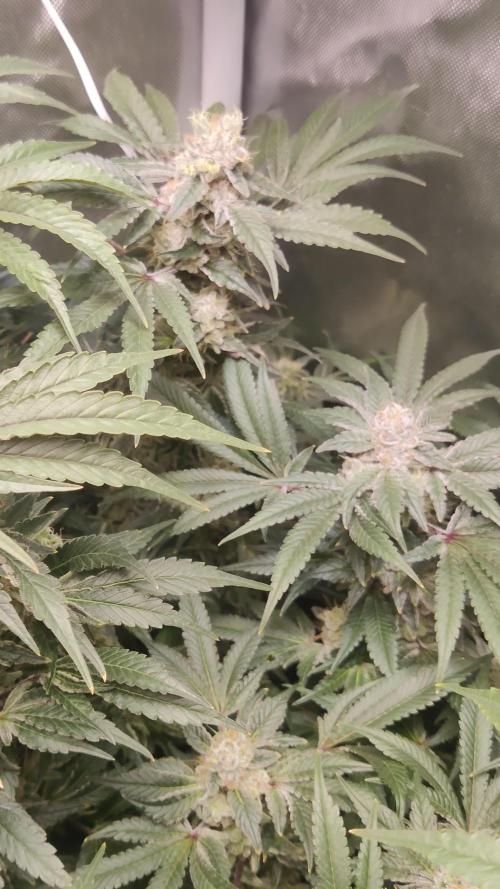
Foxtailing - temp. 26-27°C
Due to some watering issues last week we got some salt buildup.
Drain Ph has risen to 6.6 and Ec peaked at 2.9 mS/cm
This week I gave the plants more water and checked drain frequently. It went back down to 1.8 and Ph came down to 6.3.

Likes
77
Share


@BipolarHellas
Follow
Hello everyone, 🇬🇷
this is my diary for the GHSC Contest...package received on 21st April...I will be growing Banana Crumble in this diary...It's a cross between Banana Punch and OG Kush, from Green House Seeds...
I wish everyone Good Luck!!!!!Let's Do It.
WEEK 1:"COME OUT AND PLAY"
☠️Day 0...seeds are placed in a bowl with wet paper towels,on a heat mat...
...after 48 hours... they need more time...
☠️Day 000..after 56 hours 3 were ready to be planted,the other two seeds need more time...I planted them in coco coir.My earth is called "Coco Humus", it's a Greek product and it consists of coir, perlite and organic matter...I covered them with baggies for extra humidity...They are now under a 50 W Led light...Fingers crossed...
☠️Day 1...24/04/20...the babies have popped their first tiny leaves...their cotyledons are different than usual,they are a bit longer...the are under a 50W Led inside a cupboard..I have removed the baggies...they are still fragile and small
☠️Day 4...the babies are growing very slowly but they are OK
☠️Day 6...so they are growing very slowly...they have just popped their second pair of true leaves but they are still tiny...Our journey has begun...
See u all next week...

Likes
33
Share


@burnerac
Follow
Day 106: removed some yellowed leaves. Decided to wait one more day on water. Not adding any more nutrients. Assuming harvest in 14 days.
Day 107: Added one gallon of pH6.5 water with 2tablespoons of Herculean Harvest
Day 108: Removed yellow or brown leaves. Added no water. Trichomes clear. The urge to harvest is huge but will go 2 more weeks. Removed a box elder bug that sneaked into the tent.
Day 109: nothing new to report. Added no water. Tempted to add nutrients once more. After taking photos, removed several yellowing or browned leaves.
Day 110: did not add water. Removed some more leaves.
Day 111: did not add water. She is starting to look frosty. Read some mixed messages about the last two week flush and am feeling the urge to feed again.
Day 112: Replaced Viparspectra 600W with a Horticulture Lighting Group Quantum Board 288 V2 and Slate 2 heatsink. Very pleased although my temperature jumped to 81°F.

Likes
13
Share


@Aedaone
Follow
The temperatures, humidity, and watering volume(if measured) in grow conditions are all averaged for the week. The pH is soil pH. Any watering done by me is well water which is 7.6 pH and 50° F. Any listed nutrients are ml/gallon of soil.
Day 1 we had thunderstorms and rain in the morning followed by sunshine.
Day 2 we had rain in the morning followed by sunshine. That might we had severe thunderstorms and the threat of hail. We missed the hail but had heavy wind and rain.
Day 3 we had rain in the morning followed by rain and thunderstorms intermittently into the night.
Day 4 we had rain in the morning then mostly cloudy until the late afternoon.
Day 5 we had sunshine and clear skies until the afternoon. Around 4:00 pm a severe thunderstorm hit. It produced strong winds, heavy rain, and grape sized hail. Fortunately the hail lasted only a few minutes and only damages some leaves.
Day 7 we had rain and thunderstorms through the previous night and into the morning. We had sunshine, clear skies, and temperatures in the upper 70's. That was followed by severe thunderstorms, rain, and a touch of hail from 4p.m. to 6p.m.
The rain hammered this girl this week. It didn't seem to slow her down any. This week was a success
Likes
91
Share


@Fire_Farmer
Follow
Week 6 Day 7 Flower
They are all very frosty now, smell is pungent and hairs are turning brown but they still have a lot of potential for more weight yet and the trichs are still clear.
I reckon I'm going to run week 7 as normal then run week 8 with shogun dragon force/sumo active and flush with water week 9 and 10.
Anyone know if it's ok to run terpinator alongside dragon force and sumo active in last week before final water flush? The npk of terpinator is only 0-0-4 what's your thoughts @shogun your advice is always gold.
Weird and wonderful development in the garden, if you look at the pics you will notice that one of the girls has thrown out buds in the centre of it's leaves.
I've seen pictures of this before but it's a first in my garden and strange considering it's only one plant yet all are cuts from the same mother grown in the same system feeding from the same reservoir and I've grown from this mother before also but never seen this. Any knowledge regarding this would be appreciated.
That pretty much covers week 6, hope you all have a blessed remainder to the week.
Peace and love
Fire_farmer
🔥👨🌾


Likes
37
Share


@PapaNugs
Follow
Everything went well over vacation! The girls are doing okay overall. They needed bigger pots and it's starting to show overall. Another reason not to use autos cause I can't lollipop. But the watering process is going well.
The orange isn't doing too hot either in this tent. Small pots. Hopefully starts to look better. I'm considering using synthetic nutrients in this grow to start giving for power.
Dimmed to 80%
Here are the lights details:
Medic Grow Mini Sun-2 150W LED
Model: MN150-022
Spectrum mode: V1
Efficacy: 2.8 umol/J
Thanks for stopping by!
You can find the light on Grow Diaries:
https://growdiaries.com/grow-lights/medic-grow/mini-sun-2-150-watts
You can find the light on Medic Grow's website:
https://medicgrow.com/
Likes
7
Share


@Stifler
Follow
No big changes this week, some pistils have started to mature, I believe that starting today she will get fat! 😀
The smell started to get stronger this week too, the aroma resembles coffee with pine! 😋
Likes
14
Share


@inhale_exhale
Follow
This week the girls were covered in snow. I've never seen anything like it with my own eyes before, only in pictures :D
The lower large leaves have turned yellow, but this time don't panic :D experts say it's normal.
Likes
34
Share


@MarsHydroLED
Follow
The ladies got 2 more days then they’re getting the chop ✂️
Harvest time is coming~ So excited!! 😋


Likes
6
Share

@Chucky324
Follow
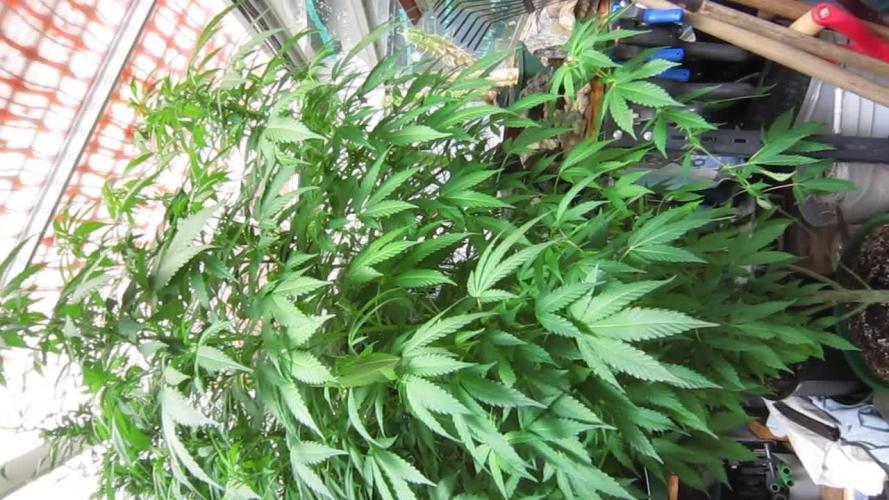
Hello. This the end of the 1st week and the start of the 2nd week of flowering.
Just a fast entry... I'm starting harvesting of the front 1/2 of this greenhouse tomorrow.
So, I'm getting ready for that. These plants have still got 6 or 7 weeks of flowering to go still.
These plant will go in the front of the greenhouse when I'm finished with the harvest in there.
Did a stock rub test of these plants and the smell reminded me of the good old days of buying land race pot.
It smelled like The Columbian sativa from the 1970's... mmm wonderful.
OK. Have Fun.
Chuck.

Likes
48
Share


@TheCannaProphet
Follow
~ WEDDING CHEESECAKE FAST FLOWER by FastBuds ~
Well fam, here we go again with another epic strain from FastBuds Fast Flowering stable. After having such tremendous success growing their Gorilla Cookies Fast Flower outdoors last year, I've decided to run another of their fast flowering strains outdoors this year... Wedding Cheesecake Fast Flower!
The best description of this awesome cultivar comes directly from my friends at FastBuds which is as follows:
"A delight for the mind and body: Wedding Cheesecake FF (Fast-Flowering) is a delicious strain that offers XXL yields in a 7-8 weeks flowering cycle. This terpene powerhouse produces loads and loads of mouth-watering vanilla-creamy-cookie-scented terps with hints of citrus and cinnamon. In addition to its delicious aromas, this variety grows very well in both indoor and outdoor setups, yielding up to 650 g/m2 without extra maintenance, making it the ideal strain for beginners as it allows you to maximize yields while minimizing work. This super-fast feminized photoperiod version offers upbeat and energetic yet deeply relaxing effects that are perfect for consumers looking for a heavily focused, motivating, and creative high. It’s the ideal strain for those needing that extra energy boost to start a busy day on the right foot.
Wedding Cheesecake FF boasts chunky, large-sized buds with a thick layer of silvery-white resin and bright orange hairs scattered all over: that just screams ‘quality’. The lime-green flowers sparkle with an array of hues ranging from dark to light green, to magenta and purple, and reek of a delicious aroma that’ll remind you of fresh store-bought cheesecake.
This is an XXL hybrid that grows extremely tall in height, reaching up to 3m with one huge main cola and multiple long side branches that can withstand enormous yields of up to 650 g/m2 with ease. Wedding Cheesecake FF is extremely resilient to the elements and can be grown in almost every climate as long as you’ve got the space and basics covered, making her an excellent choice for those looking for large-scale harvests with a quick turnaround time without much effort."
____________________________________________________________________________________________________________________________________________________________________________________________________________________________________________________________________________________________________________________________________________________________
The Setup:
This is going to be an outdoor grow, but I have started the Wedding Cheesecake FF indoors as our weather is still too cold to put her outside (nighttime temp's dipping regularly into the 30's℉).
The plan is simple... let her grow inside under a 19/5 light schedule until the nighttime temperatures stay above the mid 40's℉, at which point she'll be moved outside and transplanted into the soil which I have already setup and inoculated with beneficial microbes, and then let the fun begin!🤪💚
__________________________________________________________________________________________________________________________________________________________________________________________________________________________________________________________________________________________________________________________________________________________________
Weekly Updates:
4/19- Here we go into the 4th week from seed for the FastBuds Wedding Cheesecake Fast Flower and despite some less than ideal weather, she's doing remarkably well! It's been cool so I'm only watering every 2-3 days right now.
4/20- 🍃HAPPY 420 FAM!🍃
4/21- The Wedding Cheesecake continues to do well with good color and vigor considering the cooler weather we're having right now.
4/23- I gave her a good watering today and am getting ready to get some straw to spread over her soil mound to help keep the soil moist and reduce watering frequency.
4/25- There's another week on the books and the Wedding Cheesecake Fast Flower from FastBuds is starting to come into her own now. The next few weeks should see her starting to take off hopefully! 😎🤞
Thank you for checking out my diary, your positive comments and support make it all worthwhile! 💚Growers Love!💚😎🙏
Likes
18
Share


@Brownsbuds69
Follow
Week 8 and there definitely starting to smell a lot more now .buds on the plant at the back are getting bigger and starting to feel quite dense and the one in front is starting to pack them buds on now getting frosty 😁