


Likes
Comments
Share


@Roberts
Follow
Mandarin XL auto is starting to bulk. She is in need of some selective defoliation which I will do hopefully soon when there is more time to work with her. She is starting to produce some trichromes as well. Everything is going well. 🤞🏻for some tasty buds when done. Thank you Medic Grow, Ganja Farmer, and Gen1:11 nutrition. 🤜🏻🤛🏻🌱🌱🌱
Thank you grow diaries community for the 👇likes👇, follows, comments, and subscriptions on my YouTube channel👇. ❄️🌱🍻
Happy Growing 🌱🌱🌱
https://youtube.com/channel/UCAhN7yRzWLpcaRHhMIQ7X4g

Likes
16
Share


@MisterMaGoo
Follow
OK So had some non plant related as well as plant related issues this week.
Been hectic with personal life, and still finding my groove with the girls ..
I decided against any sort of training .... get it you can maximaxe and all but m all about letting them do their thing with some love and help, i feel like the hst and defoliation is just not for me at present time. If i get into commercial i definately see the advantages... Im growing for just myself , have zero friends and girlfriend doesnt really part take except the sometimes will hit a vape pen and shes done .. so all the fruits are for me and just do not see the need to mutalate my plants to get extra,, ill just grow more :D
Recap :
5 - Barneys Glue Gelato Autoflowers
2 - "Freebie" Caramel Cream Aut o <I believe Maine Clone Company > though did not have label.
All seeds came from AMAZING
NORTH ATLANTIC SEED COMPANY
.... ZERO issues ordering , shipping and popped 7 for 7 seeds even with some pretty disasterious goofs , see week 1
1. Struggled with Lighting - Definatly had the California Lightworks Solar Extreme TOO CLOSE .. now keeping a good 24 inches and will adjust soon with flowering
2. Struggled with PH
- My well water is great .. low PPM and 7.0 ph . BUT i use ph down it seems each day with the top off water to bring the girls down from 6.5 - 6.8 to a nice 5.9-6.0 Eariier not too bad as the girls were not drinking so much ... which leads me to next
3. THEY ARE DRINKING BOY ... Holy cow this week they became drinkers liike i did not expect. I run my lights 2 pm to 8 am and turn off until 2 pm each day .... I top off in the morning before i put them to sleep , the bigger girls ... 4 of the glue gelatos autos are drinking almost half gallon each per day atm . While my lil girls <caramel cream autos > are much shorter and i have one gelato glue auto on the smaller side . They do not drink nearly as much maybe a quart .
4. I goofed on the BLOOM, I did not expect bloom so early i was planning on this week to start them .... but nope showed signs of sulfur deficiency , caught it early and changed the feeding to bloom cycle and WOW they took the hell off ... Have TREMENDOUS growth in past week sinced changed cycle ... Again im following FAST BUDS auto feeding chart for expert for general hydro to the T and adding HYDROGUARD
5. I have one caramel cream auto with mag deficiency signs on some bpottom fan leaves but i believe i got that fixed when i did the water change, not sure why just her , unless i goofed on the bucket mix.
Which brings me to next statement ...
IM INVESTING IN A GDAM 13 GALLON x 8 bucket plus RES kit for next grow ...
Doing and maintaining 7 buckets is a royal pain in the ass . I honestly only expected 4 plants out of the 7 . AND expected fully i would kill something along the way
I am visually impaired and BRain Tumor Dude .. so i gots some issues sometimes . .. but if you check out the videos i post in a bit here you can see, WTF i am doing ok i feel like .
Great looking plants from my amateur opinion , always room for improvement as i am super critial of everything i do OCD/ADHD glorious combo
BUT YES a better setup is needed for ease of use .. I bought my complete setup at PA HYDROPONICS , meaning my BUCKETS with fittings and hydroton . 200 bucks could not find better price anywhere
he does a great fallponics custom build with 3 inch pvc that i have seen in action and tis a thing of beauty for us home growers. Plus i can add a small chiller to the mix to keep that temp a tad bit lower. IT about an 800 dollar upgrade BUT for the rest of my setup it belongs :
vivosun 4x9 tent
Ac Infinity T8 x 2 <one for vent one for blower , also have a great merv 13 filter box from ac infinity so as not to such in yuck from basement.
2 california solar extreme 550
So i figure adding an 8 bucket fallponics to fill the tent would look so much better tahn my 5 gallons and the constant checking each one and filling etc ....
Having the res would be nice I also see the cons of it as if you goof you goof on all not just one .... But i m fairly certain i will upgrade.
*****************
So right now it looks like nice buds are starting to form on all 7, the Glue Gleatos are much taller and full than the caramel creams ...
I am tracking water being added and at this rate will need another change over in a day or two if drinking 1/2 gal a day and about 3 gallons <12 liters> labout inch from bottom of net pot.
Rule of thumb being water change to replace nutes when you replace a volume equal to the total volume ... which is about every 6 days , last water change being 8/7
I will post some more when i inspect the ladies when i turn on the lights at 2 pm
First time grower in setu

Likes
53
Share


@Schnabeldino
Follow
end of week 5
Buds have developed well and are more compact and nicely swollen.
The smell becomes more and more intense. Sweet smell spicy
Honey Cream: sweet smeel
R. Gorilla: a bit spicy
I hope the buds are getting even thicker now
we see you next week
Update: I have a slight deficiency in 2 of the 4 plants, very strange since all plants get the same conditions and nutrients.
the gorilla on the bottom right shows no signs of nutrient deficiency.
any Idea why?
---------------------------------------------------------------------------------------------------
Controller AC Infinity Pro
- connector for the external light control, RJ-12
- 2 plugs with which I can control dehumidifier and humidifier on automatation.
- 2 fans run 24/7, 1 Oscillating from spider farmer
Light - 12/12 h | 2 x 200 Watt
PPFD - 900-1000 µmol
VPD - 1,3 - 1,6
week average
RH: 55,1 %
Temp: 22,9 °
VPD: 1,28 kPa

Likes
126
Share


@WhiteWidow
Follow
Last 2 weeks only plain water on blue medi kush.
Flushing other girls for a week now and this should be their final week of life but dinafems grape and og kush are still shooting white hairs or they are just turning them to orange very slow. I got the runoff ppm on all girls down to 200(my tap water), want the smoke to be as clean as possible.


Likes
10
Share

@carlitoshaze44
Follow
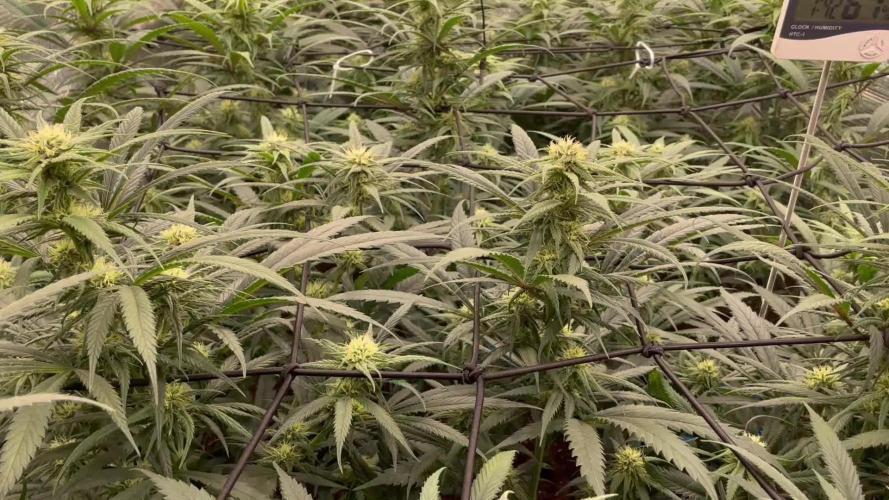
Otra semana más
Creo esta semana hoy día 27
Anunciando así el próximo día 28 inicio de esta quinta semana de floración del calendario de mis niñas,semana en la que comienzo subiendo la cantidad de comida y con ello de agua para mis niñas.
En los últimos riegos de la cuarta semana fui subiendo hasta alcanzar los 1700.
Las plantas mayoritariamente lo aceptaron,así que con ello subiré esta semana hasta alcanzar los 2000.
No defoliaré ninguna planta
Hoy ajuste la luminaria a una altura de 30cm con respecto a los 45 de la anterior semana.
Esta semana pegarán un buen apretón con la subida de PK,y la ayuda de los azúcares.
Seguimos con muchas lluvias y una humedad muy alta que dentro del armario se combate entre ventiladores extractor y desumificadores pasivos de sales de silicio.
Que me mantienen un 35% menos de la que tengo en el exterior llegando muchos días a los 45/50% de humedad.
Tengo que añadir que vivo a un kilómetro de la playa.
Día 28
Di un pequeño fumigado, de agua con ajo y jabón potásico en la entrada al cuarto de cultivo.
Como preventivo ante cualquier insecto que quiera acercarse atraído por el aroma.
Hoy e podido ver que el último riego de 1700EC,no causó ningúna sobre fertilización apreciable en el cultivo casi nula,viendo esto en el siguiente riego subiremos a 1900Ec.
Día 29
Primera impresión al abrir el armario es que había una humedad alta dentro del almario.
Un 72% que una vez encendí el pequeño desumificador de 8l de casa,a mejorado a 53%
Hoy compré la gama de completa de aptus.
Iré añadiendo alguno de estos componentes de la fase de floración,para ver qué tal se combinan con la gama de plagron.
Hoy le metí un riego de 55litros,una Ec de 1900
Sin carga de pk,desorbitada.
Este riego me centro en los azúcares junto con algunos aditivos como silicio,aminoácidos,azúcares,encinas,sulfatos y manteniendo el nitrógeno en pequeña parte el potasio y el fósforo,calcio y magnesio que nunca falte en cada riego!,las lámparas están bajas y a toda potencia.
Quiero en estos días conseguir mejorar con grandes empujones .
Saludos compañeros!
Día 30
Todo bien,todo correcto y me alegro!,buenas tardes,buenas noches.
El cultivo aceptó muy bien la subida de EC 1900,esta variedad come de buena manera!.
De esta manera seguiremos subiendo para ver,hasta donde llegan.
Obviamente no vamos a sobrecargarlas,pero vamos a ver hasta donde llegan.
El siguiente riego lo haré trabajando con pk,mineral y algunos aditivos más orgánicos-minerales.
Tengo que decir que el aporte del té frío de plátano junto a la melaza le habrán venido fantástico también a las lombrices!
Día 31
Todo perfecto dentro del cultivo ,veo que las 9 semanas de floración son fijas..
Un gran punto a favor,es que el clima empieza a ser más favorable a partir de este fin de semana..
Subirán más las temperaturas y las lluvias van a detenerse por unos días.
Espero contar con una humedad ambiental más baja para poder seguir tranquilo con el desarrollo de las flores.
Dia 1
Lo comentado en el día anterior,bajo la humedad ambiental,tenemos buenos parámetros!
Una temperatura con luz de 21 grados y una nocturna de 16.
Va aumentando mucho la resina!,eso me gusta!
Hoy le metimos una EC2100 en el riego.
Mañana veremos qué tal lo reciben las niñas.
Va aumentando de buena manera el engorde,no me puedo quejar!
A ver si llegamos al 1,7g/w que es el rendimiento que se está obteniendo con esta configuración en los cuartos de los compañeros! Sin Co2 obviamente.
Día 2
Ya veis,todo viento en popa!
Hoy hice una prueba en el cultivo con el riego ya que en el último riego cogió aire el sistema.
Aún sigue así,en el día de mañana lo purgaré.


Likes
10
Share

@Ganjin
Follow
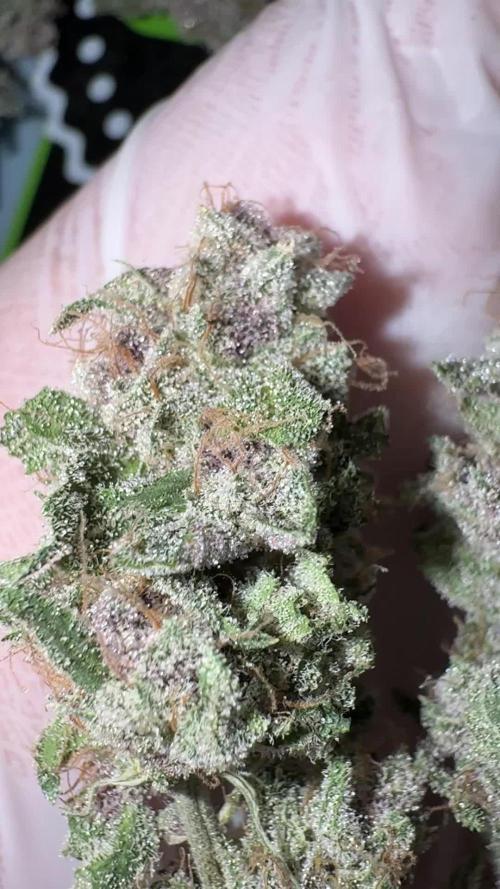
I tried her now several times. She get's better every week during cure but after roughly 1,5 months, she still tastes only slightly like a cookies strain.

Likes
1
Share

@Bones_1986
Follow
Day 50.
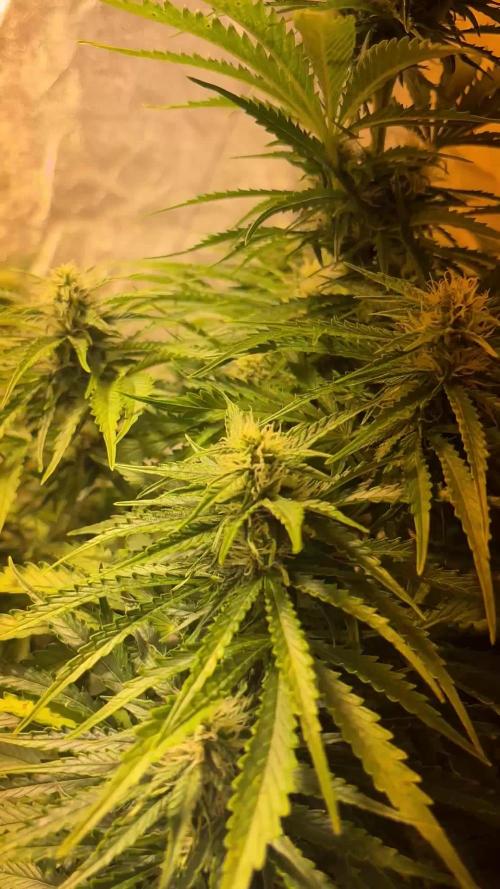
Very annoyed at myself as 2/3 plants needed a strong feed, but the other one didn’t but forgot and fed the strong feed to all 3. As a result the 1 what was already thriving has now foxtailed on the main cola. Such a shame, but lesson learned.
That plant will have just a water feed for the next week, and PH run off was also high at 6.8 also contributing to the foxtail I’m guessing so next few feeds will be PH at 6.0.
Another 15 - 20 days to go I’m guessing, I will now be swapping big bud out for overdrive, really make these swell to the finish line.
Likes
40
Share


@BudXs
Follow
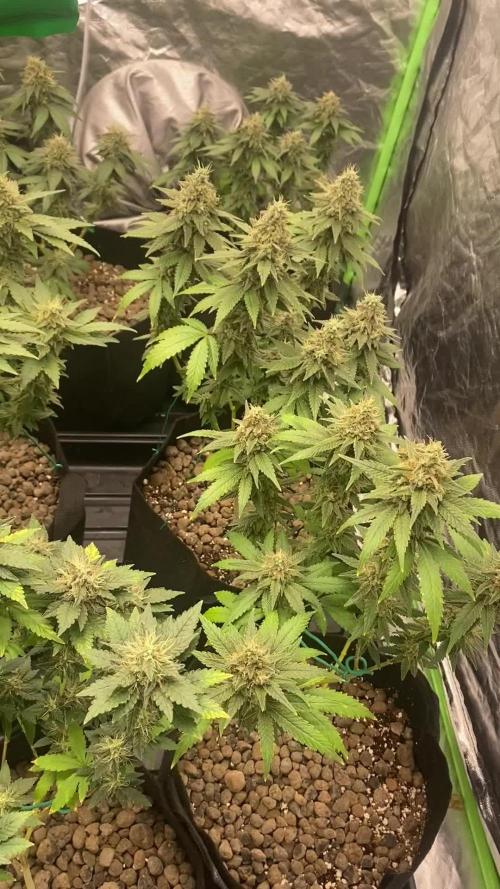
Incredible colas stacking up, and a really impressive harvest on the way. A bit of foxtailing, but thats my fault with an underpowered AC. Supplementing co2, and these are only for me, so whatevs. Live and learn, 2021 will se a much larger ac unit.



Processing
Likes
22
Share


@PrairieFrostGrow
Follow
*
***************** Week 1 of Growth From Seed, April 11 to 17, 2020 - Days 1 to 7 from germination **********************
*
Okay, we are off running now. Through germination and was delighted to experience 100% success rate👍
Two girls this run and now have a GSC and a GSC2 this run. GSC was chosen for the first to break the surface and while the second GSC to come up is now GSC2, she was actually the third to break the surface. Excited to run this strain from Fast Buds.......there are newer strains but sometimes a classic is good😃
Greater focus on VPD this run. Already pushing the humidity higher than I ever have with having controller set at 72% with temperature at 79 degrees. I have been reviewing the numbers and I have normally been close but it looks like I have to raise everything by about 10% and for a few weeks long😬😬😬😬😬😬 Trust the science and lets learn some more from this grow!!!
*****Daily Detail:
Apr 11, Day 1:
- VPD - 1.2
- 500ml first watering given with nutrients as listed. (minus Velokelp)
- pH water to 5.6
- Girls up and looking like they are ready to go.
Apr 12, Day 2:
- VPD - 1.0
- 500ml feeding with VeloKelp @ 2ml/L, Piranha & Voodoo @ 2ml/L. pH to 5.6
- lowered light intensity a bit more.
- Both girls are doing very well. Nice leaf colour and tips are turning up now!!
Apr 13, Day 3
- VPD - 1.2
- 500ml water with 0.5ml/L each of Piranha & Voodoo, Dual Fuel.
- 300ppm with 5.4pH.
Apr 14, Day 4
- VPD - 1.1
- 500ml water with Virtathrive and Piranha & Voodoo Juice @ 1ml/L, VeloKelp @ 2ml/L, and SensiCal @ 0.5ml/L.
- 210ppm with 5.5pH.
- the girls are very happy and colour looking good. Tips are pointed way up on GSC and GSC2 seems happy but may have a little more going on below the soil right now so a little slower looking.
Apr 15, Day 5
- VPD 1.0
- 250ml water with VeloKelp @ 1ml/L.
- 95ppm with 5.4pH
- GSC really looks happy and hope she is pushing out some serious roots below:)
- GSC2 is holding her own looks fine.
Apr 16, Day 6
- VPD 1.0
- 500ml water with Piranha & Voodoo @ 1ml/L, Vitathrive @ 0.5ml/L, Dual Fuel @ 0.5ml/L.
- 300ppm with 5.8pH
- GSC still looking pretty happy and continues to point tips up.
- GSC2 is standing up a little more and over looking like a nice.
- Moved all the girls today one spot in a clockwise rotation.
- Noticed more residual moisture on the bottom of the pots than anticipated.
Apr 17, Day 7
- VPD 1.1
- Turned on flower light on UnitFarm this afternoon and they are happier.
- Both ladies up and proud to be alive this afternoon.
- Dry out day today and no added water/feed, just misting.
- Let the medium dry out a bit and give a nice week 2 feed tomorrow.....they are ready for a little more nutrients now.
Likes
5
Share


@Stickybudz420
Follow
New addition to the family donated kindly by @dropseedsnotbombs, just managed to squeeze this girl in hopefully she takes a liking to her new habitat an 19hrs light schedule 😃🌲🙏
Likes
2
Share


@SamDo
Follow
Journal de culture – Semaine 4 de croissance (fin)
Je ne suis vraiment pas satisfait de la plante, que je trouve faiblarde et manquant de vitalité. Son développement est lent, et je suspecte que la température, qui descend peut-être trop bas la nuit, pourrait en être la cause. Cependant, même le pied-mère de cette variété n’a pas une croissance exceptionnelle, ce qui me fait penser que le phénotype de cette variété n’est peut-être pas très bon.
Pour ne pas perdre trop de temps, j’ai décidé de la passer en floraison aujourd’hui, avec un cycle de lumière 12-12. J’ai également changé la soupe et préparé 20 litres avec les nutriments nécessaires à la floraison. Sachant que cette variété a tendance à beaucoup stretcher, j’ai pratiqué du LST (Low Stress Training) pour recourber les sommités. Cependant, j’ai accidentellement cassé un apex, laissant seulement trois apex au lieu de quatre.
Bien que je ne sois pas satisfait de cette plante ni du pied-mère, je vais finaliser cette culture et passer à une autre variété ensuite.
🇺🇸Cultivation Journal – Week 4 of Vegetative Growth (End)
I’m really not satisfied with the plant; it seems weak and lacks vitality. Its development is quite slow, and I suspect the nighttime temperatures might be dropping too low. However, even the mother plant of this strain doesn’t show great growth, so I’m thinking the phenotype might not be very good.
To avoid wasting more time, I’ve decided to switch it to flowering today, setting the light cycle to 12-12. I also replaced the nutrient solution, preparing 20 liters with the ingredients required for flowering. Knowing this strain stretches a lot, I applied LST (Low Stress Training) to bend the tops. Unfortunately, I broke one of the four apexes, so now there are only three left.
Even though I’m not happy with this plant or the mother plant, I’ll finish this grow and move on to another strain afterward.

Likes
6
Share


@eldruida_lamota
Follow
Venga familia, cosecha de estas Thunder Banana de Seedstockers, que ganas que tenia ya de darles machetazo.
No veas que pinta que tienen estas plantas.
Las flores aparte se ven bien resinosas, prietas, aparte son aromáticas huelen bien fuerte.
En general es una genética con la que disfruté bastante cultivarla, la genética es perfecta para cultivos de floración corta con rangos entre los 20/25 grados en interior, es de dificultad media cultivarla y bien resistente, es excelente para cultivadores algo experimentados y con algo de conocimientos.
Hasta aquí es todo, espero que lo disfrutéis, buenos humos 💨💨.
Likes
39
Share


@HydroHerb420
Follow
Looking beautiful this week. Getting some lovely fades on the white widows. The blue sherbets are really packing weight on and smell banging. Trichs now really milking up. Will just keep diluting the res with plain water this week to drop the ec slowly down before the final 5 day flush. Will also drop the res temps to try and shock them into a few more trichs.


Likes
31
Share

@Susquihanna
Follow
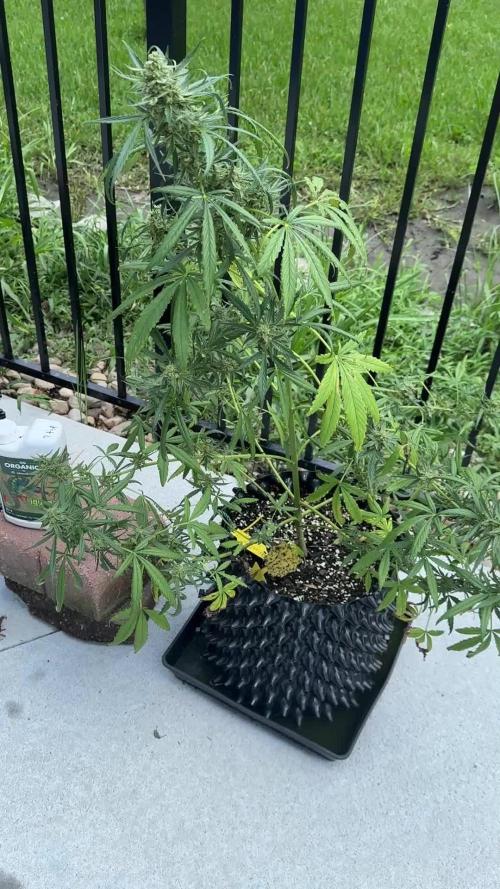
Whew, what a hot, humid and wet week. Although we had a major storm this week, Gorilla Cookies proved her strength to withstand:) This week I took the time to go to the Fast Buds website and read about the "plant appearance." FBA says Miss Gorilla Cookies will grow to a height of 150cm which is 59 inches. My Gorilla Cookies is 33 inches tall. So, I can boast about that, however, I can not boast about my Gorilla Cookies being "Stout and Bushy." I even looked on the FB website to see some pictures of other growers Gorilla Cookies and mine are tall and lean. BUT, my plant stems look very similar to the plant stems on FB website.
I did stop using Miracle Grow and started giving my plant Advanced Nutrients!! I am hoping this will be good for bud growth.
Fast Buds does boast Gorilla Cookies will be completed around 10 weeks and that I will " be amazed at the insane trichome production. Especially in the final weeks when she definitely packs on some weight and you see the buds getting white in resin and reeking of cookies and gas."
I am excited to see what the next two weeks will produce. Miss Gorilla Cookies has definitely proven to be resilient because we have certainly had some tough weather to deal with and I gave my Gorilla Cookies Miracle Grow nutrients which I would never do again.
Please leave me a comment and let's chat it up:)


Likes
19
Share


@nonick123
Follow
Día 69 (01/07) Riego con 1 Litro sólo H20 - ph 6.2
Día 70 (02/07) ¡ Cosecha Banana Purple Punch Auto ! 😁
💦Nutrients by Aptus Holland - www.aptus-holland.com
🌱Substrate PRO-MIX HP BACILLUS + MYCORRHIZAE - www.pthorticulture.com/en/products/pro-mix-hp-biostimulant-plus-mycorrhizae
Likes
14
Share


@SkunkyDog420
Follow
Hallo zusammen 🤙.
So das war es für sie wir sehen uns in 3 Wochen mit dem Erntebericht 🤙.
Sie erhalten 25 Prozent Rabatt in unserem Shop
Mindestbestellwert beträgt 75 Euro
https://greenbuzzliquids.com/en/shop/
Code: GD42025
Likes
1
Share

@GrowdadGage
Follow
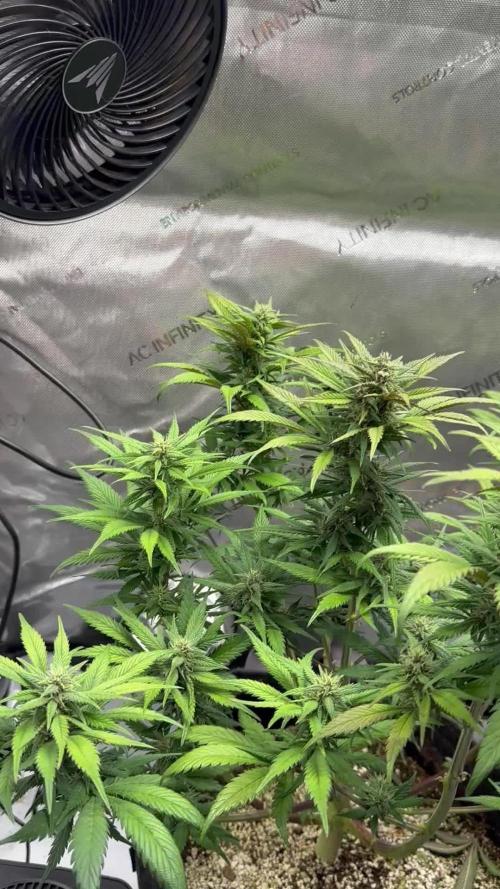
Well one is finishing strong and the other is coming back strong. Currently have one on its last week of nutrients and will be starting the flush this coming week!
The one that is a little behind still taking nutrients the base as well as bud candy and big buds. Next week the slow plant will switch from big bud nutrients to overdrive.
Very fun grow with lots of great lessons learned on this one. Almost finished now I’m getting excited for harvest and the next grow already 😂 anybody else get eager to crack the next seeds this deep into harvest?