The Grow Awards 2026 🏆
Likes
Comments
Share
@Strife957
Follow
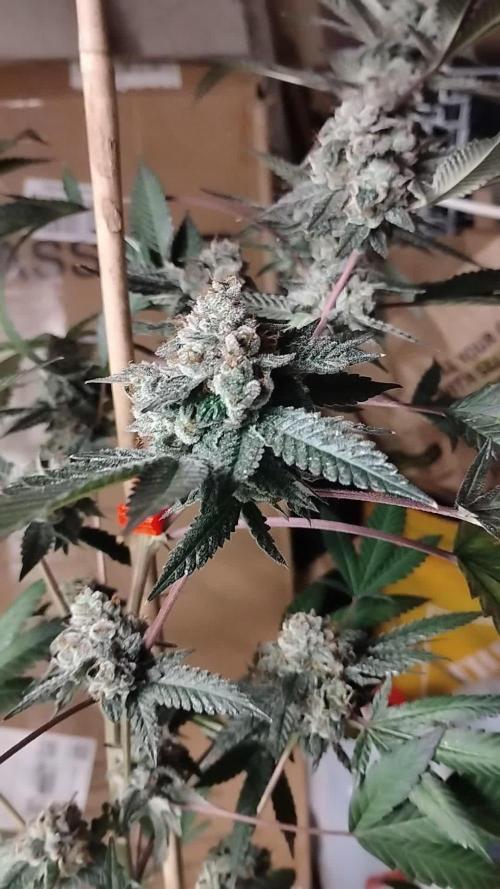
This week was hottt Record breaking temps wer cooking my girls sooo I let them out. I took out their light also (saturday) I also put green celophane on all the house windows (that dont have blinds) because i dont want the house lights to disrupt their sleep. ( i dont know how sensitive they r ) Next week will be their first full week of flower
Likes
13
Share
@Drawer
Follow
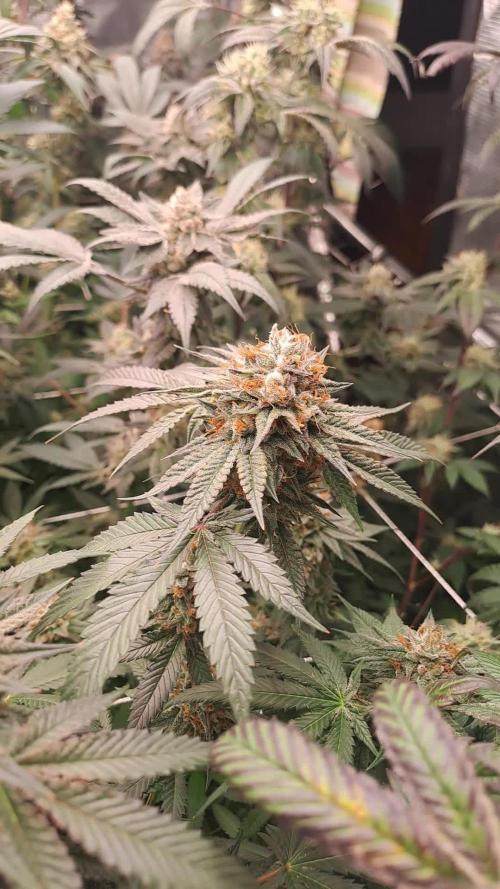
The plant is doing fine, the light has been a bit to close to some buds so light bleaching appeared (Light is raised) Getting close to harvest and the plant smells really sour and citrussy, its amazing.
Likes
5
Share
@Todzilla
Follow
My harvest is well over. This was a light dep run on 6 plants. On my 3 black cherry gelato (BCG), I started with 3 plants and one succumbed to both shock and caterpillars, one I fresh froze early into hash and one plant at about 14 oz dried and cured. Both the surviving plants were hit hard by the cats and my yield is about 50-60% of what it could have been. But that’s growing in SoCal. I really liked the outdoor BCG, it kept its terp profile well past 8mos from harvest. The hash was mixed with my PPP outdoor hash. TBH, the hash is so potent, I can’t really use it that much. I’ve probably smoked 7g over 8 months and still have over 46-50 grams of hash left. I’m writing this about 9 months after I harvested. I harvested about 50 jars total inside and outside as well as a 2oz temple ball of hash. I still have 19 of 50 jars left and 48g of hash left after 8-9 months. Not to mention a good 6lb of trim.
Likes
22
Share
Die Blüten werden langsam dicker. Die Dame wird immer durstiger. Sie ist schon echt klebrig und man kann wirklich Lemonen und Mamdarinen Terpene wahrnehmen.
Likes
48
Share
As always thank you all for stopping by and for supporting me on this journey, i am super passion about growing and fell blessed to have you all with me on this new journey <3 <3 <3 Genetics - Fast Buds Tester 2310 Ligth - LUMATEK ZEUS 465 COMPACT PRO 
Food - APTUS HOLLAND #aptus #aptusplanttech #aptusgang #aptusfamily #aptustrueplantscience #inbalancewithnature #trueplantscience #fastbuds #dogdoctorofficial #growerslove With true love comes happiness <3 <3 <3 Always believe in your self and always do things expecting nothing and with an open heart , be a giver and the universe will give back to you in ways you could not even imagine so <3 <3 <3 
All info and full product details can be find in can find @ https://2fast4buds.com/ wen released 

https://aptus-holland.com/
 
https://autopot.co.uk/ 

https://lumatek-lighting.com/ <3 <3 <3 Growers love to you all <3 <3 <3
Processing
Likes
3
Share
@DBanned
Follow
July 12, 2020 Hi, Plants are looking great and stretching a lot( i want a christmas🌲🤤) 7 plants are showing pistils, two little ones still need to bloom. Talking of bloom, we added Gaiga Green bloom, organic powder. To all the blooming plants. The other got veg feed. We topped one of the biggest plants and a medium size plant. Lots of water and lot of movement for the plants. Two thunder storms last week so The plants were moved in and out of their cover a few times. Thanks everyone Happy grow and high fun !
Likes
1
Share
Slightly slower start and flower initiation with this one but impressed with the amount of flower sites all over and is pretty pungent although it’s merely just started flowering can’t wait to kick back and taste this one
Likes
7
Share
So far I've had two plants pop out from the 8 seeds I threw in the soil (2-30 gallon pots). A ninth seed was germinated later in the season. These are seeds I obtained from the Grease Monkey OG clone I grew last year. I don't mind getting a few seeds from the bees pollinating my plants. I can't say how good that strain is; I recommend it to everyone. I'm happy to have some cross-pollinated offspring. The soil is mostly FFOF, Happy Frog, Roots Organics, some worm castings, worms and whatever has been living in the soil. I recycle my soil and just add more stuff when necessary. I'll try and keep updates this season.
Likes
52
Share
Lacewings seemed to have mostly killed themselves by flying into hot light fixtures. I may have left the UV on which was smart of me :) Done very little to combat if anything but make a sea of carcasses, on the bright side its good nutrition for the soil. Made a concoction of ethanol 70%, equal parts water, and cayenne pepper with a couple of squirts of dish soap. Took around an hour of good scrubbing the entire canopy. Worked a lot more effectively and way cheaper. Scorched earth right now, but it seems to have wiped them out almost entirely very pleased. Attempted a "Fudge I Missed" for the topping. So just time to wait and see how it goes. Question? If I attached a plant to two separate pots but it was connected by rootzone, one has a pH of 7.5 ish the other has 4.5. Would the Intelligence of the plant able to dictate each pot separately to uptake the nutrients best suited to pH or would it still try to draw nitrogen from a pot with a pH where nitrogen struggles to uptake? Food for stoner thought experiments! Another was on my mind. What happens when a plant gets too much light? Well, it burns and curls up leaves. That's the heat radiation, let's remove excess heat, now what? I've always read it's just bad, or not good, but when I look for an explanation on a deeper level it's just bad and you shouldn't do it. So I did. How much can a cannabis plant absorb, 40 moles in a day, ok I'll give it 60 moles. 80 nothing bad ever happened. The answer, finally. Oh great........more questions........ Reactive oxygen species (ROS) are molecules capable of independent existence, containing at least one oxygen atom and one or more unpaired electrons. "Sunlight is the essential source of energy for most photosynthetic organisms, yet sunlight in excess of the organism’s photosynthetic capacity can generate reactive oxygen species (ROS) that lead to cellular damage. To avoid damage, plants respond to high light (HL) by activating photophysical pathways that safely convert excess energy to heat, which is known as nonphotochemical quenching (NPQ) (Rochaix, 2014). While NPQ allows for healthy growth, it also limits the overall photosynthetic efficiency under many conditions. If NPQ were optimized for biomass, yields would improve dramatically, potentially by up to 30% (Kromdijk et al., 2016; Zhu et al., 2010). However, critical information to guide optimization is still lacking, including the molecular origin of NPQ and the mechanism of regulation." What I found most interesting was research pointing out that pH is linked to this defense mechanism. The organism can better facilitate "quenching" when oversaturated with light in a low pH. Now I Know during photosynthesis plants naturally produce exudates (chemicals that are secreted through their roots). Do they have the ability to alter pH themselves using these excretions? Or is that done by the beneficial bacteria? If I can prevent reactive oxygen species from causing damage by "too much light". The extra water needed to keep this level of burn cooled though, I must learn to crawl before I can run. Reactive oxygen species (ROS) are key signaling molecules that enable cells to rapidly respond to different stimuli. In plants, ROS plays a crucial role in abiotic and biotic stress sensing, integration of different environmental signals, and activation of stress-response networks, thus contributing to the establishment of defense mechanisms and plant resilience. Recent advances in the study of ROS signaling in plants include the identification of ROS receptors and key regulatory hubs that connect ROS signaling with other important stress-response signal transduction pathways and hormones, as well as new roles for ROS in organelle-to-organelle and cell-to-cell signaling. Our understanding of how ROS are regulated in cells by balancing production, scavenging, and transport has also increased. In this Review, we discuss these promising developments and how they might be used to increase plant resilience to environmental stress. Temperature stress is one of the major abiotic stresses that adversely affect agricultural productivity worldwide. Temperatures beyond a plant's physiological optimum can trigger significant physiological and biochemical perturbations, reducing plant growth and tolerance to stress. Improving a plant's tolerance to these temperature fluctuations requires a deep understanding of its responses to environmental change. To adapt to temperature fluctuations, plants tailor their acclimatory signal transduction events, specifically, cellular redox state, that are governed by plant hormones, reactive oxygen species (ROS) regulatory systems, and other molecular components. The role of ROS in plants as important signaling molecules during stress acclimation has recently been established. Here, hormone-triggered ROS produced by NADPH oxidases, feedback regulation, and integrated signaling events during temperature stress activate stress-response pathways and induce acclimation or defense mechanisms. At the other extreme, excess ROS accumulation, following temperature-induced oxidative stress, can have negative consequences on plant growth and stress acclimation. The excessive ROS is regulated by the ROS scavenging system, which subsequently promotes plant tolerance. All these signaling events, including crosstalk between hormones and ROS, modify the plant's transcriptomic, metabolomic, and biochemical states and promote plant acclimation, tolerance, and survival. Here, we provide a comprehensive review of the ROS, hormones, and their joint role in shaping a plant's responses to high and low temperatures, and we conclude by outlining hormone/ROS-regulated plant-responsive strategies for developing stress-tolerant crops to combat temperature changes. Onward upward for now. Next! Adenosine triphosphate (ATP) is an energy-carrying molecule known as "the energy currency of life" or "the fuel of life," because it's the universal energy source for all living cells.1 Every living organism consists of cells that rely on ATP for their energy needs. ATP is made by converting the food we eat into energy. It's an essential building block for all life forms. Without ATP, cells wouldn't have the fuel or power to perform functions necessary to stay alive, and they would eventually die. All forms of life rely on ATP to do the things they must do to survive.2 ATP is made of a nitrogen base (adenine) and a sugar molecule (ribose), which create adenosine, plus three phosphate molecules. If adenosine only has one phosphate molecule, it’s called adenosine monophosphate (AMP). If it has two phosphates, it’s called adenosine diphosphate (ADP). Although adenosine is a fundamental part of ATP, when it comes to providing energy to a cell and fueling cellular processes, the phosphate molecules are what really matter. The most energy-loaded composition for adenosine is ATP, which has three phosphates.3 ATP was first discovered in the 1920s. In 1929, Karl Lohmann—a German chemist studying muscle contractions—isolated what we now call adenosine triphosphate in a laboratory. At the time, Lohmann called ATP by a different name. It wasn't until a decade later, in 1939, that Nobel Prize–-winner Fritz Lipmann established that ATP is the universal carrier of energy in all living cells and coined the term "energy-rich phosphate bonds."45 Lipmann focused on phosphate bonds as the key to ATP being the universal energy source for all living cells, because adenosine triphosphate releases energy when one of its three phosphate bonds breaks off to form ADP. ATP is a high-energy molecule with three phosphate bonds; ADP is low-energy with only two phosphate bonds. The Twos and Threes of ATP and ADP Adenosine triphosphate (ATP) becomes adenosine diphosphate (ADP) when one of its three phosphate molecules breaks free and releases energy (“tri” means “three,” while “di” means “two”). Conversely, ADP becomes ATP when a phosphate molecule is added. As part of an ongoing energy cycle, ADP is constantly recycled back into ATP.3 Much like a rechargeable battery with a fluctuating state of charge, ATP represents a fully charged battery, and ADP represents a "low-power mode." Every time a fully charged ATP molecule loses a phosphate bond, it becomes ADP; energy is released via the process of ATP becoming ADP. On the flip side, when a phosphate bond is added, ADP becomes ATP. When ADP becomes ATP, what was previously a low-charged energy adenosine molecule (ADP) becomes fully charged ATP. This energy-creation and energy-depletion cycle happens time and time again, much like your smartphone battery can be recharged countless times during its lifespan. The human body uses molecules held in the fats, proteins, and carbohydrates we eat or drink as sources of energy to make ATP. This happens through a process called hydrolysis . After food is digested, it's synthesized into glucose, which is a form of sugar. Glucose is the main source of fuel that our cells' mitochondria use to convert caloric energy from food into ATP, which is an energy form that can be used by cells. ATP is made via a process called cellular respiration that occurs in the mitochondria of a cell. Mitochondria are tiny subunits within a cell that specialize in extracting energy from the foods we eat and converting it into ATP. Mitochondria can convert glucose into ATP via two different types of cellular respiration: Aerobic (with oxygen) Anaerobic (without oxygen) Aerobic cellular respiration transforms glucose into ATP in a three-step process, as follows: Step 1: Glycolysis Step 2: The Krebs cycle (also called the citric acid cycle) Step 3: Electron transport chain During glycolysis, glucose (i.e., sugar) from food sources is broken down into pyruvate molecules. This is followed by the Krebs cycle, which is an aerobic process that uses oxygen to finish breaking down sugar and harnesses energy into electron carriers that fuel the synthesis of ATP. Lastly, the electron transport chain (ETC) pumps positively charged protons that drive ATP production throughout the mitochondria’s inner membrane.2 ATP can also be produced without oxygen (i.e., anaerobic), which is something plants, algae, and some bacteria do by converting the energy held in sunlight into energy that can be used by a cell via photosynthesis. Anaerobic exercise means that your body is working out "without oxygen." Anaerobic glycolysis occurs in human cells when there isn't enough oxygen available during an anaerobic workout. If no oxygen is present during cellular respiration, pyruvate can't enter the Krebs cycle and is oxidized into lactic acid. In the absence of oxygen, lactic acid fermentation makes ATP anaerobically. The burning sensation you feel in your muscles when you're huffing and puffing during anaerobic high-intensity interval training (HIIT) that maxes out your aerobic capacity or during a strenuous weight-lifting workout is lactic acid, which is used to make ATP via anaerobic glycolysis. During aerobic exercise, mitochondria have enough oxygen to make ATP aerobically. However, when you're out of breath and your cells don’t have enough oxygen to perform cellular respiration aerobically, the process can still happen anaerobically, but it creates a temporary burning sensation in your skeletal muscles. Why ATP Is So Important? ATP is essential for life and makes it possible for us to do the things we do. Without ATP, cells wouldn't be able to use the energy held in food to fuel cellular processes, and an organism couldn't stay alive. As a real-world example, when a car runs out of gas and is parked on the side of the road, the only thing that will make the car drivable again is putting some gasoline back in the tank. For all living cells, ATP is like the gas in a car's fuel tank. Without ATP, cells wouldn't have a source of usable energy, and the organism would die. Eating a well-balanced diet and staying hydrated should give your body all the resources it needs to produce plenty of ATP. Although some athletes may slightly improve their performance by taking supplements or ergonomic aids designed to increase ATP production, it's debatable that oral adenosine triphosphate supplementation actually increases energy. An average cell in the human body uses about 10 million ATP molecules per second and can recycle all of its ATP in less than a minute. Over 24 hours, the human body turns over its weight in ATP. You can last weeks without food. You can last days without water. You can last minutes without oxygen. You can last 16 seconds at most without ATP. Food amounts to one-third of ATP production within the human body.
Likes
4
Share
@Ensign420
Follow
|»» LOG DISCLAIMER: Not intended as a grow guide. Grow log entries are usually posted 3 weeks later and are for my learning reference. ««| Introduction - Week 21 Summary - Ensign's log, stardate 17578.1, Pretty smooth grow week! For the main tent, did a bit of super-cropping, but for the most part, been letting these girls do their thing! Bud growth is ramping up and looking beautiful! As for the veg tent, transplanted two more clones into the right quadrants and topped the mothers in the left quadrant. Top watered all veg plants with a few microbial goodies. Also kept up with clonal RO waterings. Decided to dive into the world of tissue culture and am stoked to give it a try! Kind of forgot to take PPFD reading and height checks, but will do so next week. Anyways! Onwards Ensign! [START OF WEEK 21] ========================================================== ---------- [ 4x4 MAIN TENT ] ---------- Heady OG BX1 #1 [Round4 ~Wk14] - WEEK 21 - Full Bloom Wk5 TKO [Round2 ~Wk19] - WEEK 21 - Full Bloom Wk5 ----------- [ 3x3 VEG TENT ] ------------ TKO - WEEK 04 - Full Veg Gorilla Goat #1 - WEEK 00 - Transplant Heady OG BX1 - WEEK 04 - Full Veg Garlic Budder OG#1 - WEEK 00 - Transplant 09/08/25 → 09/14/25 This Week's Estimated Goals ---------------------------------------------------------------------------------------------- DLI: ~35 mol/m²/d PPFD: ~810 μmol/m²/s VPD: ~1.0 kPa This Week's Meter Readings & Averages ---------------------------------------------------------------------------------------------- Light On/Off: 19:00 - 07:00 | Wattage: ~390.1W [LV05] Distance From Canopy: ~7”, 7” DLI: ~37.32 mol/m²/d PPFD: ~864 μmol/m²/s VPD: ~0.62 kPa Soil %: [49.0, 38.9, 30.6, 52.3, 42.9, 40.9, 25.3, 43.0] ========================================================== Day 01 - Monday - 09/08/25 - Total Days: 148 ----------------------------------- Daily Averages ~[+01:00] - Temps: 84.0°F [28.9°C] - Humidity: 83.5% - VPD: 0.66 kPa - Soil %: [49, 40, 31, 52, 42, 39, 28, 41] ----------------------------------- - [+00:19]: Night check on the 4x4 tent. --- Looking healthy and green in the garden! --- Heady OG and TKO are swelling up with buds and growth looks dank and frosty! - [+00:22]: Checked the Ecowitt soil moisture sensor data: ------------------ [ 4x4 MAIN TENT ] --------------- ------ 47% - [CH01 FT » G30 - Heady OG BX1 #1] ------ 40% - [CH02 FB » G30 - Heady OG BX1 #1] ------ 26% - [CH03 BT » G20 - TKO] ------ 51% - [CH04 BB » G20 - TKO] ------------------ [ 3x3 VEG TENT ] ---------------- ------ 44% - [CH05 BL » GR7 - TKO] ------ 39% - [CH06 BR » GR7 - Pheno #2] ------ 27% - [CH07 FL » GR7 - Heady OG BX1 #1] ------ 40% - [CH08 FR » GR7 - Pheno #4] --------- Veg: 38% - 45% | Flower: 45% - 55% --------- General: 30% [Dry] «| 45 - 60% [Moist] |» 70% [Wet] - [+00:25]: Checked the 3x3 veg tent. --- Veg garden is healthy and perky with green growth! --- Both mothers are looking great and growth is bushing out beautifully! --- Both of the spare Heady OG clones need to be watered! - [+00:27]: Here are the starting initial watering ranges: ------ Heady OG BX1 #1A » 237.7g → 300.3g ------ Heady OG BX1 #1B » 244.4g → 305.6g --------- General Solo Range: [Dry] «| [Initial Cup Weight] + ~55-100g |» [Wet] --- Both cups were last watered 4 days ago. --- Took the starting weight of both clones before watering, ------ Heady OG BX1 #1A » 211.8g ------ Heady OG BX1 #1B » 241.7g --- While on a scale, --- Gently misted the straw mulch of both cups with RO water. --- Focused on the straw and sprayed as evenly as possible. --- Misted 10-20 sprays. Waited a moment, then misted again. --- Made sure to reference the watering weights. --- Repeated this process until both cups weighted at least 300g. --- There was no runoff. - [+00:47]: Took the saturated weight of both clones after watering, ------ Heady OG BX1 #1A » 325.3g ------ Heady OG BX1 #1B » 320.0g --- Marked the final wet weight on the back of each cup. Also marked the watering date on the front. --- Placed both phenos back into the tent. - [+00:54]: Checked the humidifiers. --- Tanks are still full and no leaks found. Day 02 - Tuesday - 09/09/25 - Total Days: 149 ----------------------------------- Daily Averages ~[+01:00] - Temps: 83.0°F [28.3°C] - Humidity: 82.0% - VPD: 0.70 kPa - Soil %: [49, 40, 28, 52, 42, 38, 26, 41] ----------------------------------- - [14:01]: [ » SUPPLEMENTAL LIFE ENTRY « ] --- Fixed my computer! Glad the issue was just the PSU and not the motherboard. --- Anyways! - [20:58]: Night check on the 4x4 tent. --- Ahh yea! Looking bushy and bud colas are starting to form! --- Heady OG has taken over the front of the tent, but TKO is also looking great in the back. --- There are a few tops that need a bit of training. Let’s go! - [21:06]: Super-cropped and lowered the taller branches. --- Nice! Now the canopy looks a lot more even! --- Ca-Caw!! Ooo yea! Terps are getting louder! --- While pinching the taller tops, noticed that Heady OG’s terpene profile is ripening into a more distinct lemon citrus gas on the nose and wow she is greasy! TKO’s terps have changed to more of an earthy creamy (or dough-like) fuel. Very nice! --- Getting absolutely hyped for this cycle’s harvest!! - [21:09]: Checked the Ecowitt soil moisture sensor data: ------------------ [ 4x4 MAIN TENT ] --------------- ------ 53% - [CH01 FT » G30 - Heady OG BX1 #1] ------ 39% - [CH02 FB » G30 - Heady OG BX1 #1] ------ 30% - [CH03 BT » G20 - TKO] ------ 53% - [CH04 BB » G20 - TKO] ------------------ [ 3x3 VEG TENT ] ---------------- ------ 40% - [CH05 BL » GR7 - TKO] ------ 38% - [CH06 BR » GR7 - Pheno #2] ------ 26% - [CH07 FL » GR7 - Heady OG BX1 #1] ------ 42% - [CH08 FR » GR7 - Pheno #4] --------- Veg: 38% - 45% | Flower: 45% - 55% --------- General: 30% [Dry] «| 45 - 60% [Moist] |» 70% [Wet] - [21:12]: Checked the 3x3 veg tent. --- Looking healthy and thriving with growth in the veg garden! --- Both Heady OG and TKO mothers are looking green and the canopy is getting a bit tall but still okay. Will need to top both soon. --- All clones look healthy and the four in the propagation tray need watering. Let’s go Ensign! - [21:17]: Here are the starting initial watering ranges: ------ Gorilla Goat #1 » 256.1g → 300.4g ------ Gorilla Goat #2 » 255.4g → 300.3g ------ Garlic Budder OG#1 » 263.5g → 305.2g ------ Garlic Budder OG#2 » 256.4g → 300.2g --------- General Solo Range: [Dry] «| [Initial Cup Weight] + ~55-100g |» [Wet] --- All cups were last watered 4 days ago. --- Took the starting weight of all clones before watering, ------ Gorilla Goat #1 weighed 258.0g ------ Gorilla Goat #2 weighed 247.6g ------ Garlic Budder OG#1 weighed 255.2g ------ Garlic Budder OG#2 weighed 261.9g --- While on a scale, --- Gently misted the straw mulch of all cups with RO water. --- Focused on the straw and sprayed as evenly as possible. --- Misted 10-20 sprays. Waited a moment, then misted again. --- Made sure to reference the watering weights. --- Repeated this process until all cups weighted at least 300g. --- There was no runoff. - [21:58]: Took the saturated weight of all clones after watering, ------ Gorilla Goat #1 » 310.1g ------ Gorilla Goat #2 » 315.7g ------ Garlic Budder OG#1 » 315.3g ------ Garlic Budder OG#2 » 310.3g --- Marked the final wet weight on the back of each cup. Also marked the watering date on the front. --- Placed all cups back into the tent. - [22:24]: Checked the humidifiers. --- Tanks are still full and no leaks found. Day 03 - Wednesday - 09/10/25 - Total Days: 150 ----------------------------------- Daily Averages ~[+01:00] - Temps: 83.8°F [28.8°C] - Humidity: 82.8% - VPD: 0.68 kPa - Soil %: [49, 39, 28, 52, 43, 38, 25, 41] ----------------------------------- - [+00:20]: Night check on the 4x4 tent. --- Looking great my girls! --- Wow the top growth is getting stacked! --- Both Heady OG and TKO’s buds are swelling up with more white hairs! - [+00:24]: Checked the Ecowitt soil moisture sensor data: ------------------ [ 4x4 MAIN TENT ] --------------- ------ 54% - [CH01 FT » G30 - Heady OG BX1 #1] ------ 39% - [CH02 FB » G30 - Heady OG BX1 #1] ------ 30% - [CH03 BT » G20 - TKO] ------ 53% - [CH04 BB » G20 - TKO] ------------------ [ 3x3 VEG TENT ] ---------------- ------ 41% - [CH05 BL » GR7 - TKO] ------ 38% - [CH06 BR » GR7 - Pheno #2] ------ 25% - [CH07 FL » GR7 - Heady OG BX1 #1] ------ 40% - [CH08 FR » GR7 - Pheno #4] --------- Veg: 38% - 45% | Flower: 45% - 55% --------- General: 30% [Dry] «| 45 - 60% [Moist] |» 70% [Wet] - [+00:26]: Checked the 3x3 veg tent. --- Veg growth is looking beautiful and green! --- Both mothers and all clones are looking healthy! --- Need to water the spare Heady OG clones! - [+00:33]: Here are the starting initial watering ranges: ------ Heady OG BX1 #1A » 237.7g → 300.3g ------ Heady OG BX1 #1B » 244.4g → 305.6g --------- General Solo Range: [Dry] «| [Initial Cup Weight] + ~55-100g |» [Wet] --- Both cups were last watered 3 days ago. --- Took the starting weight of both clones before watering, ------ Heady OG BX1 #1A » 216.1g ------ Heady OG BX1 #1B » 230.8g --- While on a scale, --- Gently misted the straw mulch of both cups with RO water. --- Focused on the straw and sprayed as evenly as possible. --- Misted 10-20 sprays. Waited a moment, then misted again. --- Made sure to reference the watering weights. --- Repeated this process until both cups weighted at least 300g. --- There was no runoff. - [+00:57]: Took the saturated weight of both clones after watering, ------ Heady OG BX1 #1A » 325.6g ------ Heady OG BX1 #1B » 325.4g --- Marked the final wet weight on the back of each cup. Also marked the watering date on the front. --- Placed both phenos back into the tent. - [+01:02]: Checked the humidifiers. --- Tanks are still full and no leaks found. Day 04 - Thursday - 09/11/25 - Total Days: 151 ----------------------------------- Daily Averages ~[+01:00] - Temps: 82.9°F [28.3°C] - Humidity: 82.9% - VPD: 0.71 kPa - Soil %: [49, 39, 29, 51, 44, 41, 25, 44] ----------------------------------- - [09:40]: Quick morning checked on the 3x3 veg tent. --- Veg garden is looking healthy and all around growth is green with no issues! - [18:17]: Evening check on the 3x3 veg tent. --- Ooo yea! The veg garden is green and thriving with perky growth! --- Okay! Need to transplant two of these girls! --- After bit of self-debating (and quite a few bowls), I’ve finally decided on the ones! --- Going to transplant Gorilla Goat #1 along with the original Garlic Budder #1 --- Decided to the transplant the Gorilla Goat #1 for the loudness and overall lemon chem gas terp profile. --- As for the Garlic Budder phenos, going with the purple pheno. For a while, was planning on transplanting the #2 pheno, but after a 5-month cure, the unique and smooth smoke of the #1 pheno was the ultimate reason for switch. --- Ca-Caw! Always pheno hunting! This is why we grow! --- Okay, anyways! - [18:22]: Time to transplant! --- Both 7-gallon pots have been pre-amended and ready for more roots! --- Alright let's go cutty! --- Placed both of the spare Heady OG clones in the propagation tray. - [18:25]: Gently removed the solo cups from both fabric pots (on the right side of the tent) leaving perfect holes. ------ Sprinkled 1/16tsp of Great White, --- Dusted the sides of both holes. --- Also sprinkled a bit around the top soil. --- Great! Time to transplant! --- It’s been two days since both have been watered. --- To loosen and unstick the rootball from the cup, I gently squeezed the sides before pressing the bottom upwards. --- Once fully loosened, I simply Vulcan-gripped the base of the plant and flipped her upside down. - [18:33]: Gorilla Goat #1 dropped straight out of her cup! --- Hmm. Not as rooted as I would hope, but roots look white and healthy! --- The original Garlic Budder #1 pheno easily slipped out of her cup! --- Similar the Gorilla Goat, she could have more roots, but that’s okay. Roots look healthy and that is all that matters! --- Did not break up the rootballs. --- Gently flipped and placed each clone carefully into the pre-inoculated holes. --- Pressed and evened out the top soil for both phenos. - [18:39]: Transplant done! --- Gorilla Goat #1 was transplanted into the back right quadrant. --- Garlic Budder OG#1 was transplanted into the front right quadrant. --- To prevent transplant shock and to help even out the soil moisture, going to give 2 cups of wetting solution each. --- Also adding in a few extra microbes. - [18:55]: Filled a pitcher with 6 cups of RO water. ------ Added 1/64tsp of Quillaja Saponaria Extract [60] ------ Added 1/32tsp of Recharge ------ Added 1/32tsp of Stash Blend ------ Added 1/8tsp of Horticultural Aloe ------ Added 1/8tsp of Horticultural Coconut ------ Added 1/8tsp of Mycrobe Complete ------ Added 1/2tsp of WDG3000 Extra Strength BTI --- Mixed the solution and poured 2 cups straight into a pump sprayer. --- Misted Gorilla Goat #1's straw mulch with the wetting solution (back right quadrant). --- Took my time and tried to go evenly. - [19:15]: Repeated this process for the original Garlic Budder #1 pheno (front right quadrant). --- Using the remaining 2 cups of the wetting solution, misted the straw mulch for both Heady OG (front left quadrant) and TKO (back left quadrant) mothers. --- Ca-Caw!! Done with the transplant! Grow strong my veg queens! - [19:22]: As for the remaining veg clones, --- Decided to try to preserve the genetics in solo cups and basic clonal cycling techniques. --- Plan to take new cuttings in a few weeks or so and will begin the rooting process once more. --- Curing has really changed the way I currently hunt phenos and I really don’t want to lose another keeper pheno (recently regret not keeping a cutting of Garlic Budder #4). --- Oh! Also finally decided to fully give tissue culture a go! --- Another huge shout out to Laur and her independently ran business, Plants-In-Jars! --- If successful, learning tissue culture will be a huge ganja journey milestone by providing a sustainable way to preserve and maintain a diverse genetic library. --- Through continuous subculturing and micro propagation, I should be able to maintain unrooted explant cuttings forever. --- Then when needed, theses cuttings can be rooted and conditioned back into a clonal state and back into solo-cups for transplanting. --- Of course, I have absolutely no idea what I am doing, so developing a successful cannabis tissue culture protocol is going to be fun and full of failure, err, I mean, learning experiences! --- What can possibility go wrong right!? --- While learning (which will most likely take a bit), will continue to maintain the vegging mothers and solo cup clones. --- The ganja journey continues! Getting hyped! --- Don’t frack this up Ensign! --- Anyways!! - [19:28]: Checked the Ecowitt soil moisture sensor data. --- Also made sure to update the Ecowitt sensor names: ------------------ [ 4x4 MAIN TENT ] --------------- ------ 54% - [CH01 FT » G30 - Heady OG BX1 #1] ------ 39% - [CH02 FB » G30 - Heady OG BX1 #1] ------ 28% - [CH03 BT » G20 - TKO] ------ 49% - [CH04 BB » G20 - TKO] ------------------ [ 3x3 VEG TENT ] ---------------- ------ 54% - [CH05 BL » GR7 - TKO] ------ 55% - [CH06 BR » GR7 - Gorilla Goat #1] ------ 34% - [CH07 FL » GR7 - Heady OG BX1 #1] ------ 61% - [CH08 FR » GR7 - Garlic Budder OG#1] --------- Veg: 38% - 45% | Flower: 45% - 55% --------- General: 30% [Dry] «| 45 - 60% [Moist] |» 70% [Wet] - [19:58]: Checked the 4x4 tent. --- Ca-Caw!!! Ahh yea! --- The canopy is looking beautiful and wow buds are thickening up beautifully! --- Both Heady OG and TKO are healthy and getting frosty! --- Pretty easy night in the main garden! --- Let’s go my girls! - [20:04]: Quickly checked on the auto-watering system. --- System is still charged and no leaks or kinks found in the tubing. - [22:00]: Checked the humidifiers. --- Tanks are still full and no leaks found. Day 05 - Friday - 09/12/25 - Total Days: 152 ----------------------------------- Daily Averages ~[+01:00] - Temps: 83.7°F [28.7°C] - Humidity: 81.7% - VPD: 0.72 kPa - Soil %: [49, 38, 32, 53, 43, 45, 26, 47] ----------------------------------- - [22:55]: Night check on the 4x4 tent. --- Ooo yea! Garden is thriving and terps are getting louder! --- Heady OG and TKO are swelling up with top buds! --- The canopy is completely full and with 4-5 weeks left in flower, absolutely hyped for harvest! --- Will probably start checking trichomes in 2-3 weeks. - [23:01]: Checked the Ecowitt soil moisture sensor data: ------------------ [ 4x4 MAIN TENT ] --------------- ------ 52% - [CH01 FT » G30 - Heady OG BX1 #1] ------ 38% - [CH02 FB » G30 - Heady OG BX1 #1] ------ 29% - [CH03 BT » G20 - TKO] ------ 51% - [CH04 BB » G20 - TKO] ------------------ [ 3x3 VEG TENT ] ---------------- ------ 46% - [CH05 BL » GR7 - TKO] ------ 44% - [CH06 BR » GR7 - Gorilla Goat #1] ------ 25% - [CH07 FL » GR7 - Heady OG BX1 #1] ------ 45% - [CH08 FR » GR7 - Garlic Budder OG#1] --------- Veg: 38% - 45% | Flower: 45% - 55% --------- General: 30% [Dry] «| 45 - 60% [Moist] |» 70% [Wet] - [23:04]: Checked the 3x3 veg tent. --- Looking good ladies! --- All mothers are looking beautiful and green! --- Clones look great too but need watering, let’s go! - [23:07]: Here are the starting initial watering ranges: ------ Gorilla Goat #2 » 255.4g → 300.3g ------ Garlic Budder OG#2 » 256.4g → 300.2g ------ Heady OG BX1 #1A » 237.7g → 300.3g ------ Heady OG BX1 #1B » 244.4g → 305.6g --------- General Solo Range: [Dry] «| [Initial Cup Weight] + ~55-100g |» [Wet] --- Gorilla Goat and Garlic Budder were last watered 4 days ago. --- Both Heady OG phenos were watered 3 days ago. --- Took the starting weight of all clones before watering, ------ Gorilla Goat #2 » 243.4g ------ Garlic Budder OG#2 » 272.3g ------ Heady OG BX1 #1A » 232.9g ------ Heady OG BX1 #1B » 244.6g --- While on a scale, --- Gently misted the straw mulch of all cups with RO water. --- Focused on the straw and sprayed as evenly as possible. --- Misted 10-20 sprays. Waited a moment, then misted again. --- Made sure to reference the watering weights. --- Repeated this process until all cups weighted at least 300g. --- There was no runoff. - [23:38]: Took the saturated weight of all clones after watering, ------ Gorilla Goat #2 » 320.0g ------ Garlic Budder OG#2 » 310.3g ------ Heady OG BX1 #1A » 330.2g ------ Heady OG BX1 #1B » 330.3g --- Marked the final wet weight on the back of each cup. Also marked the watering date on the front or side. --- Placed all cups back into the tent. - [23:44]: Checked the humidifiers. --- Tanks are still full and no leaks found. Day 06 - Saturday - 09/13/25 - Total Days: 153 ----------------------------------- Daily Averages ~[+01:00] - Temps: 83.5°F [28.6°C] - Humidity: 80.1% - VPD: 0.79 kPa - Soil %: [49, 38, 33, 52, 43, 43, 24, 44] ----------------------------------- - [07:59]: Quick morning checked on the 3x3 veg tent. --- Veg garden is thriving and growth is looking green and healthy. --- All mothers and clones look healthy and both transplanted ones seem to be rooting and perky! - [20:03]: Night check on the 4x4 tent. --- Ca-Caw!! The garden is bushing out and wow growth looks incredible! --- Heady OG and TKO are stacking up with bud growth! --- Let’s go ladies! - [20:08]: Checked the Ecowitt soil moisture sensor data: ------------------ [ 4x4 MAIN TENT ] --------------- ------ 52% - [CH01 FT » G30 - Heady OG BX1 #1] ------ 38% - [CH02 FB » G30 - Heady OG BX1 #1] ------ 36% - [CH03 BT » G20 - TKO] ------ 56% - [CH04 BB » G20 - TKO] ------------------ [ 3x3 VEG TENT ] ---------------- ------ 40% - [CH05 BL » GR7 - TKO] ------ 42% - [CH06 BR » GR7 - Gorilla Goat #1] ------ 23% - [CH07 FL » GR7 - Heady OG BX1 #1] ------ 44% - [CH08 FR » GR7 - Garlic Budder OG#1] --------- Veg: 38% - 45% | Flower: 45% - 55% --------- General: 30% [Dry] «| 45 - 60% [Moist] |» 70% [Wet] - [20:13]: Checked the 3x3 veg tent. --- Veg garden is looking healthy and growth all looks green! --- All mothers and clones looking great and no need to water. Nice! - [20:19]: Checked the humidifiers. --- Tanks are still full and no leaks found. Day 07 - Sunday - 09/14/25 - Total Days: 154 ----------------------------------- Daily Averages ~[+01:00] - Temps: 83.9°F [28.8°C] - Humidity: 79.7% - VPD: 0.82 kPa - Soil %: [49, 38, 33, 54, 43, 42, 23, 43] ----------------------------------- - [08:16]: Quick morning checked on the 3x3 veg tent. --- Looking good my girls! --- Mothers all look great and clones are getting taller! - [21:35]: Night check on the 4x4 tent. --- Ca-Caw!! The garden is thriving and buds are stacking! --- Heady OG and TKO are both looking beautiful and healthy! --- The canopy looks pretty even and bud colas are thickening up! --- Heady OG has taken over the front of the tent and can’t really reach TKO now. Not too big of a deal, but for future cycles, will try to train the growth from left-to-right instead of front-to-back. --- Anyways! - [21:41]: Checked the Ecowitt soil moisture sensor data: ------------------ [ 4x4 MAIN TENT ] --------------- ------ 50% - [CH01 FT » G30 - Heady OG BX1 #1] ------ 38% - [CH02 FB » G30 - Heady OG BX1 #1] ------ 32% - [CH03 BT » G20 - TKO] ------ 53% - [CH04 BB » G20 - TKO] ------------------ [ 3x3 VEG TENT ] ---------------- ------ 40% - [CH05 BL » GR7 - TKO] ------ 41% - [CH06 BR » GR7 - Gorilla Goat #1] ------ 22% - [CH07 FL » GR7 - Heady OG BX1 #1] ------ 43% - [CH08 FR » GR7 - Garlic Budder OG#1] --------- Veg: 38% - 45% | Flower: 45% - 55% --------- General: 30% [Dry] «| 45 - 60% [Moist] |» 70% [Wet] - [21:44]: Checked the 3x3 veg tent. --- Veg garden is looking beautiful and all ladies are healthy! --- Both the Heady OG and TKO mothers look green and bushing out with more growth. Nice! --- All clones look great, but three need watering. --- Let’s go Ensign! - [09:48]: Here are the starting initial watering ranges: ------ Gorilla Goat #2 » 255.4g → 300.3g ------ Heady OG BX1 #1A » 237.7g → 300.3g ------ Heady OG BX1 #1B » 244.4g → 305.6g --------- General Solo Range: [Dry] «| [Initial Cup Weight] + ~55-100g |» [Wet] --- Gorilla Goat and Garlic Budder were last watered 4 days ago. --- Both Heady OG phenos were watered 3 days ago. --- Took the starting weight of all clones before watering, ------ Gorilla Goat #2 » 259.5g ------ Heady OG BX1 #1A » 240.1g ------ Heady OG BX1 #1B » 253.7g --- While on a scale, --- Gently misted the straw mulch of all cups with RO water. --- Focused on the straw and sprayed as evenly as possible. --- Misted 10-20 sprays. Waited a moment, then misted again. --- Made sure to reference the watering weights. --- Repeated this process until all cups weighted at least 300g. --- There was no runoff. - [10:15]: Took the saturated weight of all clones after watering, ------ Gorilla Goat #2 » 325.2g ------ Heady OG BX1 #1A » 335.4g ------ Heady OG BX1 #1B » 335.2g --- Marked the final wet weight on the back of each cup. Also marked the watering date on the front or side. --- Placed all cups back into the tent. - [22:23]: Checked the humidifiers. --- Tanks are still full and no leaks found. --- Another grow week done! --- Oops, forgot to take the weekly PPFD, and height measurements. Will updated PPFD and measurements next week. --- Glad that it was a simple week in the garden so there shouldn’t be much change. --- Life happens. --- Anyways! --- Onwards Ensign! [END OF WEEK 21]
Likes
4
Share
Welcome to Flower Week 7-8 and harvest of Divine Seeds Auto 77 Days I'm excited to share my grow journey with you all as part of the Divine Seeds Autoflowering Competition 2025. It's going to be an incredible ride, full of learning, growing, and connecting with fellow growers from all around the world! For this competition, I’ve chosen the Feminized Automatic strain: Auto 77 Days Here’s what I’m working with: • 🌱 Tent: 120x60x80 • 🧑‍🌾 Breeder Company: Divine Seeds • 💧 Humidity Range: 60 • ⏳ Flowering Time: 56 Days • Strain Info: 21%THC • 🌡️ Temperature: 26 • 🍵 Pot Size: 3 • Nutrient Brand: Narcos • ⚡ Lights : 200W x 2 A huge thank you to Divine Seeds for allowing me to be a part of this amazing competition and Sponsoring the Strains. Big thanks for supporting the grower community worldwide! Your genetics and passion speak for themselves! I would truly appreciate every bit of feedback, help, questions, or discussions – and of course, your likes and interactions mean the world to me as I try to stand out in this exciting competition! Let’s grow together – and don’t forget to stop by again to see the latest updates! Happy growing! Stay lifted and stay curious! Peace & Buds!
Likes
45
Share
Hello my friends, 🍍 May 18.. Day #96🍍 🌻 Flowering Day 33 🌻 5th week of flowering for my three Feminized Gypsy Widow. Les buds grossissent à fond, la lampe y est pour quelque chose c'est de la balle..😘 Cette génétique ressemble à la White Widow que j'ai fait de chez 00 Seeds. It starts to smell very good.. 💉 : I don't change anything.. 👍 🔦 : Quantum Board 480 watts at 100% power and 40 cm canopy. www.exoticseed.eu That's all for now my friends, thank you very much for coming to see my darlings, feel free to Sub and I will follow you back. Take care of yourself and your loved ones. I wish you only happiness with your plants.. 😘 See you soon.. 💨
Likes
4
Share
@CBDFarmer
Follow
Another strong week. I lifted Purplematic by 10cm so that enjoys the same spectrum of light at the top as the others. Pink Kush going strong into flowering and I see some dense bud formations. CBD 20:1 getting ready to an explosive flowering stage. Late into flowering due to HST, it is still growing, spreading and increasing the number of main buds. My guess is that this will be the latest but most productive strain of the 3.
Likes
115
Share
Cherry Cola's Grand Flourish in the Floral Symphony Greetings, fellow cultivators! Week 4 has unfurled its petals in the mesmerizing floral journey of our beloved Cherry Cola Auto. The tent is now a stage for a grand botanical opera, and our green queen stands as a testament to the wonders of cultivation. Let's dive into the details of this flourishing spectacle! As we venture deeper into Week 4, the floral elegance of Cherry Cola Auto takes center stage. What was once a lush bush has evolved into a breathtaking beauty, a true testament to the success of our horticultural endeavors. The topping technique and the release from training supports have paved the way for a regal display of colas and buds. The decision to set our Cherry Cola free from the constraints of training supports continues to be a triumph. The tent is now a realm of bushy brilliance, and our green queen stands tall, a majestic presence commanding attention. It's a living masterpiece in perpetual motion. The echoes of our topping tales from previous weeks resonate in the structure of Cherry Cola's colas. Each topped branch has evolved into a flourishing bud-laden entity, contributing to the overall grandeur of our green canvas. The decision to embark on this topping journey has truly paid off. Our nutrient symphony, now joined by the magical touch of Potassium (K), continues to fuel the botanical brilliance. P-Boost and Topbooster, with their orchestration of phosphorus, organic grace, and now potassium magic, create a harmonious dance of blooming processes. The buds are becoming robust, laden with fibers, resins, and sugars, promising a top-tier end product. Every day, the visual majesty of Cherry Cola unfolds with new growth, showcasing the resilience and vitality she possesses. It's more than a plant; it's a living testament to the artistry of cultivation. As we conclude Week 4, Cherry Cola Auto stands as a botanical opera in full swing. The tent is alive with the grand flourish of a floral symphony. Stay tuned, fellow enthusiasts, as we eagerly await the next thrilling act in the Cherry Cola Chronicles! Genetics Cherry Cola Auto @Fast_Buds @fastbuds_genetics_official @fastbuds_official @fastbuds_espana Nutrition: @aptusholland @aptus_world @aptus_ Love, Care, and Attention: @dogdoctorofficial As always, thank you all for joining me on this journey, for your love, and for it all. My horticultural odyssey would never be the same without you. Your love and support are cherished, and I feel both honored and blessed to have you in my life Friendly reminder all you see here is pure research and for educational purposes only Growers Love To you All 💚 💚 💚
Likes
14
Share
Que pasa familia, vamos con la quinta semana de floración de estas Gorilla Zkittlez Auto de FastBuds. La tierra que utilizamos que está en la publicación anterior es top crop all mix, aparte alimentamos nuestras plantas con Agrobeta. Por supuesto el ph se mide en cada riego y se mantiene en 6.2, regando cada 48/72 horas e intentando mantener la humedad un poco alta al principio. Se ven bien sanas tienen buen color , ya empiezan asomar aromas y el tamaño bueno no puedo quejarme, estas semanas vemos como maduran las flores. Agrobeta: https://www.agrobeta.com/agrobetatiendaonline/36-abonos-canamo Hasta aquí todo, Buenos humos 💨💨
Likes
7
Share
@Dunk_Junk
Follow
Wow she over doubled her height this week. Grew 15cm! Now she's 25cm tall.
Likes
4
Share
Fastbuds seeds Gorilla zkittles auto Only using spring water for first week and spraying with foop mist. Going to use foop nutrients with Humboldts secret cal/mag and nectar for the gods ph up and down! Planted right into substrate. I’m using Mother Earth coco coir/perlite mix with hydroton at bottom of pot
Likes
6
Share
@Moss420
Follow
Plants in the main tent are coming along well since correcting the light intensity and run-off ppm, the one on the left is filling out now, so is the one in the middle just much slower. Not sure if I will let that one cook longer or just pull it with the rest... will see how she looks in a week. The plant on the right I spread out to take up almost half of the tent (I didn't want the spindler taking up unnecessary space) - her nugs are real nice - some foxtails and bleaching on the taller ones but for the most part looking good. Plant on the left has filled out a lot more despite its weirder more "wiry" bud structure - does't look as nice as the good plants but definitely better than the spindly plant in the middle. Big Mumma is still killing it - wondering if its getting close to flush time for her as it looks like some of her tricomes are starting to brown...