The Grow Awards 2026 🏆
Likes
Comments
Share
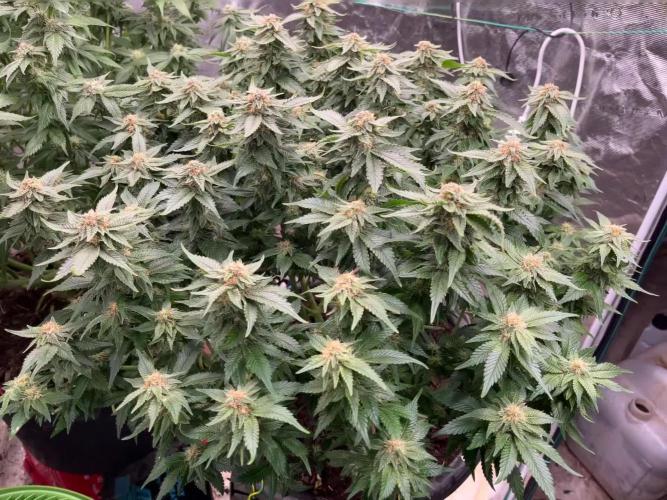
Vamos familia cuarta de floración de estás Punch Pie de RoyalQueenSeeds . Que ganas tengo de ver el progreso de esta variedad, las plantas están sanas, se ven con buen color. La cantidad de agua cada 48h entre riegos, nutrientes de la gama Agrobeta. Esperaremos que no me suba mucho la temperatura , por el momento se mantiene entre 25-26 así que lujo. Esta vez me pasé un pelín con los productos pero echaré agua destilada y en unos días apañamos. Estas próximas semanas veremos cómo avanzan y progresan estas flores. Mars hydro: Code discount: EL420 https://www.mars-hydro.com/ Agrobeta: https://www.agrobeta.com/agrobetatiendaonline/36-abonos-canamo Hasta aquí todo, Buenos humos 💨💨.
Processing
Likes
6
Share
4-26 Continuing to grow well. Have started watering with run-off because my PPM was really high last week. Watering twice a day and buds are looking nice. 4-27 Defoliated more bottom mini branches and got a few upper leaves blocking bud growth.
Likes
13
Share
Likes
86
Share
@AsNoriu
Follow
Day 122. Job done !!! My first apprenticeship, which was documented here , was a success !!! My friend will smoke his own !!! Not a lot tho ;)))) Day 132. Girls still need couple days to dry out and i am extremely happy with such long dry. I personally in my setup never passed day 9 and here is day 10 and still going ..... Day 135. They spent almost 14 days on strings and in my mind could spent two more, but Boveda packs are in and they will cure for a bit ;) Cure day 20. She is super nice. Will try to do updates very soon. Will update Happy Growing !
Likes
12
Share
I have at least 3 weeks to go on this Green Poison, hoping the Ohio weather holds out for me ✌️🌱✌️
Likes
13
Share
Buenos pues nada..un saludo! Aqui tenemos unos regalos de eurogrow. Teniamos 10 runtz y solo an salido 4 y esperemos que no fallen.3 bud bunner.1 girl scout cookies de frenetic seed y una lemon hace. Bueno pues ya estan puestas en macetas de 7 litros es su segunda noche de armario todavia no an salido...os iré dejando fotos y videos para que me hecheis una palmadita.me encantaria hacer supercroping esta vez que opinais???un saludo amigos desde España
Processing
Likes
27
Share
@Hawkbo
Follow
This week they are all just putting on some weight still a few weeks left to go. Pics were taken on Monday video on Tuesday. The aromas are pretty strong in the tent in general. Shes a struggler but it's too late to turn back now just gunna let it finish.
Likes
82
Share
@WhiteEdge
Follow
26.03.2024 Continue into week 4 Update firmware on TrolMaster Tent-X (3.6) Replace all filters, remove and clean drain buckets and tubing. Mix new batch with 56ml AN connoisseur AB + 4.5g Big Bud Powder + 7.5ml Silica - total 30l @ 1.34EC. NPK Ratio is 1-2-3 , Cal/Mg ratio is 4-1.5 Target EC for this week is 1.2 start and end week with 1.3. Checking plants will determine timing of strength Donne one pass off long misting (3min) with diluted solution @ 0.84@C Set Day/Night misting cycle @ 60s ON time Finally have time for managing canopy, pull down taller branches and position all tops to fit under screen without touching. Try ro spread them evenly across the net, top per square of net Defoliating all girls, remove all fan leaves and prune lots of smaller branches from middle. Lot of foliage is removed! After stripping humidity drop significantly (41%) , need to install humidifier again to keep RH @ 50-52% Set dehumidifier thermostat to work @ 50% RH. Reduced light intensity for this day, let girls recover from stress PAR map 1150max/650min PPFD, VPD -1.2-1.3, DRH 50-54%, NRH 45-49%, NT-20-21c, DT-24/25.5c, Leaf temperature 22-23c, Light distance 45-55cm, CO2 700+ppm HLG Scorpion Diablo @ 65-75% - 45-55cm distance 60s ON time 20min OFF time @ Day Time 60s Off time 30min OFF time @ Night Time NT-Nutrient Tank - PH -5.90-, EC -1.32, Temp-20-21 27-28.03.2024 All girl looking great after defoliation,) Clean benches and floor in box Replace all filters Set dehumidifier thermostat to work @ 47% during night times, 50% @ day. Humidifier is also connected and set @ 49% Day and 45% @ night, if needed Inkbird humidity controller stop executing's automation for day/night settings. Start manually to change day/night values for now Next several days, until weekend, temperatures outside will be high , 29c max. Hope it will not raise temperature in box to much. Light is set on TrolMaster Tent-X controller to dimmed at 28c AC Infinity fans are set to AUTO mode with height temp set at 26c and high RH set at 54% Top up tank with 25ml AN connoisseur AB + 4.5g Big Bud Powder + 7.5ml Silica - total 75l @ 1.34EC PAR map 1180max/680min PPFD, VPD -1.2-1.3, DRH 50-52%, NRH 45-48%, NT-21-22c, DT-24/25.5c, Leaf temperature 22-23c, Light distance 45-55cm, CO2 700+ppm HLG Scorpion Diablo @ 80% - 45-55cm distance 60s ON time 20min OFF time @ Day Time 60s Off time 30min OFF time @ Night Time NT-Nutrient Tank - PH -5.90-, EC -1.26, Temp-21-22 29-30.03.2024 Refilled the tanks with 20l of fresh mixture. 25ml AN connoisseur A+B + 3g Big Bud Powder + 7.5ml Silica - total 20l @ 1.21EC Refilling is done in two passes, one time before light up, and second time early in morning, two hours before night time. This give additional nutrient cooling without running water chillier. Refill solution is @ 18c Checking EC and PH 2-3 times a day. The electroconductivity values are around 1.24EC. I maintain the strength until it drops or rises. For now, I’ve caught the perfect strength, the liquid is almost static with very small oscillations in electroconductivity and PH. Replaced all filters in the system, replaced on washing… Every other day is enough, during daily cleaning there is no dirt on the filters. The girls are handling the environment well, leaves are raised as they should be, they seem like very happy plants. Formation and enlargement of flowers can be noticed with the naked eye. The wave of warm weather continues all this week. Expected temperatures for the next seven days range from 25-29c. Need to pay attention to that Raise light 10cm, top of canopy now is around 50-55cm PAR map 1180max/650min PPFD, VPD -1.2-1.3, DRH 50-52%, NRH 45-48%, NT-21-22c, DT-24/25.5c, Leaf temperature 22-23c, Light distance 50-55cm, CO2 700+ppm HLG Scorpion Diablo @ 80% - 50-55cm distance 60s ON time 20min OFF time @ Day Time 60s Off time 30min OFF time @ Night Time NT-Nutrient Tank - PH -5.95-, EC -1.24, Temp-21-22 31.03.2024 Girls totally recovered from defoliation. Almost all gig leaves grow again on all girls. Tropicana Cookies have most apparent bud development, in size as well Purple Lemonade is going to be a biggest in height in this grow . They already around 85+cm with SCROG branches. Tropical condition continue. Temperatures going from 26-29c, night temperatures still colder and stay around 16c Outside temperatures affected water temp in nutrient tank, will se if i need for a water chiller or i will cool with adding cooler nutrient solution. Lower wattage on light , set Diablo @ 75% Replaced all filters in the system, replaced on washing… Refilled the tanks with 15l of fresh mixture. 25ml AN connoisseur A+B + 3g Big Bud Powder + 7.5ml Silica - total 15l @ 1.21EC PAR map 1180max/680min PPFD, VPD -1.2-1.3, DRH 48-52%, NRH 42-48%, NT-22c, DT-25/25.5c, Leaf temperature 22-23c, Light distance 50-55cm, CO2 700+ppm HLG Scorpion Diablo @ 80% - 50-55cm distance 60s ON time 20min OFF time @ Day Time 60s Off time 30min OFF time @ Night Time NT-Nutrient Tank - PH -5.95-, EC -1.21, Temp-22-24 01 04.2024 Outdoor Climate: It’s hotter outside. I’ve set the Diablo at 73% to maintain temperatures in the box within the 25-26°C range. Humidity: After defoliation, the humidity is low, which is great! The dehumidifier hardly worked this week. Misting Routine: I start the day with a 3-minute misting session; this will be the routine for now. Nutrient Solution Temperature: I’m keeping the nutrient solution temperature between 20-23°C. I refill the tank twice a day to cool down the solution. Light Parameters: PAR Map: Maximum PPFD is 1080, minimum PPFD is 650. VPD: Ranges from -1.2 to -1.3. Daytime Temperature (DT): 25-26°C. Nighttime Temperature (NT): 22°C. Leaf Temperature: 22-23°C. Light Distance: 50-55 cm from the plants. CO2 Levels: 700+ ppm. HLG Scorpion Diablo: Set at 73%, positioned at a 50-55 cm distance. Lighting Schedule: Daytime: ON for 60 seconds, followed by 20 minutes OFF. Nighttime: OFF for 60 seconds, followed by 30 minutes OFF. Nutrient Tank (NT): pH: Maintained between 5.9 and 6.1. EC: 1.18. Temperature: 20-23°C. Week 4 off Flowering in Summary 120 litter off RO water, 210ml+210ml AN connoisseur A+B, 18g Big Bud Powder, 45ml Growth Technology Liquid Silica 70kW electricity in total for light, Pumps and AC Infinity Fans. 63kW for Light + 2kW Dehumidification + AC Infinity ventilation Week start @ 1.31EC, nutrient strength., keep strength @ 1.24 till the end of the week Girls look superb all time, Wedding Cheesecake have two pheno, realy like buds on one girl Tropicana Cookies fill bud sites this week a lot, Purple Lemonade is going to be talles from all three stains. Nice bud formation also. PH was stabile and move from 5.90 min to 6.2 max. Light distance for this week - 50-55cm from tallest top , PPFD levels around 1100 in center, trough whole week. Lowest reading 680 @ corner Temperature are from 23c at start off day to 26c max at some points. AC Infinity T6 extracting fan program in AUTO to kick in @ 26c Night temps around 21-23c, dehumidifier work less this week. Outside humidity is low this week Water temperatures in middle off week start to rise, reffiling solution is cooled to bring temp back from 23-24 to 20c Defoliate girls on first day off ths week, pruning off smaler branches, lots off foliage is removed After defoliation humidity drop inmediately in box. Need to bring back humidifier for couple of days. RH was low trough whole week Day RH is moved from 45% to 50% max, at night times drop to 40-45% Next week outside temperatures continue above average for this time of the year. Continue in next week, starting probably with one more light defoliation, bigger fan leaves only
Likes
13
Share
Week 6 day 1 video Week 6 day 4 video I’m still pushing very hard with carbs every watering, humic acid, soluble n, soluble pk, microbial mass, b+, fishshit. Already tried testers for lowers. Very potent hits harder than a pen. Feels like 30-40% baked for 1-3h per j, different phenos. Not harsh just testers dried for 0:01:15, checked seeds and developing for 2-3 weeks
Processing
Likes
5
Share
My miracle baby she started to grow a little bit in soil and then she look like she just stopped so I did an emergency cannabin ectomy yeah I just made it up and put her in Hydro then she took off again this little girl is like the Energizer Bunny @fastbuds420
Likes
7
Share
@Msmusixs
Follow
Wegen Krankheit leider erst heute ein Update. Mitte FW8 Da ich auch nicht in der Lage war nach ihnen zu sehen, habe ich das Düngen schon mitte Blütewoche 7 eingestellt. Bekommen seither nur noch Ph korrigiertes Wasser (Ph 6.3) Wie es scheint, haben sie es einigermaßen auch ohne mein Zutun gut überstanden 😊 Allerdings sind diese diesmal etwas hinten dran... Das ist jetzt der 6 Run mit der Genetik und bisher kamen die 8 Wochen immer hin.. diesmal werden sie wohl etwas länger brauchen... Ob das mit der langen Wachstumsphase zu tun haben könnte 🧐🤷‍♂️
Likes
31
Share
found a new soil bacteria product I thought I'd try out. it only contains 3 of the most prevalent bacteria found everywhere in nature. I took the min dose 2.5mg and brewed it out for 3 days with 30ml per gallon molasses. It all about the microbes.
Likes
25
Share
ANTHOCYANIN production is primarily controlled by the Cryptochrome (CR1) Photoreceptor ( !! UV and Blue Spectrums are primary drivers in the production of the pigment that replaces chlorophyll, isn't that awesome! 1. Diverse photoreceptors in plants Many civilizations, including the sun god of ancient Egypt, thought that the blessings of sunlight were the source of life. In fact, the survival of all life, including humans, is supported by the photosynthesis of plants that capture solar energy. Plants that perform photosynthesis have no means of transportation except for some algae. Therefore, it is necessary to monitor various changes in the external environment and respond appropriately to the place to survive. Among various environmental information, light is especially important information for plants that perform photosynthesis. In the process of evolution, plants acquired phytochrome, which mainly receives light in the red light region, and multiple blue light receptors, including his hytropin and phototropin, in order to sense the light environment. .. In addition to these, an ultraviolet light receptor named UVR8 was recently discovered. The latest image of the molecular structure and function of these various plant photoreceptors (Fig. 1), focusing on phytochrome and phototropin. Figure 1 Ultraviolet-visible absorption spectra of phytochrome, cryptochrome, phototropin, and UVR8. The dashed line represents each bioactive absorption spectrum. 2. Phytochrome; red-far red photoreversible molecular switch What is phytochrome? Phytochrome is a photochromic photoreceptor, and has two absorption types, a red light absorption type Pr (absorption maximum wavelength of about 665 nm) and a far-red light absorption type Pfr (730 nm). Reversible light conversion between the two by red light and far-red light, respectively(Fig. 1A, solid line and broken line). In general, Pfr is the active form that causes a physiological response. With some exceptions, phytochrome can be said to function as a photoreversible molecular switch. The background of the discovery is as follows. There are some types of plants that require light for germination (light seed germination). From that study, it was found that germination was induced by red light, the effect was inhibited by subsequent far-red light irradiation, and this could be repeated, and the existence of photoreceptors that reversibly photoconvert was predicted. In 1959, its existence was confirmed by the absorption spectrum measurement of the yellow sprout tissue, and it was named phytochrome. Why does the plant have a sensor to distinguish between such red light and far-red light? There is no big difference between the red and far-red light regions in the open-field spectrum of sunlight, but the proportion of red light is greatly reduced due to the absorption of chloroplasts in the shade of plants. Similar changes in light quality occur in the evening sunlight. Plants perceive this difference in light quality as the ratio of Pr and Pfr, recognize the light environment, and respond to it. Subsequent studies have revealed that it is responsible for various photomorphogenic reactions such as photoperiodic flowering induction, shade repellent, and deyellowing (greening). Furthermore, with the introduction of the model plant Arabidopsis thaliana (At) and the development of molecular biological analysis methods, research has progressed dramatically, and his five types of phytochromes (phyA-E) are present in Arabidopsis thaliana. all right. With the progress of the genome project, Fi’s tochrome-like photoreceptors were found in cyanobacteria, a photosynthetic prokaryotes other than plants. Furthermore, in non-photosynthetic bacteria, a homologue molecule called bacteriophytochrome photoreceptor (BphP) was found in Pseudomonas aeruginosa (Pa) and radiation-resistant bacteria (Deinococcus radiodurans, Dr). Domain structure of phytochrome molecule Phytochrome molecule can be roughly divided into N-terminal side and C-terminal side region. PAS (Per / Arndt / Sim: blue), GAF (cGMP phosphodiesterase / adenylyl cyclase / FhlA: green), PHY (phyto-chrome: purple) 3 in the N-terminal region of plant phytochrome (Fig. 2A) There are two domains and an N-terminal extension region (NTE: dark blue), and phytochromobilin (PΦB), which is one of the ring-opening tetrapyrroles, is thioether-bonded to the system stored in GAF as a chromophore. ing. PAS is a domain involved in the interaction between signal transduction-related proteins, and PHY is a phytochrome-specific domain. There are two PASs and her histidine kinase-related (HKR) domain (red) in the C-terminal region, but the histidine essential for kinase activity is not conserved. 3. Phototropin; photosynthetic efficiency optimized blue light receptor What is phototropin? Charles Darwin, who is famous for his theory of evolution, wrote in his book “The power of move-ment in plants” published in 1882 that plants bend toward blue light. Approximately 100 years later, the protein nph1 (nonphoto-tropic hypocotyl 1) encoded by one of the causative genes of Arabidopsis mutants causing phototropic abnormalities was identified as a blue photoreceptor. Later, another isotype npl1 was found and renamed phototropin 1 (phot1) and 2 (phot2), respectively. In addition to phototropism, phototropin is damaged by chloroplast photolocalization (chloroplasts move through the epidermal cells of the leaves and gather on the cell surface under appropriate light intensity for photosynthesis. As a photoreceptor for reactions such as escaping to the side of cells under dangerous strong light) and stomata (reactions that open stomata to optimize the uptake of carbon dioxide, which is the rate-determining process of photosynthetic reactions). It became clear that it worked. In this way, phototropin can be said to be a blue light receptor responsible for optimizing photosynthetic efficiency. Domain structure and LOV photoreaction of phototropin molecule Phototropin molecule has two photoreceptive domains (LOV1 and LOV2) called LOV (Light-Oxygen-Voltage sensing) on the N-terminal side, and serine / on the C-terminal side. It is a protein kinase that forms threonine kinase (STK) (Fig. 4Aa) and whose activity is regulated by light. LOV is one molecule as a chromophore, he binds FMN (flavin mononucleotide) non-covalently. The LOV forms an α/βfold, and the FMN is located on a β-sheet consisting of five antiparallel β-strands (Fig. 4B). The FMN in the ground state LOV shows the absorption spectrum of a typical oxidized flavin protein with a triplet oscillation structure and an absorption maximum wavelength of 450 nm, and is called D450 (Fig. 1C and Fig. 4E). After being excited to the singlet excited state by blue light, the FMN shifts to the triplet excited state (L660t *) due to intersystem crossing, and then the C4 (Fig. 4C) of the isoaroxazine ring of the FMN is conserved in the vicinity. It forms a transient accretionary prism with the tain (red part in Fig. 4B Eα) (S390I). When this cysteine is replaced with alanine (C / A substitution), the addition reaction does not occur. The effect of adduct formation propagates to the protein moiety, causing kinase activation (S390II). After that, the formed cysteine-flavin adduct spontaneously dissociates and returns to the original D450 (Fig. 4E, dark regression reaction). Phototropin kinase activity control mechanism by LOV2 Why does phototropin have two LOVs? Atphot1 was found as a protein that is rapidly autophosphorylated when irradiated with blue light. The effect of the above C / A substitution on this self-phosphorylation reaction and phototropism was investigated, and LOV2 is the main photomolecular switch in both self-phosphorylation and phototropism. It turns out that it functions as. After that, from experiments using artificial substrates, STK has a constitutive activity, LOV2 functions as an inhibitory domain of this activity, and the inhibition is eliminated by photoreaction, while LOV1 is kinase light. It was shown to modify the photosensitivity of the activation reaction. In addition to this, LOV1 was found to act as a dimerization site from the crystal structure and his SAXS. What kind of molecular mechanism does LOV2 use to photoregulate kinase activity? The following two modules play important roles in this intramolecular signal transduction. Figure 4 (A) Domain structure of LOV photoreceptors. a: Phototropin b: Neochrome c: FKF1 family protein d: Aureochrome (B) Crystal structure of auto barley phot1 LOV2. (C) Structure of FMN isoaroxazine ring. (D) Schematic diagram of the functional domain and module of Arabidopsis thaliana phot1. L, A’α, and Jα represent linker, A’α helix, and Jα helix, respectively. (E) LOV photoreaction. (F) Molecular structure model (mesh) of the LOV2-STK sample (black line) containing A’α of phot2 obtained based on SAXS under dark (top) and under bright (bottom). The yellow, red, and green space-filled models represent the crystal structures of LOV2-Jα, protein kinase A N-lobe, and C-robe, respectively, and black represents FMN. See the text for details. 1) Jα. LOV2 C of oat phot1-to α immediately after the terminus Rix (Jα) is present (Fig. 4D), which interacts with the β-sheet (Fig. 4B) that forms the FMN-bound scaffold of LOV2 in the dark, but unfolds and dissociates from the β-sheet with photoreaction. It was shown by NMR that it does. According to the crystal structure of LOV2-Jα, this Jα is located on the back surface of the β sheet and mainly has a hydrophobic interaction. The formation of S390II causes twisting of the isoaroxazine ring and protonation of N5 (Fig. 4C). As a result, the glutamine side chain present on his Iβ strand (Fig. 4B) in the β-sheet rotates to form a hydrogen bond with this protonated N5. Jα interacts with this his Iβ strand, and these changes are thought to cause the unfold-ing of Jα and dissociation from the β-sheet described above. Experiments such as amino acid substitution of Iβ strands revealed that kinases exhibit constitutive activity when this interaction is eliminated, and that Jα plays an important role in photoactivation of kinases. 2) A’α / Aβ gap. Recently, several results have been reported showing the involvement of amino acids near the A’α helix (Fig. 4D) located upstream of the N-terminal of LOV2 in kinase photoactivation. Therefore, he investigated the role of this A’α and its neighboring amino acids in kinase photoactivation, photoreaction, and Jα structural change for Atphot1. The LOV2-STK polypeptide (Fig. 4D, underlined in black) was used as a photocontrollable kinase for kinase activity analysis. As a result, it was found that the photoactivation of the kinase was abolished when amino acid substitution was introduced into the A’α / Aβ gap between A’α and Aβ of the LOV2 core. Interestingly, he had no effect on the structural changes in Jα examined on the peptide map due to the photoreaction of LOV2 or trypsin degradation. Therefore, the A’α / Aβ gap is considered to play an important role in intramolecular signal transduction after Jα. Structural changes detected by SAXS Structural changes of Jα have been detected by various biophysical methods other than NMR, but structural information on samples including up to STK is reported only by his results to his SAXS. Not. The SAXS measurement of the Atphot2 LOV2-STK polypeptide showed that the radius of inertia increased from 32.4 Å to 34.8 Å, and the molecular model (Fig. 4F) obtained by the ab initio modeling software GASBOR is that of LOV2 and STK. It was shown that the N lobes and C lobes lined up in tandem, and the relative position of LOV2 with respect to STK shifted by about 13 Å under light irradiation. The difference in the molecular model between the two is considered to reflect the structural changes that occur in the Jα and A’α / Aβ gaps mentioned above. Two phototropins with different photosensitivity In the phototropic reaction of Arabidopsis Arabidopsis, Arabidopsis responds to a very wide range of light intensities from 10–4 to 102 μmol photon / sec / m2. At that time, phot1 functions as an optical sensor in a wide range from low light to strong light, while phot2 reacts with light stronger than 1 μmol photon / sec / m2. What is the origin of these differences? As is well known, animal photoreceptors have a high photosensitivity due to the abundance of rhodopsin and the presence of biochemical amplification mechanisms. The exact abundance of phot1 and phot2 in vivo is unknown, but interesting results have been obtained in terms of amplification. The light intensity dependence of the photoactivation of the LOV2-STK polypeptide used in the above kinase analysis was investigated. It was found that phot1 was about 10 times more photosensitive than phot2. On the other hand, when the photochemical reactions of both were examined, it was found that the rate of the dark return reaction of phot1 was about 10 times slower than that of phot2. This result indicates that the longer the lifetime of S390II, which is in the kinase-activated state, the higher the photosensitivity of kinase activation. This correlation was further confirmed by extending the lifespan of her S390II with amino acid substitutions. This alone cannot explain the widespread differences in photosensitivity between phot1 and phot2, but it may explain some of them. Furthermore, it is necessary to investigate in detail protein modifications such as phosphorylation and the effects of phot interacting factors on photosensitivity. Other LOV photoreceptors Among fern plants and green algae, phytochrome ɾphotosensory module (PSM) on the N-terminal side and chimera photoreceptor with full-length phototropin on the C-terminal side, neochrome (Fig. There are types with 4Ab). It has been reported that some neochromes play a role in chloroplast photolocalization as a red light receiver. It is considered that fern plants have such a chimera photoreceptor in order to survive in a habitat such as undergrowth in a jungle where only red light reaches. In addition to this, plants have only one LOV domain, and three proteins involved in the degradation of photomorphogenesis-related proteins, FKF1 (Flavin-binding, Kelch repeat, F-box 1, ZTL (ZEITLUPE)), LKP2 ( There are LOV Kelch Protein2) (Fig. 4Ac) and aureochrome (Fig. 4Ad), which has a bZip domain on the N-terminal side of LOV and functions as a gene transcription factor. 4. Cryptochrome and UVR8 Cryptochrome is one of the blue photoreceptors and forms a superfamily with the DNA photoreceptor photolyase. It has FAD (flavin adenine dinucle-otide) as a chromophore and tetrahydrofolic acid, which is a condensing pigment. The ground state of FAD is considered to be the oxidized type, and the radical type (broken line in Fig. 1B) generated by blue light irradiation is considered to be the signaling state. The radical type also absorbs in the green to orange light region, and may widen the wavelength region of the plant morphogenesis reaction spectrum. Cryptochrome uses blue light to control physiological functions similar to phytochrome. It was identified as a photoreceptor from one of the causative genes of UVR8 Arabidopsis thaliana, and the chromophore is absorbed in the UVB region by a Trp triad consisting of three tryptophans (Fig. 1D). It is involved in the biosynthesis of flavonoids and anthocyanins that function as UV scavengers in plants. Conclusion It is thought that plants have acquired various photoreceptors necessary for their survival during a long evolutionary process. The photoreceptors that cover the existing far-red light to UVB mentioned here are considered to be some of them. More and more diverse photoreceptor genes are conserved in cyanobacteria and marine plankton. By examining these, it is thought that the understanding of plant photoreceptors will be further deepened.
Likes
33
Share
@DrDuhboto
Follow
Plants are all doing well and growing fast. The lights are still a bit strong for these guys so I moved them lights up a bit. Fed with fairly strong veg mix, thena supplement and water only feed once they had dried, and then a strongv eg feed again at the end of the week. The plants are burning through Nitrogen very fast. The canopy is almost completely filled in. Once every hole has a node or two I will begin the flip into preflower. I defoliated heavily to increase the amount of light getting to the center nodes. By two days later the plants had bushed out quite a bit. I think one more week before Flip should suffice. The Maui clone has quite a bit more nodes than the seeds. But the seed plants have much sturdier and healthier looking structures. I am excited to see if any other phenos express themselves. The Maui clone has been a great version in previous grows,
Likes
10
Share
Our Zamnesia Slurricane has reached 16 buds. I'm growing them a little more to make sure they don't go into flowering with small brunches but we're almost there, a few days and they'll go into flowering. She's a plant with a low internodal distance, they're not the most suitable for topping due to the slow response of the mini brunches but you just need to let them grow a little and not go into flowering straight away to get an excellent result anyway. As a general rule but very general plants with a low internodal distance are less suitable for the application of the techniques unlike plants with a wide internodal distance which are very easy to handle, they grow more slowly and can reach excellent dimensions even if worked with techniques that keep them low. The Topping worked very very well the plant at the moment of topping went into overfertilization due to the evident slowdown in growth, so I slowed down the fertilizer for growth but it was about to go into crisis, so we're starting to give fertilizer again. When topping is a delicate moment it is probably better to do what I explain below. The ideal when topping is probably to start with a soil fertilized with gradual release or to start preparing the soil for a period that is at least enough for the vegetative phase at most by adding a bit of alga grow which alone I must admit gives me some problems at least in this case if the plant grows straight much less indeed nothing. We are always using soil, feeding and all the recommended additives from Plagron 100% organic, we have only lowered the amount of grow in this topping phase for the reasons mentioned above. ---- Decide on the right soil and calculate your fertilizer sheet based on the soil on the official website. -- www.plagron.com Try a seed of this strain that drives us crazy... It's a super News! ---- https://www.zamnesia.io/it/11177-zamnesia-seeds-slurricane.html Zamnesia Description // Do you want to add a prestigious genetics to your grow room? Slurricane is a premium US strain created by In House Genetics and now available to growers thanks to the breeding processes implemented by Zamnesia. Born from the fusion of Purple Punch and Do-Si-Dos, Slurricane is 60% indica and incredibly vigorous. Whether grown indoors, outdoors or in a greenhouse, this strain can produce large quantities of dense and aromatic buds. Add Slurricane to your assortment and enjoy growing one of the most beloved hybrids in the United States. All the best that mother nature can offer is on ---- www.zamnesia.com
Likes
40
Share
BEST GROW YET! I'm so pleased with these baby girls! They are everything you could ask out of an auto! I'm really really happy with this round of plants! They are getting VERY stinky and sparkly! Installed my new flood to drain table so now hopefully this will be EVERY grow from here on out! SUPA PLANTS!!!!!!!!!!!!!!
Likes
7
Share
Die kleine Prinzessin macht Ihrem Namen alle Ehre. Kommt raus, und bleibt nach einer Woche 2 cm klein. Mal was neues. Man könnte vermuten, das es evtl. an der mittlerweile alten Genetik liegt. Moderne Strains sind bei gleichen Bedingungen ein zigfaches größer. Wir werden sehen wie es weiter geht. 🙀
Likes
15
Share
@38PLAN
Follow
Abbiamo tagliato a metà 3 piante,farò il raccolto scaglionato,le lascerò ancora per un pò cercando di evitare le cime popcorn,l'odore é fortissimo e la quantità incredibile,fino ad ora la miglior pianta mai fatta,e da tagliare rimane ancora molto....BUON ANNO!!