The Grow Awards 2026 🏆 






Likes
Comments
Share
@HowieMcHowie
Follow
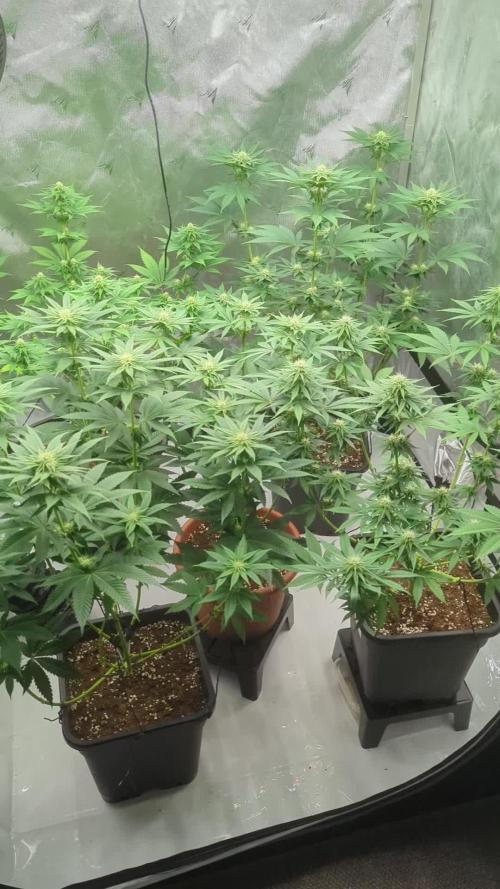
Mittlerweile sind alle Pflanzen voll in der Blüte. Alle zwei Tage wird gegossen. Den kleinen Ventilator habe ich durch einen großen 40cm/50W ersetzt. Der hängt verkehrt rum an der Decke und sorgt für eine Luftzirkulation. Besonders in der Nacht wenn die Luftfeuchtigkeit auf 80% geht. Der Geruch wird etwas intensiver. Ein wenig LST wende ich noch an. Die Bieger lasse ich aber höchstens 2 Tage dran. Keine Lust das mir ein dritter Seitentrieb abbricht.

Likes
35
Share
@valiotoro
Follow
A wonderful genetic thank you Fast Buds ❤️🔥🤩
The trim was super easy the buds are FAT & FROSTY full of resin 🤤
I’m very happy with the harvest 103g !!
For the light i’ve used the Spider Farmer SE-7000💡
Likes
11
Share
@NachoTheDog46
Follow
02 Feb 2022
Update:
I noticed a strange chromatic coloring on some leaves of the "older" plants, a couple of the smaller plants have small brown spots on the leaves ...
i also noticed that the grow tent is quite hot and the ground is quite dry, could be that the watering maybe is not enough, so from today i'll give a bit more water. I didn't expect that kind of temp from a led, adjusting the watering should goes better.
Light regime ☀️21/3🌑 temp ☀️22/32 🌑 18.5/22 humidity 48%
The lamp is till running it at 100% of his power but I just moved the lamp up to 70cm from the ground for more air flow and maybe the leds where to near the leafs, this why the chromed coloring on leafs?
03 Feb 2022
Update:
Light regime ☀️21/3🌑 temp ☀️24/28 🌑 18.5/24
Plants looks already more happy now!!! soon photo/video update
04 Feb2022
Update:
Little check and evrething looks great now, the new distance of the lamp did the magic , temperature is also much much better and stable, all plants look bit happyer now 😁
Light regime ☀️21/3🌑
temp ☀️22/26 🌑 20/18 humidity 51%
07 Feb 2022
Update:
With a Lamp distance of 70cm at 100% is going really good, temperature is right and the earth in the pots also stays moist longer, the new leaves on all plants are doing well and the two "older" plants are doing a lot of side arms. In the last couple of days I have been noticing an increase in the speed of growth. The little BlackBerry Banana is staying small but is making new leaves that look healthier than the plant was born, I wait another week before deciding what to do but most likely I will pull her out of the tent and she will grow as an outdoor plat looking out the window 😂
Light regime ☀️21/3🌑
temp ☀️22/26.9 🌑 19.5/22 humidity 59%
08 Feb 2022
Update:
After a little thinking i decided and Ijust moved the small BlackBerry Banana plant out the tent for a "Free" grow ☃️🌈🌤️
😅😅
More air/co2 space and lamp ☀️ for the other 8 plants.
Sometimes have to do wha need to be done.
Auto Blueberry Banana · Anesia Seeds
Wedding Cake Automatic · Zamnesia Seeds
Do-Si-Dos Automatic · Zamnesia Seeds
Girl Scout Cookies Automatic · Zamnesia Seeds
White Choco Autoflower · Amsterdam Genetics
Californian Snow Auto · Fast Buds
Diesel Automatic · Zamnesia Seeds
Purple Power Auto · Amsterdam Marijuana Seeds AMS
Likes
20
Share
@DrGanj
Follow
Bit of nute burn appeared on just one of these phenos overnight. I think this is as this plant flowers longer than my nute charts so did a bit of experimenting. Wil dial it back a bit at this stage next grow to avoid this and have dialled back a bit now, moving forwards. It's not too bad and still seems localised to certain parts of just one plant so not gonna stress about it.

Processing
Likes
29
Share
@Grey_Wolf
Follow
Ginger Nut Cookies & Aussie Music Videos
Fastbuds GSC x Barneys Red diesel
6 weeks of flowering completed
9th April 2020
Hi Everyone I hope you are all feeling well and keeping busy during the lockdown.
It's raining cats and dogs here (lucky there's no chinese around LMFAO)
and the humidity is 100% so today Ive chopped this little lady down and she is now drying up in my shed with fans going 24/7.
I was quite pleased with the amount of bud I got off her and it's smelling fantastic and is very sticky.The trichomes were very milky with a few amber as well. 😍
very easy to grow no fuss and no problems but we'll have to wait and see as to whether she is a good smoke or not .
Now for this weeks Aussie Music videos 👊
Because we are almost at the end of this grow I thought I had better add a few extra songs this week to make sure I get a decent selection of Diffrent music videos for you all to check out.
So for this weeks selections I chose
Empire of the Sun 👊
Walking on a Dream
https://youtu.be/eimgRedLkkU
Big Pig 👉 (from Bill n teds excellent adventure) 👊
I can't break away
https://youtu.be/f_rfXVdYelA
Peking duk 👊
Reprisal
https://youtu.be/4GboBAg2Syo
The white stripes 👊
Seven nation army
https://youtu.be/0J2QdDbelmY
Grinspoon 👊
Chemical Heart
https://youtu.be/58mXxWuUqYw
The hilltop hoods 👊
Leave my lonely
https://youtu.be/yKifJ4Q5ph0
And Silverchair 👉Not bad for a bunch of 16yr olds which they were at the time this video was made
https://www.youtube.com/watch?v=RZD982yrmx4
The Next update will be the Final harvest update with the dried n trimmed buds etc. I will also have to add another heap of tunes in that I had wanted to play ,
so keep an eye out for my next Update of Ginger Nut Cookies & Aussie Music videos .😀
Until then Stay safe and Keep lit And we'll all get thru this Together 🙏 👍
Likes
39
Share
@BelgianBudtender
Follow
'Sup Growmies, hope everyone's crop is doing great!
Buds! flowering has started and the first bud sites have established, my canopy is pretty even, and I am pretty happy with her at the moment, I cannot wait to see how these flowers develop!
The tent smells amazing, I cannot place the smell, its not your typical early flower weed smell, most of the normal green growth chlorophyll smell is already dying down.
My time-lapse camera broke, so i'll have to figure out something new because I really liked watching them grow. also added some extra shots of the canopy in the video, which is probably what I'll do next week as I find a solution.
I also want another bucket, outside of the tent, acting as reservoir, I think next week I am going to turn this DWC into a 1 bucket RDWC, for easier access and more importantly better temperature control.
Plus, this plant drinks way too much, I can't keep up, even with this massive 33 Litre mayonnaise bucket, I'll add a picture of what I have in mind..
Next week I am starting Green sensation, its a finisher, which will give this girl access to some much needed PK for those pretty flowers.
Thank you for stopping by, enjoy the rest of your week, stay safe; and keep growing!

Likes
43
Share
@CrazyRussian
Follow
This is the last week, when I gave nutrients to my girls. I think the harvest will be next week, or in 2 weeks. I had some trouble with them, because I increased the lights a couple of weeks ago, and they started foxtailing, and one of the plants turned a little bit red, because she tried to protect herself from the strong light. I decreased the lights a week ago back to 80%, but now as I' giving them only water I raised it again to 100%. These girls are more sensitive to strong light.
Note for myself for the future:
Only increase the lights if I stopped with the nutes, and I started flushing, because that will be only 1-2 weeks of intensive light. Overall they look, and smell incredible, can't wait to harvest them.

Likes
7
Share
@BudBrewerz
Follow
This fast version is doing very great imo. She became this very bushy lady with some awesome looking and smelling buds in her. I've just noticed that she smells really really sweet ... Cannot wait to taste her.
She is very close to done , I think I will have her another week at max before she gets harvested.
I kept her on the plagron bloom nutrients and the Green Sensation, until the end of last week and started flushing then.
Processing
Likes
7
Share
@Silverback_Guerilla
Follow
7/6:
Heavy thunderstorms last night and half the day today, so she won't be ready to eat again for a few days. I went out to the site about an hour after it quit raining today and saw HUNDREDS of tiny little green grasshoppers feasting on my girls!!! I immediately sprayed them all down with pyrethrins, and did it again right before dark.
I've got the fan blowing across the pots to try to dry them out faster.
I started using TPS One (one part nute solution) the other day, and the plants seem to love it. Really growing well, but I'm glad I amended their soil with some happy frog fruit and flower granular fertilizer this time. They get fed whether it's too wet or not.
7/7:
Rained again last night...and more hoppers again this morning, so i sprayed with pyrethrins.
7/12:
I tied down her main earlier this week and took about 5 or 6 cuttings from her today.
Sprayed with Bt-k again, with some fulvic acid and silica.

Likes
22
Share
@420_TRON
Follow
wet trim, nice buds, will update when more details are available
---
got 0.3g of crazy scissors hash - vaped a tiny bit of it and the high is amazing 🤩
---- 11/6/20
started curing & made some RSO of the trimming (~3ml)
---- 11/7/20
made a 2nd batch of RSO (~10ml)
Likes
28
Share
@rainman
Follow
Start of second week. Everything is going ok. Getting used to coco. Watering every day, getting about 10-20% runoff. No signs of problems on plant, seems to be healthy and happy. Getting about 10-20% runoff.
Day 8 - 500ml with nutrients.
Day 9 - 750ml with nutrients.
Day 10 - 600ml water.
Day 11 - 750ml with nutrients.
Day 12 - 750ml with nutrients.
Day 13 - 1L 250ml with nutrients.
Day 14 - 1.5L with nutrients.
Peace.

Likes
6
Share
@k0nz1
Follow
Big defoliation and lollipopping on day 18 flower. Now push Back und bulking Phase after. LO got a little stem split due to too heavy LST... Could fix it with wire and tape.
Trichome developement starts now and the smell in the tent ist getting stronger. LO already with a nice citrusy and sweet aroma.
Lights 100%
Temp 25/20 Celsius
RH 53-58 %
VPD 1.1 - 1.4


Likes
57
Share
@Organic_LarF
Follow
High GD community,
Week 14,
She is starting to stretch, not as much as the runtz, but also a nice short(3cm) internodal spacing.
1 feeding this week with bokashi juice, honey and molasses.
Thats it for this week boys and girls,
Thanks for reading and passing by and 💚💚💚👏👏👏👍👍👍 for Marshydro leds. Quality/price top!
Grow safe buds and feel free to check out my other ladies doing fine thanks!
🙏🌿🌿🌿🙏
Weedseedsexpress!!!! 👏👏👏
LarfxWSE for discount at weedseedsexpress!!! 15% off!!!
Zamnesia!!! 👽👽👽
Add OrganicLarF as a code when buying your own MarsHydro LED light and get a nice reduction!!!👽🚀🛸

Likes
97
Share
@Roberts
Follow
Big Jack widow grew great, and finish fast. She has some great frosty purple hues in her dense colas. The Viparspectra P4000 light worked great. I am Cutting her down, and will try to post a video here, but if it does not take it. The video can be found on my YouTube channel, link below. I learned a lot about the quality of water, and treating it properly this grow. So far roots on other grows has been great. This grow was saved by it just in time. Thank you Viparspectra, and Weed Seed Express. 🤜🤛💪❄️
Thank you grow diaries community for the 👇likes👇, follows, comments, and subscriptions on my YouTube channel👇. ❄️🌱🍻 Happy Growing 🌱🌱🌱
https://youtube.com/channel/UCAhN7yRzWLpcaRHhMIQ7X4g
Likes
39
Share
@Mastr
Follow
Hi everyone Today day 30 and I stop feeding with silica and I take co2 bag off too due make high humidity also I reduced bio grow from 3ml to 1ml for this week next week i will stop bio grow till harvest
And I done aggressive defoliation on bottom almost take half leafs down
Update day 39 I done another defoliation and some lst to keep them separate from each other guys the orange sherbat is thirsty strain and seems she love nutrients she drank twice a day and each time 1.5L nutrients whitch is
.5 calmag
2ml heaven
2ml activera
2ml alg amic
2ml bloom
1ml top max
Because they are in small pot so I don't wanna give lots off water so I prefer to feed them twice a day
Likes
15
Share
@moritz
Follow
Week 6 is a short one. Humidity is high as shit but I've just ordered a dehumidifier. VPD sadly is only at about 0.8 mPa during the Day and wayy lower at night.
Processing
Likes
43
Share
@Master_weeda
Follow
Bonjour à tous les padawans et maîtres jedis
Jour98 grosse defoliation et léger arrosage
Jour101 arrosage avec 2, 5 litres d'eau ph6.3

Processing
Likes
6
Share
@Jabberwolky
Follow
The Ladies are going great so far this week the buds are comming in really nice. the smell is wonderfull
Kind soil as a base media and roots organic on the top.
only di water
Its really nice not having to worry about the ppms and ph of water and this n that ...
so far this grow is just want i need
nite time temp dropped below 58 a clp times on me .. i hope it done hurt the outcome to much
Processing
Likes
1
Share
@Mr_nugs_lover_David
Follow
She's stinky as hell,very powerful aroma, so sweet and floral, loving her so far, hope I can grow this strain many more times, that smell it's hard to forget. Hope you enjoy, I put my heart on every plant! 💚 🌱 ✌️ 💎
Likes
11
Share
@DrDuhboto
Follow
This week I inoculated the room leaves and plants with Neoseiulus cucumeris, I have had minor thrip problems all summer, Usually I use lady bugs to combat them but none have been available this year.
I inoculated the plants by shaking the bottle full of Cucumeris and bran over the leaves. I will do this a few times before pre flowers show.
Cucmeris are predatory mites that eat the thrip larvae. And are supposed to work for spider mites as well.
I added the scrog nets to the room and began training the plants through them.
I then flipped the lights over to 12 and Initiated pre flower.
All vegetative growth was very vigorous.
The goal of this grow is to do a preliminary test to begin to determine if Mycelium provides any additional benefits to Cannabis when allowed to colonize in super soil before being added to bottom layer of the pot.
The Process:
1) 8 weeks Prior to Germination Super Soil is mixed (see super Sub cools super soil recipe further down the page) and added to spinning two part composter, water is added and the super soil mix is allowed to break down for a week.
2) 7 weeks Prior To germination 1L of colonized mycelium is added to each side of composter. Mycelium is now allowed to colonize the super soil.
3) After 8 weeks total the Mycelium has had enough time to colonize throughout the super soil mix and is ready to be added to the bottom 1/3rd of the pots. See Pictures for an example of what this looks like.


