The Grow Awards 2026 🏆 








Likes
Comments
Share
@Nicogreen
Follow
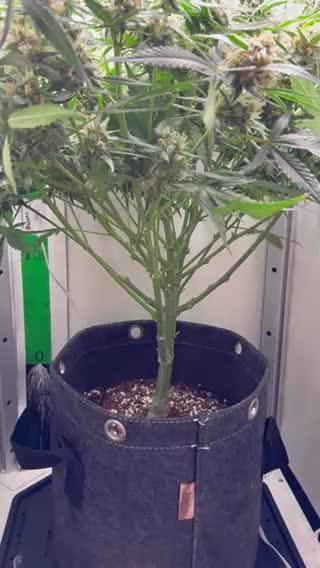
Kunne ikke være bedre og har vist fundet ud af en del siden sidst år må man sige,, jeg skal starte på vækst hus gartneri skole 🚸 til september 👌 😇 💪 🇩🇰 🤞 🙏🏼 💚 💚 ❤️


Likes
4
Share
@Miqgro
Follow
3oz dry weight from 1 plant! The maximum I've managed before was 18g and 20g per plant so a huge improvement from my first grow. Only issue is the buds came out airy, the tent was a bit hot throughout so think I need to up the airflow to remove excess heat in future grows. :) I've sealed the bud into mason jars now for curing, hopefully should be smokable in the early new year!
Likes
12
Share
@Jays_Not_Here_Man
Follow
This was their last week! Harvested on Day 60. Smells are incredible, tricomes are carpeted and have a good mix of amber and cloudy. Love the wireless microscope I got of Amazon ❤️ i gave the girls their last watering on day 55 , and I watered till I had about 15% runoff. I like to whole plant hang dry my plants in my tent, hopefully, aiming for about 60 degrees and 60% humidity for about 10-14 days. Typically the more there is, the longer it takes. i cant wait! 🤤

Likes
17
Share
@gottagrowsometime
Follow
Candy Cream Go Fast Kannabia, 16-17 weeks in. She was stuck in a small for for faaaar to long. She vegged well. But took along time to reach out its roots. But she's turned into a beautiful plant. I'll try explain as best I can until I find device with full veg pics
Veg weeks 4-6-------2l pot
She grew & grew as much as the 2L would allow. She was the biggest 2L pot phenos I've ever seen. She starting sexing & took ages to recover back into full veg.
Veg weeks 6-10------18L pot
She took a long time to recoup. As she started sexing on me. It took over a week or more to start growing again, as she was in the 2L pot. But she kicked off into a rapid spurt of growth.
Flipping wait weeks 10-13
Took nearly a month before I started seeing full pre flower. I expected as much. As I brought her back from from nearly sexing it took about a week to get back Into any form of veg.
HEAVY FLOWER 14-17
Flower weeks Weeks 10-17 Sadly I can't find my device with all the pics. These are what the pics ive took in the pastv3 weeks. She's roughly 4-5 weeks into flower & doing really well. She took about 3 weeks to go into preflower as it grew so many shoots after I uppoted from 2L to 18L from veg week 6 or so. (Far to late for this fast mover). So, the pre flower you see there. That's the 4th of Feb. That took 4 weeks or so to FULLY flip. But if not rootbound, she's UBER QUICK.
Veg nutes were used right up until it started ro sex, and was kept under my p1000 / hs1000 light/tent right up until I got tired of putting it into my dark room
DISCOUNT CODES L
20% off Kannabia & Xpert Nutrients with code: GGST
20% off Oringal Sensible Seeds with code:GGSTGD
20% off Zamnesias entire catalogue with code: ZAMMIGROW2024

Likes
2
Share
@FourTwenty_Plants
Follow
Sooo I added a scrog net a few days ago to get the branches more outward beacuse they were growing way to bushy. Seems to be a good solution!
Did a nother update for this week because of the trichome beauty that they have.
They both smell really really fruity and somewhat gassy, if you ever grew a Cherry Cola from FastBuds and you loved the smell then this strain is specially for you. The smell reminds me so hard of the Cherry Cola and I fcking love it
Likes
27
Share
@Dreamchvser
Follow
Hello Friends 👋🏾
I had a few problems with nutrient deficiency as you could see last week, I managed to solve the issue. I started feeding them nutrients again, as they really started growing fast.
I did a lot of defoliation and lollipoping today, as I want the plant to focus all its energy to the top.
They drink roughly 3-4L every 3-4 days, I increased my VPD to 1.3 and will go up to 1.4 in 2 weeks, shortly before flushing. I’ll lower the feeding to 2L and will check how long it lasts.
Thanks for all your advice and feedback so far ☺️ I appreciate every single one following my journey

Likes
107
Share
@Tropicannibis_Todd
Follow
💩Holy Crap Growmies We Are Back💩
Entire grow has been stunted by the soil/medium
Code Name FBT2309
Well growmies we are at 42 days in and everything is going great 👌
👉 So the low stress training👈 has been going great she's gonna be a big girl, shes in full flowering mode so let the stretch begin 👌
Lights being readjusted and chart updated .........👍rain water to be used entire growth👈
👉I used NutriNPK for nutrients for my grows and welcome anyone to give them a try .👈
👉 www.nutrinpk.com 👈
NutriNPK Cal MAG 14-0-14
NutriNPK Grow 28-14-14
NutriNPK Bloom 8-20-30
NutriNPK Bloom Booster 0-52-34
I GOT MULTIPLE DIARIES ON THE GO 😱 please check them out 😎
👉THANKS FOR TAKING THE TIME TO GO OVER MY DIARIES 👈
Likes
37
Share
@MG2009
Follow
09/12/2018
Purple tip cutting seems to be taking .#1 is filling out well lots of fresh flowers stacking up nicely.#2,#3,#4 all doing well👍hope they finish up in 4weeks🙏 No feeding this week just molasses for soil microbes,
09/17/2019
Did some defoiliating and green tie 's to spread out lower branches on #1 . she is a beast. Seeing, some differences between #2,#3,#4 .#4 being darker green, #3 is paler green #2 not as pale, #1 lighter green but not pale at all. Given deep soaking today, and I noticed phase 3 flowering is starting!🙏 should start stacking them fat buds for next couple of weeks hope she done at 10 weeks fingers crossed.
Likes
33
Share
@420DeepGrow
Follow
Gracias al equipo de Sweet Seeds, Marshydro, XpertNutrients y Trolmaster sin ellos esto no sería posible.
💐🍁 Sweet Mandarine Zkittlez F1 FV :
Genética feminizada y fotodependiente de floración ultrarrápida. Primera generación filial (F1) resultante del cruce entre un clon élite de Zkittlez (muy potente y resinoso, con un marcado aroma tipo Sour Diesel cítrico, entre naranja y mandarina) y nuestra Sweet Mimosa XL Auto (SWS94) que también tiene tonos aromáticos cítricos entre naranja y mandarina.
El resultado del cruce es una vigorosa variedad híbrida fotodependiente muy resinosa, potente y aromática.
El aroma de esta variedad es delicioso, con tonos Sour Diesel muy especiados, tonos de naranja y mango, fondo amaderado y lejanas pinceladas frescas como de pino o hierba recién cortada.
Algunos individuos pueden mostrar flores y hojas con tonos púrpuras y rojizos al final de la floración.
El efecto es enérgico, alegre y estimulante de la concentración y la creatividad.
💡TS-3000 + TS-1000: se usaran dos de las lámparas de la serie TS de Marshydro, para cubrir todas las necesidades de las plantas durante el ciclo de cultivo, uso las dos lámparas en floracion para llegar a toda la carpa de 1.50 x 1.50 x 1.80.
https://marshydro.eu/products/mars-hydro-ts-3000-led-grow-light/
🏠 : Marshydro 1.50 x 1.50 x 1.80, carpa 100% estanca con ventanas laterales para llegar a todos los lugares durante el grow
https://marshydro.eu/products/diy-150x150x200cm-grow-tent-kit
🌬️💨 Marshydro 6inch + filtro carbon para evitar olores indeseables.
https://marshydro.eu/products/ifresh-smart-6inch-filter-kits/
💻 Trolmaster Tent-X TCS-1 como controlador de luz, optimiza tu cultivo con la última tecnología del mercado, desde donde puedes controlar todos los parametros.
https://www.trolmaster.com/Products/Details/TCS-1.
🍣🍦🌴 Xpert Nutrients es una empresa especializada en la producción y comercialización de fertilizantes líquidos y tierras, que garantizan excelentes cosechas y un crecimiento activo para sus plantas durante todas las fases de cultivo.
Consigue aqui tus Nutrientes:
https://xpertnutrients.com/es/shop/
📆 Semana 4:
Aparecieron un monton de erizos esta semana, el temporal ha hecho algo de mella en la carpa al bajar las temperaturas aunque todo sigue correcto.
Continuamos con las dosis de nutrientes recomendadas por el fabricante.

Likes
27
Share
@GrowersParadise
Follow
Been back to cruise control now after having a few questionable spots pop up on random leaves which I’m pretty confident was PH swing and temp shock when changing the res out.
Once everything is back to being stable, new growth looked fine.
The EC/PPM is dropping slowly along with water consumption daily, looks to be in a good spot for now. I have been defoliating leaves blocking tops in the middle, and I’ve been pinching out the tops on the plants as well.
I cut my lights back just a touch in hopes I could get a little more vertical growth, these things are stocky!! Maybe that’s the Mammoth Si at work..
See you next week!


Likes
12
Share
@BLKSWN
Follow
Another late week, but... so like I said I add the 300w led (150w)to the room and I think the girl is loving it. I had to raise the HPS up due to the heat, so the HPS is at 17” from the top of the canopy and the LED at 12”. The colour in the room is unbelievable. I can’t wait to see how this GG turns out.

Likes
3
Share
@Lesjardiniers420
Follow
Week 2 of flower and week 8 from seed , the plants have really started spewing THC and they are looking and smelling amazing . The Black gelatos color has started coming in some are light purple some are very dark purple . If you'd like to know anything specific please leave a comment and I'll do my best to answer it .
Likes
Comments
Share
@CCSAUTOVGROW
Follow
Thickening up nicely. I recently did a light defoliation to make sure nothing was blocking the light. Nice medium sized buds. Nicely frosted. She smells delicious. Like cookies & cream. 😏
Likes
21
Share
@Highgrade_Harvests
Follow
Week 10 is all done. This plant is by far the most beautiful cannabis plant I've ever grown. The genetics are amazing. Everything from the bud structure to the fading patterns is what you want to see in a plant. The smell is amazing and it is completely covered in trichomes. More
than last week which I didn't think was possible. They just look completely frosted over now. Can't wait to smoke test! I will do a video of the harvest and maybe some timelapse videos to close this grow out! Thanks for following along!

Likes
3
Share
@Rabidreject
Follow
So yeh this weeks been good. This is the first flowering entry even tho they’ve been on a 12/12 cycle for about a week now because I wanted to at least see pre flowers before I started the flower entries. I now see a few but not on all plants. Not long tho I suspect.
Everything is going great. These are the tallest plants at the mo and they are just preying too the light. They look so beautiful. I did lollipop them and spread the growth nodes out quite a bit with LSTing and they’ve responded beautifully.
It’s such a relief coming from photos to know i can make a couple mistakes if I like and if I don’t make any my god do they reward you and respond well!!!
I’ll be going back in at day 42 of flower to tidy up again but they are good for now 👍

Likes
14
Share
@Paultemp
Follow
Hi all! 😊👊
Week 1 flower
Og kush
7 gallons pot
Hp promix soil
Remo nutrient
Aelius led 300gh
1 gallons water every 2 days
Start nutrient for flower 2 days after flipper 12/12
Likes
27
Share
@LSchnabel
Follow
This plant was amazing from start to finish.
I will update a final comment soon as well as final weigh and a review of the smoke once sent out to a group of testers.


Likes
7
Share
@HIAZ_urbanbudfarmer
Follow
Hello to all , Do-si-do's are going well #1 is 21 days old , the others around 15 days old. #2 was a bit mutated (leaves) but is coming back. Upgraded to a Mars Hydro Fce 4800, a very nice light ,good build quality, great coverage . Start Lst this week, increased nutes & feeding, every 2 hours for 15 minutes. Till next week Gromie's rock on🤙🤪🤘

Likes
10
Share
@DogDoctorOfficial
Follow
Grow Update — GMO Cookies
Week 6 from seed | 12/12 from seed
Marked as: Week 1 Flower
Quick recap for anyone just joining
This is a 12/12 from seed run, meaning plants have been grown under a flowering light schedule from day one. Because of that, development doesn’t follow the classic “veg → flip → flower” timeline. Instead, plants express themselves at their own pace, and structure, stretch, and flowering signals appear more organically.
Now, in week 6 from seed, there’s no doubt anymore: this GMO Cookies is in flower.
⸻
Current environment (stable & shared across the room)
• Temperature: ~27.5 °C
• Humidity: ~65%
• CO₂: ~900 ppm
• PPFD: ~600–850
• Smaller plants: ~600–700
• Taller plants: up to ~800–850
Light intensity is intentionally staggered. Plants are allowed to grow into the photons naturally, rather than forcing a flat PPFD across different genetics and sizes. This helps maintain balance and reduces stress during stretch.
⸻
Root zone & watering
• pH: 6.5
• EC: 2.4
• Root / reservoir temperature: ~17 °C
Slightly on the cold side, acknowledged. Still within a manageable range, and plants are responding well.
⸻
Nutrition — why the switch happened
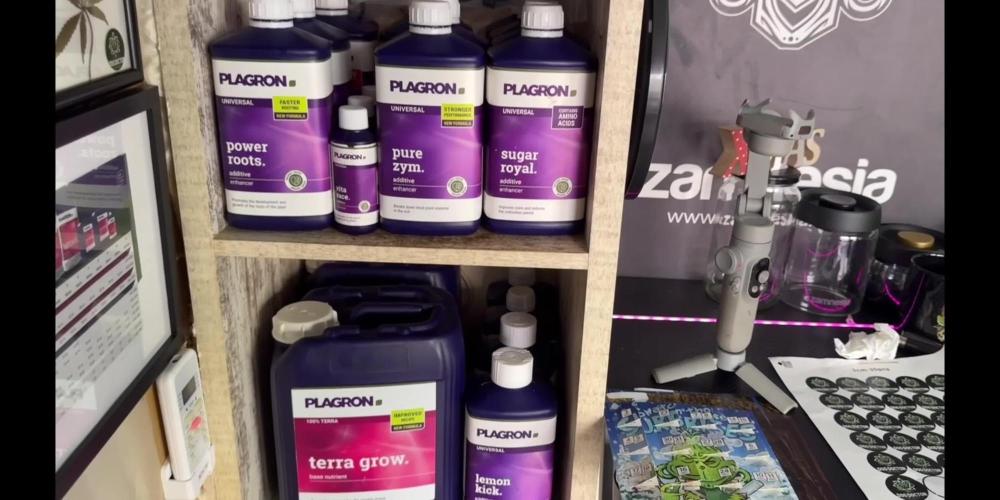
• Switched from Plagron Terra Grow → Terra Bloom
• Following the Plagron feeding schedule
• This was the only intentional change
As plants clearly entered flower, nitrogen-forward feeding (Terra Grow) was no longer appropriate. The switch to Terra Bloom reflects what the plant is now asking for:
👉 support for stretch, branching, and early flower development.
The feeding schedule is being adapted slightly to match uptake speed and plant response, rather than followed blindly. Observation first, bottles second.
⸻
Training & plant behavior
Low stress training is ongoing:
• Leaf bending
• Gentle positioning
• No aggressive topping or hard stress
The response has been excellent.
This GMO Cookies is:
• Stretching evenly
• Branching beautifully
• Forming compact, bushy structures
What you see now are little green bushes, with multiple tops forming naturally. Those “little balls” and dense branching patterns are exactly what we want at this stage — it means the plant is distributing energy well and preparing multiple flowering sites.
Color is strong, healthy green, with no signs of active stress.
⸻
What this means
• Training is working
• Environment is dialed
• Nutrition is aligned with the plant’s phase
• The plant is confident enough to push structure and flower at the same time
This is the kind of growth that doesn’t happen by force — it happens when conditions allow it.
⸻
What to expect next week
• Continued stretch
• Clearer flower formation at branch tips
• More defined structure as internodes space out
What not to expect
• Instant bud stacking
• A frozen structure (she’s still moving)
• Identical behavior to other genetics in the room
Each plant runs its own race.
⸻
Final thoughts & thanks
This 8x8 has been a real roller coaster — emotionally, visually, and educationally — and this GMO Cookies is no exception. Watching her respond, adapt, and thrive has been a pleasure.
Huge thanks to:
• The OGs
• The newcomers
• The lovers and the haters
• The sponsors
• The platform
• And the community that makes these diaries worth writing
It’s truly an honor to share these grows openly.
Week 6 from seed.
Week 1 flower.
We move forward 🌱
FOR DISCOUNT CODES AND MORE JUST FOLLOW THE LINK https://website.beacons.ai/dogdoctorofficial
📲 Don’t forget to Subscribe and follow me on Instagram and YouTube @DogDoctorOfficial for exclusive content, real-time updates, and behind-the-scenes magic. We’ve got so much more coming, including transplanting and all the amazing techniques that go along with it. You won’t want to miss it.GrowDiaries Journal: https://growdiaries.com/grower/dogdoctorofficial
Instagram: https://www.instagram.com/dogdoctorofficial/
YouTube: https://www.youtube.com/@dogdoctorofficial
⸻
Explore the Gear that Powers My Grow
If you’re curious about the tech I’m using, check out these links:
🔆 Lighting & Environmental Control
• Future of Grow — Advanced LED lighting technology
https://www.futureofgrow.com/
DISCOUNT CODE: DOG20
• Lumiflora — Under-canopy LED lighting
https://lumiflorade.com/
• TrollMaster — Environmental controllers and automation gear (past collaboration)
⸻
Genetics
• Zamnesia Seeds — Genetics used in this project
https://www.zamnesia.com/
⸻
🌱 Soil, Substrates, Boosters & Root Support
• Plagron — Substrates, bio mixes, and supportive products
https://plagron.com/en/
⸻
🎒 Storage, Curing & Preservation
• Grove Bags — Curing and storage solutions
https://grovebags.com/
⸻
📸 Photography Equipment & Tools
(Not sponsors, but part of my creative toolkit)
• Sony A6700
• Sony full-frame macro lens + few more
• Stacking photography workflow - learning
• iPhone (for behind-the-scenes shots)
We’ve got much more coming as we move through the grow cycles. Trust me, you won’t want to miss the next steps, let’s push the boundaries of indoor horticulture together!
As always, this is shared for educational purposes, aiming to spread understanding and appreciation for this plant. Let’s celebrate it responsibly and continue to learn and grow together.
With true love comes happiness. Always believe in yourself, and always do things expecting nothing and with an open heart. Be a giver, and the universe will give back in ways you could never imagine.
💚 Growers love to all 💚
📸 P.S. – The Eye Behind the Lens
All photos in this diary (for now — except for the ones showing the camera, which I took with an iPhone) are taken with a Sony A6700 paired with a Sony full-frame macro lens and a few more.
Photography is part of the story — it’s how we share the fine textures, the glow, and the quiet details that words can’t always capture.
I’ve also started experimenting with photo stacking — a technique where multiple images, each taken at a slightly different focus point, are layered together to create one perfectly sharp image from front to back.
It’s not digital enhancement or AI; it’s pure photography — a way to reveal the plant’s beauty in microscopic depth, from trichome to petal.
You’ll even see a few shots of "ghost me" capturing the shots — camera, lens, setup — because every grow deserves not just to be cultivated, but documented like art.
FOR DISCOUNT CODES AND MORE JUST FOLLOW THE LINK https://website.beacons.ai/dogdoctorofficial
NEW DISCORD - Official Server Invite Link : https://discord.gg/ksjAkA5T74