




Likes
Comments
Share

@DogDoctorOfficial
Follow
? Blueberry Muffin – Pheno B
Week 5 | Letting the Plant Choose Her Own Pace
One of the reasons I love growing multiple phenotypes from the same seed pack is that they constantly remind me of one important lesson…
Genetics always have the final word.
Even when plants share the same parents, the same environment, the same nutrition and exactly the same lighting schedule, each one develops its own personality.
Blueberry Muffin Pheno B is proving exactly that.
While her sister is already comfortably stepping into flowering, this lady is taking her time, continuing to build structure before fully committing to bloom.
And honestly…
I’m perfectly happy to let her decide.
⸻
🌱 The 12/12 From Seed Journey
For anyone joining this diary for the first time, welcome!
This entire project is being grown using the 12/12 from seed method, meaning the lighting schedule has remained at 12 hours of light and 12 hours of darkness from the very beginning of the grow.
Unlike traditional cultivation, where growers decide exactly when flowering begins by changing the light cycle, this method leaves much of that decision to the plant itself.
Each phenotype transitions when its genetics decide the moment is right.
That’s exactly what we’re seeing here.
Although the first pre-flower signs are beginning to appear, I still consider this another week of vegetative growth.
She simply hasn’t committed enough to flowering for me to officially change the diary yet.
It’s a perfect example of how two sisters can follow completely different timelines while growing side by side.
⸻
🌿 Building Structure Before Flowers
Rather than rushing her into bloom, this week focused on preparing the strongest possible foundation.
Pheno B naturally grows with an extremely compact structure, producing very short internodal spacing and dense foliage.
That beautiful compactness comes with one small challenge…
Light struggles to reach the interior of the canopy.
To help with that, I spent the week using gentle Low Stress Training together with regular leaf tucking to expose developing shoots hidden beneath the large fan leaves.
Toward the end of the week I also performed a very light defoliation.
Nothing aggressive.
Just removing a few carefully selected leaves to improve airflow and allow more light to reach the inner branches.
Sometimes less really is more.
By the end of the week the results were already becoming visible, with several lower shoots responding by stretching upward and beginning to develop into future flowering branches.
Exactly the response I was hoping for.
⸻
💧 Hand Feeding Continues
Unlike her sister, Pheno B remains completely hand-watered.
For now I want full control over how she receives her nutrients while continuing to observe how this phenotype develops naturally.
Hand watering also allows me to monitor her appetite closely and make adjustments whenever necessary based on her individual needs rather than following the same routine as the AutoPot system.
As always, every plant earns its own management strategy.
⸻
🍽️ Feeding
This week’s feeding consisted of the complete Plagron program, including:
• Terra Grow – 1.8 ml/L
• Terra Bloom – 1.8 ml/L
• Pure Zym – 1 ml/L
• Sugar Royal – 1 ml/L
• Power Roots – 1 ml/L
• Power Buds – 1 ml/L
The introduction of Terra Bloom and Power Buds marks another exciting milestone as the plant slowly begins preparing for reproductive growth.
Although she’s still spending most of her energy building structure, it’s the perfect moment to begin supporting what’s coming next.
Solution parameters remained stable with an EC around 1.78 mS/cm and a pH of approximately 6.02, providing a balanced nutrient profile while keeping the root zone healthy.
⸻
🌡️ Environment
The room continues running under intentionally warm conditions.
Day temperatures averaged around 31.1°C, nighttime temperatures remained close to 25°C, relative humidity stayed around 72%, and atmospheric CO₂ measured approximately 693 ppm.
Those humidity levels are still intentional.
At this stage I’m encouraging vigorous vegetative expansion and allowing the plants to establish as much healthy biomass as possible before gradually reducing humidity later in flowering.
It’s all part of preparing for healthier flowers in the weeks ahead.
⸻
📸 This Week Behind the Lens
This week’s photographs beautifully capture the personality of Pheno B.
She’s noticeably shorter than her sister, yet incredibly dense.
The studio side profiles reveal a stocky plant packed with tightly spaced growth sites, while the bird’s-eye photographs highlight just how compact her canopy has become.
Several close-up images also document the early effects of leaf tucking and the gentle defoliation, showing new shoots beginning to emerge from areas that were previously hidden beneath large fan leaves.
Watching those branches respond over only a few days is one of those quiet victories that makes plant training so rewarding.
⸻
🔍 Looking Ahead
Next week should answer one of the biggest questions of this grow.
Will Pheno B finally commit fully to flowering?
Or will she continue investing another week into structure before stretching?
Either outcome is perfectly welcome.
If she continues vegetative growth, I’ll maintain gentle training and keep opening the canopy to encourage even more secondary branching.
If flowering officially begins, the focus will shift toward supporting the stretch while maintaining an open, evenly lit canopy.
Whatever she decides…
I’ll simply help her become the best version of herself.
⸻
💚 Thank You
Thank you to everyone following this journey and taking the time to grow alongside me.
Every comment, every question, every shared experience—and yes, even every constructive criticism—helps make these diaries more valuable for growers all around the world.
Special thanks to:
💚 GrowDiaries for providing a platform where growers can document every success, mistake and lesson.
Zamnesia for these wonderful Blueberry Muffin genetics, already demonstrating just how unique individual phenotypes can be.
🌱 Plagron for supplying the complete nutrition program that keeps these plants healthy from seed to harvest.
💡 Future of Grow LED for delivering the consistent light that powers every stage of this adventure.
And finally, thank you for following this 8×8 project.
Whether you’re here to learn something new, compare techniques, cheer the plants on, or simply enjoy the journey, I’m genuinely grateful to have you here.
Growers Love and see you next week… where we’ll discover whether Blueberry Muffin Pheno B finally decides it’s time to bloom, or keeps reminding us that nature follows its own schedule. 🌱💙
Likes
3
Share

@Ketamine
Follow
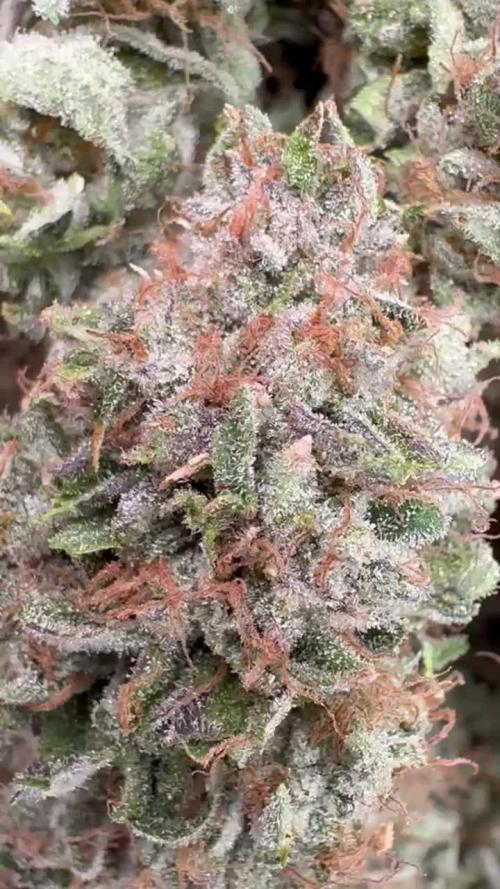
This run should yield about 2.5 ounces a plant I would estimate, maybe more. I will update this in about 2 weeks to let ya know after it has dry'd/cured.
If that estimate is accurate which it likely is not that is like .6g/watt which is poor result. But then again I am looking at the top canopy and not really even seen the underneath. We will see. Short lil plants for sure, that typically yield on the lower end. I am excited to start the next one which will be TOAD VENOM bred by Green Dragon in N.Hollywood.

Processing
Likes
15
Share


@donovanliam
Follow
Took the 3 other plants out side, 2 out in the country one in my backyard. So she has full range of the tent just switched from 14-10. So the stretch should start soon :) oh and I dont water it daily just when it drys usually 2days.




Likes
1
Share


@OldskoolHed
Follow
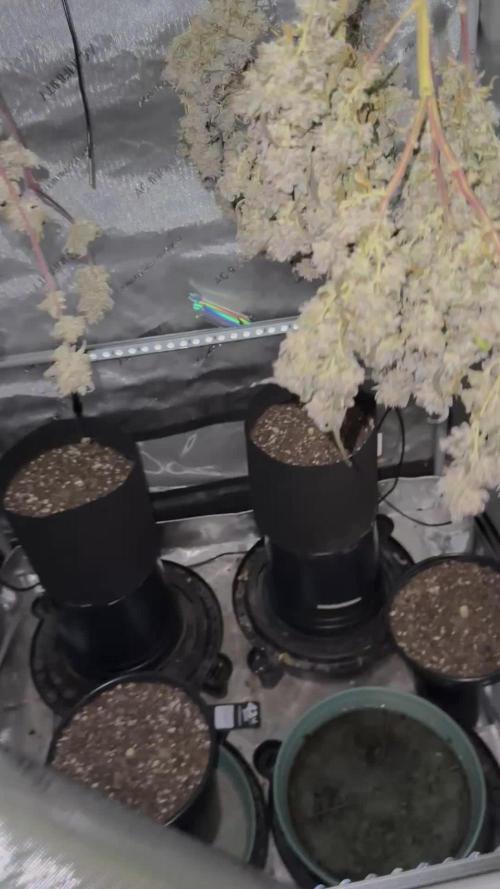
Super thick resinous buds the size of my forearm. Started flush. Will chop at day 65
Likes
19
Share


@Mzsnoop2001
Follow
2da semana de flora y cambio positivo para las quebradas 😅 Blue Moby ni se enteró del supercroping accidental lo que si quedo con baja estatura que las demás. moby dick se recupero de la arrancada de la.punta principal 💪 viene un poco atrasada en flora en comparación a ww y bm pero viene remontando. Whithe widow viene súper bien y florando con cambios día a día 😍 está semana defolie las 3 por última vez y agregue una segunda malla de scrog para evitar el error anterior de quebrarla queriendola entrenar!
Como siempre acepto criticas y concejos gracias y buena semana!! 🤝


Likes
79
Share


@Belverde
Follow
(At the end of the photographs there is a video .. if you look at them enlarged it does not appear on smartphones and tablets)
All by handmade..
Welcome Ganja lovers 🌍🌎🌏
We are today at the conclusion of this exciting cultivation journal
I hope you have already enjoyed the photos of these beautiful flowers 🙂
In the end they speak better than me..
But anyway..
This was a very good experience
KALINI ASIA is an amazing Kush strain 👌👌
I have grown all five seeds that ZAMNESIA sent us, each with something different..some nutrients or the specific cultivation technique..
But in the end the story was the same
Vigorous
Resistant
Great aroma
Good trichome production
And heavy buds production
🔝🔝
I went far enough beyond the timing reported by the seed bank, it could probably have affected the heat wave in the last month 🌡️🌡️🌡️
Especially K # 5 performed more like a Sativa, even in the very fox-tailed shape of the buds.
Personally I love them 😍🔥
However, apart from K # 4, all the others showed flowers with that shape.
By researching, I discovered that genetics from Asia tend to show flowers with these characteristics..
The effect is still purely Kush, and so is the flavor.
But the inflorescence production is really powerful.
The buds have grown almost entirely on each branch.
Concerning the purple / dark pink colors..
K # 1 and K # 3 did not show these shades, but as terpenes they were the same
K # 2 was the only one grown in an 11l pot practicing lst, exactly like K # 1-3, but where I used my Living soil..
Its colors ranged from rosy to purple, and it was a sight to behold as it slowly depleted all nutrients.
To be honest it is the best and with the most delicious scents of all five 🙌
To its detriment, however, it has a much lower production than its two sisters in 11l..
[ For lovers of numbers I will report some data later ]
K# 4 also presented colors tending to pink / purple, less marked than K # 2-5..
On its side it had a greater resin production 🚀
But I think the (accidental) topping has slowed her down a bit 🤔✂️
K # 5 instead was the one with the darkest purple color of all..
But now it has turned more towards a brownish / purple color..
However, I repeat..
Slightly different look
But flowers with the same fragrances and effects.
As I reported above, this strain is very Kush, so it tends to be earthy and spicy with some citrus notes in the distance.
Kush effect, sweet calm of the senses.
Personally I find it a ganja to use regardless of the time of day or the various chores done ..
Also good for sleeping : 1:
Most users will find it more suitable for relaxing moments..
Anyway
I generally use vaporizers , because I find them the top from all points of view..
And I generally vape between 180 ° up to 200 ° using mighty or ghost mv1 and sometimes dynavap m.
Top flavor and effect 🤩
However, to better assess the quality of the flowers, he always carried out a smoke test
Organic papers and filters and only weed, no tobacco or blunt..
Four weeks after the cut, I carried out a first pre-test for each single plant..
The weed was already burning very well and the ash was, and is, a nice light gray color..
This test was done precisely to evaluate drying.
To properly evaluate the flavor, especially with varieties with Kush-style terpenes, I wait at least two months after cutting..
So I did another test for each one, and the taste was great 👌👌
In the video you saw I instead decided to roll a nice two-gram joint, with a mix of all five flowers 😎😁
Solo test 🛸
All excellent : 1:: 1:: 1:
I love Kush so I'm biased
A really good variety that I can only recommend !
.......... ......... ....... .....
About the nutrients
Leaving aside the one grown in the Living soil, all the others drew nutrients mainly from the fertilizer that ZAMNESIA sent us..
The MONSTER-MIX
What to say..
Really a great product
Extremely easy to use
With a cocoa scent that makes you want to eat it once opened
And plants really appreciate it
🔝👌💯🔥
I have never checked the pH, as I do with my Living soil, and everything went top ..
With one bag I managed to feed four of them almost entirely
In addition to the MONSTER-MIX and my Living soil, I have added all mycorrhiza plants during transplantation.
Also, from the fourth week of life onwards, I used some liquid organic stimulant.
Below I report the exact quantities I used for each product (total calculation)
For K # 1-2-3 I used, each for each one
_Rootjuice (Biobizz) 4ml
_Bioheaven (**) 7.5ml
_Topmax (**) 13ml
_Activera (**) 4ml
_Activator (Biomagno) 4ml
_Biomass (**) 0.5ml
_Voodojuice (Advanced Nutrients) 6,5ml
_Piranha (**) 6.5ml
_Tarantula (**) 6,5ml
_Rinhoskin (**) 15,5ml
_Sensizym (**) 13ml
_Molasses 23ml
For K # 4-5 something less (total sum values, each)
_Rootjuice (Biobizz) 3ml
_Bioheaven (**) 7.5ml
_Topmax (**) 6.25ml
_Activera (**) 3ml
_Activator (Biomagno) 2.25ml
_Voodojuice (Advanced Nutrients) 2.25ml
_Piranha (**) 2.25ml
_Tarantula (**) 2.25ml
_Rinhoskin (**) 6.75ml
_Sensizym (**) 6ml
_Molasses 10,5ml
Regarding mycorrhias, I have used an Italian patented product for many years which is called Micosat F 👌👌👌
I spread about 10g in contact with the roots
On top of that, I just washed it down with normal water
.......... ......... ....... .....
Always remaining in the field of numbers, for lovers of the sector I report below the various days of vegetative, flowering and respective quantities by weight of the flowers (weighed after drying, precise manicure and maturation of two months in a glass jar)
K # 1/2/3
_VEG STAGE: 6 weeks
_BLOOM STAGE: 10 weeks
K # 4
_VEG STAGE: 5 weeks
_BLOOM STAGE: 10 weeks
K # 5
_VEG STAGE: 4 weeks
_BLOOM STAGE: 11.5 weeks
Regarding the final production, I report the various weight systems below
_K #1 52g
_K #2 31g
_K #3 55g
_K #4 21g
_K #5 41g
As lighting I first used a 205w Optica2 led panel in the vegetative phase, but in addition to them there were also two other plants
During the flowering phase I switched to using two Black-dog LED panels, each of 200w
But even in this phase, the girls divided the light source together with another plant (CORAÇÃO BRASILEIRO diary...55g dry buds) and two more in the last week ..
So , 400w for six plants
💡💡💡💡 × 🌿🌿🌿🌿🌿🌳
Personally I am more than satisfied with the yield compared to the final quality.
.......... ......... ....... .....
What to say more
To be honest, this genetics literally surprised me
I can only recommend it to everyone and, even if you don't find the purple phenotype, don't worry too much ..
However, you will have a lady plant in your hands who will be able to give you many large and fragrant flowers ..
Thanks to Grow Diaries and especially Zamnesia for this opportunity 🙏
And thank you all for appreciating : 1:: 1:: 1:
I am looking forward to other similar competitions..
Because personally, every day of these weeks has been a victory.
Having the chance to grow cannabis is already the biggest reward 💚
Until next time..
Stay connected 😎
Ciao ✌️
🇮🇹
.
.
.
(The support sticks used, which were a little too long, were unfortunately the only ones I found during lockdown)😅

Likes
24
Share


@OGOZHigh
Follow
Denn Ladys geht es bis jetzt hervorragend.
Die Buds werden jetzt so langsam dicker 🎊✌️

Likes
34
Share


@PrairieFrostGrow
Follow
***** Week 10 growth - February 13 to 19, 2021 - Week 2 Flower *****
Mandarin Mimosa is certainly growing beautifully!!! MM1 has been strong and a taller grower from the start. MM2 however has taken off in stretch.......she is also being grown in a 3gal pot so she will be slightly smaller than MM1. These are 1:1 girls but I am really looking forward to smoking this strain😍👍 The terps should start coming out more over the next couple of weeks, Terpinator being added now as well to assist with aromas. Tips up on these girls almost all day long, they are the happiest in the tent this week😂😂
2nd SCROG layer in now....finally😞 Lots of work to do in cleaning up the lower leaves next week. Will do larger leaf strip and lolipoping when they start focusing more on bud development.
Light is at 24” only pulling 310 watt, and the meter at the tops of the girls is roughly 28,500LUX. It is feeling like it’s a little strong for them but it’s close......the curling leaves is slowly increasing on the tops. By the end of the week we are at 400watts and reading 38,500LUX, this should be roughly 980 umol/s/m2.......over 900 and less than 1,000.......should be good for going into week 3.
Nutrients switched over to flower schedule and following week 2.....but so-called back a couple of items. Adding some other items beyond IPP line so backing off some of the ppm to compensate. Still only one “feeding” per week. Early flower so hitting the microbes a little harder this week and next and then slowly start backing off. I like Remo’s Natures Candy for sweetener because it has humic, sweetener and old school molasses, amongst other things to feed the microbes as they are in coco. Bud Fusion being used now for pk boost.........no more “red kool-aid”😂 Still adding Rezin from Green Planet becuase it seems to boost my trichome quantity.....Terpinator likely this week as well......increase some of the sulfer to increase aromas.
Little more detail.......
Feb 13/21 - Day 8
- 3.5L watering with CalMag @ 1ml, Nature’s Candy @ 1ml, Resin @ 1.5ml
Feb 14/21 - Day 9
- 2nd SCROG added today.....finally. Plucked a bunch more leaves in the process
- watering with microbes only today. Recharge has some molasses in it so just adding that.
- 4L water for these girls with Recharge @ 1/2 tsp/gal
- 320ppm and 6.0pH
Feb 15/21 - Day 10
- today is big feed day....its been 7 days.
- 3L each girl with all the IPP line as listed plus silica @ 1ml, Nature’s Candy @ 1ml. (Bud Fusion was 0.2gr/L)
- 1325ppm and 6.0pH
- Girls gave run off at 3L today so didn’t push past that.
Feb 16/21 - Day 11
- some feed left from yesterday so added 6L of plain water to dilute it and watered into the girls tonight.
- 3L full feed of nutrients for each girl
- 800ppm and 6.1pH
Feb 17/21 - Day 12
- 3L each girl with Terpinator and CalMag @ 2ml, Nature’s Candy @ 1ml, Recharge @ 1/2 tsp/gal
- 775ppm and 6.1pH
- increased light power to 350 watts. Now at 32,500LUX.......take it slow over the next week and keep creeping up. Leaves have a bit of a taco shape coming out and looking fairly serrated at the edges.....pushing the light intensity on the tops👍
- leaf colour on the girls is very good......tips are not burnt either.
Feb 18/21 - Day 13
-3L each girl of plain water today
- added beneficial bacteria and enzymes @ 1.5ml
- 330ppm and 5.9pH
- was looking for a little lower pH as I have not been checking runoff.
- have to do a leaf strip this weekend......start of week 3.
- light power increased again, 400 watts now.
Feb 19/21 - Day 14
- day out day.......they have not had one in a bit.
- humidity was higher today as door to grow room closed today to assist clones with more humidity.
So that takes us through two weeks of flower now. Not knowing these girls enough yet, I suspect feeding will stop at the end of week 6. That leaves four more weeks. I will treat the next two weeks like mid flower for nutes, and the following two weeks as late flower. Feed supplements accordingly. These two girls are very happy and looking like we should get some nice colas from MM1!! They are rocking ETS.......looking forward to seeing the bud swelling next couple of weeks💪👍👊

Likes
5
Share


@Black_Venom
Follow
Harvest in week 12. But I screwed up, I didn't have enough room to separate each variety, so I would put an average weight when everything was dry... I had done everything well, I had to mistake on the place of the drying bag
Last pictures, mixed buds
Likes
2
Share


@Budking420
Follow
She was a little dried out before this update I gotta admit. So shes a little upset but otherwise looking really good. Shes drinking a lot right now! Check back next week for more

Likes
5
Share

@psychonaut420
Follow
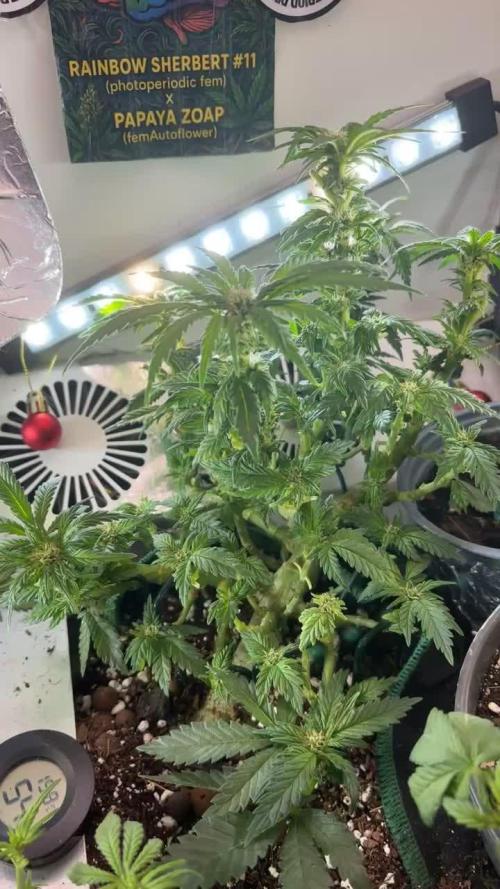
She’s developing her bud formation nicely hopefully see more and more fattening and more stretching of the side branches so far so good

Likes
10
Share

@Simba732
Follow
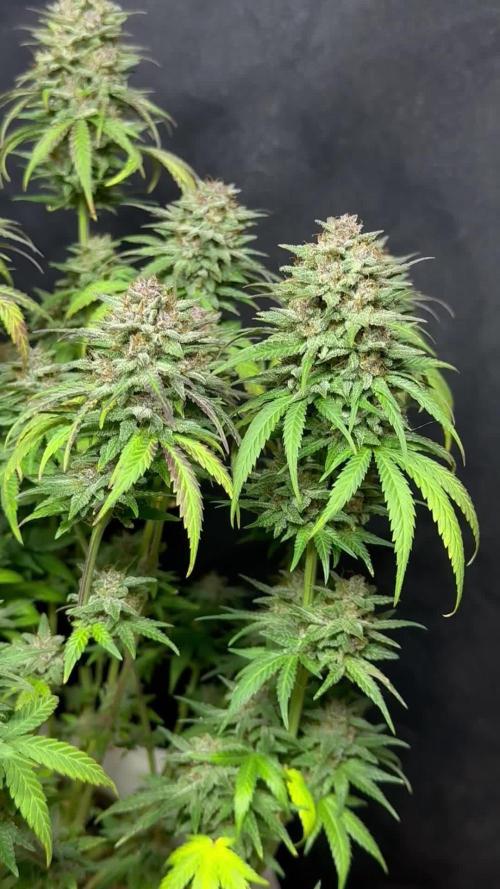
✨ And just like that, Ms. Purple’s final feeding week has officially come to a close!
She’s smelling absolutely divine right now, so fragrant that you can’t even walk past the tent without getting smacked in the face by her delicious aroma 😋🍌🌸
She got cleaned lightly before these pics. I checked her trichomes again and boom we’ve hit that sweet spot we’ve been waiting for!
Starting this week, we’re ditching the nutrients and giving her that clean, smooth finish with a proper Flawless Flush 🚿💎
It’s truly been a joy raising this big girl. Learned a lot, laughed a lot, and she definitely kept things exciting from start to finish!
Thanks for rocking with me through this journey!
Happy new month & happy growing 💚🌿
Likes
12
Share

@Northern_Ent
Follow
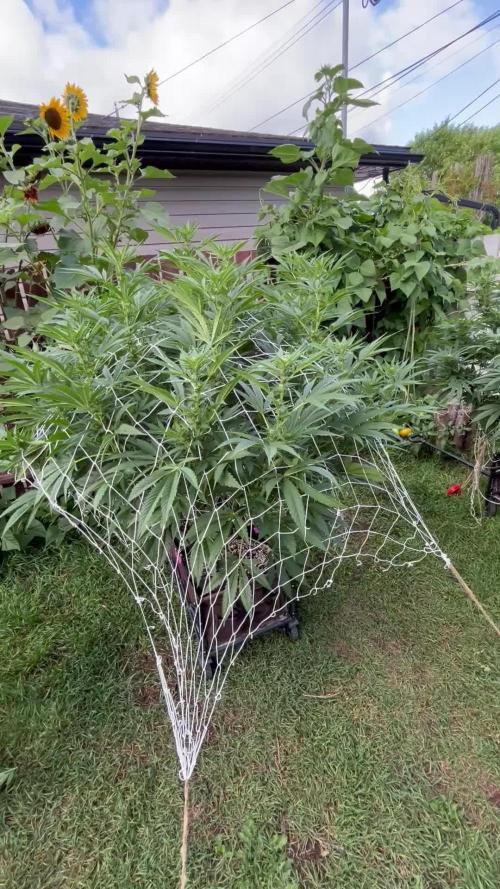
Aug 2: Tropicana Cookies FF is three weeks younger than my two biggest plants (Sunday Punch EV and Mimosa Shot) and two weeks younger than Lemon Cream Kush. This is a very strong plant and is progressing very well.
This wagon with LCK started force flowering a week later than the other wagon and will go another week longer.
TC is now the tallest of the four plants despite being the youngest.
Aug 5: now done force flowering after 2.5 weeks. Plants in this wagon are getting too big to easily get into garage. Continuing to use far red light as a bloom booster at dusk. Back to 15.5 h of daylight in the backyard now.
Aug 7: now 51 inches so she’s had a quick vertical growth spurt. Looking very happy with leaves ‘praying’ upwards nicely.
Likes
12
Share


@CaliforniaOGkush
Follow
they all made it through the nasty summer heat. now the weather has changed here in California let's see how theese girls bloom


Likes
4
Share


@Santica_Garden
Follow
So this is how things are looking for the ladies at the end of Week 9 of Flower, through out week 9 they have been getting just plain PH water for the flushing stage.
One thing I forgot to mention on the video is that I checked the ladies Trichomes and only one of them is ready for harvest, the other shorter lady needs another week or so.
But I will upload the videos for you guys. And check out the Phat Budz on these ladies 😍😍😍


Processing
Likes
29
Share


