Processing
Likes
Comments
Share
@MG2009
Follow
08/13/2019 Another rainy day. Recovering from topping and,fimming. Looking good for start of flower, soon. 08/18/2019 Did a little training.
Likes
9
Share
@Green4H
Follow
Hello growers, it's another week and I'm giving another video of my plants, I know that no one knows what they are like, but it's the first time, so I'm glad that they are what they are, thank you to everyone who answered my questions as much as possible, I'm trying to apply your advice in practice.. .Thanks again for any advice…
Likes
14
Share
Posting the phenos when I do them
Processing
Likes
7
Share
@BongRip
Follow
Terrible week. Day 43 - No sign of over-fed. They are doing great regardless the ppm so I checked online and found out the ppm In organic soil could be higher and it's normal. Anyhow, I gave my plants plain PHed water after the fed, and the run off is about 1800ppm. I think I will remain around this ppm for coming weeks. Day 45 - Half of the Led broke. Day 46 - Gave them natural sunlight. Accidentally broke the main stem :(((( Day 47 - New Light, New Tent! (It's BloomPlus BP-1500 light)
Likes
4
Share
This is the biggest auto and best to date of my doing she is very exciting to watch 💜🍓🥛 🌱 I just started giving all my plants nutrients so we will see how this works out now 👌😂📚 happy growing fam
Likes
25
Share
@7THBEZ
Follow
hi, everyone👉😍 Let's Go😘👍 she look very nice with the LST that i give to her😘 i feel this week maybe the last week for veg 😝 so, i water with "homemade mixed for veg" (the old one) 👍😘 and add some "homemade mixed for bloom" 😵👉😵😂 i also do defoliation the twin leaf under the twin branch 😂😭😖 😍👈the twin branch is fine👉😍 edit : 17/9 , i start water with homemade mixed for bloom🙌 for next week i will change the diary to flowering period😊 thank you for watching 👊 hope all of you enjoy , see ya✋
Likes
52
Share
Its time to prepare for war. *Blows bagpipe* FISH SH!T THE ORGANIC SOIL CONDITIONER (used twice before and always noticed instantly) Fish Shit is a living product! It provides a complex Microbial profile that includes thousands of different species of bacteria, fungi, and protozoa. This profile is closer to a natural ecosystem than anything you will find on the market. Fish Shit helps release essential oils and terpenes which contribute to the building of a myriad of flavonoids. Flavanoids play a key role in the development of the most potent aromas and tasteful flavors of a plant and its fruit. Fish Shit contains beneficial microorganisms that help plants maximize nutrient uptake. It does this by transforming nutrients into more usable forms and keeping these nutrients in the soil longer. During photosynthesis plants naturally produce exudates (chemicals that are secreted through their roots). Through these exudates, plants can attract the types of good bacteria that are beneficial to them at different points in their growing cycle. These good bacteria cover the roots and act as a barrier to the invasion of disease-causing organisms that may harm the plant. What Are Enzymes? Before we dive headfirst into how, exactly, enzymes can benefit cannabis plants, it helps to understand a little about what these microscopic proteins do. Essentially, enzymes facilitate chemical reactions. They do so by binding with a substrate and forming or breaking molecular bonds. In this context, the substrate is the molecule upon which an enzyme acts to boost the efficiency of a reaction. •substrate /sŭb′strāt″/ •noun •The material or substance on which an enzyme acts. A surface on which an organism grows or is attached. An underlying layer; a substratum. Enzymes are proteins with complex 3D shapes that feature regions called active sites. When the substrate binds to these active sites, it forms an enzyme-substrate complex that causes a chemical reaction to take place, temporarily changing the structure of the enzyme and ultimately causing molecules to either come together or break apart. As a result, molecular products are released, and the enzyme returns to its original shape. Specific enzymes are capable of binding with certain substrates, as the substrate fits into the active site more or less via a lock-and-key principle. Although, new research suggests a more accurate theory of "induced fit", in which enzymes and substrates undergo structural changes to facilitate the reaction. If you take the human body as an example, we have an abundance of enzymes in our saliva and digestive system. These molecules bind with substrates in these regions (food particles), working to break down the food we eat into usable parts before converting them to energy. Enzymes in cannabis work in a similar way to the example highlighted above. Typically, enzymes occur in soil naturally, but if your soil mix is lacking organic material, or you're growing hydroponically, then adding enzymes directly to the substrate is crucial. By using them in cannabis growing, enzymes not only help break down essential nutrients into smaller, more readily available pieces, but they also support the digestion of dead root cells, clearing a direct path for nutrients. Overall, enzymes make it easier for your cannabis plants to absorb all the elements they need to reach their full potential. For growers, a plant that reaches its full potential means a bucketload of juicy buds come harvest. This is essential if you want to reuse a pot with old systems left over like mine. Common plant enzymes include: •Cellulase •Xylanase •Beta-glucosidase •Hemicellulase •Amidase Amino acids are a crucial, yet basic unit of protein, and they contain an amino group and a carboxylic group. They play an extensive role in the gene expression process, which includes an adjustment of protein functions that facilitate messenger RNA Nitrogen, phosphorus, and potassium are the three main pillars of nutrient solutions and fertilizers, but there are countless other nutrients that your cannabis plants need to produce the best possible harvest. Amino acids are one of them. You may have noticed that amino acids get a lot of attention from bodybuilders and other athletes. That’s because they play a key role in the synthesis of protein, which, as you probably know, is super important for sports recovery and muscle growth. Amino acids are the building blocks of protein and the foundation of both plant and animal life. But what do amino acids do for cannabis? WHY IS PROTEIN IMPORTANT FOR CANNABIS? Just like proteins are important for the human body, they are equally important for the growth and development of plants. For example, proteins help plants: •Facilitate the growth of intracellular plant structures •Promote energy generation •Stimulate metabolic processes •Facilitate the absorption and transportation of nutrients So, where do plants get these vital proteins from? Well, unlike humans, plants can’t source proteins or amino acids from other organisms. Instead, they need to create their own amino acids, and then use these to build protein. That's why gardeners, much like athletes, go wild for amino acid supplements. Amino acids help plants by… • Increasing their production of chlorophyll, which ultimately improves their ability to photosynthesize • Serving as an easily absorbable form of nitrogen • Stimulating the synthesis of key vitamins • Improving their resistance to pests and diseases • Boosting the strength of their cells Amino acids also serve as the precursors to auxins, a group of plant hormones produced in the meristems—the apex of the stems where new leaves and stems are born. Auxins play a key role in the plant, activating genes for plant growth and development by triggering a multitude of vital plant functions. In other words, they determine what its size and architecture will look like. Auxins influence the development of branches, flowers, and roots, and even help to regulate the photoperiod response of the plant. Some amino acids, like cysteine, also work together with antioxidants like glutathione to help cannabis plants deal with oxidative stress, which can be caused by high-intensity lighting, some nutrient solutions, and high levels of CO₂. Unlike humans, plants can synthesize all the amino acids they need to survive and develop properly. Unfortunately, however, amino acid synthesis is a really high-energy process, and plants may struggle to produce enough amino acids when exposed to stress. WHAT FACTORS AFFECT A PLANT’S ABILITY TO SYNTHESISE AMINO ACIDS? Any kind of stress can affect a plant’s ability to produce enough amino acids. This includes: • Drought • Temperature extremes • Poor soil health • Pests • Diseases • Poor lighting • Lack of space • Poor root health WHAT DOES ALL OF THIS MEAN FOR WEED PLANTS? If you want to push your plants to their extreme in terms of floral growth and resin production, you should look into amino acid fertilizers. By making amino acids readily available to your plants, they’ll be able to use crucial energy to grow and bloom, rather than focusing on synthesizing amino acids themselves. Game of Inches, this is another Plants can absorb amino acids via their roots and leaves. They can also benefit from amino acids during both their vegetative and flowering phases. The fastest way for plants to absorb amino acids is via their leaves. The foliar application of amino acids is believed to improve the transportation of nutrients, increase transpiration, and boost photosynthesis. Hence, I recommend feeding your plants with foliar amino acid fertilizers. When doing so, however, carefully measure the amount of fertilizer you use, as—like with any nutrient—overfeeding can damage your plants. FOLIAR FEED AND SOIL SOAK • 1 crushed queen anne carrot • Add 2 tbsp of NPK Raw powdered water-soluble cane molasses • 20ml h2o2 • 1 crushed radish • 0.25 tsp NPK Enzymes • 0.25 tsp NPK Amino Acids • 50ml coconut water ( nature's own amniotic fluid packed with amino, enzymes ) + The sound of songbirds. Onto the predators 1250 -Green Lacewings Lacewings are extremely voracious predatory insects that feed on several pests. In adulthood, it feeds on pollen and nectar. In the larval stage, it feeds on aphids, thrips, and mealybugs at all stages of growth. It can also attack spider mites in moderate quantities. It is initially an aphid predator, but very effectively controls thrips and mealybugs infestations. It is so voracious that in the absence of prey, it will feed on its congeners. Lacewings are cannibalistic if there is no food available for them. It is therefore important to introduce them into an infestation situation, and not just preventively. •congener /kŏn′jə-nər/ •noun •A member of the same kind, class, or group. •An organism belonging to the same taxonomic genus as another organism. •A thing of the same kind as. or nearly allied to, another; specifically, in botany and zoology, a plant or an animal belonging to the same genus as another or to one nearly allied. Ideal temperature 20°C – 26°C Ideal humidity 60% – 70% Predatory stage life cycle 21 days Introduction rate 4 weeks Storage Refrigerator Use Immediately Are there any specific instructions on how to use this predator? Lacewings are available on small paper cards that you can hang to plant stems. On the cards are dozens of eggs ready to hatch. There are also sterile eggs they can feed on once they have hatched before they are ready to disperse in the foliage. It is important to use them quickly upon receipt to avoid cannibalism. If you don't use them right away, you can store the cards in the refrigerator for 24 to 48 hours to prevent the eggs from hatching too quickly. Avoid storing them for longer than this or you risk losing eggs. 1250 eggs are divided into 7.5 cards, 2500 eggs on 15 cards, and 5000 on 30 cards. The application rate is one card per square meter of growing surface. Is this predator best used for preventive or curative treatments? Lacewings are used as a curative solution. Anything else I should know? Lacewing eggs hatch approximately 24-72 hours after the cards are exposed to room temperature. When they emerge, the lacewings are just 1.5-2 mm long. They are very small so they are difficult to see. Once hatched, they will stay on the cards for a few hours and then disperse in the foliage. You quickly lose sight of them if you have not witnessed the hatching. They then live in the foliage for about 3 weeks. Often, you will see them towards the end of their larval cycle. After feeding for 3 weeks, they will triple and even quadruple in size. At that point, they are easier to see. But they remain very discreet insects, it is not abnormal not to see them. Egg carcasses left behind on the cards do not disappear after the hatching has happened. It's normal to see eggs still on the cards. Visually it is very similar before and after hatching. Also, on the boxes, there are sterile ephestia eggs which are used to feed the lacewings once hatched. Not all lacewing eggs are viable either. Only a certain percentage of lacewing eggs will hatch. Once hatched, the eggs are white. You can observe this using a magnifying glass. With, 5000 Stratiolaelaps Scimitus It is used to prevent or control thrips pupae, fungus gnats larvae, and root mealybugs in the soil. It can also be used for red mites in bird farms or hen houses. The adult is about 1 mm long and is medium brown with a beige triangle on its back. Another fun fact about them is they can survive without prey. They can eat algae and plant debris. This is why they can reproduce and stay in plants for long periods. Ideal temperature 15°C – 23°C Predatory stage life cycle 18 days Introduction rate 2 weeks Storage Room temperature Use Within one week Are there any specific instructions on how to use this predator? Sprinkle directly on the growing media. They can live in all types of substrates like potting soil, coconut fiber, rock wool, cedar mulch, etc. Stratiolaelaps establish easily so they are permanently fighting pests. One introduction is generally enough unless you have an infestation. In this case, introduce them at least twice at a 2-week interval for best results. If you grow your plants in a 100% mineral substrate, it will have to be released more often since there is less organic matter than in traditional soil. Do I need to take any specific precautions? Stratiolaelaps breed in the top layer of the soil. So it is important not to disturb them in the first days following their introduction. They don't like temperatures below 8 ° C. So be sure not to introduce them in a water-saturated or cold environment. Release them 24-48 hours after your last watering. They are very sensitive to chemical acaricides and diatomaceous earth. These methods are incompatible with their use.
Likes
8
Share
Lots of hairs this week had a bit of an airline issue on the airstones I fixed it and the leaves stopped curling downward so they are looking alot better did my usual weekly feeding 6 oz of each remo nutes and ph water 5.8 added as well cannazyne for the breakdown of old dead roots helps keep things clean and productive lots of hairs and new top development through each plant right plant started getting some yellow leaves I defoliated then and will continue to monitor for any issues but also going to re defoliate and take out those bottom useless larfe nugs
Likes
62
Share
@MeaCulpa
Follow
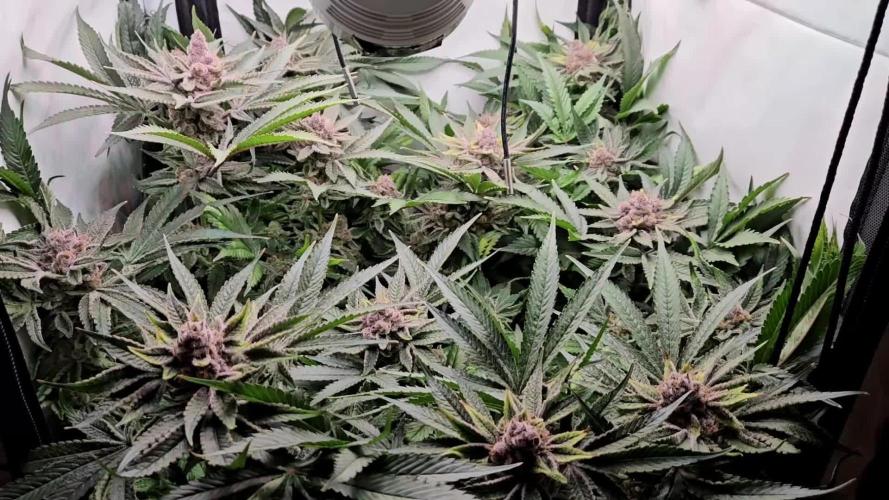
Third week in bloom. Everything is going well. My only concern is that I have defoliated too much and my humidity is too high. Difficult to get it down when it's just raining outside. I'll see what happens... 19.12.2023 I've made some space and flanged my old 60x60x120cm tent on the right site and switched on another PC fan. I hope I haven't made a serious mistake. All fans repositioned. And everything is taped off so that no light comes in. That was too crowded. Next time 4 or 5 will be enough for me.
Likes
11
Share
Ho sistemato LST giornalmente perché continuano a crearsi nuove ramificazioni e gemme ovunque. Sto irrigando con 0.5L di acqua ogni giorno, ma credo dovrò passare a 1lt perché l’assorbe subito. Giorno 35 - l’apicale si é spezzato al 50% ho provveduto subito a mettergli del nastro di carta intorno e fargli un sostegno sotto per reggerlo nella sua posizione. Immagino che ora se dovesse sopravvivere avrà un blocco di qualche giorno. *Giorno 35 h.20.30 dopo solamente 6 ore l’apicale ha iniziato ad alzarsi da solo staccandosi dal sostegno, assurdo!
Likes
1
Share
Привет садоводы !!! Прошло ровно 10 недель и цветок готов Прекрасная генетика- супер auto запах очень приятный сладковатый карамельный и цветки увесистые Ставлю оценку Отлично !!!
Likes
Comments
Share
🌱 Folder 09 | Candy Rain Auto Week 1 – Finding Her Rhythm Welcome to the first chapter of Candy Rain Auto in the 8×8 Adventure. Unlike many of her neighbors, Candy Rain didn’t have the easiest start. She entered the room a few days later than the rest of the project, immediately placing herself at a slight disadvantage on paper. But plants don’t read calendars, and every phenotype writes its own story. The purpose of the 8×8 Adventure has always been exactly this: documenting every individual plant honestly, allowing each genetic to express itself naturally under identical conditions. There are no races here. Every plant is given the same opportunity to demonstrate what it is capable of. Already during this first week, Candy Rain is proving that patience is often rewarded. While initially producing only simple juvenile leaves, she quickly transitioned into healthy three-finger leaves, with each new set arriving larger, wider and noticeably more vigorous than the last. The journey has only just begun. ⸻ 🌿 Grow Environment The entire room remains carefully controlled to provide every cultivar with the same stable environment. Environmental Conditions * 🌡️ Day Temperature: 27°C * 🌙 Night Temperature: 25°C * 💧 Relative Humidity: 55% * 🌱 Substrate Temperature: 21°C * 💦 Nutrient Solution Temperature: 20°C * ⚡ EC: 1.3 * pH: 6.0 * 💨 CO₂: 666 ppm * 💡 Light Cycle: 12 / 12 From Seed * ? Pot Size: 15 Litres Because Candy Rain emerged slightly later than the rest of the room, irrigation has been adjusted specifically to her needs. Rather than following the volume given to the larger plants, watering remains concentrated around the young root zone, encouraging the roots to actively search through the substrate while avoiding unnecessary saturation. ⸻ 🌿 Nutrition Candy Rain is receiving exactly the same Plagron Terra program as the rest of the garden, simply scaled appropriately for her stage of development. Feeding Schedule * Terra Grow — 1.8 ml/L * Power Roots — 1 ml/L * Pure Zym — 1 ml/L * Sugar Royal — 1 ml/L * pH Plus — adjusted when necessary * Lemon Kick — adjusted when necessary The objective during these first weeks isn’t rapid top growth—it’s establishing a healthy root system capable of supporting explosive development once flowering begins. A strong foundation always pays dividends later. ⸻ 🌱 Plant Development Watching this week’s progression has been incredibly satisfying. The earliest photographs show a delicate young seedling still carrying its juvenile characteristics. By the end of the week, however, the transformation is obvious. The stem has thickened considerably. Leaf spacing has become more symmetrical. The newest growth appears increasingly vigorous. Most encouraging of all is the transition into beautifully formed three-finger leaves, signalling that the plant has fully entered active vegetative development. Each new node displays noticeably more energy than the previous one, suggesting that the initial establishment period is already behind her. Despite being the smallest plant in the room, she doesn’t appear weak. Quite the opposite—she appears determined. ⸻ 📸 Behind This Week’s Photos Sometimes the smallest plants create the most rewarding photographs. The early overhead images capture a tiny seedling standing almost alone within a large container, emphasizing just how much potential still lies beneath the surface. As the week progresses, every photograph tells a different story. The side profiles reveal a stem becoming stronger each day, while the overhead shots beautifully document the increasing symmetry of the canopy. One of my favorite moments is seeing those first fully developed three-finger leaves spreading confidently across the frame. They’re small, but perfectly formed, and they represent the moment where Candy Rain truly begins her journey. Macro photography reminds us that growth doesn’t always happen dramatically. Sometimes the biggest victories are measured in millimetres. ⸻ 🌿 Looking Forward Next week should be particularly exciting. With the root system now becoming established, I expect noticeably faster vertical growth, larger fan leaves and shorter intervals between new nodes. The gap separating Candy Rain from the rest of the room should gradually begin to shrink. Autos often surprise us with sudden bursts of development once they settle into their final containers, and there are already signs that she may be preparing for exactly that. Her story isn’t about catching up. It’s about revealing what she’s capable of. ⸻ 💚 Thank You As always, thank you to every single person following this adventure. Whether you’ve been here since day one or you’ve only just discovered this diary, your encouragement, feedback and conversations are what make documenting every week so rewarding. This project isn’t simply about growing plants—it’s about learning together, sharing experiences and celebrating every stage of the journey. A huge thank you to GrowDiaries for providing a platform where growers from all over the world can learn from one another and document their passion. My sincere thanks also go to Plagron for providing the Terra nutrient line that is powering this entire 8×8 Adventure. Their products continue to deliver consistency, simplicity and reliability throughout every stage of growth. Finally, thank you to the incredible breeders whose genetics make projects like this possible. Every seed carries its own personality, and watching those differences unfold under identical conditions is one of the most fascinating parts of this journey. And of course… Growers Love and, Thank you for taking the time to follow along. One week at a time. One photograph at a time. One plant at a time. The 8×8 Adventure is only just getting started. 🌱💚
Likes
61
Share
@Roberts
Follow
Sweet Bourbon Kush is growing great in her little potter. She is starting to get into her bulking stage. Everything has been going good for her. I am really curious to see the final result. I have been increasing her feed as she is taking it great. She got some selective defoliation and some additional pruning where needed. Thank you Super Sativa Seed Club. 🤜🏻🤛🏻🌱🌱🌱 Thank you grow diaries community for the 👇likes👇, follows, comments, and subscriptions on my YouTube channel👇. ❄️🌱🍻 Happy Growing 🌱🌱🌱 https://youtube.com/channel/UCAhN7yRzWLpcaRHhMIQ7X4g
Likes
2
Share
@habibi
Follow
Die Lady scheint sich zu erholen👍
Likes
19
Share
Nice bright hues on the nugs and definitely the highest yield out of my whole grow this strain impressed me with the quality of the bud and how fast they stretched in flower smells fruity too 😋
Likes
80
Share
Hi all. Welcome to this run withbthe Viparspectra XS1500 which i was kindly sent to try by their helpful rep Valerie. As I have a fairly good space to use for my main grow , it seemed an ideal time to explore a few options while I wait for space to appear following upcoming harvests. The opportunity hit at a good time and has now driven the future play time. lol The light is a full spectrum 150W( at the socket) , Dimmable and very well made unit. As summer is here now , my concerns of more heat being an issue have stopped me from adding my other light so the smaller 2ftx2ft area covered by the XS1500 is a good option , The heatsink is built into the case design with a finned top to dissipate the heat so no noisy fans. Switching it on to full power was a nice surprise as the footprint was way wider than I had expected and the actual coverage is even better for my Nursery to harvest plan.... I am growing autos perpetually at present and have been able to throughput the plants with just 2 lights and using the overlaps at the edges to bring seedlings along to veg/flowering, as harvesting is finishing. The timing had been working well but the plants were getting smaller towards the last runs . I gave it some thought and Rh % came to mind. With the perpetual runs not having a higher rh in their veg periods due to other plants needing a lower Rh% in flower , the vapour pressure deficit (vpd) was not within veg periods healthier range. This current run has exploded and filled my normal space very quickly which in turn means I cannot use the same principle as the last perpetual run of bringing the next ones along ready for the exchanges. The XS1500 takes care of this issue with it being perfect for an initial nursery light that is easily covering all the new seedlings but is also able to cover my experimental "5 plant 1 Pot" attempt. I have placed 5 of my own autob seeds from a previous seeding in a single 60 L pot and intend to strip them to their 4th nodes and only allow 2 mains per plant to develop and flower. Inam hoping to have 10 mains growing in it that will be under the xs1500 solely as the other plants outgrow the lights footprint and space they are in. They will go into the main grow space once able so i can really see how well this new light can flower with the 10 mains to fill the space. Until that point , I will diary as we go and see what we can achieve.
Likes
7
Share
estamos no 6° dia de 12/12 por aqui, ela está crescendo muito e tomando muita água. Esperar mais uns 10 dias pra fazer uma limpeza de folhas e seguir no MiP mais uma semana. já comecei a usar JLF ( jadam) faz 10 dias pra suprir algo que possa faltar. estou gostando demais do desenvolvimento dela.
Likes
3
Share
@Kokot
Follow
I went to vacation and my roommate didnt water them at all… they were near dead when i came home… probably lost like a week of growth.
Likes
5
Share
@Stork
Follow
Day 77 Mon Refresh water and nuts PH 5.8 EC 1.0 DLI 12h PPFD Water 28c Day 78 Tue Add Bloom B PH 4.7 - 5.8 EC 1.0 - 1.2 DLI 12h PPFD Water 20 Day 77 Mon Refresh water and nuts PH 5.8 EC 1.0 DLI 12h PPFD Water 28c Day 78 Tue Add Bloom B PH 4.7 - 5.8 EC 1.0 - 1.2 DLI 12h PPFD Water 20 Day 79 Wed Add water PH 5.8 - 5.9 EC 1.3 - 0.9 DLI 12h PPFD Water 20 Day 80 Thu PH 6.0 EC 1.0 DLI 12h PPFD Water 20 Day 81 Fri Refresh water and add nuts PH 5.9 EC 0.7 DLI 12h PPFD Water 25 Day 82 Sat PH 6.1 - 5.8 EC 0.8 - 0.9 DLI 12h PPFD Water 23c Day 83 Sun PH 5.7 EC 0.9 DLI 12h PPFD Water 23c
Likes
81
Share
Well this was my second seed I had too pop as the very one did not germinate , so she is 1 week behind the rest of my garden , but thankfully this pip popped within days , very excited about this one as I've never seen let alone smoked red bud before eeeek !!
Likes
33
Share
@Theia
Follow
I love this plant. She is so strong and grows with a lot of vigor. I am a little annoyed as I have been quite busy so I have been feeding the room the same mix and I think this one is started to show signs she is pissed off at me . There are the start of nutrient burn on her tips. I do not like this. I do not want this. So I I'll make her a slightly different feed this week and reduce the EC by a bit. Back down to a 1.5-1.6ec . Lights are at 40% drawing 180w. Lovely..😎 Uvb is not on yet as I have been away working and don't want to scare my wife away from the great job she does feeding when I'm away.. so I will deploy it as soon as I'm back and can be around to observe the effect.. it's all new to me so a bit of a lesson to carry forward to future grows... Thanks for passing. Grow well 🌿💚🌿🙏🏼