Likes
30
Share
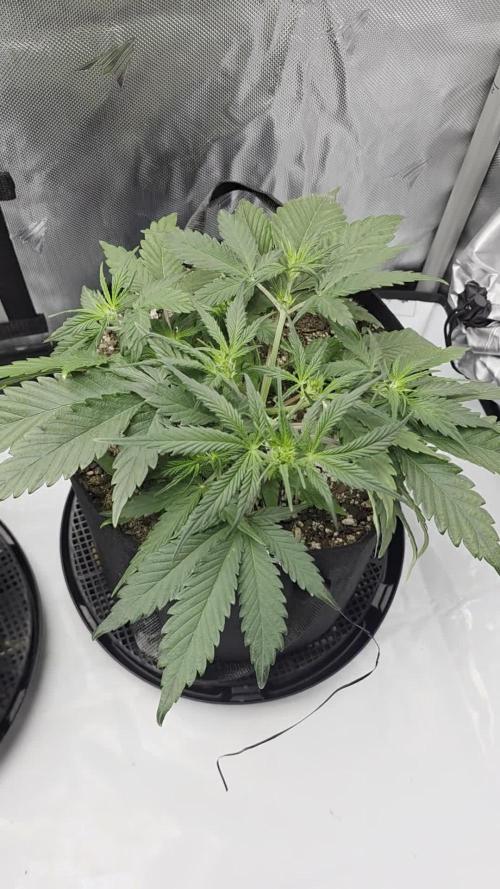
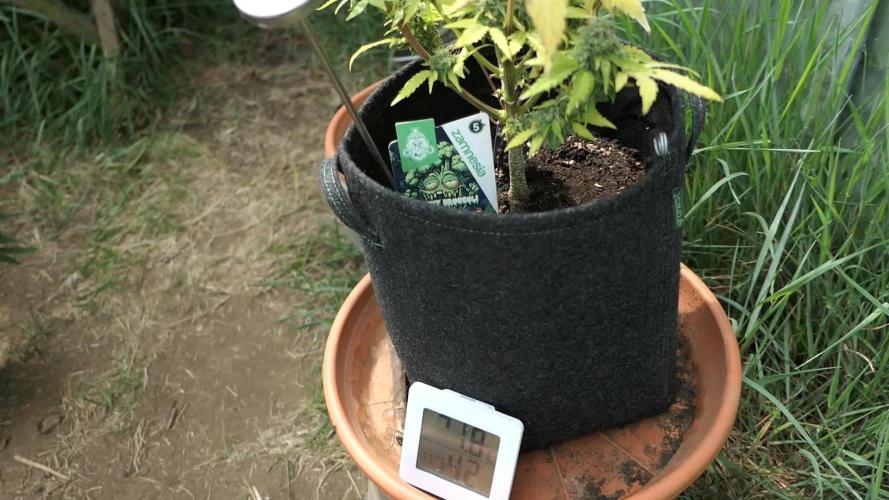
10000 ml jeden 3 Tag in der zwanzigste Woche pH-Wert: 6,2 EC-Wert: 1,1 mS/cm Temperatur: 24ºC Luftfeuchtigkeit: 60% Schädlingsbekämpfung: / Düngemittel: Sie bekommen ab jetzt Brenneseljauche da sie im Outdoor Bereich ist. Besonderheiten: Wir mussten sie jetzt toppen da sie zu hoch wurde und das Dach berührte, es besteht die Gefahr von Schimmel oder das die Blätter Schlächter wachsen. -Tag 136 immer noch in vegetative Phase 😖 -Tag 137 Heute hat sie 10l Wasser mit 1l Brenneseljauche bekommen
Likes
104
Share
The growth is going quite well this week. I've selected the 3 best plants (one of each strain) for the final pots transplants. The Blackberry Cake is a bit late compared to the other ones but it keeps growing and the roots look good. I moved a bit the light away from the plants because they seemed to be slightly light burned. I also started the fan (when the light is ON), and set the dehumidifier to 65%. Plants heights at the end of the week : ------------------------------------------- Blackberry Cake : 8cm Jack Herer : 14cm Cashew Kush : 14,5cm
Likes
13
Share
@goeser
Follow
I love this strain. Really strong genetics. Nice fruity and og kush like smell. Cant wait to harvest and try them.
Likes
2
Share
Just watering plain phd water. She's thickened up quite a bit in the last week.
Likes
6
Share
Whoa we made it to week 3!! Today is the first day of week 3 growing three Froot by the foot strains , one gummi bear and one cheetah the hut(photo period) by Atlas seeds and I’m staring to LST 🤔 please leave feed back . Also will be introducing liquid nutrients this week, soil has been amended with 4-4-4 and 2-8-4 Gia green (3 tbsp)
Likes
11
Share
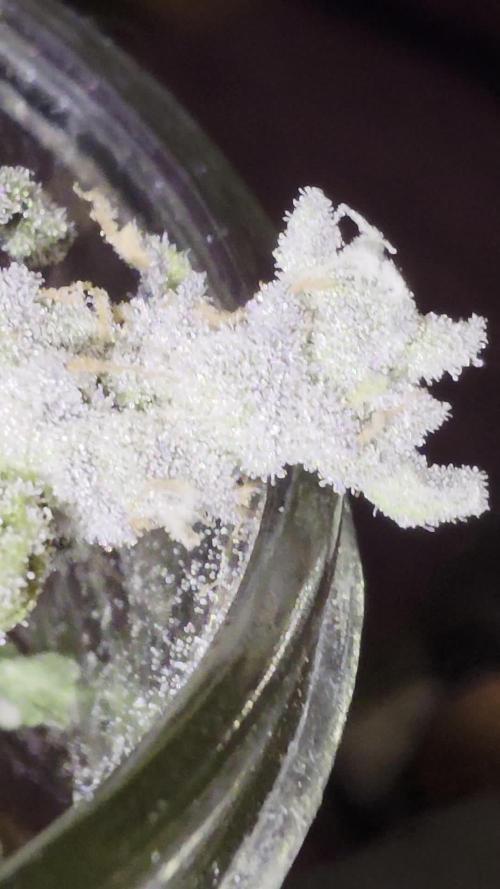
1 - 2 week left before Harvest!! Smells like Grape and Blueberry if anyone's had blueberry hash they would understand what I'm smelling .Not A Huge yield but quality should be !
Likes
17
Share
@Elpicor
Follow
Sakura season has begun, I hope everything goes fine. Strawberry Pie is going to have a tough time this week, let's hope it survives, meanwhile there are signs of heat shock and sunlight, it's developing 3 point leaves and strange ramifications but maybe I'm wrong. D38 Defoliation, I hope I haven't overdone the pruning D41 First week of flowering, I think it couldn't have gone better, it's growing visibly, let's hope it's like this until the end, maybe shortening the timing, we'll see. on the contrary strawberry pie has stopped growing, I have to thank that she survived, who knows what will come out of her, I wish her a sweeter climate... D42 Defoliation is limited for what I did last night, I literally deforested, I did it because the humidity was sky high and the vegetation was too thick covering so many peaks,,, the fascinating thing is that they recovered within the night, if I may say that 6 hours of darkness relax the plants just as if they were on vacation.
Likes
4
Share
0.23v tuned to 7.83Hz Plants exposed to the Schumann resonance often show greater resistance to stress factors such as drought, diseases, and pests. It is possible that these natural electromagnetic waves strengthen plants' immune systems and increase their ability to resist disease. Pretty neat, in the afternoon when the tent hovers around 84F the plants are 🙏, can visually see in time around 10 minutes after I opened the tent the temp had dropped to 76 pressure was lost, she is still chilling but she doesn't quite have that perk anymore. *Salinity3.5% - 100ml H2O=100g The concentration of salt in a solution 3.5%= 3.5g in 100ml. Growing well. Not going to top or do any training, I'll let the plant do its own thing, she is constructing foundations now for what she senses ahead. Smart girl. ✨️ Let her, do her thing, let me do mine. The voltage that is needed for electrolysis to occur is called the decomposition potential. The word "lysis" means to separate or break, so in terms, electrolysis would mean "breakdown via electricity. Green hydrogen is hydrogen produced by the electrolysis of water, using renewable electricity. The production of green hydrogen causes significantly lower greenhouse gas emissions than the production of grey hydrogen, which is derived from fossil fuels without carbon capture. Electrolysis of pure water requires excess energy in the form of overpotential to overcome various activation barriers. Without the excess energy, electrolysis occurs slowly or not at all. This is in part due to the limited self-ionization of water. Pure water has an electrical conductivity of about one hundred thousandths that of seawater. Efficiency is increased through the addition of an electrolyte (such as a salt, acid or base). Photoelectrolysis of water, also known as photoelectrochemical water splitting, occurs in a photoelectrochemical cell when light is used as the energy source for the electrolysis of water, producing dihydrogen . Photoelectrolysis is sometimes known colloquially as the hydrogen holy grail for its potential to yield a viable alternative to petroleum as a source of energy. The PEC cell primarily consists of three components: the photoelectrode the electrolyte and a counter electrode. The semiconductor crucial to this process, absorbs sunlight, initiating electron excitation and subsequent water molecule splitting into hydrogen and oxygen. Water electrolysis requires a minimum potential difference of 1.23 volts, although at that voltage external heat is also required. Typically 1.5 volts is required. Biochar, a by-product of biomass pyrolysis, is typically characterized by high carbon content, aromaticity, porosity, cation exchange capacity, stability, and reactivity. The coupling of biochar oxidation reaction (BOR) with water electrolysis constitutes biochar-assisted water electrolysis (BAWE) for hydrogen production, which has been demonstrated to reduce the electricity consumption of conventional water electrolysis from 1.23v to 0.21v. Biochar particles added to the electrolyte form a two-phase solution, in which the biochar oxidation reaction (BOR) has a lower potential (0.21 V vs. RHE) than OER (1.23 V vs. RHE), reducing the energy consumption for hydrogen production via biochar-assisted water electrolysis (BAWE). BAWE produces H2 under 1 V while eliminating O2 formation: key word "eliminating". Air with a normal oxygen concentration of around 21% is not considered explosive on its own; however, if a flammable gas or vapor is present, increasing the oxygen percentage above 23.5% can significantly increase the risk of ignition and explosion due to the enriched oxygen environment. The addition of ion mediators (Fe3+/Fe2+) significantly increases BOR kinetics. Air: Nitrogen -- N2 -- 78.084% Carbon Dioxide -- CO2 -- 0.04% Hydrogen in homosphere H -- 0.00005% Hydrogen "GAS" H2 in homosphere - 0% "Nitrogen, oxygen, and argon are the three main components of Earth's atmosphere. Water concentration varies but averages around 0.25% of the atmosphere by mass. Carbon dioxide and all of the other elements and compounds are trace gases. Trace gases include the greenhouse gases carbon dioxide, methane, nitrous oxide, and ozone. Except for argon, other noble gases are trace elements (these include neon, helium, krypton, and xenon). Industrial pollutants include chlorine and its compounds, fluorine and its compounds, elemental mercury vapor, sulfur dioxide, and hydrogen sulfide. Other components of Earth's atmosphere include spores, pollen, volcanic ash, and salt from sea spray." Although the CRC table does not list water vapor (H2O), air can contain as much as 5% water vapor, more commonly ranging from 1-3%. The 1-5% range places water vapor as the third most common gas (which alters the other percentages accordingly). Water content varies according to air temperature. Dry air is denser than humid air. However, sometimes humid air contains actual water droplets, which can make it more dense than humid air that only contains water vapor. The homosphere(where you live) is the portion of the atmosphere with a fairly uniform composition due to atmospheric turbulence. In contrast, the heterosphere is the part of the atmosphere where chemical composition varies mainly according to altitude. The lower portion of the heterosphere contains oxygen and nitrogen, but these heavier elements do not occur higher up. The upper heterosphere consists almost entirely of hydrogen, cool. 78%nitrogen as N2, a far too stable bond to be used by organisms. 20%oxygen 0.04%co2 0.00005% hydrogen When lightning strikes, it tears apart the bond in airborne nitrogen molecules. Those free nitrogen atoms N2 nitrites then have the chance to combine with oxygen molecules to form a compound called nitrates N3. Once formed, the nitrates are carried down to the ground becoming usable by organisms. Will it react with the oxygen in the air spontaneously, the answer is no. The mixture is chemically stable indefinitely. A mixture with air near the release point can be ignited, but if this does not happen then when its concentration gets below 4% it will be unable to carry a flame. Taking a small detour into chemistry here, a key concept to understanding the health impact of nitrogen-based compounds is knowing the difference between nitrates and nitrites. What Are Nitrates and Nitrites? A nitrite (NO2) is a nitrogen atom bonded to only two nitrogen atoms. Very strong bond A nitrate (NO3) is a nitrogen atom bonded to three oxygen atoms. Weaker bond The optimal pH for nitrate (NO3-) depends on the process and the type of bacteria involved. Nitrification The optimal pH for nitrification is between 7.5 and 8.6 Nitrification is the process of oxidizing ammonia to nitrate and nitrite Nitrosomonas has an optimal pH between 7.0 and 8.0 Nitrobacter has an optimal pH between 7.5 and 8.0 Nitrification ceases at pH
Likes
25
Share
Going into darkness at day 61
Likes
3
Share
. 📹 : Full Video on YouTube @hinterhofgrower, please like & subscribe 🌱 : Supercropping on day 44 & day 47 💧 : 4l day 44, 4l day 48 💡 : Dli: 45 mol/m²/d 🤔 : Because the plant grew so vigorously, supercropping, a high-stress training (HST) method, was necessary to keep it from getting too tall. There's only 20cm of space left above the lamp, and I expect further growth. Supercropping involves first softening the branches between the fingers and then carefully bending them 90°.
Processing
Likes
10
Share
Nice colas popping up showing to see the hard work pays off
Likes
60
Share
@Roberts
Follow
Alaskan Purple auto has sprouted, and is getting acclimated. She is under the Medical Grow Mini Sun 2. 🤞🏻for a killer plant for the contest. Thank you Medic Grow, and Seedsman. 🤜🏻🤛🏻🌱🌱🌱 Thank you grow diaries community for the 👇likes👇, follows, comments, and subscriptions on my YouTube channel👇. ❄️🌱🍻 Happy Growing 🌱🌱🌱 https://youtube.com/channel/UCAhN7yRzWLpcaRHhMIQ7X4g
Likes
3
Share
I can already tell this girl will be a healthy one.I will do some training soon as she is getting big enough to bend over.Day 20 I started LST and she is looking like a good candidate for strong healthy bushy one.
Likes
53
Share
@Mz876
Follow
The week before I topped this baby’s and I’ve added some LST clips . Hasn’t started showing signs of preflower yet. What’s the longests it’s taken your autos to flower ? Just curious. Be back next week with another update . Happy Growing 🌱
Likes
4
Share
Twenty20 Ateam R&D Update! Wow this week went so great, Germination was 100%successful!! We went with the usual paper towel method an they all popped up in the soil on Saturday the 28th! Let’s grow lil babies let’s grow!!
Likes
6
Share
Likes
13
Share
Progress from last week some of the pictures/videos are 2 days apart you should see the difference in them all in all a busy week so short and sweet happy flowering
Likes
6
Share
This is my favorite new auto strain now. Enjoyed every part of the grow. She likes the nutrients very light, but was a simple grow with zero problems. Very sticky plant but not too loud. Curing in the Cannatrol as of now and will update in a couple weeks.