


Likes
Comments
Share


@Limez
Follow
Seit dem umtopfen in 11L hat sich nochmal einiges getan. Der Orange Bud hat das konstante Licht im Zelt auch gut gefallen und sie ist schön gewachsen. Das Wetter war ja leider sehr bescheiden. Richtig im Regen standen sie aber nicht und ich habe immer drauf geachtet, dass die Wurzeln nicht über einen längeren Zeitraum im nassen stehen.



Likes
15
Share


@Messypies
Follow
04/07/2020 - 1st day of germination. All 4 have sank to bottom of glass. Now currently in paper towels in a warm dark area.
07/07/2020 - only 3 seeds germinated correctly . Planted, they have now sprouted and are looking good


Likes
6
Share


@Canaryweed_tf
Follow
Aquí tenemos la segunda semana de las PurpleKush de la familia de Kannabiaseeds. En está semana han ido creciendo muy bien ya me van pidiendo trasplante, tienen muy buen color y espero que sigan creciendo así de sanas 😘

Likes
29
Share


@Hasard
Follow
Starting week 6
Tent is being slowly full
A little bit too hot for the next days as the weather outside will climb to 36-38°C, I thnk I will bring them some CO2. I will check with the growshop. Any idea is welcome.
The stretch is really impressive, 1 of them get 20cm in 7 days
Waiting for the buds 😁
Day 39 I have now added CO2 with an organic boost, it is linked it to the fan. Should be a little bit better with that temperature

Likes
9
Share


@Fede224466
Follow
The first week of vegetative growth has passed, the seedlings are recovering from the shock of repotting and the growth has slowed down a bit, probably due to the growth of the root system in the new soil. In this second week I hope to get to the fifth node to start some lst. Irrigation / fertilization: I continue with the same light solution as last week with the addition of root stim 1ml / l to promote rooting. 0.1-2 l every 2-3 days.
20/01 150ml each plant of 8ml/l plant start 1ml/l root stim 1ml/l calmag pH 6,2
23/01 150ml each plant of 1ml/l calmag pH 6,0

Likes
85
Share


@tschw1
Follow
In this week i removed a few big leaves to ensure the light exposure for the blossom.
They look a bit naked now but they can focus the energy in the buds now and I‘m looking forward to harvest them in the next few weeks.

Likes
8
Share


@SmashDabz
Follow
The thrips are gone. It is taking more nutrients it’s more hungry these days still cutting off lots of defoliation lots of buds growing in so I’m having to keep her close eye and make sure I take out anything that’s not worth spending energy on buds are getting huge but it’s not growing any taller it’s going to be a short stocky plan

Likes
12
Share


@Imperial_Weed
Follow
The babies 😍 have a beautiful look and colors, they seem quite filled with resin. Now the drying phase of 15 days begins after which I will complete the trimming and weigh it. By eye I can say that it will be about 100gr per plant

Likes
567
Share


@Legendaryseedthumb
Follow
Day 29: one plant is a beast but the other one i don’t know what happened there😂
Day 31: everything is going fine and the autopots are doing a great job! I’m using (torus hydro) to manage the ph!
Mars hydro SP3000
High PPFD at 2.8 umol/j, average yield at 2.5g/w, increasing your yield 50% or more compared with old blurple and HPS lights, 300 watts output.
Dimmer knob added, more convenient to adjust the brightness. Up to 30 lights can be daisy-chained and control together on just one light, or just have one lamp in 120x60 tent is perfect for light.
https://www.instagram.com/marshydro_aliexpress2/
Likes
Comments
Share


@Growedbypepper
Follow
La planta se nota muy bonita y con cogollos grandes de característica esponjosa, sin mucho que decir presenta una presencia aunque muy poca de oidio
Likes
29
Share


@Prilyfe13
Follow
May 17, 2024 Day 92
We are at the end. Tropicana Cookies is in the dry tent having a nice 48 hours of dark. Tropicana C is now in the back of the tent with the 4 Sour Diesels up front. Yes I Tetrised the shit out of it to get them in. But everything is snug.
Tropicana Cookies is officially done with the main tent and is now in the dry tent for dark. I defoliated her up yesterday and only left the sugar leaves on. No sense in keeping the fan leaves on the plant if it's going to be pitch black for 2 days. Plus it's much easier to manage. And will be much easier at trimming time. She is also nearly dried out. Just perfect timing for this part. I just hope I'm not too early. Trichomes are almost all cloudy and there's a good 10% amber. A couple more days and in the dark should help them mature right along.
Tropicana C is still a hot floppy mess, but the tops have some potential. I think the majority of this plant will end up being pressed for concentrate. I wish I had a bubble washer. Oh well. Pressing flower is the option then.
Anyway, she isn't quite fading still, so I'm hoping for that over the next couple of days. If not, then I'll defoliate and put her in the dark for a couple days as well. Her buds are all purple and that's what matters.
She has about 5% amber trichomes and maybe 10% clear. Not enough cloudy for my taste. 4 more days? Maybe. 2 in the main tent and 2 more in the dark tent. I'm still trying to free up space for the Sour Diesels.
The light doesn't matter really anymore. She isn't growing at all and her buds are probably as big as they are getting. It's just a matter of ripening now. Don't really need a lot of light for that part. But still, I'm leaving the light as it is. Especially now that the Sour Diesels are in there.
The environment pisses me off. How the holy hell can I change the temp by 5 degrees and have no impact whatsoever on the humidity? Seriously. The temp is climbing a bit. I have to keep an eye on it as it's going above 78° and I don't want to melt my trichomes. Back down to 74° with the stupid humidity stuck at 62%. Annoying.
Grow System Environment:
Temp: 76.4°
RH: 61.4%
VPD: 1.17 kPa
Quick update: I had to increase the light power to accommodate the Sour Diesels now in the tent. They needed 200 to 25 mol/m²/d, so the light power as increased to 80%. The DLI only increased a couple points. No at 38 mol/m²/d. Everything looks fine.
May 18, 2024
Nothing going on today.
Tropicana Cookies is finishing up day 1 of dark. The humidity is a nightmare in the tent. It keeps climbing over 66%. I've tried everything at my disposal. Leave the tent door open, dehumidifier in the bedroom, dehumidifier in the tent? I don't think I tried that yet. I have 2 dehumidifiers in the main tent trying to keep the humidity down in there to no avail. I'm not bothering with trichomes today. I'll check trichomes tomorrow afternoon when she finishes up day 2 of dark. I may have to keep her in for a 3rd day. We shall see.
Tropicana C needs to get out of the tent ASAP. Her floppy tops are flopping right over the sour Diesels, which are growing vigorously. 2 of them grew 2" last night alone. They need the room now. Tropicana C just isn't ready for the dark tent yet. Maybe a few more days? She's just starting to show signs of fading now. I'll check trichomes tomorrow as well.
The lighting is of no concern. It's making the tent too hot, but it doesn't seem to be doing anything to Tropicana C. Tropicana Cookies doesn't have light. Lol.
The environment is a nightmare. Humidity is WAY too high. And now the temp is too high. No matter what I do, I can't control it at all. The temp is 77° and the humidity is still ridiculous at 66%.
Grow System Environment:
Temp: 75.4°
RH: 64.2%
1.05 kPa
Update: so I was researching other issues high humidity can cause. It slows down production and the plant won't drink because there is too much moisture in the air. It makes total sense. All of the flowering plants are taking forever to finish up. Now I think I know why.
Also, I added 1/2 gallon of plain water to Tropicana C reservoir. As she isn't quite done yet, I would rather her have a source of water if she needs or wants it.
I added one of the dehumidifiers to the dark tent with Tropicana Cookies. Now the humidity is around 51% with the temp hanging out around 76° to 77°. It spiked into 79° earlier, but I was messing with the heat in my room.
May 19, 2024
Busy day today. No watering or anything, but a very busy day.
Tropicana Cookies was wet trimmed and chopped down today. It took 94 days total from seed to harvest. After wet trimming, her total wet weight was 14 oz. A bit surprising to me. I was honestly thinking closer to like 9 oz, but I'll take it. Trimming took roughly 4 hours. I'm not sure why, but it did. I'm slow I guess.
There was no sense in trying to keep the trimmings for this round. There really wasn't much and I need a bigger table to catch it all. Messy. I've also discovered that the majority of the buds are a bit loose. Mostly the lowers and some of the middles, but the tops are mostly good.
I think based on my own mistakes, I'll be using the majority of this plant for concentrate. Maybe the whole plant. We will see. It all depends on how it dries and what the end result is. Both plants were not very happy with my nutrient regimen. Oh well. A lesson well learned.
Tropicana C is still floppy as ever, but now instead of a near black purple, she's almost like magenta or something. Dark pink? Lol. Something like that. She's starting to fade now and most of her tops are all colored. I'm just waiting for the fan leaves to catch up. I'll keep her in the tent for as long as I can. Maybe 3 more days? Maybe.
Her buds are definitely loose in the bottoms. The mids and tops are pretty nice. We'll see how they look after wet trimming.
The dry tent is hanging out at 70° and 61% humidity. I'd love it to go down to 65°, but for some reason it won't. I'll get it right in no time.
Grow System Environment:
Temp: 72.5°
RH: 68.3%
VPD: 0.84 kPa
May 20, 2024
We have fade! Tropicana C is finally starting to fade. Light green leaves coming in with purple hues. The buds are basically pink, it I expect them to get darker as she moves along.
Tropicana Cookies Day 1 Drying.
She looks good. Not much to report. She's drying. It could take between 5 and 7 days. Due to her smaller buds and the wet trim I did, I don't expect her to take very long to dry. And it seems that the environment is pretty nice. 61% humidity and 68°. The temperature could be lower though.
Tropicana C looks good. Still super floppy, but she has pretty buds. Not very tight buds. I'll do the same wet trim as well. She should end up drying after about 5 days. For now, she's drying her soil out and fading at the same time. I might give her another half gallon just to tie her over until harvest. I also plan on defoliation in the next few days after the fade is well underway.
The light is the same. No changes there.
The environment is still wonky. The temp is at 74° which I finally got control of again. The humidity on the other hand is still super high at 65%. I really don't understand. It was 40% humidity out yesterday and even with the outside door wide open, the humidity did nothing to drop. Nothing at all. It's weird.
It's back to being humid today, so no opening the door. Hopefully I can get it to clear up ASAP.
Oh, I did just learn that the central air isn't working either. And that is the main source of cool dry air. With none, I'm stuck using a portable AC that just blows wet air back into the room when the condenser is off. Stupid design. Very stupid. Even the dehumidifier function doesn't work right. It does the same thing except with heat. So my room gets too warm but the humidity stays the same.
Grow System Environment:
Temp: 72.6°
RH: 67.7%
VPD: 0.86 kPa
May 21, 2024
Day 2 of drying for Tropicana Cookies. The whole plant shrunk to half its size. Small tight buds. As I said before, the majority of this plant will most likely be pressed. We shall see.
Tropicana C is showing way more fade now. Like twice as much as yesterday. It's coming on fast and hopefully that means she's finishing up fast.
I checked her trichomes today. Looking good. She definitely needs way more amber though. But has much less clear. So it's mostly cloudy, but definitely nowhere near enough amber.
What's funny is how floppy she is. One would think those buds wouldn't develop properly, but they are swelling and getting more purple just like the rest of the plant. Interesting. I still don't know what happened here, but I'm guessing it has all to do with the nutrients this run. Bad timing.
This plant may also be mostly pressed. Her buds aren't as dense as Tropicana Cookies and they are definitely not tight. Unless by some miracle, they blow up and fill in over the next few days. We shall see.
The environment is finally leveling out now that the central air is on. Finally. It won't drop the humidity all the way to the low 40s%, but it will drop it below 55%. And that's keeps the tent below 60% and put of the danger zone for mold. However, I know it's still too high for the plant to perform at max potential, but it's the best I can do for now. Once it kicks on again, the humidity will hopefully drop to 50%, then maybe my dehumidifiers will start working as they are meant to.
Grow System Environment:
Temp: 72.7°
RH: 62.9%
VPD: 1.00 kPa
May 22, 2024
Tropicana Cookies day 3 of drying. I haven't weighed her up yet to see how far along she is. I'm really not expecting her to take very long at all. Her buds are small so she should be done in a couple more days.
Tropicana C is fading quite quickly. Looking really close to finishing up. However, the Sour Diesels in the tent are already in pre-flower and are starting to stretch. The need space ASAP. So I think I'll harvest her whole tomorrow she's not very leafy and I don't think she will get mold at all. She still has super loose buds so she will dry up within 5 to 7 days I think. Even at 60% RH, I think.
On the other hand, she was way too dry, so I added a half gallon to the reservoir. I was planning on harvesting in a couple days, but I don't think I have that much time anymore.
Originally I was going to wet trim Tropicana C just like Tropicana Cookies, but her branches are way too weak and floppy to trim without snapping branch after branch. So as I said earlier, I'll be dry trimming her instead.
The environment is back to being wonky. The central air hasn't turned on yet today and it's 85° out. So my room is suffering a bit with my crappy portable AC. It blows wet air when the compressor turns off. So the humidity is back up above 60%. The temp is fine at 75°, so I'm opening the tent periodically until the AC turns on.
I also added a new trichome video for Tropicana C. Getting really close. Let me know how close I am? Or does it not really matter at this point?
Update: I decided to completely defoliate Tropicana C. I don't know I will do. Full wet trim. The buds are small and so are the branches. So there shouldn't be any issues with the higher humidity. I'll be doing it in sessions as not to stink up the whole house. But basically anything with a stem I can access is getting cut off. Who knows, maybe I'll finish defoliating fst than I think and will wet trim anyway. She is definitely getting harvested tomorrow. I'm completely out of space for the Sour Diesels.
Grow System Environment:
Temp: 75.7°
RH: 59.4%
VPD: 1.20 kPa
May 23, 2024
Tropicana Cookies Day 4 Drying. I have a moisture meter for the stems and will be using that tomorrow to see how far along she is. Still a couple more days I think.
It might be Harvest Day for Tropicana C! Honestly, I would have liked a little more time, but I have other plants that need the space.
So I'm wet trimming her today and will harvest later tonight or maybe tomorrow. We shall see. Either way, she is done even if she's not.
I'll take one last Trichome Video after I'm done trimming. Then I can see if she's actually ready or not. Maybe she is. I don't think so though.
Not much else for today. Unless I harvest, then I'll update.
Grow System Environment:
Temp: 76.2°
RH: 60.6%
VPD: 1.18 kPa
Likes
56
Share


@KingSalomonsWeed
Follow
19.11. day 29.
Hallo Leute.
Die LeM ist etwas gebremst durch 25 w/h Blaulicht. Lässt sich aber nicht aufhalten.
Die Strawberry.... Ist nicht in Blüte, aber explodiert an trieben .
20.11. Armes Strawberry. So klein wie sie ist gab es HST. Alles gequetscht, gedreht, gebrochen. Das darf Mann ruhig hören.
Jetzt hängt sie etwas durch .
Egal in 7 Tagen wird das nochmal wiederholt.
21.11. so Leute der Stamm der LeMellon ist schön Dick. Erst Recht für day 31.
Und die Strawberry ist nicht in Blüte. Sweet Seeds gibt Tag 40 als Blüte an . Bin Mal gespannt.
24.11. Strawberry Cola Sherbet F1 .
Wie gut ist denn Sweet Seeds?
Ich hatte bereits ne Red Poison. Die war ECHT gut .
Day 34 . Sie ist nicht in Blüte trotz 7 Tagen 12-12. Was haben die da reingebaut ? Ruderalis so gut getimet das die egal wie nach 40 Tagen erst in Blüte geht?
Echt?
Das will ich wissen. Cannabis ist und bleibt spannend. Vor allem die neueren Sorten.

Likes
43
Share


@Hashy
Follow
********************************************
Week 4 Veg.
********************************************
Light cycle=18/6
Light Power=90w 37%
Extractor controller settings
High temp= Day 25c, Night 20c
Low temp= c
Temp step=0c
High Rh= Day 60%, Night 65%
Low Rh= %
Rh step=0%
Speed max=8
Speed min=1
Smart controller settings (during lights on).
Lights on=4.00am
Humidifier on=-50%
Humidifier off=+55%
Top fan on=+24.0c
Top fan off=-23.5c
Smart controller settings (during lights off).
Lights off=10.00pm
VPD aim=0.6-1.2
DLI aim=20-30
EC aim=0.2-1.8
PH aim=6.0-6.8
NPK(20-6-13)
💧💧💧💧💧💧💧💧💧💧💧💧💧💧💧💧
Method= Autofeed 6 drippers.
Feed=Veg Nutes.
Neutralise=0.1ml/L
Grow=3.0ml/L
Roots=0.2ml/L
Silicon=1.0ml/L
Calmag=1.0ml/L
Volume=8L
Easy Ph down= 0.12ml/L
Ec=1.8 PH=6.5/6.5
Runs=12
Run times=4min (240ml each)
Gap times=16min
Total runtime=48mins (2.8L each)
Total flowrate= 120ml/min (60ml/min each)
Auto start time=5.00am
Auto stop time=8.44am
💧💧💧💧💧💧💧💧💧💧💧💧💧💧💧💧
********************************************
📅9/6/24 Sunday (day 22)
📋 Outside has started to cool of a bit.
📅10/6/24 Monday (day 23)
📋 Drip system didn't work for this one so she got manually watered.
💧💧💧💧💧💧💧💧💧💧💧💧💧💧💧💧
Method= manually
Feed=water
Volume=8L
Ec=0.21 PH=7.0/7.0
Volume left=6L
Volume used=2L
Volume each=L
Runoff.
Total runoff=0L
Ec= PH=
💧💧💧💧💧💧💧💧💧💧💧💧💧💧💧💧
📅11/6/24 Tuesday (day 24)
📋 Cleaned drip system. Was manky.
H=18cm D=45cm Dli=22.1 Ppfd=340
📅12/6/24 Wednesday (day 25)
📋 Leaf tucking.
📅13/6/24 Thursday (day 26)
📋 Test revised drip system, 6 drippers.
Flow rate between 100ml/min and 150ml/min. Removed humidifier from grow room.
📅14/6/24 Friday (day 27)
📋 Drip system worked great.
💧💧💧💧💧💧💧💧💧💧💧💧💧💧💧💧
Method= automatic
Feed=Nutes veg
Volume=8L
Ec=1.8 PH=6.5/6.5
Volume left=2.25L
Volume used=5.75L (120ml/min)
Volume each=2.8L (60ml/min)
Runoff.
Total runoff=0.3L
Ec=6.0 PH=5.7
💧💧💧💧💧💧💧💧💧💧💧💧💧💧💧💧
📅15/6/24 Saturday (day 28)
📋 H=24cm D=39cm Dli=24.8 Ppfd=382
Raised light and inceased power to 120w =50%.
H=24cm D=48cm Dli=26.2 Ppfd=405
********************************************
Weekly roundup.
📋 She's done great this week, bushing out a bit after the topping, the top nodes look good so I'm just debating if I should remove the lower 2 nodes that aren't receiving much light. I think 1 more week of Veg then 12/12
Take it easy.
Back soon.
********************************************
Likes
3
Share


@Aerogrower1104
Follow
I am browsing this in an ottoman as a stealth grow it only smells when I open the top and even when I do it doesn’t smell up the whole room. Plenty of growth. I had a little root rot and cleared it with peroxide and water method. Hopefully harvesting next month

Likes
4
Share

@CheeRz
Follow
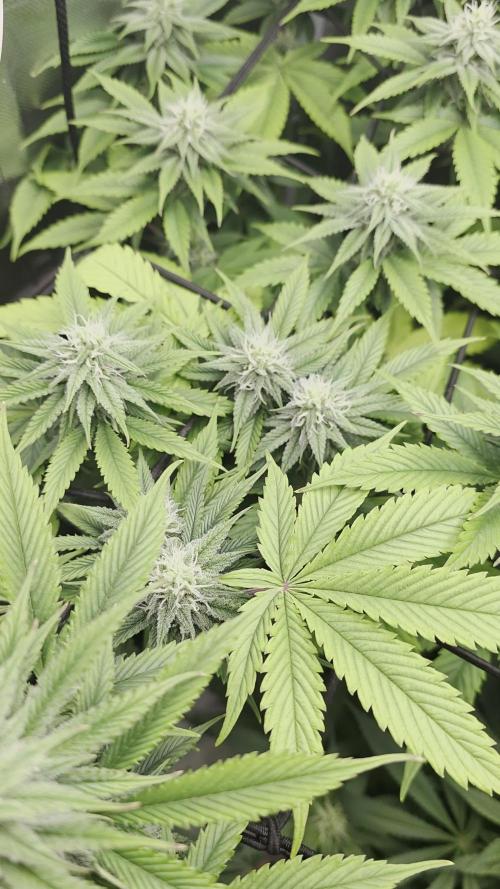
It's week five of flowering, and the plants are doing really well. The CalMag deficiency has been remedied, and bud production is slowly picking up speed. The buds are becoming frosty, and the aroma is intensifying. 💚💚💚
Likes
4
Share
@Kinghaze
Follow
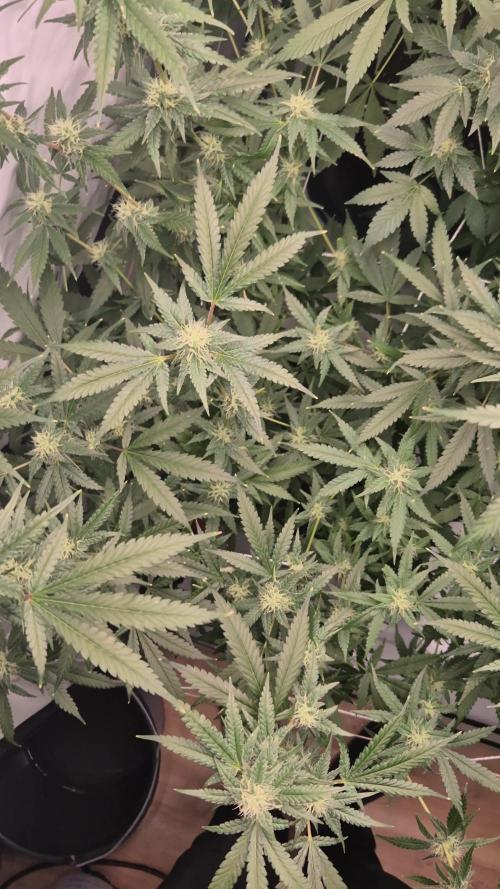
Week 5 of 12/12
Have some nutrient burn some plants more than the other. Thats a risk if you grow different types of plants.
Give them to much so now i lowered the ec a bit.
I have gave them also advanced nutrients revive with ph 6.0.
Next time i will give them just plain water and them slowly build up the ec again depending on the reaction of the plants.

Likes
6
Share


@IamCy
Follow
Here we are. Week 2. On the Day 8 video, I give my method on how I produce nearly zero larf and huge buds. It's easier than most think 😉


Likes
9
Share
@BossberryFarms
Follow
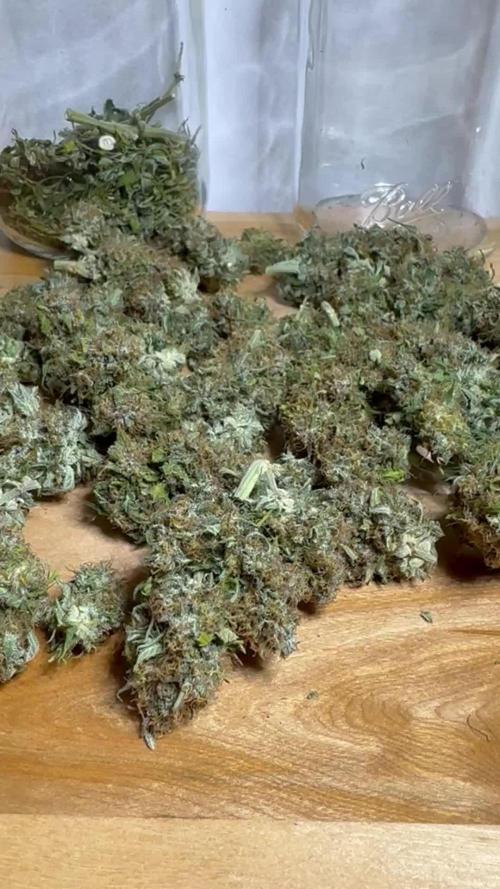
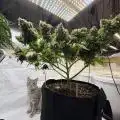
Harvest Week!!
WET WEIGHT— DRY WEIGHT
Plant C: 597g — 105g
Plant B: 605g — 122g
Plant D: 413g — 86g
Plant A: 507g — 105g
Total Wet Weight: 2,122g
Total Dry Weight: 418g
Averaged about 80% reduction from wet to dry
This was an abundant harvest for me 😍 super grateful for the outcome of this set of plants!
All are curing at this time!