


Likes
Comments
Share


@tresplantes
Follow
Heading into week 4 of Flower everything is budin up really nice
Zake is the frostiest and really has a mint smell to it
Looks like i already can say that breakpad breath will take more than 8 weeks
Pink runtz x Hollywood has a Creazy Sweet smell to it


Likes
17
Share


@420DeepGrow
Follow
Cosechas asombrosas con XpertNutrients, el clima no ha ayudado pero ya tengo algo de hierba para fumar.
Gran calidad,tiene un aroma muy potente a gasolina y fresas. Estoy deseando darle una calada, mas tarde actualizaré las notas de humo.

Processing
Likes
41
Share


@Hawkbo
Follow
Just started them all on the Green Buzz Liquid Organics and will run it the rest of the way. I'm not going to add much to the line just some calmag, enzymes maybe terpinator I have to experiment with it a little bit. The first feed went extremely well the plants instantly reacted within an hour after the feed especially the next day. The additives in this line barely raised PPM at all which I liked. It also doesnt stink like other liquid organics I've used.
These are doing good the big one seems to be flowering faster than the first run from seed with this cut. The second one is still completely untrained and the 3rd one is the weakling. Day 21 of bloom.
Added in a shot of the feed chart I'm using from G Buzz, white board is where I record the run off values especially during the flush👍

Likes
9
Share


@Lifesgarden420
Follow
This beautiful lady is getting huge and those nuggets are so dense they are so Frosty she is going to provide some wonderful rosin yeah yeah she's almost ready maybe two more weeks

Likes
8
Share


@Gonjuk
Follow
Fin'ora tutto bene a un mese di fioritura ho cambiato l'acqua, c'è un problema l'acqua è a 25/26° ogni tanto ci metto delle bottiglie congelate e aumento il perossido d'idrogeno


Likes
25
Share


@mageman314
Follow
D57 F13 - The week is off to a good start. This lady continues to bush out AND stretch at the same time! I started doing some minimal HST - just to try to keep her going as much "out" as possible, as opposed to "up."
D59 F15 - Feeding every other day was just not cutting it anymore, therefore, I started feeding daily this week. There are two other plants in the tent besides this 707 Headband, one Sour Diesel and one Zkittles. So, I'm currently mixing up 12 gal. of nutes in a batch, feeding 6 gal every day - 2 gal/day per plant. Check out the ladies getting fed in the video I included above ;-) Also, I took several pics today; some of those pretty buds getting of to a good start.


Processing
Likes
13
Share


@Xelxz
Follow
ºDay 44 (21Dez) - Did some "plant work", moved upper bigger leaves under the colas that were developing below so they get more light.
ºDay 45 (22Dez) - LSTing the rest of the colas, 13th watering (1st vegNute);
ºDay 47 (24Dez) - LST on other colas, 1st and 2nd videos;
ºDay 48 (25Dez) - 14th watering (2nd vegNute), broke one of the colas on accident...
ºDay 49 (26Dez) - End of week 7;

Likes
11
Share


@Heregrowsnothing
Follow
These girls where a joy to grow and even more of a joy to smoke! It really is a weed that has delivered in every department the colour, the smell, the taste, the yeilds. I'm off to binge watch prime and order an obscene amount of takeaways 👋🏻✌️🏻
Likes
40
Share


@BudBoutique
Follow
Welcome to Bud Boutique Grow Diary - really appreciate all your love and support :)
Don't forget to check out my other current grows!
🗓️ This Week:
- still lack of nutrients, which got even worse
Thank you for still staying with me 💚
___________________________________________
--- 🌱 Strain (Sponsor) ---
🏷️ Wedding CheeseCake by Fast Buds
https://2fast4buds.com/seeds/wedding-cheesecake-fast-flowering
--- 🥗 Nutrients and Feeding (sponsored by APTUS: APTUS Ambassador) ---
🍸 APTUS: full nutrient schedule extreme
-- Regulator, N-Boost, P-Boost, CaMg-Boost, K-Boost, Allin1 Liquid, Startbooster, Topbooster, Enzym+ every feeding
-- Fulvic-Blast, NutriSpray as Foliar each once a week
🔗 https://aptus-holland.com/
--- ♻️ Grow Control (Sponsor) ---
TROLMASTER: TENT-X + LM14 Light Adapter to dim/sunrise/sunset lights + Temp & rH Sensor all remote on App
🔗 https://www.trolmaster.eu/
--- 🚿 PetraGrow (Sponsor) ---
CannaFogger Foliar Spray
🔗 https://www.petratools.com/product/petragrow-cannafogger-atomizer-new-mini-fogger
--- 🏭 Grow Setup ---
💡LUMATEK Zeus Pro 600
* 🏠🌿 Indoor: Homebox 120x120x200cm (4x4)
* 📐🌀 PrimaKlima exhausting Fan 1180m3/h (running on 60-80%)
* 🌀 Can Light Filter 800m3/h & 1x Fanbox 1x Dyson fan for Air circulation
🔗 https://lumatek-lighting.com/zeus-600w-pro-29/
🔗 https://primaklima.com/de/shop/ventilatoren-de/ec-ventilatoren/pk160ec-tc/
🔗 https://canfilters.com/products/filters/
All Likes and comments are highly appreciated!!!
👨🌾 don't forget to check out my Instagram for daily educational content: budboutiquee
- Bud Boutique
Likes
9
Share


@Canadian
Follow
Day 71 from seed the plant seems to be growing beautifully and now they are starting to develop beautiful flowers and they are entirely covered with white snow trichomes it is a very strong and powerful plant to grow what a beauty . I also I defoliate some of the lower branches that will not going to develop well enough because lack of light so they can use that energy on the upper buds instead of the lower ones.
thank you for reading I will continue to update have a happy grow.

Likes
67
Share


@Canna96
Follow
Hey now, this week went pretty good! The Acid Dough from Ripper Seeds is almost done stretching, she didn't get as tall as I hoped but that was mostly my fault for training her too long. I have noticed no matter how long I train the stems outward, they always grow back up towards the middle in the end, so I am starting to think I am wasting height of colas by training a few days or a week too long. Anyways, other than that I did some light defoliation and that is about all. Super excited to see what my first run of Ripper Seeds will produce! I also added a video of a press I did earlier today of the Jack 47 by Sweet Seeds. I hope you enjoy the video, be safe and Blaze On!!!
Processing
Likes
9
Share


@Luv2Grow
Follow
Day 85 - Starting week 13 and this is by far going to be one of the longest grows I’ve had to date. Going to give her some straight pH’d water tomorrow but still not sure when she’ll finish up. Thinking about 2-3 weeks left but could be longer.
Day 86 - Looking really bad today, waited a day longer than I should of for water but gave her 2 gallons of 6.6 pH water today. The buds are getting pretty heavy and causing her to lean quite a bit so will be hooking some of the stem yo-yo’s to help keep her up.
Day 87 - Looking a lot better today, leaves are perked back up for the most part. She’s definitely starting to fade and hopefully she’ll make it another two weeks cause the buds are for sure not ready yet. She’s to big now to really pull out every day for pictures so just leaving her in the tent unless she needs water.
Day 88 - No really update today, just letting her go to try and use up all the nutes in the soil and leaves and by the looks of her, she’s using them up quickly. Looking forward to her bulking up her remaining couple weeks.
Day 89 - She’s still dying off and buds are swelling massively. Can’t really explain the smell coming from her right now but it smells good. Checking trichs all the time but still a few clear in there and pistils are still popping like crazy.
Day 90 - Almost the end of week 13 and thinking she’s gonna be chopped sometime during week 15. Gave her 2 gallons of plain 6.5 pH’d water today so she wouldn’t completely wither up on me. Other than that, not much else happening.
Day 91 - The end of week 13 and she’s still plumping up. She’s definitely starting to fade out on all the fan leaves so I’m hoping she’ll make it another week and a half or so. If she’s gotta go longer, I’ll let her go as long as she needs to. I’m hoping I didn’t start flushing her to early.
Likes
9
Share


@Kushizlez
Follow
Harvest:
Everything dried up to 347 grams + 96 grams of super high quality trim. Overall I am not too pleased with the smoke of the product. Although the bud size, bag appeal, smell and taste are pretty much all there, the shitty burn is a deal breaker for me and the majority of this weed is quite frankly useless. Another downside is while smoking I’ve found 4 seeds in an ounce from almost every strain. Light leaks? At least I learned a ton, including how to get super good burn for my next crop. I’m hoping that curing for a month or so will improve the burn but I wouldn’t really count on it. I have seen weed dried for 4 days with no cure and no flush smoke clean and not go out once. I have been told that the key to white ashes/clean burn is proper mineral content in the soil and there is tons of scientific studies on cigar ash going back 100 years. Plants grown in a medium with high levels of decomposing organic matter, phosphorus, magnesium, chlorine and heavy metal ratio tend to produce black/grey ash. Whereas plants grown in a medium with a higher ratio of trace minerals like calcium carbonate and potassium in the form of wood ash, rock dusts, oyster shell flour and lower levels of decomposing organic matter will produce a dense, uniform white ash that rarely goes out. But this is still all theory until I test it to confirm for myself a few times. My last few outdoor harvests did not improve with curing at all so I’m hoping this will be the missing link. Plain peat moss and coco clearly lack essential minerals that help burn. If said theory is correct I should find a synthetic nutrient line with more trace minerals. Makes me wonder if growing if rockwool/basalt rock could improve burn in a hydro setup.
I think I did a fairly decent job for my first grow. I went wrong in a million different places but I still stuck it out and got some decent herb. Things went wrong early when I got black spot mold, nitrogen/magnesium deficiencies and powdery mildew. I corrected most of it but things didn’t get really bad until mid veg when I intentionally skipped a few feedings and defoliated quite heavily stunting the plants. I also didn’t even top or start LST until the 6-9th node which was really stupid and hurt my yield. My temperatures were all over the place from the learning curve. I was severely overwatering without realizing it. 100% peat moss is a shitty medium. I also fed way too late in flower (not what caused shitty burn). I also used synthetic nutrients in soil.
Zkittlez bonsai
Yield: 1.9g
Smell: 7/10 - sweet, candy, berry, gassy, piney hints
Bag appeal: 7/10 - slightly leafy/stemy
Crystal coverage: 7.5/10 - very impressed
Ash: 6/10 - flaky, mostly white/grey
Fire holding: 4/10 - stays lit for 10-30 seconds
Smoke: 6/10 - taste is decent, needs curing
High: 6/10 - indica dom
Comment: looks nice, smells nice, tastes nice, burns like shit.
43.5/70 = 62% 👎🗑️
Black Garlic #1
Yield: 53.6
Smell: 8/10 - gassy, piney, earthy, skunky
Bag appeal: 7/10 - slightly leafy/stemy
Crystal coverage: 7.5/10 - very impressed
Ash: 8/10 - thick, uniform white ash
Fire holding: 7.510 - stays lit for 45+ sec
Smoke: 7.5/10 - taste is good until the end
High: 7/10 - sativa dom
Comment: looks nice, smells nice, tastes nice, burns great but quite leafy.
52.5/70 = 75% 👍🔥
Black Garlic #2
Yield: 42.3
Smell: 7/10 - woody, earthy, tea
Bag appeal: 6.5/10 - slightly leafy/stemy
Crystal coverage: 7/10 - impressed
Ash: 6/10 - flaky, mostly white/grey
Fire holding: 4/10 - stays lit for 10-30 seconds
Smoke: 6/10 - taste is decent, needs curing
High: 8/10 - sativa dom
Comment: looks nice, smells nice, tastes nice, burns like shit.
44.5/70 = 63% 👎🗑️
Zkittlez
Yield: 39.4
Smell: 7/10 - sweet, candy, berry, gassy, piney hints
Bag appeal: 6.5/10 - slightly leafy/stemy
Crystal coverage: 7.5/10 - very impressed
Ash: 8/10 - thick, uniform white ashes
Fire holding: 8/10 - stays lit for seconds
Smoke: 7.5/10 - taste is decent, needs curing
High: 7/10 - indica dom
Comment: looks nice, smells nice, tastes nice, burns great but smalls didn’t fill out.
51.5/70 = 73% 👍🔥
Blackberry Breath #1
Yield: 57.5
Smell: 9/10 - sweet, grape, berry, gassy, earthy, hashy
Bag appeal: 8.5/10 - dense, sparkly buds
Crystal coverage: 9/10 - super impressed
Ash: 5/10 - flaky, mostly grey/blackish
Fire holding: 4/10 - stays lit for 10-30 seconds
Smoke: 5/10 - tastes like chalky shit
High: 6/10 - indica dom
Comment: looks amazing, smells amazing, tastes like shit, burns like shit.
46.5/70 = 66% 👎🗑️
Blackberry Breath #2
Yield: 76.1g
Smell: 6/10 - musky, tea, berry, herbal
Bag appeal: 8/10 - slightly leafy/stemy
Crystal coverage: 7.5/10 - very impressed
Ash: 5/10 - flaky, mostly grey/black
Fire holding: 4/10 - stays lit for 10-30 seconds
Smoke: 5/10 - taste is shit
High: 6/10 - indica dom
Comment: looks nice, smells shitty, tastes shitty, burns like shit.
41.5/70 = 59% 👎🗑️
Slurricane #4
Yield: 34.5g
Smell: 8.5/10 - gassy, deep piney, fuel, earthy,
Bag appeal: 8.510 - slightly leafy/stemy
Crystal coverage: 7.510 - impressed
Ash: 6/10 - flaky, mostly white/grey
Fire holding: 4/10 - stays lit for 10-30 seconds
Smoke: 6/10 - taste is decent
High: 6/10 - indica dom
Comment: looks amazing, smells amazing, tastes nice, burns like shit.
46.5/70 = 66% 👎🗑️
Badazz OG Cheese
Yield: 43.5g
Smell: 6.5/10 - musty, woody, cheesy, piney hints
Bag appeal: 6/10 - slightly leafy/stemy
Crystal coverage: 6/10 - very impressed
Ash: 5/10 - flaky, mostly white/grey
Fire holding: 4/10 - stays lit for 10-30 seconds
Smoke: 6/10 - taste is decent
High: 6/10 - sativa dom
Comment: looks like shit, smells decent, tastes decent, burns like shit.
39.5/70 = 56% 👎🗑️

Likes
6
Share
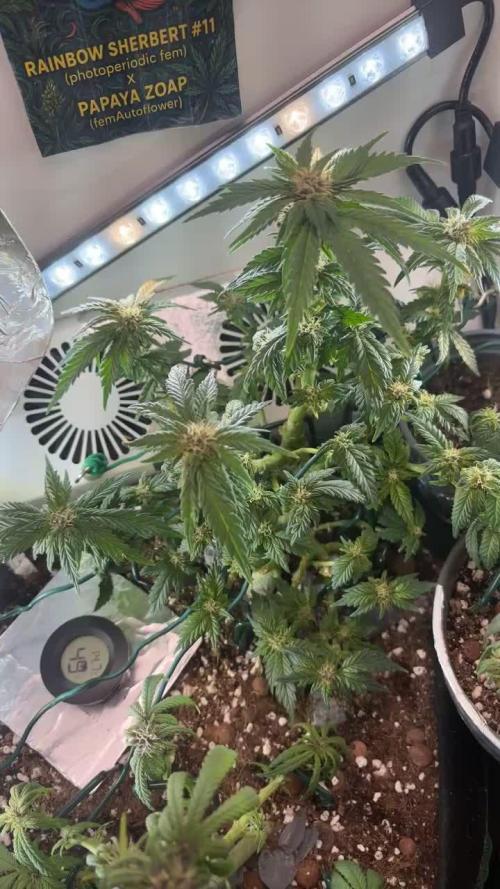

@psychonaut420
Follow
Have seen a major development in mental rainbow F1 her buds are fattening up as well as the stems have notice more bud site development hopefully be more noticeable development
Likes
47
Share


@Northern_Ent
Follow
May 11: plant looks good and the bad colour in the pic is due to wildfire smoke. Seems happy in the final 5 gallon grow bag.
Today was overcast and smoky after two beautiful sunny spring days. First smoke of the season arrived at about 7 am this morning. This smoke is likely due to fires in northeast BC about 1000 km (600 miles) from here. Hopefully it won’t be as bad as last year.
May 13: air quality is better again. Plant is doing fine. Watered with Monster Maxx during afternoon.
May 16: cool and rainy today. There was some sun in the late afternoon. She’s looking good and off to a better start than most of my previous starts.
May 17: very cool and rainy again which is just as well for forest fires. We’ll take the rain, thanks.
#seedsman420growoff
#seedsmanseeds

Likes
23
Share


@Kakui
Follow
Primera ves cultivando una cepa de esta calidad, algo ansioso por obtener los mejores resultados posibles con estás genéticas.
Básicamente elegí la Grandpa's Stach R2 y la Grandpa's Cookies #6 S1 solo por sus tiempos de floración, espero que sean buenas tanto de sabor y resina, cómo también de producción.
G1, brotaron las semillas, solo 1 semilla brotó chueca, por lo que tuve que ayudarla con un alambre y va un poco atrasada en comparación del resto.
G3, primer riego con pH 6.1 y EC 0.6, y micorrizas Great White.
G5, creciendo bien.
G11, riegos cada 2 o 3 días, a punto de pasar a etapa vegetativa.
Likes
209
Share


@BioBuds
Follow
At the beginning of this week, I have been fighting the gnats, which are less and less now. Just some watering and gradually lowering the light and going to full power. The Orange Hill Special has been filling out great and I must say, she is a pretty plant. With some manual bending and super cropping, I'm bending the longer stalks sideways and we are off. What I actually do is more of an intuitive hybrid between mainlining (where I bend the whole plant 90 degrees at the third week), LST (where I bend branches outward slightly, without tying), HST / Super crop (where I bend the stems 90 degrees with the clips or manually), after which I keep bending outward to SOG and, put the net over to end in SCROG.
This same method gave me the canopy in my prize-winning Gelato 33 grow. Check it out if you haven't seen it, it was my first experimental accident that led to beta test of Super Soil mixture 0.7, now we are at Alpha version 1.00 and testing great so far if I say so myself. I haven't seen such lush greens in my own grows, only outdoor. They seem uber-healthy and resilient, with very sturdy stems and leaves. Way more resilient than previous strains I tested in the beta soil.
The light is performing, the natural color of it makes everything pop. Mars Hydro has a winner with the SP-3000. Check out their site: www.mars-hydro.com
Thank you @MarsHydroLED for letting me test it, hook them up for a great deal or info on their products!
Halfway through this week, I took the clips out, AND...... we switched them to go into flowering. After a day the stretch is already visible. I had to bend them again after a couple of days. Now we have almost a tent filling foundation for a maximum result canopy of buds.
I was wanting to amend the soil with flowering additions (see recipe in yellow image), but I'm holding it off for two reasons. A/ The leaves are still so green and lush, I think there is an abundance of nutes. B/ @Haoss mentions his suspicions on his OHS grow (@#CannapediaProGrowersCup Orange Hill that very sadly went hermie on him) that nutrition in this phase could have had an influence, after asking what happened to him. I would have loved to see that grow to full harvest. But it makes me a bit cautious. if Haoss (whom I consider to be one of the star growers here) couldn't prevent this, what chance have I?
I'm waiting until the girls start asking for nutrients. They'll show me what they need in their own time. For now this soil is the shizzle (also quite literally) and Im happy with how everything is going. I remember much more hassle and steering in the last grow. This grow, even the Gorilla runt seems happy.
I now water them 3 liters of water / Perma tea mixture every 4 days, every 3rd watering I don't do the tea. This makes for fewer gnats and this soil seems to hold water nicely, also due to the hydro corn.
What I like is there is always some unforeseen circumstance, a tilt of the tables, some battle to be fought which delivers in big harvests or, in worst case, no harvest at all. It makes it more exciting, when your heart is at stake, we pour a lot of love and attention in the ladies.
So with hopes, but not too high, we go into flowering. Thank you all for joining me again in this Orange adventure! I hope you all had great weeks, germed seeds, extreme growth and buds bursting with trichomes!! See you next week!
Hug Bud
PS Sunshine made her first appearance, as she promised on the Gelato 33 grow. She is still a bit camera shy, so her digital alter makes an appearance first, if you all want to see more of her and my other helpers, let me know in the comments. Sunshine will make a real appearance if yall are real nice to her.
Likes
3
Share


@JeyGanesha
Follow
Prima settimana di fiori 12/12...
Stiamo per terminare la prima settimana di fioritura...Si dovrebbero vedere già i prefiori........,.. vediamo tra un paio di giorni 💪🔱🙏


