


Likes
Comments
Share


@stacksfarms
Follow
Trasplantamos de 3 a 5 litros de fibra de coco, instalamos el goteo Netadrip y pasamos a floracion


Likes
Comments
Share


@RosQuare
Follow
Successful regeneration has led to a new problem.. I don’t know where to flower her! I took a couple of cuttings of new normal growth to clone for now. Will take more cuttings as she develops further. She’s healthy and very cool.
I apologize for the strand of my hair caught around her old flower in the video.
Runoff ppm 1020-1150 pH 6.2-6.3 medium lighting
Likes
8
Share


@MissBudReefer
Follow
Amazing week for the gorgeous lady 😁 I removed all bottom stems and leaves 🌱🌿

Likes
6
Share


@LAShugars
Follow
Getting there! Continuing to feed her Pride Lands Flower and GreenGro flower finisher. Add seaweed, humic acid and silica to the water. I’m thinking one more feeding and then just water and blackstrap molasses.
I sure am going to miss this girl


Likes
1
Share

@c1note
Follow
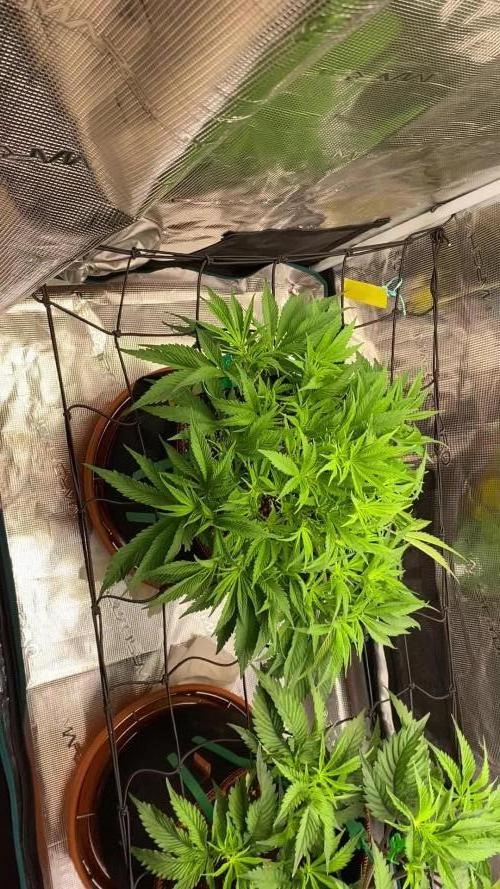
06.11 Woche 6 Blüte Tag1
Umstellung auf 12/12 nach 24 Stunden Dunkelheit. Dli 28- 30.
2L mit Ec1.72 5.8 ph so wie immer. VPD 1.1
Likes
36
Share

@Comfrey
Follow
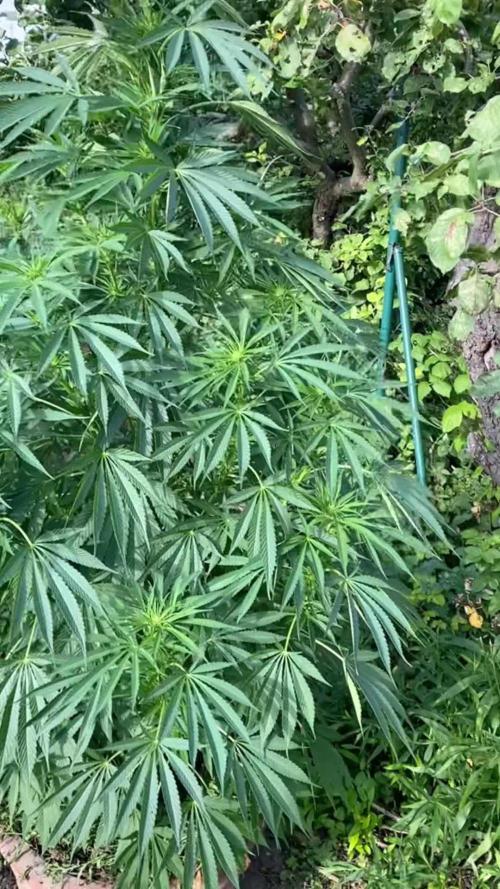
Dutch Passions Shaman
Meine Shamaninnnen blühen nun beide und es macht mir einen Riesen Spaß ihnen beim Wachsen zuzuschauen. Bei No. 2 habe ich Vergilbungen festgestellt, ich vermute es liegt an dem zweistündigen Tauchbad nach der Sieben-Tages-Dürre im Topf. Ich hatte sie etwas vergessen, der Schwarzkohlekompost war patschnass.
Die regelmäßigeren Trockenphasen, regelmäßigere Wasserversorgung und die Brennessel- und Beinwelljauche, die ich den beiden Anfang letzter Woche gab, sollten aber schon bald Wirkung zeigen. Ebenso das Bittersalz als Magnesium- und Schwefelquelle. Der Topf ist mit 17 Litern einfach viel zu klein für die wüchsige Shamanin. No. 1, die in dem 30 Liter Topf lebt fühlt sich sehr wohl, keine Anzeichen von Stress oder Mangelerscheinungen. Die Bewässerung läuft nicht optimal aber ich versuche nun regelmäßiger nach den beiden zu schauen. Ende der Woche habe ich beiden Damen, vor allem Shamanin No. 1, einige untere Fächerblätter genommen und eine kräftige Entlaubung im Inneren der Pflanzen vorgenommen. Beide bekommen wieder ausreichend Licht, Luft und Liebe. 24 Stunden später sehen sie sichtlich erfrischt und glücklich aus. Der Mulch auf den Töpfen wird unter Hochdruck vom Bodenleben zersetzt, und die Shamaninnen haben schon längst mitbekommen, dass es da oben was leckeres zu naschen gibt. Sie Wurzeln bis in das Laub der Wildkräuter.
Danke für‘s vorbeischauen. Bis nächste Woche.

Likes
16
Share


@gottagrowsometime
Follow
Welcome to my Black Jack..(After looking through my seeds and seen that my packaging for this strain. I've the normal Black Jack, not the FV)
I seen this strain in the Sweet Seeds List when asked to pick. And it was a year ago. And I picked it from its pedigree and the fact I didn't do a FV of any kind, nor have I still. (I am actually doing their OG high prize pedigree strain. Even better. I've the Cream Cartmel FV as I got confused)
She is a healthy girl in day 35 now.
Really healthy. I Broke A few of her walls to bend it as it was all stacked up. (I've tons more pics of her progress hopefully I'll be able to pull up)
But, as you can see. Her structure was mainly stacked so she was shaped and I let her nodes go hard as they do when HST'ed not for the fact to get big buds, as that's not when HST Is meant for only. Super cropping requires a lot of early hst. (Its simple you just fell a node by rolling it and bending it to fall where you plan to shape for a few days you need to make sure if sticks as if she's in any stages of rapid growth. She'll just grow straight back upwards
Anyways. I've set her up nicely ill put her to flip soon.. After she pre flowers and does that full phase I'll HST and watch her few nodes explode. As she doesn't have a lot of foliage and I lollipopped a lot as you can see. Need to do plants with not a lot of mentinance as I've 21+ atm going.
Every plant is healthy.. all at different stages and going according to plan actually an extra week ahead on 3 autos that have already moved into the fattening stage.
FC 3000 is turned up to 100% and held at 40% away giving the autos 1000ish ppfd and allowing my whole tent to get more light. I've the light about 130cm up from the floor.
Nutrient wise. Looks like a lot. Well if I were doing weeks. Power roots, pure zym are given once every 10 days or so. Alga Grow was stopped on day 30. I did give her she fish force only today. (Day 33 and 2 weeks ago) Terpinator will be applied in a few days and will be every 10 days or so until soft flush (water feeds for a wk, no run-off). ALL NUTRIENTS ARE EVEN DAYS APART AND ENZYMES AND POWER ROOTS ARE USED AS FOLLOW FEEDS. No ph'in as this is organic. TERPINATOR IS 6.4 WITH MY WATER AND I GAVE THAT TODAY 3 DAYS APART FROM HER LAST ORGANIC PRODUCT (As they hold a ph of 4 some are 9. But its organic and true organic soil doesn't need ph'in) only additives need to be brought in line with soil needs if using synthetic nutrients and should not be given near anything that may clash. Rule is if you're giving a different brand/type organic/synthetic don't put them in the same pot that will allow them to mix there ph's as synthetic nutrients require a set ph in soil where as true organics don't.
Thanks to sweet seeds for giving me these seeds. Sorry it took so long to get to. Real hardy seeds. 1.3yrs old and they she looks great for a 33 day old lady.


Processing
Likes
12
Share


@Silverback_Guerilla
Follow
4/6:
The shortie is still drying, and I the bigger one is in the dark until tomorrow.
4/7:
I harvested the bigger one and washed her buds. Very berrry! Later that night, I jarred up the shortie....drum roll please....she came in at a whopping 314g!!!
It's very humid lately, so I'll weigh her again in a couple of days...she'll probably lose another 10-15g...but still...she fat. She very fat.👍
4/9:
Evidently, I'm retarded.
I must've put both #6's into the same drying rack. The photos I had posted of the "#6" were actually of a #3.
The combined total weight of both #6's is actually 314g...the shortie probably weighed about 180g and the bigger one probably weighed about 130g.
I'm still looking for the harvest photos of the bigger #6...


Likes
3
Share


@jaydee702
Follow
this grow stretched a t least an extra week my last 2 grows were ripe in 8 weeks .There re no hermi flowers and its going to be at minimum 9 weeks mabe 10 to get ripe .dont know why it stretched into week 6 of flower when its normally 4 weeks stretching the buds are now getting filled in and solid just have to wait i guess
Likes
4
Share


@UnicornSparklehorn
Follow
Four week of vegetation and the canopy is filling up nicely. Lost the branch I tied back unfortunately. I need to make cleaner cuts in the future.


Likes
42
Share


@m0use
Follow
Good first week, plants have been growing well. When mixing up the ingredients and pouring them into the sprayer, I noticed they made a stream or vapour, wondered if that will cause any issues with the plants or what it was.
All the seeds have sprouted as well so happy about that.
This is a combo of week 1 and 2


Likes
10
Share


@Shakazulu
Follow
I am very satisfied with the results as of right now. We have had an incredible amount of rain in the Northeast US. I laid about 2 in of pea gravel at the bottom of the whole I Dug. Seems to be holding up okay. I put in 5 lb of nature's choice super soil concentrate from Amazon, sub cools recipe mix ed with roots organic potting soil at the bottom three or four inches maybe. I filled the rest with roots organic potting soil and a mix of my homemade vermicompost. She is stayed green and super healthy praying all the time. I may need to top dress mid flour maybe. Happy growing
Likes
12
Share


@Daviz_42
Follow
Como podemos ver ya todas están para el corte o casi, en algunas tendré que seleccionar el pheno, ya que hay alguna que me gusto más que la otra, en general un terpeno muy diferente en cada variedad y también la calidad de la resina, en general mucha resina, pero por ejemplo he podido observas que los tricomas de la Gorilla Melon son más grandes y se oxidan de una manera más lenta, ideal para hacer extracciones, en cambio, la Reinbow Melon .... ese terpeno dulce intenso tanto que es hasta abrumador...me muero de ganas ya de probarla... la Lemon Mandarín es exagerado el olor que tiene a mandarina si cierras los ojos y ueles fuere parece que te vayas a comer una buena mandarina y la Paya Sherbet tiene un olor dulce y muy agradable, pero nada que aún pueda relacionad del todo..... un saludo y buenos humos fam.
Processing
Likes
12
Share


@Piablo
Follow
Day 21: First topping. Happy to removed the light-stressed part of the plant from the equation if only for cosmetic reasons. I waited for 5 nodes before the topping.
Day 22: Godammit, the light failed again. Turned it off and waited for it to cool down. Turned it back on and it worked. Lost 1 hour of light.
Day 23: Because of previous light stress and canopy temperature, I felt that 35cm is a good distance for the light.
Day 25: First LST on the new growth tips. Started the mainline.
Day 26: Again the light is failing to come on. I rewired once again, cursing my very existence, and it worked again. Again lost an hour of light in the morning. Continued refining the LST, and seeing how far I can push it. Noticed a slight tear at the base of one of the mains. Since the plant energy is coming from below and there is no noticeable affect on growth I'm going to ignore it. Checked the roots - look healthy. Though the new growth tips are not completely symmetrical, those leaves look good enough to eat. Trimmed the excess fan leaves. Topped up with a small amount of nutrients.
Day 27: light didn't come on again. I rewired again, but this time it was stone cold refusing to do anything. Again I cursed my existence and all of life. Returned to grow store, turns out bulb was defective after all. Again lost 4 hours of light. But at least now I know the problem is solved. Rene at the grow store is a champ though, very helpful guy. The new bulb is noticeably brighter also. Maybe this was affecting growth? Also once this issue was fixed, I noticed some small amount of nutrient burn on the leaves tips. Rebalanced nutrients. Was 1.9 mS/m lowered to 1.65 mS/m, then to 1.48 mS/m. Must be more careful in future when upping the dosage but the water conductivity is now less than before (1.55 mS/m) so this should be ok. Also lowered pH of water slightly since it was 6.0. It's currently showing 5.2 but experience has taught me that this measurement will comfortably go back up to 5.7. water pH is seemingly constantly rising as the plant grows, and adjusting pH is really more art than science. (Edit: It was 5.7 the next morning, so ya ... )

Likes
9
Share

@HanzzCZ
Follow
What’s uppp! 🖖
Weekly update… 🔥
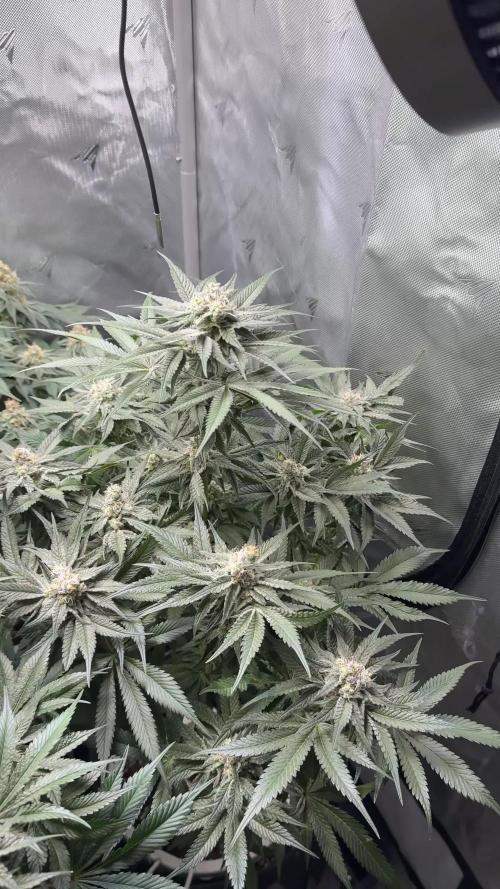
Day 76 | Flower Day 41. The girls showed even more color and frost this week. 🤤🌼 The big girl looks like she could use a little more phosphorus. The middle girl didn’t feel like drinking much this week, so we skipped one watering for her. The smallest one seems to be doing just fine, no problems so far. 👌
Good luck and happy growing! ✌️🍀
____________________________________________
Servus! 🖖
Den 76 | Den květu 41. Holky tento týden přidali další barvičku a cukr. 🤤🌼 Velká holka by asi chtěla více fosforu. Střední holka nechtěla tento týden moc pít, jednu zálivku jsme u ni vynechali. Nejmenší asi bez problému…. 👌
Ať se daří! ✌️🍀

Likes
11
Share


@CrushedCana
Follow
Tomo muy bien esa desfoliacion que aplique y está tomando fuerza, me llegó una lámpara para completar sus horas de luz
Likes
38
Share

@Sadhus
Follow
**Semaine 8 : Huitième Semaine de Floraison – Phase Ripening (8-14 avril 2026)**
**Note :** Mise à jour hebdomadaire. On entre officiellement dans la phase **ripening** (mûrissement). Les données TrolMaster et GrowOps confirment une transition très propre et contrôlée. Tout se passe bien, sans aucun souci.
### Contexte et Objectifs de la Semaine
Semaine 8 sur 12 totales : on passe du bulking pur au **ripening**. L’objectif n’est plus de faire grossir les buds, mais de les densifier, de maximiser la production de trichomes et de laisser la plante terminer sa maturation.
Steering : passage progressif vers **génératif** (irrigations moins fréquentes, dryback plus marqué la nuit, baisse progressive de tous les paramètres).
Changements appliqués cette semaine :
- PPFD diminué progressivement (750 → 550)
- Température et humidité baissées
- EC réduit (2.6 → 1.5)
- UV maintenu à 90 min/jour pour continuer à booster terpènes et résine
**Petit tips éducatif : Pourquoi baisser progressivement en ripening ?**
En phase ripening (dernières 4-5 semaines), la plante arrête de pousser en taille et concentre son énergie sur la maturation des fleurs.
- Baisser le PPFD/DLI évite le stress lumineux et permet aux trichomes de grossir sans brûler.
- Baisser la température (surtout la nuit) et l’humidité favorise la synthèse des terpènes et réduit le risque de moisissure.
- Réduire l’EC évite l’accumulation de sels en fin de cycle et améliore le goût final.
- Passer en steering génératif (dryback plus long) force la plante à « finir » ses buds et à concentrer résine et cannabinoïdes.
Fait correctement, cela donne des buds plus compacts, plus frosty et avec un profil terpénique plus prononcé.
### Observations des Plantes
La plante dominante reste à **150 cm** avec une structure massive et une canopée bien remplie.
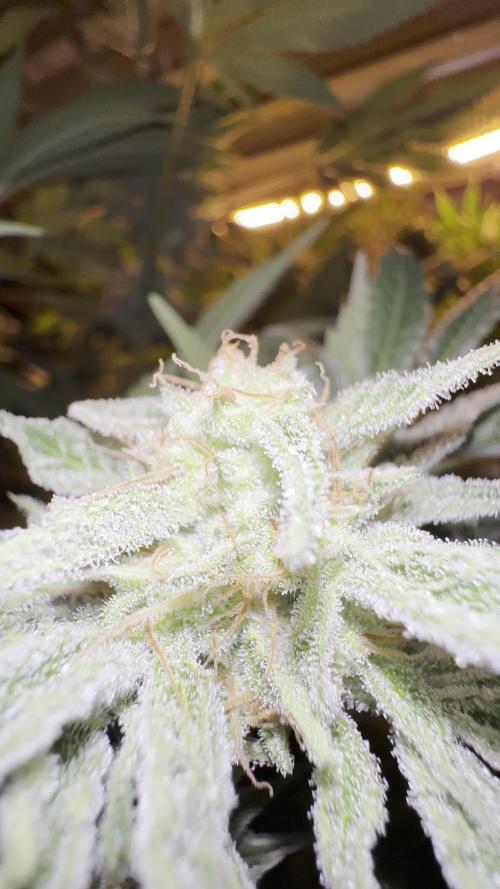
Les buds sont **follement frosty** : couverts d’une épaisse couche de trichomes (sugar leaves très blanches), ce qui donne un aspect brillant et collant incroyable. La densité des buds est bonne et devient bien compacte, même si la taille reste raisonnable (j’ai déjà vu des buds plus gros sur d’autres variétés, mais ici la qualité prime).
Odeur : très forte et agréable, mélange sucré/épicé/floral typique de Sticky Broccoli. Pistils majoritairement colorés et enroulés.
Santé générale : parfaite, vert profond sur les feuilles restantes, zéro pest, zéro carence, zéro stress visible. Les plantes sont en pleine forme et concentrées sur la maturation.
### Paramètres Environnementaux (TrolMaster + GrowOps – synthèse semaine 8)
- **Température jour** : 19-21 °C (cible 20 °C, live 20.3 °C)
- **Température nuit** : 14-15 °C (baisse nette pour ripening)
- **Humidité jour** : 48-58 % (cible 55 %, live 51.5 %)
- **Humidité nuit** : 29-39 %
- **VPD** : 0.9-1.3 kPa (live 1.16 kPa → bien adapté au ripening)
- **PPFD** : 550 (baisse progressive, DLI ~24)
- **UV Light** : 90 min/jour (maintenu)
- **Far Red Light** : 30 min en fin de cycle
- **CO₂** : setpoint 900 ppm jour
- **EC solution** : 1.5 mS/cm (live ~1.62)
- **pH solution** : 5.8-6.0 (live 6.27)
- **Runoff EC** : 2.5-3 mS/cm
- **Irrigation** : moins fréquente (transition générative)
- **Runoff % daily** : 20-30 %
- **Night dryback** : 20-30 % (augmenté pour ripening)
- **Steering** : génératif (confirmé cette semaine)
### Nutrition et Irrigation (Soupe actuelle)
La recette reste la même que les semaines précédentes, mais avec EC réduit à 1.5 :
- Cocos A + B
- CANNA PK 13/14 (dose légère)
- Green Sensation suprimer
- Pure Zym suprimer
- Sugar Royal suprimer
- Cal-Mag Amino 1 ml
- Silica Force 1 ml
- pH- pour ajuster
Eau à ~20 °C. L’irrigation est maintenant moins fréquente pour accentuer le dryback nocturne et favoriser la concentration des buds.
### Problèmes et Ajustements
**RAS total.**
Aucune alerte, aucune carence, aucun excès. La baisse progressive de tous les paramètres se fait en douceur et les plantes répondent très bien. Le passage en ripening est maîtrisé.
### Plans pour la Semaine 9
- Continuer à baisser tranquillement : PPFD, température (surtout nuit), humidité et EC
- Maintenir UV à 90 min/jour
- Défoliation très légère si nécessaire (seulement les feuilles qui bloquent la lumière sur les buds inférieurs)
- Photos rapprochées pour suivre la couleur des trichomes (passage vers ambré)
- Préparer le flush (généralement à partir de la semaine 9-10 selon maturité)
Ce journal sera mis à jour hebdomadairement.
#GrowLegendary #Zamnesia #Plagron #EternityGrowCup2
Les buds sont magnifiquement frosty, denses et résineux, avec une odeur qui devient vraiment puissante. La qualité est au rendez-vous, même si la taille reste raisonnable. On continue la descente en douceur vers la récolte ! 🌱✨