Likes
Comments
Share


@Tropicannibis_Todd
Follow
👉Alrighty Then👈
70 days in flipped at 28 days
👉we are now around 3 to 4 weeks left and I'm super happy thus far 👈
It's been a great week all plants are killing it ......... 👉we are now in full flowering 👈
There all gonna get a slight defolation over the next few days to let air and light get in there which seems like I'm doing just about every feeding 👈
👉So I topped all but Babba Kush and Slurricane they didn't require it ... 👌 Got some nice level tops 👌
I've now started lowering there full flowering nutrients program , so we are set to go ...... up to the flush 😳
Persian Pie from Greenhouseseeds
Full Gas from Greenhouseseeds
Babba Kush from Greenhouseseeds
Rainbow Melon from Fastbuds
Papaya Sherbet from Fastbuds
Weddingcheesecake FF From Fastbuds
Purple Oreoz F1 From Seedsman
Slurricane From Premium Cultivars
Soil by Promix
Nutrients by Cronks
Well this should be fun 🙃
Thanks to all my growmies out there for stopping by its much appreciated 👈
👉Happy Growing👈


Likes
57
Share


@LockDownGrow
Follow
Finally at the swelling stage and growing out nicely , this lady has been a joy too grow , no decency's what so ever , she really did stretch in here flower stage going from the size of the Zkittlz plant into a plentiful branched beast she is today stacked with bud sites and let me tell you she smells absolutely amazing !
her buds look frostie already and are starting too swell lovely and there are plenty of them too ,
Likes
43
Share


@TheCannaProphet
Follow
~Entry for the 'Best Rarest & Smallest Pot by Seedsman' contest~
Starring 🤩....
~ Seedsman Zkittlez Auto ~
Zkittlez (Grape x Grape Apple) Auto x Auto Fruit (Auto Fruit Cheese x Auto Blueberry)
Zkittlez Auto is one of the very sweetest-tasting auto strains available anywhere. It is a sativa-dominant (60%) strain that was bred from Zkittlez (Grape x Grape Apple) Auto crossed with a male Fruit Kush Auto, the latter a remarkable fruity strain bred from Fruit Cheese Auto and Blueberry Auto. Growers can expect to harvest some good yields of high-THC buds.
Zkittlez Auto remains a fairly short plant, rarely exceeding 120 cm. in height wherever it is grown. This is a vigorous plant which is able to metabolize a high level of nutrients and she's a thirsty girl too! If growing indoors close to neighbors it is strongly advised to ensure good and effective carbon air-filtration in order to neutralize powerful odors. This strain's life-cycle is approximately 90 days from seed to harvest.
The leaves on this plant are big and wide serving to convert every lumen available into Zkittlez goodness. Indoor growers should obtain between 400 - 500 gr/m2 while plants cultivated outdoors will produce slightly more at 500 - 600 gr/m2. Lateral branching is very good and it is recommended to use supports/ties to prevent snapping and keep buds close to the light source.
This strain's scent is sweet and fruity with candy and berry notes. Its high-THC has been measured at between 21 - 24% with less than 1% CBD. The effect is well-balanced, cerebral and euphoric, and is very good for social situations as well as for relaxing in front of the TV either alone or with company. It also has the added effect of helping to relieve chronic pain, helping with nausea, insomnia and depression as well as stimulating the appetite.**
**Credit to Seedsman.com
______________________________________________________________________________________________________________________________________________________________________________________________________________________________________________________________________________________________________________________________________________________________________________________________________________________
~ The Setup ~
~ Grown in a 2qt plastic popcorn pot filled with Mother Earth Grow 70/30 Coco/Perlite with Xtreme Gardening Mykos added.
~ Seed was germinated directly in the medium without any 'pre-soak'
~ Feeding will be by Dutch Pro Nutrients
~ 24hr light cycle while germinating
~ 20/4 light cycle after first leaves appear.
~ 4x8 Gorilla Tent
~ HLG 650R w/ 30w Supplemental UVA Bar controlled by a Trolmaster Hydro X controller set for a 15min Sunrise/Sunset simulation. (also a HLG Blackbird for additional side lighting if necessary)
~ Supplemental co2 controlled by an AutoPilot APC 8200 co2 controller
~ AC Infinity Cloudline T6 with Controller 67 using a Terrabloom 6x24" carbon filter
~ De-Humidifier and Humidifier when needed.
~ 14k BTU IdealAir portable A/C unit plumbed into tent for temperature control.
~ BlueLab testing instruments
~ Two Hurricane 18" oscillating fans
~ Two 6" Clip-on fans
~ Two 10" floor mounted fans
______________________________________________________________________________________________________________________________________________________________________________________________________________________________________________________________________________________________________________________________________________________________________________________________________________________
Weekly Update:
1/17- Week Eight of flower and it's almost MOVIE TIME!!!
I'm beginning to flush the Seedsman Zkittlez Auto now giving it straight well water that's ph'd to 6.5-6.7 @ 70-72℉ and turning her pot 1/4 turn daily.
1/19- The Zkittlez Auto was watered until runoff yesterday with well water that's ph'd to 6.5 @ 70℉ and her pot was turned.
This lady is looking absolutely AMAZING now with HUGH colas that are super frosty!
1/21- I didn't water yesterday, today I realized that because our RH has dropped into the 30's that she'd dry out faster, and today she was wilting 😶. I'm not too concerned as the stress will do nothing but force her to up her trichome production.
I went ahead and flooded her pot until I had a good runoff with well water that's ph'd to 6.6 @ 71℉ and gave her pot a turn. Four hours later when I checked on her, she had already perked back up and looked much better! Her fade is coming on strong now and I anticipate placing her in the dark for 72 hours within 4-5 more days, after which she'll be ready to hang to dry!
1/23- I gave the Zkittlez Auto a healthy flush today with well water that I ph'd to 6.6 @ 72℉ and turned her pot. Her trichomes are 80% milky now and I anticipate her being ready anytime so I've been checking her trichomes daily to hit that 'sweet spot' if possible.
Well, eight weeks of flowering on the books and this beauty is just about done! The Seedsman Zkittlez Auto will be finished up in the next couple of days and then will go 'dark' for 72 hours before I hang her to begin the drying/curing process! See you next week fam! 😎👍
~ Thank you from the bottom of my heart for following my grows and for all the ❤️and support you give! 💚What you grow - Grow what you💚
Likes
31
Share


@MrJones
Follow
MrJones VIPARSPECTRA XS1000 LED
📜 SUMMARY - I have been given the opportunity to run the next generation of LED lights by VIPERSPECTAR, the XS1000! I set up a Stealth Cabnient and moved 3 Cream Manderain Auto XL.s under these lights, the cabinet set up is automated with WIFI light controllers, and INKBIRD Temperature and Humidity Controllers, I am very excited about this opportunity!
Specs and Discount Codes Listed Below.
🔹🔹🔹🔹🔹🔹WEEKLY GOALS 🔹🔹🔹🔹🔹🔹
🌞Environment - 80F and 50%Humidity - using Humidfyer as needed.
💧 Feeding - Feeding with FOOP Canna Organic Nutrient Line
🍃Training / Keeping Stems Stable and Strait
🕷️ IPM - Will be using Green Cleaner" 1 OZ per Gallon, and CannControl from Mammoth alternating between product each month for Integrated Pest Management.
💡 Vegetation & Flower (new) Viparspectra XS-1000 Release on March 15th.
🔹🔹🔹🔹PLANT UPDATES🔹🔹🔹🔹🔹
🌱 Plant #1 - Week 5 Flowering is starting to happen, should see more stretch this week, she is about 15 inches wide not.
🌱 Plant #2 - Week 5 Flowering is starting to happen, should see more stretch this week, she is about 12 inches wide not.
🌱 Plant #3 - Week 5 Flowering is starting to happen, should see more stretch this week, she is about 12 inches wide not.
🔹🔹🔹🔹🔹🔹🔹🔹🔹🔹🔹🔹🔹🔹🔹
▶️Monday 03.23.21 / Plants are starting to flower, I decided to defoliate and remove many of the small sucker branches, I would prefer the hormones being spent in the larger and more productive colas, I also fear that these plants may outgrow their space, we will see,I am moving the feed up to the next level as well. I am amazed that just at a week under these VIPARSPECTRA XS1000 LEDs they have almost doubled in size, the FOOP Canna nutrients are so easy to use and the plants just love them!
▶️Tuesday 03.24.21 / These girls just keep stretching, not much room left under the lights feeding FOOP 30 ounces each day.
▶️Wednesday 03.25.21/ Feeding FOOP 30 ounces per day.
▶️Thursday 03.26.21 / Feeding FOOP 30 ounces per day.
▶️Friday 03.27.21 / Feeding FOOP 30 ounces per day.
▶️Saturday 03.28.21 / Feeding FOOP 30 ounces per day.
▶️Sunday 03.29.21 / Feeding FOOP 30 ounces per day.
🔹🔹VIPARSPECTRA XS1000 LED🔹🔹
Amazon US:
XS1000 10% off: in10MrJones http://yx-8.cn/0y-6
XS1500 5% off: in15MrJones http://yx-8.cn/0yA
XS2000 5% off: in20MrJones http://yx-8.cn/0y2Y
XS4000 5% off: in40MrJones http://yx-8.cn/0y5k
Amazon Canada
XS1000 10% off it10MrJones https://amzn.to/38udUVe
XS1500 5% off: it15MrJones https://amzn.to/3esVUyr
XS2000 5% off: it20MrJones https://amzn.to/3l5zAfg
XS4000 5% off: it40MrJones https://amzn.to/3l7k5Uj

Likes
5
Share


@Hempcules
Follow
WEEK 7 (Day42 - 48)
The training has proven effective for all plants. I continuously defoliate them at the beginning of flowering. This strain has a very compact growth form, almost resembling a bonsai. Nevertheless, all the shoots are covered with dense flower pistils. I think this strain is ideal for small grow spaces.
The current growth suggests a really strong, compressed flowering pattern, and I believe these plants will deliver solid performance in the coming weeks.
As for the values, I have increased the VPD to 1.2 kPa and raised the light intensity to 650 PPFD.

Likes
68
Share


@Theia
Follow
Just left a bean in the garden.did not feed her except for some runoff from the flower room.
This year seems to be horrid for outdoors around the world. Mould spores blowing around.. I think if I do put doors next year I will pick a nice landrace strain maybe some Kumaoni..
I will report back once she gets fully dried and trimmed.
Likes
6
Share


@Ryno1990
Follow
Started soaking purple lemonade autoflower from fast buds on 5/17
Placed in damp paper towel with some great white for 2 days till taproot got decent size then planted into coco
She popped up in coco 2 days later on 5/23 an has been doing good
She's growing good comming up ending week 1 of seedling stage
Begining week 2 of seedling the Purple Lemonade is doing good she sprouted missing a leaf in one side but grew the next set perfect so hoping she keeps on the good path
Likes
5
Share


@BasiGoToGrow
Follow
🌱🌞🌱Week4🌱🌞🌱
Bruce is much smaller, LST is almost completely tied to the ground, but looks super healthy. All the side shoots have now been directed and I hope that she will now grow nicely upwards 😅
Sherbet is my queen in this grow so far 🌞
It's just fun to watch the beauty grow. To start the fourth week, I removed some leaves today and directed the shoots in the right direction, otherwise Brucie will soon be completely overgrown 😂 but hopefully it will also have the effect that the good energy of growth will now go in the right direction.... I'll be surprised. Now she looks like a beautiful chandelier 😎
Likes
8
Share

@NoProbation4Weed
Follow
the weather is perfect and the outdoor plant looks healthy and grows like a champ.
the indoor one finally got transplanted into 25L FibrePots.


Likes
18
Share


@VI_Cannabis
Follow
June 7 - We ordered some new lights last week, they are 240w kingbrite samsung lm310h with uv/ir, 3000k, and meanwell drivers.
We setup the new room and moved the girls into there. After a bit of LST and a watering (with nutrients) at roughly 7ph, they were ready to go under the 2 new lights and the same SF-1000 we have been using in this grow.
The new room is a 12 ft enclosed trailer. I moved everything from the small tent into this. I put clear poly on the walls, floor and ceiling. I put poly on the shelf I am going to be keeping in there as well. I bought 50ft of 6mm mylar and lined the floors, roof and sides with it. I plan to get some reflective tape to seal everything and to cover the wood. I did not get much of a chance to watch temp's today as they it was later in the evening after all was said and done. The inline fan blowing in air from outside.
June 8 -
9 AM i checked the plants, they were at 25.2 and 50% RH. Late through the day I had checked and we had gotten up to around 32 degrees. So I moved the inline fan to the closer vent, hooked up to that, and had the air blowing out of the trailer with the inline fan sucking it from above the lights.
I then added oscillating fan and had it blowing air on the left side of the room so it would somewhat circulate once I closed the doors. I then checked at about 9pm and we were at 22 degrees. Definitely noticed a decent amount of growth already. I have the lights on a 22/2 cycle as I was worried about the heat at night time.
June 9 -
Some great growth from the girls, still having problems controlling the temps in the afternoon. I decided to prop the door open a bit to have a constant breeze throughout the day while I am at work. Decided to do some more LST and also a bit of defoliation. I took about 25% of the leaf's that were blocking the new growth as it was getting a bit bunched up. I was then told the leaf's are almost solar panels for them. So from now on I will be trying to just do some tucking unless needed. The leaf's I removed were most of the damaged leaf's, I am not to sure if that makes much of a difference. I gave them a watering with only water as there is a potential I am getting a bit of a nutrient buildup along with the PH problem. Or potentially the reason for the ph problem is nutrient buildup. After watering with A PH of 7 I got some run off and tested it. The smaller plant gave me a PH of about 5.5 where the bigger one is around 5.0.
June 10 -
Plants are looking happy and showing tons of growth. Seems to be trying to stretch outwards. Not a ton of sign of PH issues showing so potentially getting it under control. Still a bit of damage to previous leaf's but it is what it is! The last few days I have been leaving the door open a bit in order to keep the temps down. I decided to test something and turn the lights off (automatically) at 11AM and back on at 5PM so light schedule has now changed to 18/6 and it seems I may have figured out the issue. We haven't had lots of sun the last couple days so it hasn't been to hard and I have yet to know if it truly fixed the heat issue for now. (I will be looking into a ac unit as well since it typically gets to around 30-35 around here.
June 11 - Pulled some of the branches back down and added a few more LST spots. Seems we have a good amount of growth from the smaller plant out of the 2 topped spots. Unfortunately it looks like I fucked up on the bigger plant and only one of the nodes seems to have new growth. I will continue to monitor that but I think I cut the node to low and also to soon. Other then that, the girls are doing great. They seem to be absolutely loving these new lights. I gave them some nutrient water today as well. roughly 3L each. They seem to be A hell of A lot more thirsty under these new lights.
June 12 - The girls are doing great , they are still just doing growing away. Lots of progress everyday. I am going to be getting a go-pro so I can set-up a time-lapse for the rest of this grow. I received my new inline fan, I got A ac infinity CLOUDLINE T4 with the temperature humidity controller. I am going to be having one fan pushing fresh air in and one fan pulling out the hot air. I will be doing that tomorrow since I have to work today.
June 13 - I ordered another 50ft of mylar and that showed up today. I have decided to remove the shelf and add another 3+ feet to the grow space. So today I installed more poly, mylar, the ac infinity fan. I have it set-up to pump in air if it gets to warm. I am thinking of switching it to the output that way if it gets to hot or to humid I can have that air pulled out of the trailer. Right now my other inline fan is the outtake and I just have it set on full. Overall I think everything is set-up a bit better and more accessible. I will be putting my 2x2 tent in there at the left of the doors so I can have a veg room when these 2 are in flower. I plan to have 4 in veg and 4 in flower for the next grow. Still waiting on JOTI seeds, ordered 3 weeks ago and still have not been shipped. I will be getting those going the moment they arrive.
The girls seem to be happy still, did a bit more LST to try to keep everything even, mainly I'm just pulling down on the spots I already have tie wire on.
Processing
Likes
3
Share


@XxBILLZAxX
Follow
Haven't filled this in for a while - previous pics are 2 months old now.
Spider mite problems still at large. Found a spray to 'contain them' But never stopped them but killed and stunned the eggs I believe. After 3-4 days they would be back on the leaf.
Likes
1
Share

@Mr_Santos
Follow
Infos kommen morgen !
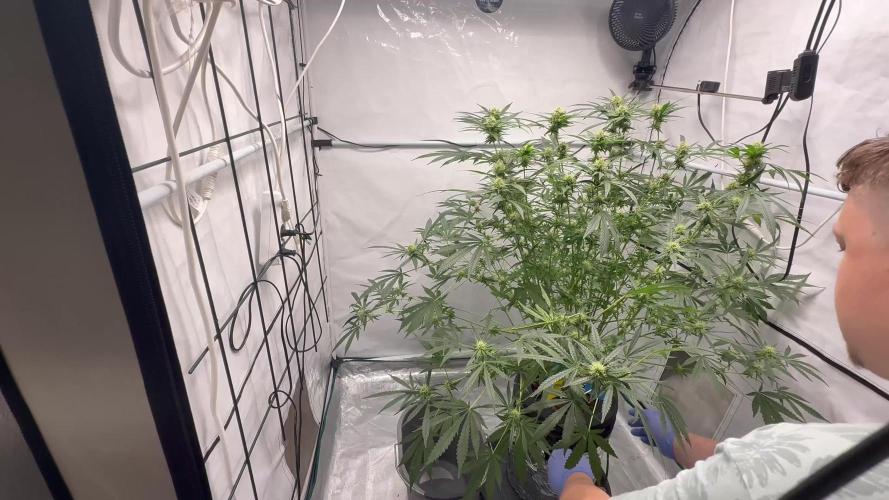
Pflanze steht im Saft. Soweit ist gesagt. Jetzt muss sie sich erstmal von dem Beschneiden erholen und dem zuvor zu hohen EC-Wert.
Nährlösung wird momentan nur mit ca 1,0 angefertigt. Anscheinend hat die Oflanze in den Zellen noch genug Nährsalze eingelagert.
Ich bin echt mal gespannt wie massiv die Blüten mal werden.
Ihr seht ja selber was für Riesen Wurzeln das sind (siehe Video)!
Sie macht Sie sich sonst echt gut bis jetzt !

Likes
2
Share


@GarciasGarden
Follow
End of week 3 of VEG I topped the plants and tied down each branch .. as you can tell I lost my plant ties soooo ribbon it is. But the plants popped up after 1 day and are thriving ! I’m ready to put these plants into flower I just need them to grow enough to get some clones ! The strain I made is definitely showing it’s washing machine traits and I think it was crossed with Blueberry so I’m hoping these buds end up coming out beautiful! The Dunkaroos are going along really well especially one of the phenos of it flowers as nice as it does during veg then it is definitely a keeper! I’ll post again in a week with the start of flower!

Likes
9
Share


@OS_Farmz
Follow
Удалось избавиться от жёлтых пятен, АК-47 здорово вытянулся - 27 см. Едем дальше😉


Likes
2
Share


@Skinnytalls420
Follow
#1-03/02/23 first one to come down will update as I cut more down!!
#2-06/02/23
#3-06/02/23
Likes
11
Share


@McShorty
Follow
Dehumidifier arrived last week and works really well. Since there is a heatwave in germany i had humidity levels of 80+% and now i can regulate down to 50%. Only the high Temperature Kind of Sucks. I am Glas the tent is in my basement, so it Never goes above 30 degrees but its Not ideal.
Also there is another Issue now, i have bugs in my tent, probably thrips. I noticed them 3 days ago and got nem oil and ordered some other bugs (dont know how they are called in english) so they dont destroy my plants.
Really annoying, but since this is my first grow ever and some of my Environment conditions are Not ideal i expected difficulties. I hoped it wouldnt be bugs, but lets See how i am able to handle Thors


Likes
10
Share


@majic_happen
Follow
day 44
- The growth process continues unabated. I am waiting for the desired size. 8 days after flowering it didn't grow as much as I thought it would, so we went back to the growing season. 👽
day 49
- I decided not to cut the leaves anymore after much defoliation. It easily tolerates strong stress easy to grow.
Likes
5
Share


@UhhDoiigreen
Follow
Perfect to this point dense even colas. Smelling great covered in 💎 last week has been compost teas last one given today. Only water for the next 7-10 and nothing after that till harvest besides 36hr of darkness
Home stretch time