


Likes
Comments
Share


@hyperborean
Follow
Nuggets are starting to get frosty and ripe. If it was inside I'd keep flowering them for another 2-3 weeks but since it's outside and there is mold, so I'm probably harvesting after one week or 10 from day 71 max.
Suprised how fast they progress. Really good smelling ganja. Theres hint of berries and fruit. Have to say I am really suprised by the potency of the smoke already. Such a joy to experience this.



Likes
Comments
Share


@Anonimo88
Follow
The flowering it's started and the vegetation is nice.
Other coffe and light mix, added grid for scrog and new lateral lamp 4 watt.

Likes
25
Share


@BudGardener420
Follow
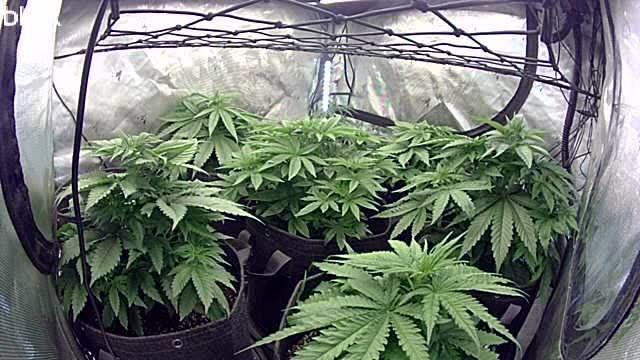
This week I had almost no time at all due to family commitments - I'm also completely at a loss as to what deficiency my plants are suffering from. I would say a serious calcium magnesium deficiency. But why? I mixed every watering with calmag - I suspect that the pH value in the soil was not right at times. The deficiency came overnight with the second compost tea. Oh well - I hope I can still salvage something. I would be very grateful for help. Thank you 🙏

Likes
2
Share

@Crop_Top
Follow
This week was spent doing some needed cleaning and minor defoliation and start aiming towards flowering in the next week or so. I dumped all pots and wiped out as well as the resivoir and added fresh water and nutes to all the plants. While plants were out of tent I did some very minor defoliating as well.
I picked up a few goodies this week. I noticed a fruit fly or two and decided to pick up an insect trap off amazon (let’s see how it works 🤞🏽). I also picked up a chargeable watering wand that is worth 3x its price for how easy it makes it to water/feed my plants. I just drop in in my 5 gallon bucket after nutes and pHing water and get to work without moving a single pot. Wish I got this sooner!


Likes
35
Share


@The_Bearded_Grower
Follow
welcome to Day 43 29/1/2021 she is looking great and vibrant. no problems at all, that being said if you have any questions drop them below. as always happy growing and keep your stick on the ice

Likes
55
Share


@MadeInGermany
Follow
Info:
Unfortunately, I had to find out that my account is used for fake pages in social media.
I am only active here on growdiaries.
I am not on facebook instagram twitter etc All accounts except this one are fake.
Flowering day 44
since time change
to 12/12 h.
Hey guys :-) .
The lady is developing very well.
The buds keep getting thicker and smell better and better :-).
This week it was poured twice with 1.2 l each (sewing materials, see table above).
The tent was cleaned and everything checked.
Stay healthy 🙏🏻
You can buy this Nutrients at :
https://greenbuzzliquids.com/en/shop/
With the discount code: Made_in_Germany you get a discount of 15% on all products from an order value of 100 euros.
You can buy This Strain at :
www.Zamnesia.com
☝️🏼☝️🏼☝️🏼☝️🏼☝️🏼☝️🏼
Strain
Gelato clone from mother (Zamnesia )
☝️
Genetics: Wedding Cake x Gelato x Gelato 33
Vega lamp:
2 x Todogrow Led
Quantum Board 100 W
💡
Bloom Lamp :
2 x Todogrow Led
Cxb 3590 COB 3500 K 205W
💡💡☝️🏼
Soil :
Canna Coco Professional +
☝️🏼
Nutrients :
Green Buzz Liquids :
Organic Grow Liquid
Organic Bloom Liquid
Organic more PK
More Roots
Fast Buds
Humic Acid Plus
Growzyme Big Fruits
Clean Fruits
Cal / Mag
Organic Ph - Pulver
☝️🏼🌱
Water: Osmosis water mixed with normal water (24 hours stale that the chlorine evaporates) to 0.2 EC. Add Cal / Mag to 0.4 Ec Ph with Organic Ph - to 5.8 - 6.4

Likes
9
Share


@DaddyPrime2
Follow
9/22 topped them at 4th node. some of them are looking better for mainlining that others. some of them i may not mainline and others i left an extra node in case i want to keep clones around.
#1 is looking happy with the topping and looks really good.
#2 is the only one thats been praying and is the tallest and strongest looking all around.
#5 short and such tight internodal spacing that it makes it hard to see whats all there. just looks like a bunch of small leaves until they grow out. i may not mainline this one either be cause of it being so tightly packed it may make it
9/27/24
day 20 theyre growing quite well. #1 i ended up taking the bottom nodes. i was originally goi g to use them as clones later on but decided to just let her go with her 4 nodes. #5 is so tightly packed, she has like 8 mains all in such a small space, its hard to even make sense of it all.

Likes
18
Share


@Rinna
Follow
As said before, I'm incredibly happy that I got to harvest a little bit. Never expected her to make it, but she kind off did! The smell was pungent and sweet like an amnesia haze should be, hoping that will be even better after drying and curing!


Likes
14
Share


@Fat_Olsh_Farms
Follow
Day 42. General Hydroponics maxigro every other watering. Frosting up nicely.
Processing
Likes
14
Share


@wolvex
Follow
I am a little bit worried about its flowers size so I've duplicated the green sensation dose from 1mL/L to 2mL/L due I haven't using any other fertilizer apart from the banana (+potato+honey) juice . These photos are intended to take a look at the state of their trichomes, since, according to the variety information, there is only one week left to be harvested (although I do not believe it). Lets see what happens.
Likes
34
Share


@ROM101
Follow
Couple more weeks of feeding then flush. This girl is stacking hard and buds are forming rock solid.

Processing
Likes
8
Share


@Squaregrouper
Follow
she is so sticky when you pass by her and she grabs your shirt you will smell it after the interlude

Likes
3
Share


@Xebediah
Follow
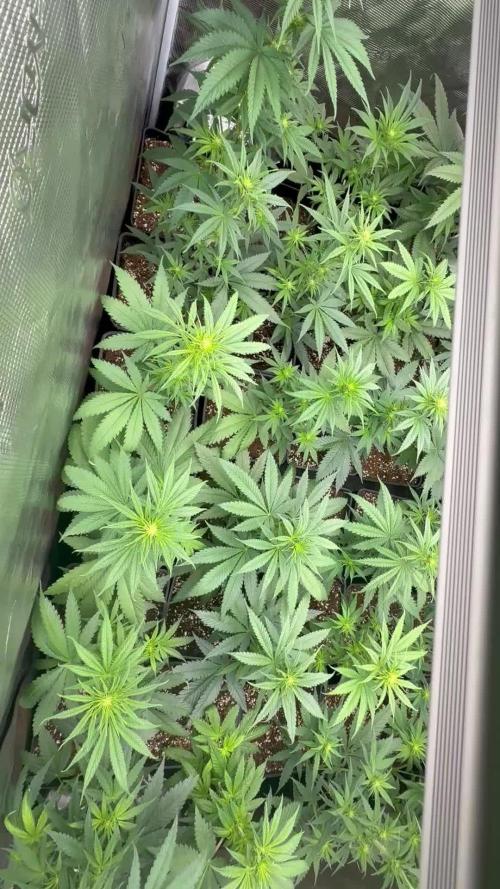
Finally got the RDWC system complete and the girls are in and under the LEDs. Started with the LED light elevated higher than recommended; didn't want to cause light burn. About mid week I bumped the TDS up to 350 and lowered the light elevation to 18 inches and they responded very well.

Likes
3
Share

@HighHolidays
Follow
I’ve kept almost all the fertilizer, light, and environmental parameters the same. I did a good defoliation to improve airflow, since I was having a bit of trouble lowering the humidity. This also helps the light penetrate better through the buds, allowing them to develop more fully.
Likes
49
Share


@Hashy
Follow
Light settings
12/12 on at 9.00am off 9.00pm
Light power= 62% 150w
Radiator settings
LIghts on
Turn on if temp drops below 23c
Turn off if temp goes above 23c
Lights off
Turn on if temp drops below 19c
Turn off if temp goes above 19c
Dehumidifier settings
LIghts on
Turn off if humidity drops below 60%
Turn on if humidity goes above 60%
LIghts off
Turn off if humidity drops below 62%
Turn on if humidity goes above 62%
Extractor settings
temperature 24c with 1c steps
Humidity 54% with 2% steps
Max speed 9
Min speed 4
VPD aim 0.8-1.2
Wednesday 1/3/23 Day 36
Autofeed 5 15 minute runs
Water 10L Ec=0.21 Ph=6.5/7.0
3L left
Roughly 2.3L each.
#2 run 0.1L Ec=3.86 Ph=5.7
7.15pm Lowered light 3cm
#2 DLI= 25.5
Thursday 2/3/23 Day 37
10.00pm
Extractor settings
temperature 24c with 1c steps
Humidity 54% with 2% steps
Max speed 10
Min speed 5
Friday 3/3/23 Day 38
Autofeed 5 15 minute runs
Feed 10L Ec=1.73 Ph=6.3
2.5L left.
Roughly 2.5L each.
#2 run 0.6L Ec=2.14 Ph=6.1
Saturday 4/3/23 Day 39
5.00pm
#2 Height= 30CM Dist= 38CM DLI= 26.6
Lifted lights 3 clicks and Lst and defoliate
Sunday 5/3/23 Day 40
Bit of Lst and scrogging
Monday 6/3/23 Day 41
Autofeed 5 15 minute runs
Feed 12L Ec=1.78 Ph=6.3/6.3
4.5L left
Roughly 2.5L each.
#2 run 0.25L Ec=2.4 Ph=6.1
#2 DLI=26.9
Lifted light
#2 Height= 31CM Dist= 45CM DLI= 20.7
Tuesday 7/3/23 Day 42 (Day 14 flower)
Radiator didn't come on when it should have. It was cold today and I don't understand why the sensor didn't trigger the Radiator.
#2 Height= 31CM Dist= 45CM DLI= 20.7
The 2nd week of flower has gone well. I have tried to keep the canopy of the overall grow as level as I can, the only problem with running different strains is they all have different traits and grow at different speeds. Nearer the end of the week the weather started getting cold again so the radiator is going to be working a bit more over the next week or 2.
#2 Tropicana Cookies FF stil hasn't started stretching, she is mega bushy and has quite a cool funky look to her, I haven't managed to spread her out as much as I wanted to so I'll hope she will be OK.
Power used for week
Light
(1.77+1.84+1.84+1.84+1.84+1.83+1.84)=12.8Kw
Extractor
(0.19+0.24+0.25+0.27+0.31+0.31+0.41)=1.98Kw
Fans
(0.48+0.47+0.47+0.47+0.47+0.48+0.48)=3.32Kw
Dehumidifier
(0.69+0.65+0.0+0.01+0.6+0.02+0.69)=2.66Kw
Radiator
(3.3+3.98+3.38+3.16+3.8+3.31+4.07)=25.0Kw
Water pump.
(0.02+0.0+0.02+0.0+0.0+0.2+0.0)=0.24Kw
Total for the week=46Kw
Back in a week.
Thanks for stopping by.
Likes
2
Share


@pepeXI
Follow
Hab heute (31.1) die Apple Fritter aus dem Zelt geschmissen. Kollege ht sich gefreut, hat leider gespargelt, hab sie noch für ihn umgetopft auf 20L. Wird ihr denke ich sehr gut tun wen sie die nächsten Tage gut behandelt wird. Die Apple Fritter geht dafür gut Steil. Hat wie die anderen gute Stickstoffmängel aber die hab ich hoffentlich gelöst bekommen. Jetzt wo auch mehr Platz im Zelt ist wirds denke mal :)
Likes
48
Share


@Focus420
Follow
Zdravím všechny pěstitele marijánky🌍🌞
Minulý týden sklizen BCN critilal xxl - tato rostlina měla od začátku problémy pak se spravila a nakonec vypadá celkem solidně.
Víc se dozvíte ve sklizni🌱🌱🙏
Nemůžu se dočkat dalšího růstu🌞🤗
Tento týden půjde pod kosu poslední automat (sleep)
Zbydou tam 3 celoroční odrůdy, ty vypadají nejlíp... ty ještě potřebují 2 až 3 týdny
Den 99. Hnojení
Celoročky - ph 6,3
ec 2,5
Den 100.🌱 holky vypadají úžasně😍
Dnes proběhla defoliace (focus)(franco lemon cheese)
Den 101.
Sekera🤟 (sleep) zbyly 3 celoroční odrůdy
2× focus , 1× franco lemon cheese
Proplach 8 - 10 dní
Den 102.
Kontrola trichomů -
focus = 10 % jantarových vrchů 🌱🤗
Franco lemon cheese = mléčné trichomy
Den 103.
Kontrola - Teplota,vlhkost,co2 v pořádku🤜
Den 104. Kontrola trichomu 15 procent jantar ( focus )👏
Den 105.proplach
Ph - 6,3
ec - 0,43

