


Processing
Likes
Comments
Share


@Cogollo_eu
Follow
**Encontrarás la traducción a español al final de la descripción**
If you like this week, please hit a like, it costs you nothing! 👊. Thanks in advance 😉!
From/Desde: 19/08/19 || To/Hasta: 25/08/19
From day/Desde día: 28 || To day/Hasta día: 34
-----IMAGES & VIDEOS-----
P5 - I'm loving this photo, is the first complete cool photo of the AK i've taken. With the structure, the fixing rods with the same length as the diameter of the AirPot, and those beauty rubbered green cables 😍.
P8 - I'm feeling that those branches looks too weak, and slim for what's coming. From next week i will use Rinho Skin to see if it can help them to get fat in upcoming weeks and before flora time. I'm also minding to create some branch supports with the 3d printer that will be placed on the LST structure, I need to twist my mind a bit with it.
-----WEEK SUMMARY-----
Another super heat week. While at home i'm at 34~36º in the street things are worse :(. Also humidity fluctuate from 50~65º.
At last I removed those ugly & dangerous cables from the branches and used a rubber covered one. For now i only need to fix her in 4 points, 1 per each main branch, as you can see, at about 13 cm of the main branch. Later i will fix her with another 2 points per branch, one in the border of the pot from inside, and the last one also in the pot's border but outside.
This week i removed the first horizontal internode on each main branch, and also removed the branch that grows vertically down from the second internode leaving in place the one that grows totally up.
At the end of the week i will fix the SCROG mesh, but it's not going to be permanent until later, or maybe not at all due to dark photography, as if i place the mesh i will not be able to move the plant (i need to think about it). For now, I just need it 3 or 4 days to test it as i never placed this 60x60 mesh before, and also i had to cut the central rods for the mesh.
About Alice K. she's growing beauty and healthy, some week ago i found a little white spider that i killed, @time (week 7) I didn't noticed any insect signs more. Also remark that she's standing well those temperatures and some days of very low humidity some hours 35% inside the tent. And also the equitative distribution she's developing.
As i said on previous week, i will kill those clones at mid week as i'm going to plant 4 more seeds in a week, and all is going to be too much work 😞to compatibilize it well with my job.
-----WATERING CALENDAR-----
23/08/19 (Day 32) - 3,000 ml with all week nutrients @ 1.1 E.C. PH5.8
*****ESPAÑOL*****
Por favor, si te gusta esta semana dale un like, no te cuesta nada 👊. ¡Gracias por adelantado 😉!
-----IMÁGENES & VÍDEOS-----
P5 - Me encanta esta foto, es la primera foto completa guay que hago de la AK. Con la estructura, las barras de aluminio de la medida del tiesto y esos cables cubiertos de goma verde, me empieza a encantar el aspecto de la planta 😍
P8 - Tengo la impresión de que las ramas son demasiado endebles y finas para lo que está por venir. A partir de la semana que viene, usaré Rinho Skin para ver si las puedo ayudar con el engorde antes de que llegue el tiempo de floración. También estoy pensando en crear unos soportes para las ramas con al impresora 3D que irían enganchados a la estructura para LST, necesito darle unas cuantas vueltas a esto último.
-----SUMARIO SEMANAL-----
Otra semana super calurosa. Mientras que en casa estoy entre los 34~36º en las calles la cosa es mucho peor. También la humedad está un poco loca ya que a diario me fluctua en casa del 50~65º.
Al final he quitado esos cables feos y peligrosos de las ramas y he usado un cable con goma en condiciones. Por el momento sólo he tenido que atar la planta a 4 puntos, 1 en cada rama que he dejado, como se puede ver a unos 13 cm del tallo principal. Más adelante usaré otros dos puntos de fijado en el borde del tiesto, uno de ellos en la parte interior y otro por fuera del tiesto.
Esta semana he quitado el primer nodo de cada rama y también la rama que crece hacia abajo del segundo nodo, dejando la rama que crece totalmente hacia arriba.
Al final de la semana colocaré la malla de SCROG, pero no va a ser de manera permanente, por lo menos hasta más adelante. Voy a empezar a hacer fotografías de fondo oscuro, y el tener la red me va a imposibilitar la tarea ya que debo sacar la planta del armario para las sesiones (necesito pensar en ello). De momento la quiero montar 3 o 4 días para probarla ya que nunca la había montado antes y también tenía que cortar las barras horizontales para la malla.
Sobre Alice K. está creciendo super bonita y sana, hace un par de semanas encontré y maté una arañita blanca (Requiescat In Pace), a día de hoy (semana 7) no he visto más signos de insectos. También debo remarcar lo equitativamente que está creciendo y lo bien que soporta las altas temperaturas y la escasa humedad, hay alguna vez que he mirado el higrómetro y estaba al 35% dentro del armario.
Como dije en la semana anterior, mataré los clones a media semana, voy a plantar otras 4 semillas la semana que viene y va a ser demasiado curro 😞para compatibilizarlo con mi trabajo.
-----CALENDARIO DE RIEGO-----
23/08/19 (Day 32) - 3.000 ml con todos los nutrientes semanales @ 1.1 E.C. PH5.8

Likes
11
Share


@ClosetGrower
Follow
This week noticed the plants grow considerably faster, and the roots have shown impressive growth after just one week.


Likes
11
Share


@Walligator
Follow
the girls have really taken off, things are going well, just trying to deal with my humidity. I do not have a dehumidifier, and the outside % is +60%....so it hard to bring it down too much.
I think I may need to purchase on in the near future.
Also would like to get C02 going but realize I'll need a dehumidifier first, so I went cheap and designed a C02 generator from my wine making supplies. It's producing bubbles, as you can see in the video, but not too sure how much its contributing, especially since I have the fan on for controlling the humidity. but it was fun to build


Likes
6
Share


@Happy_Roots
Follow
Pretty cool....i have two males of each cultivar to choose from as well as a female from each. The 3 females will get there own diaries.
Males-
-Koffee F8
#2 is just dumping pollen like crazy. Way more then #3 and has a fatter "Flower" structure
#3 has thinner "Flower" structure but is showing more purple then the #2.
I have plates colleting the pollen the best i can. Ive never grown a male plant past 3 weeks. This is exciting.
-Clover Shake
#1 male is very thin
#3 male is now showing sex and will go into the male tent
-Candy Master Star Dawg
#2 male
#3 male
Both going into the male tent
Likes
30
Share


@Green_Dream
Follow
I'm quite impressed by this week's development. The girls are starting to show their fatness. I did a flush at the beginning of the week and it helped a lot. Now I'm starting to give them less and less nuts, as they show obvious tip burns.
What a big coincidence that they are both polyploids(gene mutation). I'm starting to question myself if the guys from RQS are making experiments with these types of mutations to increase yield and potency???
Likes
13
Share


@Popothamio
Follow
Fue como la semana anterior sigo alternando riegos con abono si abono no y esta semana uno de los días se me quedó la luz encendida y tuvieron 36 horas seguidas de luz, espero no les pase nada grave. Por lo demás todo bien


Likes
Comments
Share


@Krautis_IndoorFarm
Follow
Update Tag 31
Heute war wieder Gießtag 💧 Jede Pflanze hat 1,5 Liter Wasser bekommen natürlich mit angepasstem pH-Wert von 6,5.
Dazu gab’s pro Liter:
• 1 ml Fish-Mix
• 1 ml Bio-Bloom Mix
• 1 ml Top-Max
• 1 ml Heaven von @biobizzwwo 🌿
👩🌾 Unsere Sorten:
• Auto Orange Amnesia XL
• Blue Dream Auto
• Auto Amnesia 47 XL
• Red Velvet Auto
💸 Seeds wie immer von @ganjafarmer.seed mit dem Code „krauti10“ spart ihr dort 10%! 🚀
Die Mädels entwickeln sich super und man merkt schon, wie gut sie die Nährstoffe aufnehmen. 🌸
#growupdate #biobizz #selbstversorger #cannabiscommunity #ganjafarmerseeds #


Likes
1
Share


@Elguacho420
Follow
Buenas a tod@s.... Bueno, sexta semana de esta red cookie gelato, la variedad para mí gusto en lo q va de tiempo para mí va muy bien, va tomando forma interesante entre aromas y evolución de la misma, la pigmentación pero solo de una planta ya q son las tresx ila misma variedad. ahora q ya le queda poco vamos a ver q tal va, de momento sigo con la misma temperatura, intentado bajar la humedad a un punto y ahi intentar mantener, la temperatura igual... 3 semanas más de floración, vamos a ver q tal siguen, para mí gusto, van de lujo... Una joya! 💎👌🏻 Buen finde para tod@s y buenos humos... 🇦🇷🤝🏻🇪🇦 💨💨😎😎
Likes
39
Share


@Bluemels
Follow
Tag 77: Heute ein letztes Mal die Lampe auf 30cm gestellt. Wurde auch Zeit so langsam werden die heller. Nun auch die volle Düngemenge.
Nur das Klima ist ein Krimi 😱 wir haben aktuell hier viel Regen, zwischenzeitlich recht warm, also ein ewiges hin und her.
Gestern hatte ich dann schon die ersten Trauermücken 😩 Da hab ich nicht lange gefackelt und Entfeuchter in die Grow Boxen gestellt, dafür ist es nun aber mindestens 1°C wärmer in den Boxen. Wenn es draußen nicht zu warm wird könnte es klappen.wenn.....
Tag 80: Aktuell haben wir hier ein Subtropischen Klima, ich habe Temperaturen in der Box von bis zu 28°C, Abkühlung in der Nachtphase ist auch nicht mehr möglich.
Doch meine Pflanzen stecken es soweit gut weg, sie sehen sogar noch vitaler aus 😍
Likes
25
Share


@EBxAH
Follow
Still just a waiting on the light shift, lol. This is what's left, Black Widow! My neighbor took the Banner and botched it. The Skywalker in the ground died. This is all that's left, lol. I hope it turns out decent! I been cultivating, with my wife, some Early Miss, Wedding Cake, Gelato, Fucking Incredible. We've harvested 1 early miss, 1 wedding cake,and 1 gelato so far. We have 1 fucking incredible coming down in a few weeks and waiting on 4 more early miss, 1 gelato, 2 fucking incredible, and 1 wedding cake. Obviously plus the widow.


Processing
Likes
17
Share


@902EastCoast
Follow
This week everything’s went smooth. The plants are stretching like crazy everyday since I switched my lighting from 24 hours to 12/12!! Starting to flower now. Removed some leaves that were blocking bud sites.


Likes
54
Share


@AsNoriu
Follow
Day 106. AK is going to end, i start to see ambers. Will push 8 more days.
Watered today, one more left and then chop.
Sweet smell is everywhere from her, very nice !
Mars TSL2000 has far reds integrated, so i expect a bit more coat ;) Great light !
Happy Growing !!!

Likes
23
Share

@J4kpvp
Follow
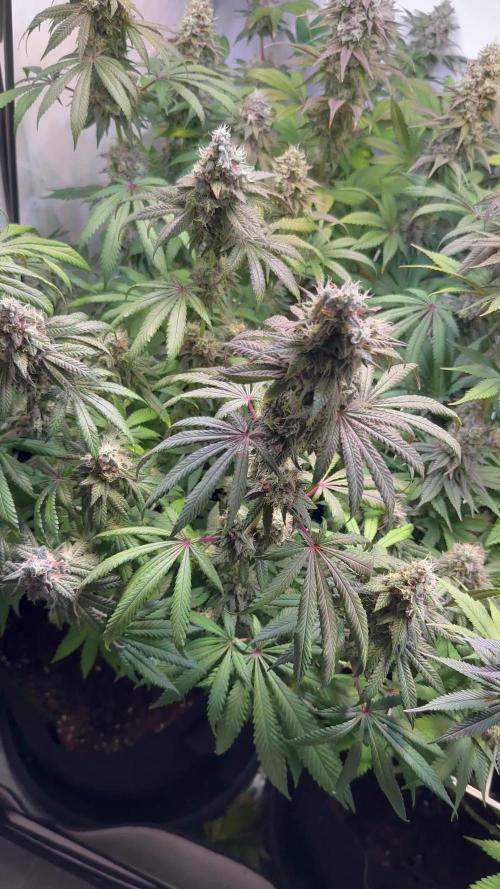
Hello:) looks like we‘re done in a few days:) the white truffle and mac n cheese look almost ready now ( right side) but the mimosa and blue zushi could do a few more days so I‘ll wait. I look at the trichomes every day now:)

Likes
18
Share


@Dunk_Junk
Follow
She's almost done.
Watching pistils to all turn colour and trichomes to go more cloudy.
Likes
22
Share


@DogDoctorOfficial
Follow
Week 9 Veg – White OG 🌿🔥 “The Topping Madness Begins”
Welcome back, fellow growers, to another wild chapter in the White OG road trip! 🚐💨 This week, it’s all about structure, training, and control—or should I say, complete madness? Because, my friends, I went full throttle with the toppings! Did I count them? No. Did I stop to think about it? Also no. I just let my instincts take over, snipping away like a sculptor carving a masterpiece! 🏆
My vision? A massive, wide, fierce bush—one that will command attention and demand respect in the grow tent! With each topping, the lower branches gain strength, new nodes emerge, and the canopy expands like an explosion of green energy.
💡 Why top so much?
• Forces the plant to spread wide instead of growing tall.
• Encourages equal light distribution to all sites.
• Increases potential flower sites for a bigger yield.
• Strengthens stems & structure to support those future fat buds!
This is plant architecture at its finest, and I’m here for it. 😎
Nutrients & Water – Keeping It Clean & Simple
I’m still riding the clean wave with Aptus Holland Clean Mineral Line, and it’s keeping this girl in top form. 💎🌊
Feed Schedule:
✅ Regulator – The silica magic keeping her strong, flexible, and stress-resistant.
✅ RO Water Conditioner – Pure hydration, setting the perfect stage for nutrient absorption.
✅ All-in-One Liquid – The full package, giving her everything she needs in one smooth delivery.
📊 Readings:
📏 pH: 6.03 (Let’s call it 6.0, perfection in balance)
⚡ EC: 1.12 (Precision feeding, steady and strong)
This plant is drinking like a beast now, and I love watching her transformation! Her color is deepening, the growth is picking up speed, and she’s responding to the training better than expected.
⸻
💡 Grow Conditions – The Perfect Playground
Under the FOG LED, every leaf is catching that perfect spectrum of light, while the TrolMaster keeps everything dialed in. The environment remains stable, and this girl is flourishing.
🔹 Temperature & RH: Same steady balance, keeping the plant happy & stress-free.
🔹 Airflow: Increasing to keep her breathing fresh & growing strong.
🔹 Defoliation: Light trims to expose lower growth & keep airflow optimal.
⸻
📢 A Big Shoutout to the Whole Squad
None of this would be possible without the dream team behind the scenes! 🙌 Much love to:
🔥 Seedsman Seeds – For this legendary strain that just keeps impressing me.
🔥 Aptus Holland – Keeping her nutritionally dialed in and thriving.
🔥 TrolMaster & Future of Grow LED – Precision control & lighting for the ultimate environment.
🔥 PRO-MIX Soil – The living foundation fueling these roots!
🔥 Cannakan, Grow Diaries & The Community – For all the love, support & passion we share.
And of course… huge respect to YOU, whether you’re here to learn, cheer, hate, or just be curious—this space is for everyone! 🎤🔥
⸻
📣 Join the Journey! 🚀
This week, I’m launching something new & exciting over on Instagram, and I want all of you to be part of it! 🎥💚 So hit me up, let’s connect, and keep pushing the plant love movement forward!
💬 How do you train your plants? Topping, LST, super cropping? Let’s talk plant training styles in the comments! 👇💬
Until next time, grow strong, grow happy, and keep the passion alive! 🌱💨🔥
#GrowDiaries #WhiteOG #ToppingMadness #AptusHolland #Mainlining #PlantTraining #GrowersLove #SeedsmanSeeds
As always, this is shared for educational purposes, aiming to spread understanding and appreciation for this plant.Let’s celebrate it responsibly and continue to learn and grow together!
💚Growers Love 💚 🌿
DISCOUNT CODE - SeedsmanSeeds - DOGDOCTOR 10% off
As always thank you all for stopping by, for the love and for it all , this journey of mine wold just not be the same without you guys, the love and support is very much appreciated and i fell honored and so joyful with you all in my life 🙏
With true love comes happiness 💚🙏 Always believe in your self and always do things expecting nothing and with an open heart , be a giver and the universe will give back to you in ways you could not even imagine so 💚
Friendly reminder all you see here is pure research and for educational purposes only
💚Growers Love To you All and remember to keep that smile big and alive 💚
