


Likes
Comments
Share


@gottagrowsometime
Follow
She's moving along at a nice pace. Bulking up while giving no real issues. Has some nice mass to her. She's a wee bit taller. And if I could redo something it would be applying HST to her after preflower. Lovely dank lemon kush smell developing. Super sticky to the touch and building a boat load of trichomes. This is my 2nd SweetSeeds grow. And I'll 100% be doing this strain again. (As I know what it's like, its being curing 45 days now).
Xpert nutrients have been a gift in their application to its ease and fast results, I simply can't praise them enough. Has brought my bud quality up easily 2-3x and Increased bud quantity. Although, that's me knowing by looking at the plants. I roughly weight stuff, I know I got 1850 dry grams from 45 plants. 13-15 were 8L pots and small such as this. So, this was 1 of the biggest yeilders out of the lot.(crop is finished and burnt my way through 2/3rds of it, I've about a halfo of this for my night time smoke, while my last 6 plants from this crop have been curing 3 weeks now and will soon be smoked) biggest crop I've done.
45 plants was a feat, a real task keeping track with whos on what and using xpert nutrients made it much smoother and any slight ph mistakes or overf/under feeds didn't destroy 1 plant to the point were it was culled.
Big thanks to ALL my sponsors. Whom I truly thank as I wouldn't have any of this without them. And to you my viewers. Whom I'd have no sponsors without. I thank you.
DISCOUNT FOR XPERT NUTRIENTS
20% OFF CODE:ggst. Free EU SHIPPING
Also, any new growers or struggling to purchase seeds and would like a few different strains. I've lots there. (Offer open to those who don't have lots of stock). Just DM me. Please be patient in response.


Likes
1
Share


@undermink
Follow
At the beginning of week 11 they both look strong and healthy to me. Though their buds still seem smaller than the one in the 20l pot. But the look great after all :) So colorful and frosty (the smaller one) and so big and yellow (the taller one). Can't wait to harvest them :D
At the middle of week 11 they both still look great and I think I saw the tall one's buds grow a bit again... There was something strange going on at the top of the head bud (of the taller one). There'S a close up picture... I guess it's just a kind of mutation and no seed. I was shocked first when I thought it was a seed...

Likes
24
Share


@el_cultivito
Follow
TOTAL YIELDS wet weight
Blue Dream 1 - 600.2 G
Blue Dream 2 - 552.9 G
Blue Dream 3 - 565.3 G
TOTAL Blue Dream - 1718.4 G
________________________________
Chemdog 1 - 616.9 G
Chemdog 2 - 598.1 G
Chemdog 3 - 558 G
TOTAL Chemdog - 1773 G
________________________________
TOTAL OVERALL - 3491.4 G
7.7 pounds wet

Likes
182
Share


@Sorsdetacachette
Follow
D92 - rien
D93 - rien
D94 - rien
D95 - rien
D96 - jour de récolte🤩
Beaucoup de travail aujourd’hui 💪
Plus de 13heures pour la manucure du gorille 🤪
Début du séchage pendant une dizaine de jours en essayant de maintenir l’humidité de la pièce à 50% , une température de 21 degrés, le tout dans le noir
Hâte de voir combien cette jolie plante va me donner ……..⚖️🔮

Processing
Likes
6
Share


@Shellshocked
Follow
Well I missed a week was going to shut down this grow as the plants were not doing anything all the deformed leaves were making it so the plant was using all its energy on fixing the deformed leaves so slowly I pulled off all the deformed leaves witch took me 2 weeks and there is still a few left now . Finally they seem to be growing again after almost 3 weeks of being stunted. Had plans of flowering them next week but there way 2 small so I will have wait probably 3 extra weeks . This grow is a good grow to show people what not to do. Will do an overview of the whole grow at the end of flower saying what I would do differently next time so these problems don't happen again . Oh yah and when I flushed the plants I did not flush them good enough and they were still being over feed for for 2 weeks .

Processing
Likes
9
Share


@JakeTheButcher
Follow
It was an interesting week...nice to have something to keep my mind occupied on these girls during this covid-19 epidemic.
2 days after water change last week, my roots started to turn brown and have appeared to stop growing, I first was concerned that it was root rot, but the plants didn't seem to be affected. So I added more UC ROOTS to the solution in hopes that it would help, I noticed white roots shooting out about 24 hours after. I think it may have been the increase in the coco cal that did the damage. They are filling the net nicely and I will be flipping them to flowering this week I think.

Likes
33
Share

@Salokin
Follow
Harvest Report | GMO × Triangle Mints BX
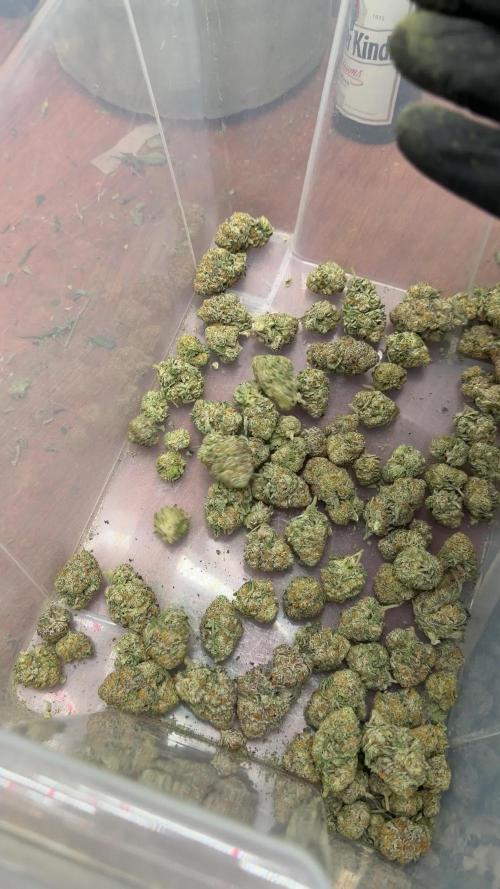
Week 17 — chop day. **6 plants** came down after a full run under **2800W** total light power in the **4.5m²** room.
The finish was everything this genetics promised. Dense, frosty colas with deep purple and near-black coloration throughout — confirmed as true phenotype expression, not a lighting artifact. The candy gas profile that built through the back half of flower hit its peak right at the chop, filling the room the moment the first branch came down.
Drying and curing now underway. **Aptus Regulator** earns a well-deserved 5-star mention — used throughout veg and flower for stem strength and structural integrity, and it delivered exactly as expected. Not a single weak stem on this run despite the bud weight these colas were carrying.
This closes out the GMO × Triangle Mints BX diary. Thanks for following along — the genetics, the process, and the result all came together. More to come from the next run.
jeder soll growen wie er will
Likes
85
Share


@Teamdirtbag2
Follow
She is growing good. Defoleated A lot. She is starting to get frosty. No burn upped the newts to 680 ppm.
Hung the second light. So things should get interesting.

Likes
3
Share


@Aqua1
Follow
Loved growing both. Will definitely be getting more of these 2 strains. Sorry I do not currently have a weight.
Likes
34
Share


@CHILLING_RACOONS
Follow
Dear Friends, 👨🌾 👩🌾
we are here to show you our journey with the MIMOSA X ORANGE PUNCH™️ by Barney’s Farm.
Germination started on the 10/11/2022, the root sprout on the 12/11/2022.
✅ VEGETATIVE week #7 (LAST WEEK)
30/12 SWITCH 12/12H
📅this week goes from 26/12 to 01/01.📅
💡💡💡Viparspectra XS2000 is working at 50% power.
💉🔍Fertilization schedule:🔍💉
26/12 3ml/lt TOP VEG
30/12 TOP MASS 0.2ml/L + 2.2 ml/L TOP VEG
31/12 SENSI CAL MAG EXTRA 2ml/L foliar spray
This new strain is hybrid produced from a cross between Mimosa Evo and Orange Punch.
It is a mostly indica strain, so, short flowering and big and dense buds! It is one of the most colourful editions to their Cali Collection.
This strain will surely be amazing, I can’t wait to smell the tangerine aroma and its sweet smoke.
We are glad to have the opportunity to try this strain from this experienced seed bank, we will do our best to grow this baby as well as possible. THANK YOU Barney’s Farm ❤️❤️❤️
***WE ARE BACK!!!
We are back after a little pause.
We take a break because we were too busy to post high quality diaries. In the last diaries we tried to post as good as possible and we have to publish about 6 or 8 diaries (in addition to these that we will publish shortly). We opened also an educational Instagram page, we growed a lot in a short amount of time BUT, Instagram suspended our account and we lost all our posts, I was so sad and disappointed... a lot of work lost in a night....***
🤓+DATA SHEET+🤓
MIMOSA X ORANGE PUNCH™️ Cannabis Seeds Strain Specifications
Type: Feminised photoperiodic
Genetics: Mimosa Evo x Orange Punch
Effect: Euphoric, Happy, Uplifted
Outdoor Yield (g): up to 1.5 kg per plant
Indoor Yield (g):up to 700 gr/m²
Flowering Time (days): 55 - 60
Indica %: 65% Sativa %: 35%
Taste: Citrusy Candy Orange
💸💸💸💸💸 Buy MIMOSA X ORANGE PUNCH™️: https://www.barneysfarm.com/mimosa-x-orange-punch-552
_______________________________________________________________________
🔧💡OUR SET UP💡🔧
✔️ 💲💲💲VIPARSPECTRA 🚀🚀🚀🌕🌕
ViparSpectra®️ XS2000 240W Infrared Full Spectrum LED Grow Light:
Excellent ratio between wattage and ppfd, excellent light penetraton, perfect light spectrum (it also has IR 🤩) and it has the best build quality on the market. Until now, built quality is really awesome. You can touch that quality. Materials are really strong, excellent driver and the best leds on the market. Heat dissipation is perfect, the lamp is never too hot and it has a passive dissipator so you will have zero noise. It also has IP65 certification. I like that this lamp is bigger than others, so the 240w of power are well distribuited on the space. Viparspectra has an awesome customer service, and shipping was creazy fast!
This awesome brand also offers 3 years warranty.
This lamp has no rivals.
A special thanks to Emily of Viparspectra ❤️❤️❤️❤️
HERE YOU CAN BUY THIS PROFESSIONAL LIGHT: https://www.viparspectra.com/products/xs-series-xs2000 or https://amzn.to/3dyUoJl
and here you can buy other awesome stuff: https://www.viparspectra.com
✔️ 💲💲💲MARSHYDRO 🚀🚀🚀🌕🌕
📦120X120 GROW TENT: an awesome box, easy and fast to assembly. Made by strong materials, solid zips and it is totally lightproof. The position of holes is optimal and the two lateral windows will make easier the work inside the box. There is also a double end, so you are 100% sure that dirt or liquids will not spill out. You can find it here: https://www.mars-hydro.com/grow-tent/buy-mars-hydro-grow-tent-48x48x80-1680d-4-x-4-size-keeps-all-light-in-top-quality-1680d-canvas-is-tear-proof-and-double-stitched-light-blocking-fast-installation-for-sale
💡TS 600 FULL SPECTRUM 100W LED GROW LIGHT : with this light you will achieve excellent buds, you will not need anything more. This lamp replace a 150w HPS lamp, but, with this Led Light you will smoke bigger, harder and tastier buds because Led have a complete spectrum and a powerful light penetration, so your plants will work as much as possible to make you happy. Psssssss it it extremely cheap and it is only 100w, your bills will never be too high, YOU HAVE NO EXCUSES!! Here if you want this little beast: https://www.mars-hydro.com/led-grow-light/mars-ts-series-led-grow-light/mars-tsw-600-led-full-spectrum-hydroponic-led-grow-light
Thank you Eleen of Marshydro❤️❤️❤️❤️
💣Quantum board - 480w - 4x120w Boards by Zhoangshan Koray Opto-Electronic Ltd.
Samsung LM301B 288 led/board 3000K 0dB noise
+24led/board led Osram 660nm
Efficiency 2.6 umol/J 220 lm/w
Driver: Meanwell HLG-480H-36B
💣Quantum board - 240w - 2x120w Boards by Shenzen Yuanhui Led Ltd.
Samsung LM301H 504 led 3500K 0dB noise
+24led/board led Osram 660nm
Efficiency 2.7 umol/J 220 lm/w
Driver: Meanwell HLG-240H-48B
-ESTRACTION FAN:
Blauberg 125 Turbo Pro Series
Maximum air flow: 430-560 m³ / h 50W 32-44 dBA
💊💉💊FEEDINGS:
We are growing in BioBizz Light Mix, it is perfect also for the first weeks.
TOP CROP:
-DEEPER UNDERGROUND: to stimulate roots system
-TOP VEG: for a excellent growth in the vegetative phase
-GREEN EXPLOSION: to promote creation of bud sites and to allow a faster growth
-MICRO VITA: bacterias for equilibrate the soil and to make the plant healty
-BIG ONE: to stimulate bud sites and to stimulate resin production
-TOP BLOOM: to achieve excellent big and hard buds
-TOP CANDY: to feed the buds with molasses for a tastier smoke and to gain weight
-TOP BUD: to enlarge buds and to gain weight
PLAGRON: PK 13-14 to have big and hard buds and to feed plants with lower effort
ADVANCED NUTRIENTS: Sensi Cal-Mag Extra-> for cal mag deficiency
GROTEK: CAL MAG for cal mag deficiency
HESI: PowerZyme to clean and balance the soil. It feeds the plant cleaning the soil.
GHE: - Final Part (ex Ripen) accelerate the final flowering phase, dissolves minerals in excess
- Flash Clean to flush the plant and to be sure that all excesses are out from plant and pot
These two products improve A LOT the smoke of our babies
-PURPINATOR to stimulate flavonoids and to have a better taste and smell.
____________________________________________________________________________________________
🙏❤️ THANK YOU FOR BEING HERE ❤️🙏
Please leave a comment with your opinions, it is very important to us to have a comparison.
If you like our job, tap the weed button and follow us. It will be really appreciated.🙏
We want to thank again everyone that help us in our project. You support us to support our dream. ❤️
SPREAD THE LOVE OF THIS PLANT ALL AROUND THE WORLD
🌿Thank you again🌿
❤️Sweet hugs❤️
👨🌾CHILLING_RACOONS👩🌾

Likes
24
Share


@DutchFarmer
Follow
Living da coco life
Week 6
🌿 Check Out My Cannabis Community! 🌿
👇 Like, Follow, Comment, and Subscribe to My YouTube Channel 👇
❄️🌱🍻 DutchF4rmer on YouTube (https://www.youtube.com/@DutchF4rmer)
----------------------------------------------------------
🎁 Join Our Discord Community for Weekly Giveaways! 🎁
👉 Join Our Discord Server (https://discord.gg/VMu6rH4a7V)
----------------------------------------------------------
🌟 Get Exclusive Help, Advice, and Mentoring on Patreon! 🌟
👉 Join Our Patreon. (https://www.patreon.com/DutchFarmer)
----------------------------------------------------------
📸 Follow Me on Instagram 📸
👉 DutchFarmer1 on Instagram (https://www.instagram.com/dutchfarmer1)

Likes
139
Share


@Rusticbuds
Follow
Super stoked for last week, watching her flower is pretty incredible, so from pretty much week 9 of veg up till now I've been feeding her half strength base nutrients with fluctuating strengths of sensizym and Cal-Mag always mixed with 8L of basic filtered water.
Update January 5 2020. Back from my fishing trip! Happy to say that everything with the durban is going swimmingly, I fed her today 8L with half strength base nutrients and half strength of sensizym. I will probably do one more feeding with sensizym and call it good.. in two-three weeks I will start adding my Overdrive nutrients to my base.
January 11 update: Not much going. Just playing the waiting game now.
January 13 update: its gotten really cold here, like -37 with wind so I put a ceramic heat emitter back in, now back up to 250w heat running 24/7. Growing in an unheated shop is definitely a challenge! But with the other one in things are picking up and shits drying out finally. Should have put the other heater back in a week ago. My bad.
January 15 update: -37!! Holy fu*ck, fed her 3L of mixed nutrients at half strength. With just a splash of overdrive.
January 17 update: outside temps finally warming up to -25°c yay!! Inside grow box temps up to 28°c she likes it warm, Fed her the remaining food I had mixed up, she got about 5L. Seeing fattening of the bud sites👀👌
January 19 update: No idea when this happened but it did.. got a crack right at first top. Now I know to leave more of stem above where it splits off into two. Quick tape fix till I figure it out, fed her 5L of mixed food with just under full strength OverDrive and some organic growth plus.. it has a high pk so I'm using it once.
More updates to follow. Update pictures daily!!
Happy growing everyone!🌱👍 Stay warm my Canadian friends.

Likes
13
Share


@DeepRootsGrowTrees
Follow
PABLO ESCOBAR
WEEK #21 OVERALL
WEEK # 9 FLOWER
This week she's looking good as she's getting close to the finish she's got some fade in her leaves and buds are dense as they run down the stem additionally she getting that frosty look to her!! Stay Growing!!
Thank you for stopping by and taking a look it's much appreciated!!
THANK YOU DIVINE SEEDS!!!
PABLO ESCOBAR / DIVINE SEEDS


Likes
1
Share

@ProfessorWeed
Follow
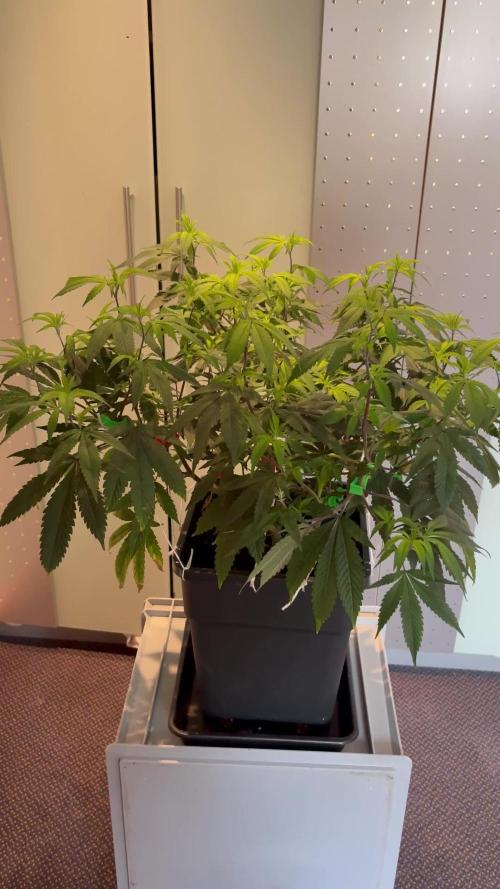
Ich war die letzte Woche kaum daheim und die Pflanze hat mir das auch direkt gezeigt.
Es ist eh Zeit zum umtopfen, also hab ich mich dazu entschieden.
Sie sitzt in 25l CANNA TERRA PROFESSIONAL mit Biotabs.
Likes
10
Share


@Sadhus
Follow
Rempotage en 13 litres après quelques signes de feuilles jaunes sur certaines , plante charnue trapue a feuilles large , ormi quelque feuilles cramé sur certaines les 7 sont jolies bientôt la floraison et j'ai hâte de voir sa! 100% organic et au naturel zero stress no topping no lst
#kannabia
#madamegrow
#trolmaster


Likes
3
Share

@AlphaVortex
Follow
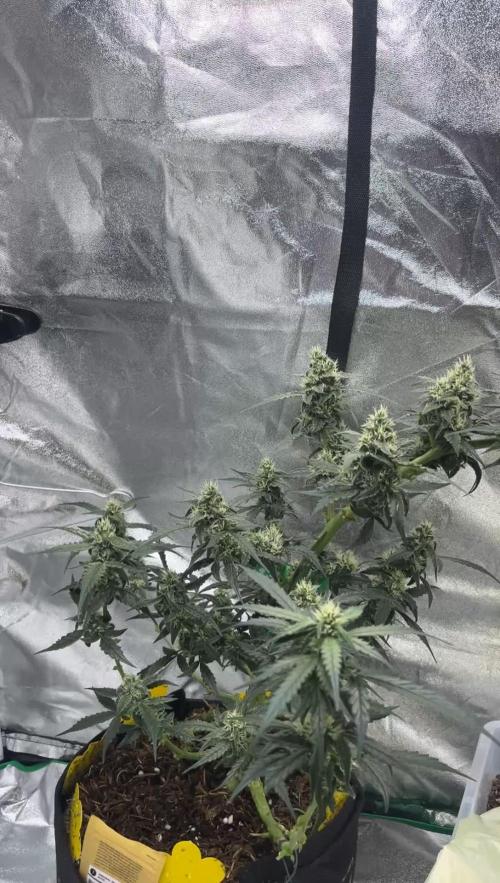
Tag 64, Lollipopping gut aufgenommen. Wachstum in den Blüten langsam vollständig wieder aufgenommen
Likes
2
Share


@Unpluggy
Follow
Partially harvested to Test the ripening of the remaining Buds.
Awesome looking and crazy strong smell.
The purple with light Green Looks awesome