The Grow Awards 2026 🏆
Likes
Comments
Share
Likes
21
Share
@Lontra
Follow
One of the targets for that grow is to keep the height of the plant as low as possible, because i only have about 80 cm from the bottom of the box to the LED lights as available space for the plant, so i thought i will a give that LST a try. Additionally i slowly started incresing the power of the LED to 60%. By now (a few weeks later) I already know that i started the LST a little bit early, but the plant was reacting well and kept growing. Furthermore I added a cheap webcam to my setup to create some timelapse videos. It's not a high res camera, but I still find it very interesting to watch that plant grow in timelapse 😁
Likes
40
Share
Day 63 : These girls are continuing their quest for glory and still popping pistils. #1 In her organic soil looks the most potent up close and her main stem is so fat now. I tried to reposition it a little and lost the battle as it could arm wrestle a Gorilla !!. I amended her pot today with some charge(200ml/10L) in her water along with the other LOS girls and a top dress with "life cycle" (30ml) . I think another week at least for her so she could use the boosts. #2 Is also looking potent and smells amazing like her sister up close. she is a very thirsty girl and uses all her nutes within a day to a lighter pot slightly every feed. She has been fed with just the shogun sumo boost (20ml) , dragon force (40ml) to 10L water to compare with her MC fed sister. her height is held down with lst but if I grew this strain again , I would not train it flat but manage it as natural as possible. #3 is the reason I say this. As she had looked a little different in size and colour , I allowed her to grow untrained. She is still completely different to the others but from talking to a member here , there are about 9 different ones. wow. She smells identical but her buds look so different to her sisters from different Misters. She is being fed with Mc (10g) , sumo boost (10ml), pk warrior (6ml) , calmag(10ml) and silica (10ml) to 10L water. She is loving life and packing her weight on now. i think she may finish a bit after her step-sisters but I expect a few more weeks possibly. Keep it green Growmies
Likes
17
Share
@Dunk_Junk
Follow
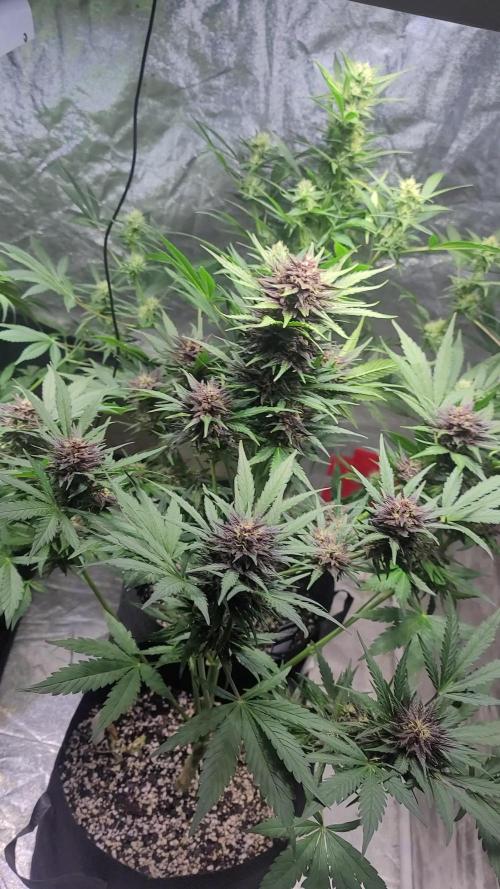
She's chugging through flowering! I notice she's not very tall at all. But very bushy!
Likes
19
Share
@creichs
Follow
Power Flower is now only an inch shorter than the Holy Punch 600W light is 9 inches away from plant (over the holy punch (Trying to give the two Power Flowers more room to grow))
Likes
225
Share
We are now on week 5 of flowering ! I've noticed the stretch has finally come to a halt and that the flowers are getting thicker and thicker by the day . GG#1 is recovering well from my mess up but some of the damages will remain . She's still in fantastic shape She just wont be what she could have been . GG#2 is pumping out all her flowers pretty well evenly and things are going great for her , during veg i fed her way way way way to much haha this is why she has the darker green then the rest even tho the rest are equally as fed as her granted one strain isnt GG like her but one of them is and its far less green haha . Another 2-3 weeks and it will be time to start my flush ! A special thank you to all my followers and the people who come down to show their support and liovemuch appriciated you guys rock ! I wish you all the best through the hollidays ! Keep on keeping on guys ! -Happy Growing!
Likes
29
Share
@GTools
Follow
I've been waiting for at least some trichomes to turn amber. I prefer to harvest when there are at least a few amber. I took the PL2 3 days before the PL1. Flushed them for a week only
Likes
15
Share
@Sergi0
Follow
Semana tranqui, siguen engordando, las Frisian Dew las voy a tener que cosechar antes me parece, pero voy viendo, ahora tengo menos moscas, pero siguen habiendo varias todavía, los 80 litros se bancan muy bien una semana sin agua (ahora riego una vez por semana).
Likes
25
Share
Overall a great strain too grow as grows with ease and seemingly without issues even with minimal care. With care she can produce hefty buds, as kept mine small my flowers reflect but still produced great smelling powerfully buds 🌱 Cycle finished in time essentially with ease and I'd be happy too recomend this strain from fastbuds. I will update with more images and videos upon timing complete and give dry weight ect, these girls wont bring much but smell absolute treat. Atm I have tried 1 small nug but still not ready not long untill can trim up, great oils and taste just need a little cure up once finished. Tried uploading longer videos but again says error 👎 have now added few extra videos
Likes
10
Share
Um suprise how fat does this buds getting. Some of the buds are start getting some frost. Will be done great CBD/THC oil.
Likes
4
Share
Likes
21
Share
@MrWolfe
Follow
Bounced back just fine after the strip and just chillin getting fat, not really a fan of these pots, I don't feel I can water as evenly and full soak like I can with my Gro Pro pots.
Likes
8
Share
Likes
8
Share
@dreamLife
Follow
Finalmente el día de cosecha, la producción no fue de las más abundantes pero suficiente para mi consumo personal, bastante entretenido el cultivo en DWC, lo repetiré en mi siguiente cultivo pero con una semilla automática.
Likes
18
Share
Week 2 Report: The White OG - The Solo Survivor Shines 🌟 She may be the solo survivor, but The White OG is already proving she’s a beauty in the making! With her third set of leaves emerging, she’s entering Week 2 of veg and starting to find her stride. This week has been all about supporting her early growth with balanced nutrition, a perfect environment, and plenty of love. Let’s dive into why Week 2 is such a game-changer and how the Aptus Holland line is setting her up for success. Why Week 2 Veg Is Vital 🌱 This is a pivotal time for any grow. The foundation laid in Week 2 determines how well your plant will perform later. It’s about encouraging root development, strengthening the stem, and building the resilience she’ll need for the big stages ahead. The third set of leaves is a sign that she’s transitioning from her seedling phase into a true vegging plant, which means she’s ready for a little extra care in the form of feeding. Feeding with Aptus Holland: A Total Game-Changer This week, I introduced the Aptus Holland organic-mineral line, and wow—this stuff is incredible! It combines the best of organic and mineral worlds for balanced, healthy growth. What’s Organic-Mineral Nutrition? • Organic Benefits: Enriches microbial health and enhances soil vitality, building a strong biological base. • Mineral Benefits: Offers immediate, direct nutrient uptake for steady, balanced growth. • Why It’s Awesome: Plants get the best of both worlds, growing stronger, healthier, and more resilient. This Week’s Feeding Schedule • Regulator (0.15 ml/L): A silica-based product that toughens plant structure, helps manage stress, and boosts nutrient uptake. Think of it as your plant’s personal trainer—keeping her sturdy and stress-free. 🌟 Why It Matters: Stronger stems = better support for future growth. • CalMag Boost (0.25 ml/L): Essential for developing robust cell walls and producing lush chlorophyll. Calcium and magnesium are like the bricks and mortar of your plant’s structure. 🌟 Why It Matters: Ensures vibrant, lush leaves and steady early growth. • All-in-One Liquid (1 ml/L): A perfectly balanced nutrient blend that provides everything she needs in one feed. Ideal for ensuring no deficiencies as she picks up the pace. 🌟 Why It Matters: Simplifies feeding while delivering complete nutrition. • Start Booster (0.25 ml/L): Packed with root-stimulating microbes and essential nutrients, this is the secret weapon for explosive root growth. 🌟 Why It Matters: Strong roots = a stronger plant overall. She’s ready to soar! Tent Conditions: Consistency Is Key The tent setup remains steady, providing the ideal environment for healthy growth: • Temperature: Warm and stable—perfect for vigorous vegetative growth. • Humidity: High RH ensures tropical vibes and keeps her roots hydrated as she develops her third set of leaves. • Lighting: The Future of Grow (FOG) LED at 200 PPFD delivers just the right intensity to keep her compact and growing strong. Why Aptus Holland? I’ve been a true believer in Aptus long before any sponsorship—it’s a brand that builds strong, healthy plants from the ground up. Their organic-mineral approach gives your plants the resilience and energy they need to thrive. The results speak for themselves: happy plants, lush growth, and vibrant health at every stage. It’s a system I trust completely. 🌱💪 Shoutouts and Community Love 🌟 Massive love to everyone making this journey possible: Breeders, LED brands like Future of Grow, and, of course, all the amazing growers and followers here on Grow Diaries. 🌱 Don’t forget to check out more updates on IG and YouTube (links in profile). Let’s grow strong together! DISCOUNT CODE - SeedsmanSeeds - DOGDOCTOR 10% off As always thank you all for stopping by, for the love and for it all , this journey of mine wold just not be the same without you guys, the love and support is very much appreciated and i fell honored and so joyful with you all in my life 🙏
 With true love comes happiness 💚🙏 Always believe in your self and always do things expecting nothing and with an open heart , be a giver and the universe will give back to you in ways you could not even imagine so 💚

 Friendly reminder all you see here is pure research and for educational purposes only 💚Growers Love To you All and remember to keep that smile big and alive 💚
Likes
2
Share
So far, so good. Smells already fantastic
Likes
4
Share
0.23v tuned to 7.83Hz Plants exposed to the Schumann resonance often show greater resistance to stress factors such as drought, diseases, and pests. It is possible that these natural electromagnetic waves strengthen plants' immune systems and increase their ability to resist disease. Pretty neat, in the afternoon when the tent hovers around 84F the plants are 🙏, can visually see in time around 10 minutes after I opened the tent the temp had dropped to 76 pressure was lost, she is still chilling but she doesn't quite have that perk anymore. *Salinity3.5% - 100ml H2O=100g The concentration of salt in a solution 3.5%= 3.5g in 100ml. Growing well. Not going to top or do any training, I'll let the plant do its own thing, she is constructing foundations now for what she senses ahead. Smart girl. ✨️ Let her, do her thing, let me do mine. The voltage that is needed for electrolysis to occur is called the decomposition potential. The word "lysis" means to separate or break, so in terms, electrolysis would mean "breakdown via electricity. Green hydrogen is hydrogen produced by the electrolysis of water, using renewable electricity. The production of green hydrogen causes significantly lower greenhouse gas emissions than the production of grey hydrogen, which is derived from fossil fuels without carbon capture. Electrolysis of pure water requires excess energy in the form of overpotential to overcome various activation barriers. Without the excess energy, electrolysis occurs slowly or not at all. This is in part due to the limited self-ionization of water. Pure water has an electrical conductivity of about one hundred thousandths that of seawater. Efficiency is increased through the addition of an electrolyte (such as a salt, acid or base). Photoelectrolysis of water, also known as photoelectrochemical water splitting, occurs in a photoelectrochemical cell when light is used as the energy source for the electrolysis of water, producing dihydrogen . Photoelectrolysis is sometimes known colloquially as the hydrogen holy grail for its potential to yield a viable alternative to petroleum as a source of energy. The PEC cell primarily consists of three components: the photoelectrode the electrolyte and a counter electrode. The semiconductor crucial to this process, absorbs sunlight, initiating electron excitation and subsequent water molecule splitting into hydrogen and oxygen. Water electrolysis requires a minimum potential difference of 1.23 volts, although at that voltage external heat is also required. Typically 1.5 volts is required. Biochar, a by-product of biomass pyrolysis, is typically characterized by high carbon content, aromaticity, porosity, cation exchange capacity, stability, and reactivity. The coupling of biochar oxidation reaction (BOR) with water electrolysis constitutes biochar-assisted water electrolysis (BAWE) for hydrogen production, which has been demonstrated to reduce the electricity consumption of conventional water electrolysis from 1.23v to 0.21v. Biochar particles added to the electrolyte form a two-phase solution, in which the biochar oxidation reaction (BOR) has a lower potential (0.21 V vs. RHE) than OER (1.23 V vs. RHE), reducing the energy consumption for hydrogen production via biochar-assisted water electrolysis (BAWE). BAWE produces H2 under 1 V while eliminating O2 formation: key word "eliminating". Air with a normal oxygen concentration of around 21% is not considered explosive on its own; however, if a flammable gas or vapor is present, increasing the oxygen percentage above 23.5% can significantly increase the risk of ignition and explosion due to the enriched oxygen environment. The addition of ion mediators (Fe3+/Fe2+) significantly increases BOR kinetics. Air: Nitrogen -- N2 -- 78.084% Carbon Dioxide -- CO2 -- 0.04% Hydrogen in homosphere H -- 0.00005% Hydrogen "GAS" H2 in homosphere - 0% "Nitrogen, oxygen, and argon are the three main components of Earth's atmosphere. Water concentration varies but averages around 0.25% of the atmosphere by mass. Carbon dioxide and all of the other elements and compounds are trace gases. Trace gases include the greenhouse gases carbon dioxide, methane, nitrous oxide, and ozone. Except for argon, other noble gases are trace elements (these include neon, helium, krypton, and xenon). Industrial pollutants include chlorine and its compounds, fluorine and its compounds, elemental mercury vapor, sulfur dioxide, and hydrogen sulfide. Other components of Earth's atmosphere include spores, pollen, volcanic ash, and salt from sea spray." Although the CRC table does not list water vapor (H2O), air can contain as much as 5% water vapor, more commonly ranging from 1-3%. The 1-5% range places water vapor as the third most common gas (which alters the other percentages accordingly). Water content varies according to air temperature. Dry air is denser than humid air. However, sometimes humid air contains actual water droplets, which can make it more dense than humid air that only contains water vapor. The homosphere(where you live) is the portion of the atmosphere with a fairly uniform composition due to atmospheric turbulence. In contrast, the heterosphere is the part of the atmosphere where chemical composition varies mainly according to altitude. The lower portion of the heterosphere contains oxygen and nitrogen, but these heavier elements do not occur higher up. The upper heterosphere consists almost entirely of hydrogen, cool. 78%nitrogen as N2, a far too stable bond to be used by organisms. 20%oxygen 0.04%co2 0.00005% hydrogen When lightning strikes, it tears apart the bond in airborne nitrogen molecules. Those free nitrogen atoms N2 nitrites then have the chance to combine with oxygen molecules to form a compound called nitrates N3. Once formed, the nitrates are carried down to the ground becoming usable by organisms. Will it react with the oxygen in the air spontaneously, the answer is no. The mixture is chemically stable indefinitely. A mixture with air near the release point can be ignited, but if this does not happen then when its concentration gets below 4% it will be unable to carry a flame. Taking a small detour into chemistry here, a key concept to understanding the health impact of nitrogen-based compounds is knowing the difference between nitrates and nitrites. What Are Nitrates and Nitrites? A nitrite (NO2) is a nitrogen atom bonded to only two nitrogen atoms. Very strong bond A nitrate (NO3) is a nitrogen atom bonded to three oxygen atoms. Weaker bond The optimal pH for nitrate (NO3-) depends on the process and the type of bacteria involved. Nitrification The optimal pH for nitrification is between 7.5 and 8.6 Nitrification is the process of oxidizing ammonia to nitrate and nitrite Nitrosomonas has an optimal pH between 7.0 and 8.0 Nitrobacter has an optimal pH between 7.5 and 8.0 Nitrification ceases at pH
Likes
3
Share
Put the largest nothern lights in its own mini green house, both have x2 large bug nets around them instead of a plastic cover as the temps and humidity were off but are perfect now. Plus it will reduce the chances of bugs flying in while also allowing the wind to pass through, I’ve used some Biobizz leaf spray no further leafs have been eaten since using it which I’m happy about.