The Grow Awards 2026 🏆
Likes
Comments
Share
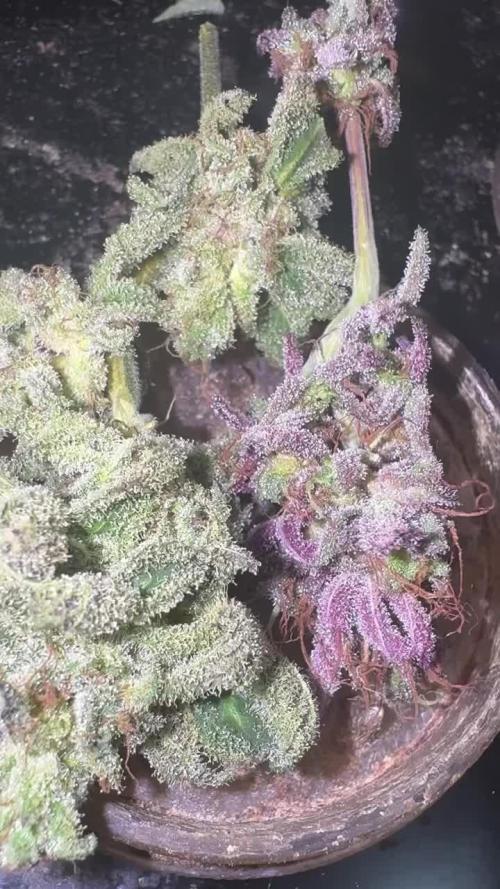
Essa é a minha Moby que está mais bela , segue com muitos cristais de THC e um aroma bem forte, os tricomas estão transparentes então ainda leva umas semanas amadurecendo, o menor dos vasos , esse de 5 litros é me parece um dos melhores resultados , chego a conclusão que plantas automáticas rendem suficientemente bem em vasos den5 a 7 litros.
Likes
41
Share
@Growing88
Follow
Ripenes plant and deafling for penetration light pop corn buds,trichome is milky,wait other 2 week for harvest day
Likes
52
Share
@Salokin
Follow
Hi Growmies,this was the last week of nutes she’s getting. Feels like I completely misjudged how far she is along, as it seems like she has started the ripening process. Ph and ec was in line the whole time, once the leaves started fading i thought that I have a lock out or sth, so I fed canna flush for a day and continued with a fresh reservoir as per my regular feeding schedule, To no avail, as she continues to fade, even after. Not a Biggy, as the trichomes are definitely all far enough along to harvest her after the next week of flushing. Thanks for stepping by and until next week :)
Likes
68
Share
Removed autoflower and put her in her own pot outside the tent. Foliars applied in strong blue 430nm with 4000Hz tone. 20-minute dose prior to application. In essence, you're seeing a combination of the infrared light reflected by the plant, which the camera perceives as red, and any residual visible blue light the plant reflects, which results in a purple hue. I was doing more stretching of the stems, adjusting weights, just a little too much, and it snapped almost clean. I got a little lucky in that it was still connected, wrapped her almost instantly while holding her in place with yoyo's. The core framework is now in place. If your soil has a high pH, it's not ideal; you want a pH of 6.4, 6.5, or 6.6, which is ideal. If you are over a pH of 7, you have no hydrogen on the clay colloid. If you want your pH down, add Carbon. If you keep the pH below 7, you will unlock hydrogen, a whole host of new microbes become active and begin working, the plant will now be able to make more sugar because she has microbes giving off carbon dioxide, and the carbon you added hangs onto water. Everything has electricity in it. When you get the microbes eating carbon, breathing oxygen, giving off CO2, those aerobic soil microbes will carry about 0.5V of electricity that makes up the EC. The microorganisms will take a metal-based mineral and a non-metal-based mineral with about 1000 different combinations, and they will create an organic salt! That doesn't kill them, that the plant loves, that the plant enjoys. This creates an environment that is conducive to growing its own food. Metal-based: Could include elements like iron, manganese, copper, or zinc, which are essential nutrients for plants but can exist in forms not readily accessible. Non-metal-based: Examples like calcium carbonate, phosphate, or sulfur are also important for plant growth and potentially serve as building blocks for the organic salt. Chelation in a plant medium is a chemical process where a chelating agent, a negatively charged organic compound, binds to positively charged metal ions, like iron, zinc, and manganese. This forms a stable, soluble complex that protects the micronutrient from becoming unavailable to the plant in the soil or solution. The chelate complex is then more easily absorbed by the plant's roots, preventing nutrient deficiency, improving nutrient uptake, and enhancing plant growth. Chelation is similar to how microorganisms create organic salts, as both involve using organic molecules to bind with metal ions, but chelation specifically forms ring-like structures, or chelates, while the "organic salts" of microorganisms primarily refer to metal-complexed low molecular weight organic acids like gluconic acid. Microorganisms use this process to solubilize soil phosphates by chelating cations such as iron (Fe) and calcium (Ca), increasing their availability. Added sugars stimulate soil microbial activity, but directly applying sugar, especially in viscous form, can be tricky to dilute. Adding to the soil is generally not a beneficial practice for the plant itself and is not a substitute for fertilizer. While beneficial microbes can be encouraged by the sugar, harmful ones may also be stimulated, and the added sugar is a poor source of essential plant nutrients. Sugar in soil acts as a food source for microbes, but its effects on plants vary significantly with the sugar's form and concentration: simple sugars like glucose can quickly boost microbial activity and nutrient release. But scavenge A LOT of oxygen in the process, precious oxygen. Overly high concentrations of any sugar can attract pests, cause root rot by disrupting osmotic balance, and lead to detrimental fungal growth. If you are one who likes warm tropical high rh, dead already. Beneficial, absolutely, but only to those who don't run out of oxygen. Blackstrap is mostly glucose, iirc regular molasses is mostly sucrose. Sugars, especially sucrose, act as signaling molecules that interact with plant hormones and regulate gene expression, which are critical for triggering the floral transition. When sucrose is added to the growth medium significantly influences its effect on floral transition. Probably wouldn't bother with blackstrap given its higher glucose content. Microbes in the soil consume the sugar and, in the process, draw nitrogen from the soil, which is the same nutrient the plant needs. Glucose is not an oxygen scavenger itself, but it acts as a substrate for the glucose oxidase (GOx) enzyme, effectively removing oxygen from a system. Regular molasses (powdered if you can), as soon as she flips to flower or a week before, the wrong form of sugar can delay flower, or worse. Wrong quantity, not great either. The timing of sucrose application is crucial. It was more complicated than I gave it credit for, that's for sure. When a medium's carbon-to-nitrogen (C:N) ratio reaches 24:1, it signifies an optimal balance for soil microbes to thrive, leading to efficient decomposition and nutrient cycling. At this ratio, soil microorganisms have enough nitrogen for their metabolic needs, allowing them to break down organic matter and release vital nutrients like phosphorus and zinc for plants. Exceeding this ratio results in slower decomposition and nitrogen immobilization, while a ratio below 24:1 leads to faster breakdown and excess nitrogen availability. Carbon and nitrogen are two elements in soils and are required by most biology for energy. Carbon and nitrogen occur in the soil as both organic and inorganic forms. The inorganic carbon in the soil has minimal effect on soil biochemical activity, whereas the organic forms of carbon are essential for biological activity. Inorganic carbon in the soil is primarily present as carbonates, whereas organic carbon is present in many forms, including live and dead plant materials and microorganisms; some are more labile and therefore can be easily decomposed, such as sugars, amino acids, and root exudates, while others are more recalcitrant, such as lignin, humin, and humic acids. Soil nitrogen is mostly present in organic forms (usually more than 95 % of the total soil nitrogen), but also in inorganic forms, such as nitrate and ammonium. Soil biology prefers a certain ratio of carbon to nitrogen (C:N). Amino acids make up proteins and are one of the nitrogen-containing compounds in the soil that are essential for biological energy. The C:N ratio of soil microbes is about 10:1, whereas the preferred C:N ratio of their food is 24:1 (USDA Natural Resource Conservation Service 2011). Soil bacteria (3-10:1 C:N ratio) generally have a lower C:N ratio than soil fungi (4-18:1 C:N ratio) (Hoorman & Islam 2010; Zhang and Elser 2017). It is also important to mention that the ratio of carbon to other nutrients, such as sulfur (S) and phosphorous (P) also are relevant to determine net mineralization/immobilization. For example, plant material with C:S ratio smaller than 200:1 will promote mineralization of sulfate, while C:S ratio higher than 400:1 will promote immobilization (Scherer 2001). In soil science and microbiology, the C:S ratio helps determine whether sulfur will be released (mineralized) or tied up (immobilized) by microorganisms. A carbon-to-sulfur (C:S) ratio smaller than 200:1 promotes the mineralization of sulfate, when the C:S ratio is low, it indicates that the organic matter decomposing in the soil is rich in sulfur relative to carbon. Microorganisms require both carbon and sulfur for their metabolic processes. With an excess of sulfur, microbes take what they need and release the surplus sulfur into the soil as plant-available sulfate A carbon-to-sulfur (C:S) ratio higher than 400:1 will promote the immobilization of sulfur from the soil. This occurs because when high-carbon, low-sulfur materials (like sawdust) are added to soil, microbes consume the carbon and pull sulfur from the soil to meet their nutritional needs, temporarily making it unavailable to plants. 200:1 C:S 400:1: In this range, both mineralization and immobilization can occur simultaneously, making the net availability of sulfur less predictable. This dynamic is similar to how the carbon-to-nitrogen (C:N) ratio regulates the availability of nitrogen in soil. Just as microbes need a certain amount of nitrogen to process carbon, they also require a balanced amount of sulfur. Both mineralization and immobilization are driven by the metabolic needs of the soil's microbial population. Sulfur is crucial for protein synthesis. A balanced ratio is particularly important in relation to nitrogen (N), as plants need adequate sulfur to efficiently use nitrogen. A severely imbalanced C:S ratio can hinder the efficient use of nitrogen, as seen in trials where adding nitrogen without balancing sulfur levels actually lowered crop yields. Maintaining a balanced carbon-to-sulfur (C:S) ratio is highly beneficial for plant growth, but this happens indirectly by regulating soil microbial activity. Unlike the C:N ratio, which is widely discussed for its direct effect on nutrient availability, the C:S ratio determines whether sulfur in the soil's organic matter is released (mineralized) or temporarily locked up (immobilized). Applied 3-day drought stress. Glucose will hinder oxygenation more than sucrose in a solution because glucose is consumed faster and has a higher oxygen demand, leading to a more rapid decrease in oxygen levels. When cells respire, they use oxygen to break down glucose, and this process requires more oxygen for glucose than for sucrose because sucrose must first be broken down into glucose and fructose before it can be metabolized. In a growth medium, glucose is a more immediate and universal signaling molecule for unicellular and multicellular organisms because it is directly used for energy and triggers a rapid gene expression response. In contrast, sucrose primarily acts as a signaling molecule in plants to regulate specific developmental processes by being transported or broken down, which can be a more complex and slower signaling process. Critical stuff. During wakefulness (DC electric current) life can not entangle electrons and protons. During the daytime, the light is sensed as multiple color frequencies in sunlight. Coherence requires monochromatic light. Therefore, at night, IR light dominates cell biology. This is another reason why the DC electric current disappears during the night. The coherence of water is maintained by using its density changes imparted by infrared light released from mitochondria in the absence of light. This density change can be examined by NMR analysis, and water is found to be in its icosahedral molecular form. This is the state that water should be in at night. This is when a light frequency is lowest and when the wave part of the photoelectric effect is in maximum use. 3600
Likes
7
Share
2/6/2023 - Day 35: After the watering yesterday the girls perked up, but they were already getting dry again. I was originally planning on waiting longer to transplant, but I felt like they were out growing their 1 gallon pots. Also, after checking their roots I could tell they were ready, so I transplanted today. Watered in with about 1.5 gallons at 6.4 ph. I know they say you don't need to ph water in a large bed like this, but my water is really bad here. At times it can be over 8 ph out of the tap. Mixed my water with Jay Plantspeaker Quillaja, Rootwise Micro Complete, Rootwise Bio-Catalyst, fresh aloa juice from my garden, and BuildASoil Big 6 Micro nutrients. 2/10/2023 - Day 39 Veg: now that the plants are in the 3x3 bed, there is much less maintenance. I'm using an Ecowitt to track the soul moister. It started at 33% when I watered on Monday, and is at 33% today. I want to let it drop below 30% before watering again. I did do my weekly IPM spray today, using Dr. Zymes Eliminator. Also, I noticed some slight leaf discoloration, so I added some Pure Protein Dry and BuildASoil Big 6 micronutrients to the foliar spray, which I sprayed at lights out. A had a small amout of the mix left after all plants were sprayed, so i used it to slightly mist the top soil. Not sure I'd the discoloration is the start of a deficiency or just left over from the under watering last week. Figured the foliar feeding wouldn't hurt either way. 2/12/2022 - Day 41: Soil moisture dropped to 30% today, so I watered with a worm casting tea. Added some Rootwise Micro Complete, Rootwise Bio-Catalyst, and Jay Plantspeaker Quillaja. Watered about 8 liters and gave the plants a foliar feed with the tea as well. All of the plants look pretty good. The Grand Prix 2 has some leaf curl and I'm not sure what is causing it, since the other 3 aren't showing similar symptoms. Thought it might be light or heat stress, since it is the tallest plant, so I raised the light and dropped the high temp down a few degrees. Also, the Frozen White Runtz is the smallest of all 4 and seems to be growing slow. We'll have to see how they all respond to the tea.
Likes
Comments
Share

Inclui Sulfato de Mg nos nutrientes pois a planta começou a apresentar deficiência. Vou segurar mais um tempo para ver se ajustou o suficiente antes de virar para a Flora
Likes
7
Share
The cookies is doing well. There's a lot of bud sites. The photos are at day 21 of flower.
Likes
9
Share
@Hypnogrow
Follow
Recovery week. Last week everything went to hell this week everything is looking up. Squanch Queen is turning into my favorite one of the bunch. She is super resilient and bounced back quickly, the Skywalker and Quarter Pounder are both going to finish early due to all the stresses and stunting early on in the grow. Squanch Queen looks to be going 9 to 10 weeks inspite of all the issues. Definitely a good strain from Night Owl to pick up if your a beginner, much more forgiving. I definitely want to try the Skywalker again with a better setup. Ph runoff is looking much much better.
Likes
13
Share
Just added Mephisto 3 sour crinkles and 2 double grapes to the equation. It was meant to be 4 sour crinkles but one seed still ent popped so I’m hoping it will! On to the grow where I haven’t trained any plants it’s a fight for space but I’m happy with most of the plants few fast buds wedding still ent properly flowered yet week 7 on but am happy with a couple glues and the 3 runtz the runtz is frosty! The grape Walkers are starting to swell and fill out big time I am happy so far with it all had a couple burns and defincys through the 7 weeks so far but got over them! The grape walkers are the big budded plants then the frosty ones at the back are runtz then the rest are glues! Started defoliating plants
Likes
5
Share
@alafmalaf
Follow
first day after a 12h night cycle, still have a big gnat problem. gonna go buy new bacteria, stickies and DT Earth. the grow shop just let me know that they got it back in stock but i haven't been able to find nematóides. doesn't seem to be a common practice here. i haven't watered them in a few days. the top soil is bone dry but the plants don't look like they're requesting water just yet so i think it's a good time to lay down the new dt earth and new yellow traps to see if we can kill the remainder. gonna grab some flowering ferts too while I'm at it. Update: got a bigger pot and some supergrow soil, only had time to transplant one of them today. but I decided to after them one more cycle before i do the DT earth. update: dt earth added, seems to be alright but not quite dry enough
Likes
31
Share
@MxGrow
Follow
Feliz por como van mis gorilas, todos los días hay cambios y cada semana tengo que aumentar el riego, esta semana utilice en total 18 litros, 4.5 litros para cada planta aproximadamente. En los primeros 6 litros uso: ▪️︎4ml de Connoisseur A y B por litro de agua. ▪️︎2ml de Rhino por litro de agua. ▪️︎2ml de Bud Candy por litro de agua. ▪️︎2ml de Carboload por litro de agua. ▪️︎2ml de B-52 por litro de agua. Espero 30 minutos y despues aplico otros 6 litros con los siguientes nutrientes: ▪️︎4ml de Connoisseur A y B por litro de agua. ▪️︎2ml de Nirvana por litro de agua. ▪️︎2ml de Big Bud por litro de agua. ▪️︎2ml de Overdrive por litro de agua. ▪️︎2ml de Voodo Juice por litro de agua. No tengo medidor de EC, por lo tanto trato de que las mediciones en ml sean exactos con una jeringa. ☆ 1 día a la semana riego las plantas con 6 litros de agua sin nutrientes y con un PH en 6.0, hasta el momento no han presentado carencias pero tengo la duda si tienen exceso de nitrógeno por el color verde intenso de las hojas.
Likes
18
Share
@cannasaxx
Follow
Alles im grünen Bereich 👍🏻💚🍉🌈🎄 Ja, viel gibt es nicht zu sagen außer das ich sehr zufrieden bin mit dem Grow. Adlite IR, UV, Deep Red sind mit angeschlossen, sie sind nämlich jetzt in der Pre-Bloom Phase das heißt 16std. Licht eine Woche und dann 12/12 Umstellung. Euch eine fröhliche Weihnacht 🎄😇
Processing
Likes
1
Share
@Lifted
Follow
Hooked up my carbon filter today. I'm only using it to scrub the air on a timer. Decided to poke a few holes in the ducting to help move scrubbed air around my plant. Added the other fan back in to keep air circulating. Since I don't have fresh air coming in I plan on using a supplement for co2. What are you guys using? It's only a small 2×2×6 tent with one plant and running a 150w HP's light.
Likes
10
Share
Purple Punch am 26.12.2024 Tag 28 / 25.01.2025 Die Purple Punch habe ich ein Topping und LST unterzogen, sie hat sich sehr schnell erholt von Topping; eigentlich habe ich keine negative Reaktion bemerkt, das einzige ist wenn ich mit Biobizz dünge, macht die Pflanze einen gewaltigen Wachstumsschub. Feedback: Ich habe unterhalb zwei Blätter entfernt, mit dem Entlaubung bin ich sehr vorsichtig. Die Pflanze werde ich gut wachsen lassen, und die große Blätter nach und nach entfernen. Ich könnte mehr Blätter entfernt, aber in der Vergangenheit habe ich Fehler gemacht. Ich habe festgestellt das die Pflanzen in Light Mix besser wachsen, einmal Gisse ich die Pflanzen mit Dünger von BioBizz und einmal ohne Dünger. Soweit ich das sehe ist eine Überdüngung ausgeschlossen, gerne nehme ich Ratschläge aus der Community an. Feedback am 29. Januar 2025 Die Entlaubung von Purple Punch war für meiner Sicht erfolgreich, die Vorgehensweise nach und nach die Entlaubung durchzuführen hat die Pflanze nicht gestresst.
Processing
Likes
67
Share
Likes
1
Share
@Raddawg
Follow
This week I continued removing lower leaves that were getting little to no light. I tied down lower branches to ensure them getting blasted with light. Buds are filling in nicely! very excited for the upcoming weeks
Processing
Likes
9
Share
Transferred 2 plants to 7gal on Day 17 and apply lst......on Day 18 nod start aiming for the sky🙂......topped on day 21
Processing
Likes
16
Share
@Andres
Follow
I have problems with her. I think it's because of the local water. the earth is not fertilized with any product. only earthworm humis.
Likes
22
Share
Just look at her.... Like I mean really look at her. What a wonder on the eyes! 😍💚. Everything is uniform. Closest lady I've ever seen to perfection 👌