The Grow Awards 2026 🏆
Likes
Comments
Share
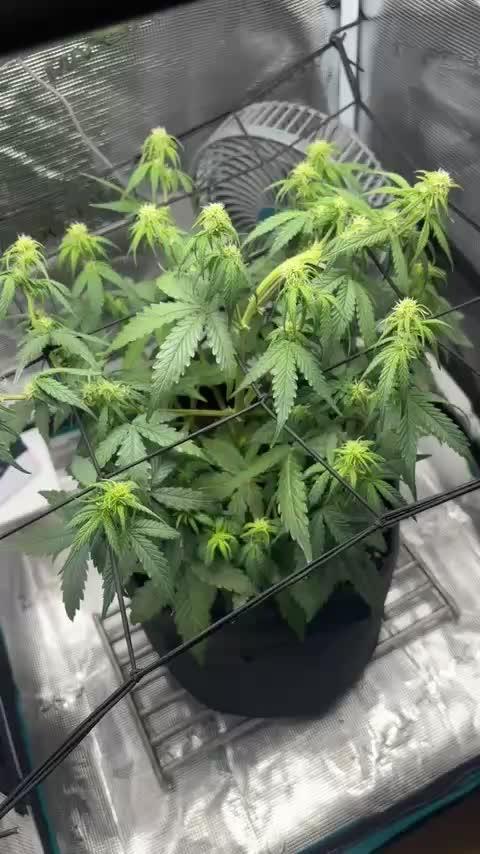
Sep 7: nice lemony smell happening and the buds are forming. Not a particularly fast flowering plant but it’s going good. Sep 8: got some time under the UV light this afternoon. Once the Blueberry Pie is done she’ll get more UV light hours but for now she has to wait her turn. Sep 12: cool nights starting to cause some purple colour. Nice smell to her, but really leafy and seems a bit slow. Watered with potassium silicate and cal-mag today.
Likes
21
Share
@OGTrauma
Follow
took some feedback from other media where i published this shit and it's a must that i need to improve a bit my uniformity, energetic efficency, air flow and hygiene as key factors ( the previows grow this setup references besides lighting and results itself it's like ok thats something to keen in a positive way because every other aspect looks like a old blanket full of crusty dry cum stains from your bf/gf and a big mass of cheetos crumbs as soil medium ), so i need to visually depict a bit of the setup as this is some legacy shit and it's on my shitty tent. there are 6 usb fans that take 2,5w of comsumptions, i preffer to do this rather than oscillating ventilators because DB noise is way less and got a decent CFM flow by numbers , and the 5w profan its now working as a very quiet yet active intraction as some dude told me to correct that and was right. i use 15/25w (2 level of power) house fans that just fit on my ducts by luck, pretty caveman setup. i obviously cleaned with the vacuum from the previous grow and im starting from scratch with fresh seeds, buy some ... just decent substrate to avoid any plague that could come from my own smegma. because fuck im a dirty cheap bastard and i need to do my bare minimum here by stating the shit that is exposed on the ppt slide, as i change and improve things i forgot some other shit and i dont want to get sloppy results, i would totally like to get like the best results and reduce negative & i told you risks. DAMN SHAWTY, IM TALKING A LOT ABOUT HYGIENE AND HAVING BECAUSE I GOT JUST ONE DAMPING OFF( a seedling died) AND I SWEAR BY MY DICK THAT WAS CAUSED BY MY DIRTY VENTILATION as germination was 100% dope, and that's the only logical explanation as if i over watered them, they could be like way more casualities so its not that . (hope autotranslates well as i know the slide won't translate and require a bit of english. Not all my Chilean/Latam/Worldwide niggas that read this shit are 666% fluent unlike my case a lot of reeferman dialect was scavenged from my old magazines, forums and random indian dude youtube video tutorials. Coming back to the gig , this week was 24/0 photoperiod, just considering that i want to stabilize and keep my best killer kush fv exemplars and at the same time not fuck them like previous paragraph as i can count them like ... 12 of 9 , if i go below 9 it means is a orange flag for me & my big cock is not as big as i think . nevertheless, they are taking very small doses of top crop's top veg now and next week i will change photoperiod (20/4) to give them a bit of resting time for physiological processes of the newborn plants , and lifespan / fatigue of the electronic devices as well. BIG GAS LEAKS MOTHERFUCKERS !!!!
Likes
16
Share
@AutoCrazy
Follow
Week 6 Well, I finally have 8 tops 😎. Now it’s just a matter of keeping her growing strong and training the tops into the right position. After that is accomplished it’s show time. I am going to guess that it will take a 7-10 days for me to get her where I like it at which point I’ll let her get a few nodes taller and then flip. Main-lining takes some extra time but it is worth it imo. Cooler internals are: 6.0 pH 0.4 EC 65 F solution temp. The tent is running 71 F lights on and 68 F lights off. Humidity is 36-38%. Onward!! 😎🍻
Likes
33
Share
If you're not already following my youtube channel go subscribe now! Appreciate it people. Now for these girls. Day 38: All very healthy and well, I said I wouldn't be doing any topping this round and i haven't. Been doing a lot of LST/Bending (haven't used any ties as i dont want holes or marks on my rdwc system buckets) but if anything else im challenging myself. As you can see, plants look quiet bald after defoliation but definitely bounce back better if done right. Opening up the plant so its more bushy and exposing potential bud sites, not rocket science just basic logic. Hope everyone is doing well and staying safe during this time. Once more, Go Subscribe to my YouTube channel.. link on profile. Stay tuned.
Likes
13
Share
Recette du tco pour 20 litres. (Grammes : gr) 50gr biochar 250gr zéolite 3gr granulé Micro-Organisme IT45 10gr pollen d’abeilles 10gr levure de bière 3gr endomychorize 10gr consoude 20gr vers de farine 10gr cendre coque de ricin 12gr ortie microniser 15gr Kelp 10gr spiruline 10gr de cbd living soil 20ml de miel liquide 30ml de mélasse 20ml d’acide humiques et fluvic Mettre tous les ingrédients (sauf la mélasse ,l’acide h/f et le miel) dans un filtre 400micron, le placer dans un seau avec de l’eau (10litres). Rajoutez le miel et 10ml de mélasse Y mettre un micro bulleur alimenter sur une pompe à air et faire oxygéné le mélange pendant 24h. Rajout de 10ml de mélasse après 12h le début de la mise en route de la pompe. A la fin des 24h rajoutez le restant de mélasse et d’acide h/f, mettez y en plus 10litres d’eau au mélange. Reste plus qu’à arroser! j’y ai incorporé 7litre de mélange La veille j’ai préparé le pot à l’arrosage avec 500ml d’eau et 2gr de Bacillus IT35 Amyloliquefaciens X5 Bacillus Amyloliquefaciens : rhyzosphère, probiotiques. Aspersion et arrosage. Utilisable pour toutes cultures. La bactérie Bacillus Amyloliquefaciens se fixe dans la rhizosphère en se nourrissant des exsudats racinaires. En contrepartie, elle stimule la croissance racinaire en sécrétant des métabolites de croissance et solubilise le phosphore en sécrétant des phytases (enzymes). Effet probiotique consistant en l’utilisation de micro-organismes bénéfiques pour la nutrition et la santé des plantes. La spiruline, le plus riche et le plus complet des amendements organiques La Spiruline est une algue aquatique connue comme complément alimentaire, la Spiruline est aussi un amendement organique et écologique très complet. D'une grande qualité nutritive, elle apporte à vos plantes une quantité de nutriments, dont l'azote, phosphore, potassium, minéraux, acides aminés, vitamines, chlorophylle et protéine. Le charbon végétal actif est capable d’absorber jusqu’à cinq fois son poids propre en eau ainsi que les éléments nutritifs qui s’y trouvent. Il joue ainsi le rôle de catalyseur et d'amplificateur pour les fertilisants traditionnels, qu'ils soient d'origine organique ou minérale. Ce pourquoi il est idéal pour activer un sol et pour les thés de compost oxygénés. Le charbon végétal améliore la diffusion et la disponibilité des éléments nutritifs dans le sol et offre des conditions propices au développement des micro-organismes. Le Biochar peut être introduit dans une grande variété de sols. Il est particulièrement efficace dans les sols pauvres, difficiles et acides. Pour faire agir rapidement et efficacement sa capacité d’amendement, le charbon végétal est enrichi et biologiquement activé avec des micro-organismes. Le Biochar se comporte ainsi comme un structurateur et un activateur dans le but de valoriser les sols. Composition : • Charbon végétal actif 31%
• Matière organique 33%
• Matière sèche 75%
• C/N : 17
• PH : 7,2
• Azote (N) : 2,1 % dont 1,2 % azote organique
• Phosphore (P205) : 0,74%
• Potassium (K20) : 1,18%
• Calcium (Ca) : 6,8%
• Magnésium (MgO) : 0,65% Le pollen est l'ingrédient de base de la fabrication du miel par les abeilles. Riche en vitamines et minéraux, il est qualifié « d'aliment parfait », y compris pour les plantes ! Les zéolithes sont des roches cristallines, présentant des capacités d'adsorption particulièrement importantes vis à vis des polluants que l'on rencontre dans l'eau et dans certains liquides, ainsi que dans l'air et les gaz. Elles sont extrêmement poreuses comme les charbons activés et elles peuvent être chargées électriquement pour opérer comme des échangeurs d'ions. La zéolithe est un produit naturel qui respecte notre environnement. Utilisé dans le milieu industriel depuis de longues années déjà, ce minerai aux propriétés filtrantes particulières commence à se vulgariser dans le domaine de la piscine privée, de l'aquariophilie, des bassins d'agrément, de la récupération des eaux de pluie, ou encore de la culture des bonsaïs et autres plantations diverses par exemple... 4 points techniques majeurs : - Grâce à leur propriété hydrophile, les zéolithes peuvent adsorber l'eau jusqu'à 30% de leur poids total et sans aucune variation de volume : pas de gonflement en présence d'eau ni de craquement en cas de déshydratation comme certaines argiles. Les zéolithes sont d'ailleurs de puissants agents anti-mottant (anti-agglomérant). Cette propriété est très appréciée dans le cas des terrains de golf et autres aires de jeux. - Les zéolithes ne captent pas l'eau de façon irréversible, elles se comportent comme une réserve au voisinage des racines. Celles-ci peuvent capter l'eau en fonction de leur besoin. Les zéolithes permettent ainsi de réduire les besoins d'arrosage jusqu'à 35 %. - Une zéolithe se comporte comme une "Zone de Stockage" qui retient l'azote et les éléments minéraux nutritifs au voisinage des racines et les relâche lentement en fonction des besoins de la plante. Cela se traduit par une croissance harmonieuse mais rapide du végétal. - La capacité d'adsorption et l'énorme rapport surface/volume des zéolithes, vont permettre à la fois la rétention de la solution du sol et une bonne oxygénation au voisinage du système racinaire. Les zéolithes favorisent donc l'organisation biologique des sols en contribuant au développement de la micropopulation. L'apport en nutriments (N, P, K) est réduit de 20 à 25 %. Ces derniers, adsorbés par la zéolithe, sont beaucoup moins sensibles au lessivage et à l'évaporation. Composition minéralogique : * Chabasite 70 % * Phillipsite 2 % * Feldspath 5 % * Augite 3 % * Illite - Mica 2% Analyse atomique: * Sio2 52 % * AL2o3 17 % * CaO 5,7 % * K2O 6,1 % * MgO 2 %, * Na2O 0,6 % * Fe2O3 3,6 % Amendement calcaire, dolomie et gypse avec préparation microbienne à base de Bacillus Amyloliquefaciens IT45 et Saccharomyces cerevisiae LYCC6420 Formulation : micro granulés (1 – 1,6 mm) à base de rhizobactéries favorisant la croissance des plantes qui se multiplient et colonisent rapidement la zone des racines, et de levures Saccharomyces cerevisiae souche LYCC ayant un effet probiotique. Les PGPR produisent des enzymes qui solubilisent le phosphore à partir de complexes inorganiques et organiques dans le sol et stimulent la croissance des racines efficaces augmentant ainsi la zone d'interception des éléments nutritifs. Les levures LYCC permettent une occupation de la rhizosphère par une flore bénéfique. Composition :
• Matière sèche : 96,8%
• Matière organique : 91,5%
• N total : 6,6% dont N soluble dans l'eau 0,17%
• P total : 2%
• K total : 1,7% Micro-granulés : 
• Oxyde de calcium (CaO) total : 30%
• Oxyde de magnesium (MgO) total : 7%
• Anhydride sulfurique (SO3) : 13% La levure de bière est une matière vivante qui permet un meilleur fermentation pour les thés de compost oxygénés notamment conseillé pour accompagner les croissances ou apporter un gros coup de pousse pendant la floraisons. La levure stimule la vie des sols également à l'arrosage direct en apportant tout aussi bien que dans le TCO sa population l'espèce micro-bactérienne positive pour votre sols ainsi que des oligo-éléments et diverse vitamines. Composition : • 2,8% (N) total dont 1% (Norg), • 2,3% (P205) • 1,6% (K20) • 35% de MO • C/N : 8. PH : 8,4. Sous forme de poudre mouillable. Il contient des spores du champignon mycorhizien Rhizophagus Irregularis MUCL57891 avec des levures inactivées spécifiques. 2000 spores/gramme d’endomycorhize Rhizophagus Irregularis MUCL57891 et Saccharomyces Cerevisiae LYC6420 inactivée. Se connecte efficacement au système racinaire et forme un vaste réseau souterrain de filaments, qui agissent comme des extensions pour atteindre les nutriments et l’eau au-delà de la rhizosphère Composition : • Poudre contenant 2000 spores/g. d’endomycorhizes Rhizophagus irregularis La Consoude (Symphytum Officinale) est une plante présentant de nombreuses propriétés. Particulièrement riche en Potassium (K) organique, la consoude est une alliée idéale pour les périodes de floraison. La consoude a tout pour plaire : riche en vitamine B12, elle agira également comme stimulateur racinaire, mais aussi comme biostimulant cellulaire, grâce aux alcaloïdes, aux allantoïnes et jusqu'à 30% de protéine ! 100% déjection de vers de ténébrions.
Très riche en microorganismes, le guano de vers de farine est une matière directement composté par les vers. En effet, c'est bien la digestion de matières végétales par des larves, insectes ou autres arthropodes qui valident le processus de compostage, que ce soit en zone de production de cultures d'insectes, pour le compost maison ou la dégradation de litière forestière. Les bactéries et autres champignons obtenus grâce au système digestif de nos vers, permettent la dégradation accélérée des éléments nutritifs dans vos supersoils, et les symbioses permettant l'assimilation des éléments nutritifs. Cette bio-activation intense mettra dans vos sols, à la disposition de vos plantes, un panel tellement varié de nutriments frais qu'il nous est aujourd'hui technologiquement impossible de pouvoir tous les nommer et de les compter. Le guano de vers de farine fournit une grande polyvalence. Très équilibré, il s'utilise en entretien ou en apport ciblé seul ou en complément de d'autres amendements ou fertilisants organiques. Il agit comme un puissant activateur de sol et/ou de substrat. Cendre coque de ricin NPK 0,1-18,6-16,5. 0,1% (N-Azote), 18,6% (P205-Phosphore), 16,5% (K2O-Potasse), 11,7%(Ca0), 9,1 (Mg0) - Origine : Inde ACTION SOL • rend rapidement accessible au sol Phosphore, Potasse, Magnésium et Calcium. ACTION PLANTE • Apport aux stades agronomiques propices. • Produit riche en éléments fertilisants : combinaison NPK 35%. • Régularité de l’apport, milieu et fin de floraison. . Favorise la sénescence. Analyse chimique : • NPK 0,1-18,6-16,5 • N-Azote 0.1% • P205-Phosphore 18,6% • K2O-Potasse 16,5% • CaO-Calcium 11,7% • MgO-Magnésium 9,1% Ortie bio micronisée Stimule la vie du sol et la végétation. Composition : • 2,8% (N) total dont 1% (Norg), • 2,3% (P205) • 1,6% (K20) • 35% de MO • C/N : 8. PH : 8,4 KELP poudre
ascophyllum nodosum
- amendement sol Croissance et floraison - Meilleure germination - Meilleur développement racinaire Meilleure assimilation - Résistance aux stress osmotiques - Augmente la production de chlorophylle = plantes plus vertes = lumière mieux captée - Lutte contre le stress osmotique - Développement des Micro-Organismes dans le sol – Riche en vitamines, fer, iode, oligo-éléments, hormones de croissance auxines et cytokinines - Idéal en épandage et pour les thés de compost oxygénés. Important : notre Kelp est un goémon noir mais il n'est pas le varech bien moins fertile de la même famille qui est l'algue qui pullule et pollue la Bretagne, notre algue pousse uniquement à plus de 50 mètres de fond dans les grands courants froids au large de la Norvège.
Likes
4
Share
@eurorack
Follow
Started feeding this on Friday and things look to be growing well. Done some LST on this today.
Likes
24
Share
@TKush
Follow
Started to flush the Pineapple Express today. Trichomes are cloudly, harvest in one or two weeks.
Likes
2
Share
@zenderman
Follow
13/12/25-beginning of last week.day 50 of flowering. yesterday was flushed with flawless finish (10 ml on 5 liters of water).today was flushed with water (PH 6.2).
Likes
146
Share
@EZgrower
Follow
Day 63 - add about 0,5l of soil. weight of pot from 3,0kg to 3,6kg Day 64 - Filling. ppm 460. weight of pot from 3,2kg to 4.3kg (1100 ml) Day 66 -filling. ppm470, weight of pot from 3,15kg to 4.15kg (1000 ml) Day 67 - fiiling. ppm490. weight of pot from 3,15kg to 4.15kg (1000 ml)
Likes
35
Share
@valiotoro
Follow
Hello everyone 😎 Week 5 of flower for the Gorilla Cookies auto from Fast Buds 💥🍪 She grew fast with a beautiful green color,for the nutrient 4ml/L terra bloom & 1ml/L power buds & Green sensation 1ml/L from Plagron Spider Farmer SE-7000 70% Have a nice day 😋
Likes
23
Share
Amazing week for this monster ladies! I do some LST on them and they bounce back so quickly no any issues with them and I will may be keep them two or three more weeks in grow for greater yield! Stay tuned 😁✌️💚🌿😜
Likes
53
Share
Week 3 Flower Report: Blackberry Auto's Blossoming Brilliance! Greetings, fellow cultivators! Week 3 of flowering unfolds with an aura of anticipation as my Blackberry Auto continues to dazzle with its blossoming brilliance. Let's delve into the verdant spectacle and marvel at the beauty unfolding before our eyes. Burgeoning Buds and Floral Flourish: As the third week of flowering commences, Blackberry Auto's buds undergo a magnificent transformation, swelling with vigor and vitality. Each bud is a testament to nature's artistry, with velvety textures and glistening trichomes adorning the floral landscape. Hydration Harmony and Nutrient Nirvana: The AutoPot Aquavalve maintains its steadfast rhythm, ensuring Blackberry Auto remains hydrated and nourished as she channels her energy into bud production. With a carefully curated nutrient regimen, the plant enters a state of nutrient nirvana, optimizing growth and resin production. Aromatic Alchemy and Visual Enchantment: The air is suffused with an aromatic symphony as Blackberry Auto's buds exude tantalizing fragrances of sweetness and fruitiness. Meanwhile, the visual enchantment continues to captivate, with hues of purple and indigo intensifying amidst a backdrop of lush green foliage. Tender Care and Gentle Guidance: Amidst the flowering fervor, I continue to provide tender care and gentle guidance to Blackberry Auto, ensuring she receives the support needed to flourish. Low-stress training techniques are employed to promote even canopy distribution and maximize light penetration, fostering optimal bud development. Anticipation and Gratitude: With each passing day, anticipation builds for the imminent harvest, a culmination of months of dedication and care. I extend my heartfelt gratitude to @fastbuds_official for blessing us with this botanical masterpiece. To Aptus Holland, my main sponsor, your unwavering support fuels this green journey and enables the flourishing of Blackberry Auto's potential. Kudos to Grow Diaries for providing the platform to document and share this journey, and a shoutout to the community for the camaraderie and shared passion that enriches our collective cultivation experience. As we embark on the third week of flowering, I invite you to join me in celebrating the resplendent beauty of Blackberry Auto in bloom. Together, let's revel in the magic of nature's creation.
Likes
175
Share
Day 8 Flower (Day 50) The first day of the second week of flower and the strech is real. The right girl is getting pretty damn big and keeps on drinking a lot. I gave her another 3 liters of pH 6.4 water today. On the other hand, the left girl drinks hardly anything, so I didn't need to water her. I also did some lollipopping today and got rid of a whole bunch of undergrowth. I saved some clones off the big girl but no clue what to do with them. We'll see what happens. Day 9 Flower (Day 51) Chill day today. All I did was to give each girl 3 liters of pH 6.5 water and snap a few pics. Day 10 Flower (Day 52) Today I finally got around to re-organize the small tent to move the light as high up as possible to give the canopy some additional space. I moved the exhaust fan to outside the tent, so it was out of the way for the light, and then put the circulation fan below the canopy, blowing upward. Finally, I adjusted the light so it was reading about 900 PPFD in the center of the canopy. The left girl didn't need any water today, but the right girl got 3 liters of pH 6.2 water. Day 11 Flower (Day 53) They're back! The fungus gnats are back in the tent, although I'm not surprised, and let me tell you why. When the light for my tomatoes and peppers broke down, I had to move them so that they get some daylight. It is still cold here (the coldest May around these parts ever, I think), so they have to stay inside even though they usually would have moved outside long ago. The best place to keep them in my apartment is by the window in the same room as my grow tents. The last time I had gnats, I only had enough nematodes to treat my girls, but I didn't do the rest of the apartment even though I should have. So currently, my peppers and tomatoes all have a ton of gnats. Put plants with gnats in the same room as your grow, and it is only a matter of time before the gnats find their way into the tents. So yeah, it wasn't a surprise at all when I noticed the gnats in my tents some days ago. I put up some yellow sticky traps to deal with the adults and ordered more nematodes, enough to treat my girls, plus all other plants in my entire apartment. Twice. The nematodes arrived today, and I mixed up 10 million of them into 6 liters of water and gave each girl half at pH 6.5. That was it for today. Day 12 Flower (Day 54) Exhausting day today. I opened the tents, took pics, closed the tents. Phew! I think I need to lay down for a bit. Day 13 Flower (Day 55) Late last night I decided to supercrop the right girl to slow her down and get the canopy to even out. We're almost at the end of the second week of flower so this is the last training I will do besides some defoliation later on. I think I cropped around 10 branches or so. Today, most of the branches were already standing up again and she was VERY thirsty so I gave her 4.5 liters of pH 6.4 water. The left girl on the other hand didn't need any water. Day 14 Flower (Day 56) The last day of the second week of flower and the right girl is in flower. Early yet so still small and no smell, but they are there. The left girl is in flower as well but isn't as far along, but that isn't unexpected considering the different lights. The left girl is 68 cm tall (18 cm increase in a week), and the right girl is 100 cm tall (23 cm increase in a week) but would have been even taller without super-cropping. I gave each girl three liters of pH 6.3 water and removed the tape from the right girl's broken branch. She looks fully healed, so I removed the supports as well, and she was looking great. However, thinking about it for a second, I put back one of the supports, just in case.
Likes
2
Share
@Revonator
Follow
Keeping moisture around bluemat 90-120. Little bit defloration and LST. She is making the transition to
Likes
2
Share
@Ninjabuds
Follow
The Bubble OG plants are looking awesome! My tallest one is stacking up with super dense buds. It's crazy to think that the other one is almost ready to chop – the colors are so vibrant. And then there's that short and squat one with the purple leaves. It's definitely the oddball of the bunch, but I kind of like it. The past few weeks have been so beautiful, watching the plants grow and change. It's amazing how something so small and fragile can turn into something so strong and vibrant. Now that they're getting ready to bloom, it feels a little bittersweet. I'm so excited to see the finished product, but I'll definitely miss having them around while they're growing.
Likes
18
Share
Hulkberry went into flowering and is stretching now. Purple Queen should follow soon. I turned up the light to 100%. Since PQ is a lot lower it should be fine even though it's not flowering yet. Friday, Day 32: Hulkberry stretching nicely, now at 52cm. I noticed some brown spots on the tops leaves. Wondering if this is a nutrient problem. Recently these leaves also started curling upward, so it also could be heat stress or light burn. Increased the distance to the light to 45cm. The timelapse also made me realise the leaves start drooping quite early each day, about 2-3 hours before lights out. So I extended the sunrise/sunset period to an hour. If this does not help I will reduce the light intensity and/or duration. Update: Just gave Hulkberry some extra Bio-Grow to counter the Nitrogen deficiency. Calmag is on the way, which will hopefully help with the brown spots. Thanks to everyone in the replies on my grow question. Looks like I underestimated how hungry she is. But it makes sense, since it is a rather fast Auto (RQS says 8-9 weeks from seed to harvest). The Bio-Bizz nutrient schedule was designed for up to 10 weeks of flowering phase. Purple queen still taking things slow. Probably needs another week before flowering. As suggested in the comments, I have propped it up to counter the height difference. Day 34, Sunday: Hulkberry got a bit of its color back after getting double doses of Bio-Grow to get some Nitrogen in there. The lower leaves are as good as gone. Also started giving some Calmag. Purple Queen looks like it's about to go into flowering phase.
Processing
Likes
6
Share
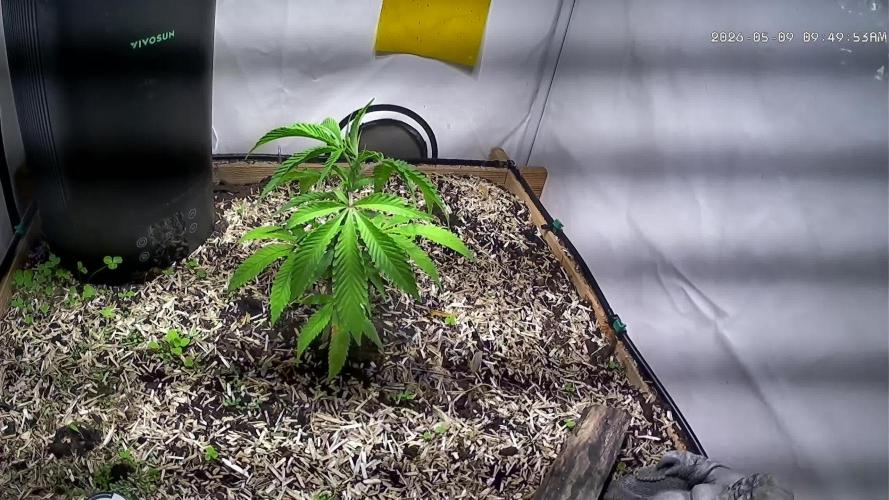
Week 5 had been amazing just that this week we had 3 days of rain which was great for the plant. I gave her some Tea again except that this time I use the rain water I collected. Which was ph at 6.3 and the run of off was ph at 6.8 The plant is around 10 inches now and I am starting to notice some red/purple lines on the stems. The smell is weak but it is still a little early to judge. I would really like some feedback you guys.
Likes
12
Share
Hello lads! How are you doing? So, week 8 and the ladies are amazing, the buds are getting fat is this stage, and I am very happy with it. Gonna start the harvesting in two weeks. Thanks for following me!