The Grow Awards 2026 🏆
Likes
Comments
Share
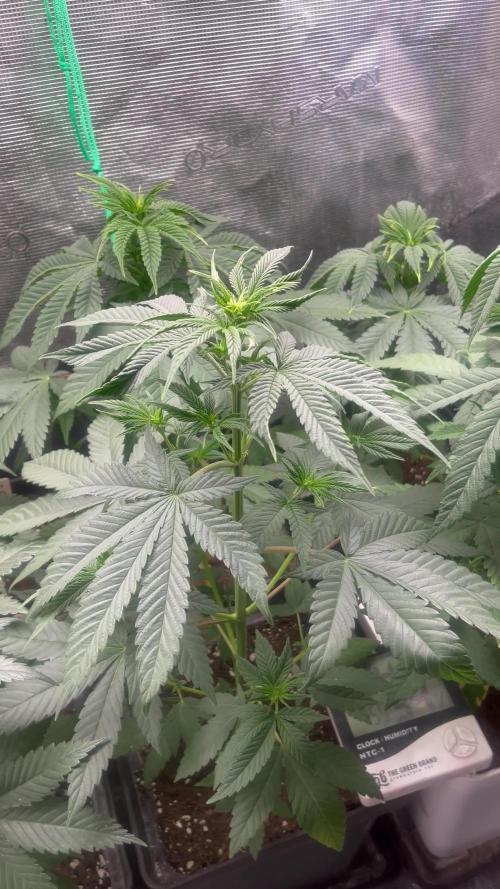
9/11/24 sadly the sun isnt hitting these girls as much as i wish. theyve got a decent smell and some decent trichome coverage for only being the begining of week 4. hopefully they chunk up and arent too far behind because of the lack of sun/ light penetration. ive had half a mind to move them indoors to finish
Likes
1
Share
Hi, everybody. With you back in touch with the Russian gardener. Today I decided to show you my friend's tent. The size of 100 cm by 100 cm has 5 plants of auto AK 47. 5 plants-63 days. 9 weeks. He did not do LST training, but pulled them with a lamp, raising it every week by 10 cm. This is one of the most common cannabis strains on the Russian market. Thanks to strong undemanding genetics, grows almost anywhere in the most adverse conditions, great for the harsh Russian climate and for novice gardeners who with minimal skills want to get the most. As you can see, yesterday we planted 21 sprouted young plants that are preparing for guerrilla cultivation in the open air Later, when we grow them outdoors, I will create a separate diary with a detailed description. Despite the little experience of growth, my friend is a good student and a reliable person, we have grown grass together and harvested. That's why I trust him. Except him, more no one knows about my Hobbies. In this case it is necessary to observe secrecy.
Likes
6
Share
Likes
11
Share
@Beedog
Follow
Gave them first feed other day growing well now I kinda sorted out the high temps
Likes
42
Share
Hey everyone ☺️. This week they have made great progress 👍. So that next week they can be put in their 11 liter pots and get their Green House Company Powder Feeding 😋. Otherwise there is nothing more to say for this week, except have fun with the update 😛 stay healthy 🙏🏻 and let it grow 🌱👌 You can buy this Strain at : https://sweetseeds.es/de/cream-caramel/ Type: Cream Caramel ☝️🏼 Genetics: Blue Black x Maple Leaf Indica x White Rhino 👍 Vega lamp: 2 x Todogrow Led Quantum Board 100 W 💡 Bloom Lamp : 2 x Todogrow Led Cxb 3590 COB 3500 K 205W 💡💡☝️🏼 Soil : Canna Coco Professional + ☝️🏼 Fertilizer: Green House Powder Feeding ☝️🏼🌱 Water: Osmosis water mixed with normal water (24 hours stale that the chlorine evaporates) to 0.2 EC. Add Cal / Mag to 0.4 Ec Ph with Organic Ph - to 5.5 - 5.8 .
Likes
112
Share
hi to all, masters and beginners! welcome to a new week of cultivation with the peaky queen let's cook these flowers a little more to make sure they have more powerful effects and to make the lower part develop well stay up to date!! we will begin by removing some of the excess nutrients in the soil and then giving only water on the next round 😎👽
Likes
2
Share
5/31/25 Sprout popped out of Coco in 400ml Menards Mini Pail. -10:00pm fed with 100-150ml~ 1050EC 5.6pH Mix. -25-75ml~ runoff -QB96x2 at 320 watts -Light is like 46-54 inches away. Using the Photon App with a printer paper diffuser it says the top of the sprout is 320 ppfd. Trying to decide which system to use for watering. Printed a bunch of stuff including a AutoPot Tray that holds the Mini Pail and AquaValve5. Lightproof Lid. Pot Elevator if needed. Made a Irrigation ring and a bunch of things to hold it to the Mini Pail nicely. Connected to a LetPot WiFi Auto Watering System that allows me to set how many times it waters a day. It also provides a feature that when its watering schedule starts it can be done in intervals instead of continuously watering. I am leaning toward using the Auto Watering System over the AutoPot to avoid salt buildup. If I use the AutoPot I wonder if I would be fine if I topfed like 1000ml~ every Saturday Afternoon?
Processing
Likes
4
Share
Just germinated the 3 OG Kush seeds, only one had a tap root. Decided to soak my White Widow just in case only one OG plant makes it. 6 plants in total (if the other 2 OG makes it)
Likes
20
Share
Not particularly growing for speed or any dedicated reason this time round, just adding water and a abundande of positivity, gotta admit I do like the autoseed logo. Off we go again into the magical forest. (Arthrospira platensis) cultivated in high-alkaline, mineral-rich water in Kailua-Kona, Hawaii. It is renowned for having a higher nutrient content, including more carotenoids and essential fats, compared to other spirulina brands. It is frequently cited as a "complete food" due to its dense concentration of proteins, vitamins, minerals, and pigments. The nutritional profile of standard dried Spirulina platensis biomass. 3kg of spirulina powder has an approximate NPK ratio of 10-2-1 (or 10% Nitrogen, 2% Phosphorus, and 1% Potassium). Here is the breakdown of the nutrient content for 3kg of powder: Nitrogen (N): ~300g (10% of total mass) Phosphorus (P): ~60g (roughly 2% of total mass) Potassium (K): ~30g (roughly 1% of total mass) 3kg of spirulina powder is more than enough nitrogen for 4 cannabis plants in a 100-gallon pot—in fact, it is likely excessive and could cause severe nutrient burn or toxicity if not properly managed. Spirulina has a very high protein content (46% to 63% dry weight), which translates to a significant nitrogen source. It is often described as a 5-1-1 NPK fertilizer. 3kg (3000g) of powder in 100 gallons means 30g per gallon. General organic recommendations for potent amendments (like frass) are often around 1–3 tablespoons per gallon. 30g of powder is roughly 2-3 tablespoons, making this a very high-strength application rate if added all at once. Balance this with calcium/magnesium, and organic nutrient delivery in soil growing can lead to deficiencies in these nutrients. Not all of that 100 gallon is used, so figuring out precise measurements was ballpark, but there is about 10kg of engineered biochar in that pot. Mostly in the top half. Ideally, I'd have 25kg in a full active 100-gallon, but......... don't mess with something that is not broken. Roots do not utilize the entire 100 gallons. This has been a couple of years of trial and error, mostly error. The amount of cations you can add in grams depends entirely on the specific cation exchange capacity (CEC) of your biochar and the type of cation being added. Biochar CEC values vary widely, typically ranging from 4 to over 300cmolc/kg. Multiple Biochars in use, ranging upwards of 100cmolc/km. Different cations have different atomic weights Potassium K+ 39.1g/mol. Calcium Ca2+ 40.1g/mol. Magnesium Mg2+ 24.3g/mol. Nitrogen NH4+ 18.04g/mol. You get more nitrogen bang for your buck. It all depends on the CEC of the biochar you use, but brrrrrrrrrr roughly I'm looking at 500-600 grams worth of elemental cation exchange capacity, give or take. That's just for the biochar alone. Elemental cation exchange capacity refers to the ability of materials—such as soil, minerals, and biochar to adsorb, hold, and release positively charged ions Ca2+, Mg2+, K+, Na+, Al3+, and Zn2+. This capacity is a critical measure of nutrient availability in soil and energy density in electrochemical systems. Added calmag 2:1 to complement spirulina. Calcium (Ca): Approximately 150g - 300g of elemental calcium. Magnesium (Mg): Approximately 75g - 150g of elemental magnesium. So long as pH stays in 6.3 to 6.7 ish, the plant will unlock hydrogen. Plants will be able to cycle CEC for their own needs. Hydrogen ion pumping (proton pumping) is a fundamental mechanism used by plant roots to facilitate the cycling of nutrients within a medium's Cation Exchange Capacity (CEC), directly increasing nutrient availability. A growing medium's Cation Exchange Capacity (CEC) does not contribute directly to Electrical Conductivity (EC). CEC represents potential nutrient storage, while EC represents active nutrients in the water/soil solution. A medium with a high CEC can hold many nutrients, but if there is no water present, the EC will be low. 98% of plant nutrient uptake comes directly from the soil solution. 2% of nutrient uptake is directly from soil particles. Nutrients held on exchange sites (CEC) are not directly measured by EC until they are released into the soil solution through exchange with other ions (e.g., hydrogen ions from roots or fertilizer). Plants source the H+ ions (protons) used in cation exchange primarily by exuding carbon sugars into the rhizosphere, then microorganisms perform root respiration, which reacts with soil water to form carbonic acid H2CO3 that dissociates into H+ and bicarbonate. Roots also actively pump out H+ ions directly to acidify the rhizosphere, plants trade hydrogen produced through metabolism for essential nutrients held by the soil. In plant cells, the H+ (protons) used in proton pumping across the plasma membrane come primarily from the cytoplasm (cytosol). The protons are derived from internal cellular sources, including metabolic processes that release H+, and the regulation of intracellular pH homeostasis. Distilled water is highly useful in managing the electrical conductivity (EC) of a growing medium by allowing for precise control over nutrient concentration and assisting in the mobilization of nutrients from the cation exchange capacity (CEC) into the active, plant-available nutrient solution. Just add water & positive energy. Potential hydrogen. pH. + - , potential charge balance for hydrogen. So long as there is adequate oxygen in the soil and air and water moves at a decent interval, its practically impossible for the pH to skew in a soil that is taking in oxygen and releasing CO2 and nitrogen, I say practically, but meh, even with plenty of oxygen, the process of converting ammonium NH4+ to nitrate NO3- by bacteria releases hydrogen ions H+, which directly causes acidification (lowering pH). While water movement is necessary, consistent water moving through the soil can leach away basic cations Ca2+, Mg2+, K+, Na+, leaving behind acidic hydrogen and aluminum ions, causing pH to drop, especially in humid regions. High levels of CO2 in the soil (from intense respiration) dissolve in soil water to create carbonic acid, H2CO3, which lowers the pH. (barometric pumping removes that possibility) The pH in a cannabis cultivation environment, particularly in hydroponic or soilless setups, will often naturally drift towards acidic (lower pH) over time. Understand how to know when to lime the pH back up. Complex but critical. Once I understood this it helped ease the pain of understanding pH. Base saturation directly reflects the percentage of CEC occupied by base cations. Generally, as base saturation increases, soil pH increases because fewer acidic cations, H+ and Al3,+ are present on the soil colloid surfaces. At a pH of 7 or higher, the soil colloids are saturated with base cations, resulting in a base saturation of 90+%. While many sources include Sodium Na+ as a base cation, some calculations focused specifically on plant nutrients (like in some nutrient management contexts) may focus solely on the "Big 3": Ca2+, Mg2+, and K+. However, in soil science and CEC (Cation Exchange Capacity) measurements, sodium is usually included in the definition of total base cations, making it the "Big 4" base cations. At a pH around 5.5, soils often have a 45–55% base saturation, while a soil with a pH between 6.5 and 6.8 generally has an 80–90% base saturation. Base saturation is considered a reliable, albeit complex, indicator of soil fertility and the degree of soil weathering, acting as a crucial metric in soil classification and management. Once you take full control of the pH, so long as there is oxygen, and one keeps tabs on base saturation levels. Its near impossible for anything to go wrong. All you are essentially doing is adding water and waiting for any sign of deficiency. Not so much growing as eliminating the possibilities of things going sideways. Can't over or under water, can't skew pH, can't go anaerobic. Everything runs in optimal cycles, watering every 2 to 3 days or as required, depending on the rate of combined ET. A little warmer, a little drier, but never short on water. All the nutrients are already there in the medium, we still focus on the water, just not adding salts, but to mobilize nutrients held in the Cation Exchange Capacity (CEC) and move them into the active soil solution for plant uptake, the best supplements to add to water are fulvic acid, humic acid, or seaweed/kelp extract. Liquid solutions with high concentrations of essential trace elements. Distilled water has no alkalinity or minerals to help buffer or release nutrients. Adding these supplements turns the "empty" water into an active agent that forces nutrients off the CEC colloids into the solution for plant uptake. When to water? When Electrical Conductivity of soil gets low. No water, no conductivity.
Likes
119
Share
Salutations, fellow cultivators and botanical enthusiasts! Welcome to the First Week of Flowering Report for our beloved Jealousy in the Power Buds competition. The journey thus far has been nothing short of spectacular, and now, as we transition into the flowering phase, the excitement is reaching new heights. To kick off this week, I decided to don my horticultural surgeon's hat and perform a series of strategic maneuvers on our green queen. The week began with a daring move – a couple of toppings to encourage a more bushy and compact growth structure. It's like giving Jealousy a little green haircut, shaping her into a voluptuous, floral masterpiece. But that's not all, my friends! A defoliation extravaganza ensued, where I carefully removed some of the larger fan leaves. Now, I can almost hear you asking, "Why on earth would you do that?" Well, it's all about optimizing light penetration and airflow, ensuring that each bud site receives its fair share of sunshine and fresh air. It's like orchestrating a botanical ballet, where every dancer gets their moment in the spotlight. Now, brace yourselves for the grand finale – taking some cuts. I know, I know, typically, we'd ease into these practices, but time is of the essence, and I wanted to put Jealousy's genetics to the ultimate test. The cuts were taken with the precision of a master sculptor, each one destined to become a clone, a green offspring preserving the essence of our marvelous Jealousy. And let's not forget the star of this green show – Jealousy herself. She's embracing these changes with open leaves, responding to the toppings and defoliation like a botanical maestro. It's like watching a symphony unfold, where each note played by nature results in a crescendo of growth and vitality. As we navigate this first week of flowering, let's tip our virtual hats to Zamnesia and Plagron for paving the way for this thrilling Power Buds adventure. Their contributions are the backbone of our horticultural success. A round of applause to the Grow Diaries community – your shared wisdom and green camaraderie elevate our collective knowledge. To my fellow contestants and growers, may your flowering phase be abundant with resinous wonders, and may the fragrance of success linger in your grow rooms. Here's to a week of strategic moves, green transformations, and the anticipation of a blooming spectacle. Stay green, stay inspired, and keep cultivating those dreams! As always, thank you all for stopping by, for the love and for it all. This journey of mine would just not be the same without you guys. The love and support are very much appreciated, and I feel honored and blessed with you all in my life !!! With true love comes happiness. Always believe in yourself and always do things expecting nothing in return, with an open heart. Be a giver, and the universe will respond in ways you can’t even dream of . Friendly reminder: all you see here is pure research and for educational purposes only. Genetics - Jelousy @Zamnesia Nutrients @Plagron Light - @viparspectra P2000 Room size - 3x3 - 0,9x0,9
Likes
42
Share
@JBoBz
Follow
I'm really happy about the quality of this strain, but I'm unhappy about the final results.. I think it was a setup mistake in the room, it probably took lots of heat but I got other seeds of it I'll probably will do another diary with her! Okay guys, thanks for the support and we will se in the next room, happy growing to everyone 💚🍀💯
Processing
Likes
31
Share
@NorCal311
Follow
11/11/19 - All is good in the hood. I love comming back from a couple of days away to see how they look. I did dome defoliation last nigh. Took off some lower branches and leaves. Mostly spindly branches. They are loving the feedings. 11/12/19 - I figured out something tonight with my lighting. I think I have it too low since the plants that right under the light are getting a little bleached and are a lighter green then the plants that are not directly under the light. So I moved it up as far as it could go w/o modification. Let's see what happens. 11/13/19 - From the responses to my question that I received from the pros today, I moved the light back down to 24". 11/14/19 - Did a BUNCH of defoliation tonight. With the SOG it was hard to get under everything. I opened the tent all the way and crawled inside to see so many little stragglers. I hope they do not get shocked too much. I also posted a new vid tonight. I need to do some better lighting next time I will try my headlamp. 😀
Likes
33
Share
El patrón Primera Semana Floración : hola buenas hemos empezado a hechar el producto Grotek de floracion mis chicas están preparado para empezar la floración ☺️
Likes
33
Share
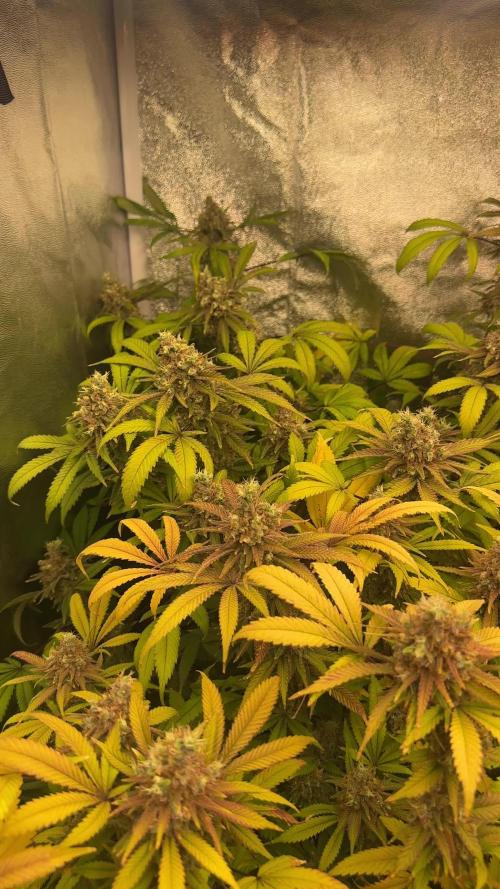
Hey guys welcome back in week 13!! Almost there, this week i'll start building off nutrients so i can give them a proper flush next week. Buds are still getting fatter each day and starting to smell real strong, i do have a bit of nute burn due to a massive PK boost (PK 50-31) but i managed to find the right amount i needed to give them, this week i'll give them a milder PK booster. So im keeping a close eye on the ladys and her crystals to get a nice 80% milky and 20% amber trichomes mix. The NL X Haze clones are good to go so they need a little bit of patience, and when the time is right il put the left one of the picture in to flower, and the other one will me cut down for clones and prepare them for the outdoor season. The other clonse i got is an "Ebola Virus" strain... the name isnt that beautiful but i've seen the mother where she was cutted from is an absolute beauty, not sure but i think i'll prepare 2 also for the outdoor season and save 1 as a mom, but like i said not sure yet. Well thats it for now guys, see ya'll in week 14 (the last week if every thing goes as planed!) PS: Sorry for the un-sharp pic's the lens on my phone isnt that good
Likes
18
Share
@Gineken
Follow
Dont have pics, :(. But I really liked it after the few hours of sunlight and all complications.
Likes
41
Share
Hey guys . Finally the time has come . From all 4 phenotypes the cutting was put into flower. In the next 10-14 days I know which ones are female and which ones are male :-) . A female stays here in the diary, all other females come back to the vegi tent because there is no space in the flower tent. The males go to an extra location to collect pollen for crossbreeding. was watered 3 times a week with 0.6 l each time. Stay healthy 💚🙏🏻 👇🏼👇🏼👇🏼👇🏼👇🏼👇🏼👇🏼👇🏼👇🏼👇🏼👇🏼👇🏼 You can buy this Nutrients at : https://greenbuzzliquids.com/en/shop/ With the discount code: Made_in_Germany you get a discount of 15% on all products from an order value of 100 euros. 👇🏼👇🏼👇🏼👇🏼👇🏼👇🏼👇🏼👇🏼👇🏼👇🏼👇🏼👇🏼 You can buy this strain at : DJ Short Water 💧 💧💧 Osmosis water mixed with normal water (24 hours stale that the chlorine evaporates) to 0.2 EC. Add Cal / Mag to 0.4 Ec Ph with Organic Ph - to 5.8 - 6.4 MadeInGermany
Likes
10
Share
@DrDuhboto
Follow
Very Happy plants, soaking up the rays. When you place your face near the buds you get an amazing sweet fruity aroma, the leaves smell like skunk and cheese. Each plant is getting 10 liters every 4 days. I water with 6.3ph tap water twice for every time I add nutrients. I use Alaska fish fertilizer when its been a few times since a nutrient feed but the plants are showing no deficiency's. They are Fed by a drip system which takes 16 hours to deliver the 10 liters to each plant, this works really well in the Fabric smart pots. I use metal racks to keep the plants off the ground then place a drip tray underneath each plant. When using the drip system very little run off occurs. I added a spider farmer sf-1000 to the room, it is full spectrum and ir, and is great for getting the corners of the room or the less dense areas of the canopy.
Likes
119
Share
Hello, my green connoisseur! The moment we've all been eagerly awaiting has arrived—the Harvest Report for our botanical queen, Jealousy, in the Power Buds competition. This has been a journey filled with anticipation, and now, we stand on the shores of botanical triumph. Jealousy, in her final act, bestowed upon us a generous yield of 195 grams of dry bud. It's like a cornucopia of green abundance, a testament to the meticulous care and strategic decisions made throughout this green saga. Each nugget is a jewel, a culmination of weeks of growth, love, and dedication. But the story doesn't end there. Jealousy, in her love for the trim bin, gifted us a beautiful golden pollen. This precious powder, transformed into ash via the French Cannoli style. Also gave me a Charas/Finger Ash ball. It's like capturing the essence of the plant in a tangible form—a botanical relic that encapsulates the spirit of our green empress. Now, let's talk about the auditory symphony that accompanied the harvest. The sound, reminiscent of a tree making timber, is like nature's applause for the bountiful harvest. It's the soundtrack to a successful cultivation venture, a melody that resonates through the grow room, echoing the grand finale of this green symphony. The drying process, carried out over two weeks with a temperature of 17°C and humidity at 58%, is like the slow and methodical crafting of a fine wine. Each day, the buds undergo a transformative journey, evolving from freshly harvested flowers to dried and cured masterpieces. And now, the pièce de résistance—the preservation of terps with the Grove Bag featuring Terploc technology. It's like locking the aromatic essence of Jealousy in a time capsule, ensuring that every toke carries the full spectrum of flavors and aromas. The anticipation for the smoke report is palpable, as the strawberry candy profile promises an exquisite sensory experience. Reflecting on this entire journey, from germination to harvest, it's like turning the pages of a botanical epic. The decisions, the challenges, and the moments of sheer joy have shaped the destiny of our green empress. It's a narrative that will be retold, shared, and cherished in the annals of our horticultural adventures. As we conclude this harvest report, let's extend our heartfelt thanks and shout-outs to Zamnesia, Plagron, Grow Diaries, and the vibrant community. Your support and contributions have been the guiding lights on this extraordinary green expedition. To my fellow contestants and growers, may your own harvests be as abundant, flavorful, and joyous as this one. Here's to the culmination of our shared green dreams, the thrill of the harvest, and the anticipation of what lies ahead. Stay green, stay inspired, and keep cultivating those dreams! With true love comes happiness. Always believe in yourself and always do things expecting nothing in return, with an open heart. Be a giver, and the universe will respond in ways you can’t even dream of . Friendly reminder: all you see here is pure research and for educational purposes only. Genetics - Jelousy @Zamnesia Nutrients @Plagron Light - @viparspectra P2000 Room size - 3x3 - 0,9x0,9