


Likes
Comments
Share


@gr3g4l
Follow
Esto sigue creciendo aunque algo menos y floreciendo a buen ritmo.
Crecimiento nº1 171 ctms y la nº4 147 ctms
Una semana bastante pasada por agua y un final de semana también fresquita.

Likes
19
Share


@MaxMo8
Follow
I transferred it to a half-gallon pot and I mixed the organic fertilizer with the soil.

Likes
38
Share


@J_diaz420
Follow
Encantado de la oportunidad de crecer estás variedades, sin duda, llenaron todas mis espectativas 🍀😍🤩

Likes
5
Share


@Bluethum94
Follow
I topped all but one the one I didn’t too hasn’t had a happy life but I’m getting it there
Likes
5
Share


@Iceloc60
Follow
Top feed soil happy frog all purpose and out recharging water half gallon anpiece


Likes
8
Share


@cannacat777
Follow
8/26 - sporty looking great, praying hard! Posh is working on it. But look who finally showed up to the party! I’m calling her Baby spice. She sprouted 12 days after going in the soil. Way to be a fighter girl!
This is going to be a tricky thing to manage I feel like my gals are tracking a week apart. I’ll keep this journal’s timeline on sporty spice. -1 week for posh and -2 weeks for baby spice. spice girls let’s grooooow!
8/30 - exactly two weeks from sprout for Sporty and Posh. Pretty wild how big a difference there is between the two. Baby is getting her footing. Now.
Sporty already pushing 4-5 nodes and I saw a tiny root through the drain hole. Wanted to pot her up! About 8 cups pro mix, one cup perlite. About 1.5 tbs of Gaia green 4-4-4, some worm castings and sprinkled mycorrhiza around where the rootball would be. God speed girly!
9/3. Potted up Posh today. About a half gallon pro mix, plus about 1.5 tbsp of the Gaia green 4-4-4. Plus about a cup of worm castings, perlite, and mycorrhiza. Sporty is looking very happy, 5 nodes and counting. Added back my second light, let’s go girls!!!
9/5. Wrapping up week 2 here, so far I’ve been really impressed with the pro mix Gaia green and soil support so far. The girls seem happy and healthy. See you in week 3!

Likes
7
Share


@Servietsky
Follow
3rd week of growth, she has beautiful and big leaves, envore a little low, I gently mix with fertilizers and she grew up saw eye.
I think next week we will see the beginning of flowering


Likes
Comments
Share
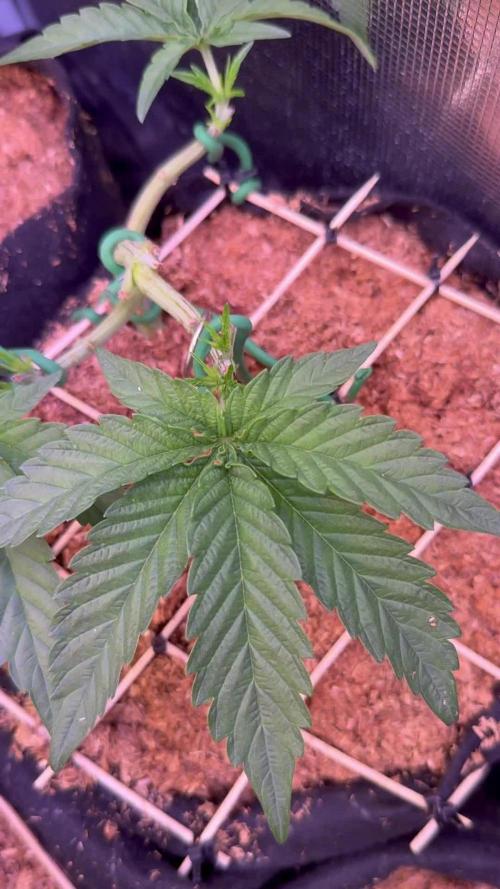

@hassehujasse
Follow
Roots came out from 4l pot. Transplanted to 7l pot
First topping Done. All others topped and recovering

Likes
10
Share


@Skuba
Follow
Hey everyone!!! Start of week five. Everything is starting to come along. Everything is gping fine in the garden. Still super cropping some of the branches on cc2 to keep it even. Added some open sesame to this weeks feed. 😎 cheers
Update 11/15 hey everyone back with an update. Fed the girls this morning, and the first thing i noticed was the sweet aroma. 😁😁 these girls love water amd nutes i feed them about a gallon of water every 2 to 3 days. Lots of pistills starting to come in as well😁😁😁😁 i also lsted and leaf stripped as well! Cheers!✌️✌️
Likes
5
Share


@123Grow
Follow
It time for push and tuck. I did the feeding for transition ( 1:1:1 ratio). I watch them for about 3 hours, then turn the lights out for 24-36 hours. This depletes the hormone that says veg and switches to flowering.
Espoma seed starter mix : 1 TBSP
Jobe’s Citrus Fruits : 1 TBSP
3 TBSP earth worm castings
1/4 tsp recharge
Aerated for 30 hours at 68 degrees ( nice and frothy 😂😂)
1 gallon of water 750-765 ppms at 1:1:1 ratio. This will last for the first 6-7 days, then we switch to 1:3:2 ratio. I will list what I use for 1:3:2 as it will change from week to week.
10-18 Lights are out for 30 hours and we will see how they look. Lights go back on at 6am EST.
10-19 The lights are kicking. Did some tucking. I did 30 hours of dark before introducing 12-12 light schedule. I can see some of the pre-flower hairs sticking out. 8-8-8 at 760 something ppm’s went well. This is the first run I will be hand feeding the plants throughout flower. I relied on dry amendments and had some success, but I think I can push the bar higher having more control over the feedings. I will be doing a total of 8 feedings.
10-22 The trellis is filling up!!! I added photosynthesis plus to the mix and some fulvic/humic acid. All the ladies are praying up.
Likes
4
Share


@High_Class
Follow
This Blue Dream grow was my best looking one. Can't wait until it's dry to sample it. The P1 clone turned a peach color, and the P2 clone turned purple.

Likes
16
Share


@eldruida_lamota
Follow
Esa familia, otra vez actualizamos, vamos con estas Blueberry Cheese de Zambezaseeds.
Finalizamos la segunda semana de floración de esta genética, tienen buen color y buena ramificación y van progresando las futuras flores.
No e comentado pero se les a practicado una defoliación de bajos a ver si podéis ver en el video
Añadimos el BETASHARK de Agrobeta y esta semana no les dimos tetra 9.
Agrobeta:
https://www.agrobeta.com/agrobetatiendaonline/36-abonos-canamo
Mars hydro:
Code discount: EL420
https://www.mars-hydro.com/
Las maximas de temperatura no superan los 26 grados y las mínimas no bajan 20, así que no me puedo quejar.
Los niveles de humedad también son los correctos van entre 50%/65% de humedad relativa.
Por supuesto el Ph lo estamos dejando alrededor de 6.
Hasta aquí es todo, buenos humos 💨💨💨

Likes
16
Share


@Fruitgrower
Follow
Wednesday 27.04.22
Day 1
Recieved package and placed the seeds in water.
6 coco pellets are soaking in a mild root solution.
Tuesday 3.05
Day 6
All seeds have sprouted, transplant sometime this week.

Likes
21
Share


@BigBudWolf
Follow
The plants hung in the grow tent with the exhaust fan running low for 10 days with an RH between 45-50%.
80 grams at trim from 3 Blueberry Autos.
For a first time grower, I tried to let the plants do their own thing mostly, aside from some lite defoliation and tucking. In doing this I see ways I can improve.
After curing for 10 days, first sample was not disappointing. (I intend to cure it at least 1-2 months.)
Sweet berry aroma when chopping up the bud. Smooth burn with white ash. Can get a hint of berry flavor in the smoke however it also is not ready yet. But I can almost predict the possible flavors after curing.
I believe a strain like Blueberry benefits from longer cures of a few months or more. I will attempt to give it as long as possible.
Overall impressed with the grow and look forward to the final smoke. Ready to apply what I've learned and improve on my next grow.

Likes
111
Share


@Salokin
Follow
Hello Growmies,
I'm thrilled to update you on the plant's progress! In the last week, she has beautifully filled out the scrog. Just yesterday, I flipped her into the flowering stage. This means I'll slowly increase her feeding, although I don't plan to go too heavy on the nutrients since she seems to prefer a lighter touch.
She's quite particular about her nutrients, requiring me to change the reservoir every five days. If I delay, she shows signs of distress on her leaves, but these issues resolve immediately after I refresh the reservoir.
While she's stretching in the preflower stage, I'll continue to guide her growth into the empty areas of the scrog screen.
Also, here's a special offer: use the code ZAMMIGD2023 at Zamnesia's online store to get a 20% discount.
Thanks for dropping by, and I'll share more updates next week!

Likes
79
Share

@Salokin
Follow
Hey Growmies!
I'm thrilled to share my latest project: two exceptional grow environments, each a lush green haven with 9 plants on plant rollers. We’re employing a blend of Scrog (Screen of Green) and Sog (Sea of Green) techniques. Each plant has its individual ScroG, directly connected to its air-pot, facilitating easy mobility and care within the tent.
As the Room is on the cooler side at the moment, I've set up a Solea infrared heater, controlled by an Inkbird ITC-308 temperature controller, to maintain a cozy climate. Each tent is also equipped with a Spider Farmer Cool Mist humidifier for perfect humidity levels. Initially, I planned for identical setups in both tents, but adaptation is crucial. I encountered a challenge with the UR45 lights due to their single plug and UV/IR switches. To overcome this, in Tent 1, I’ve installed two UR45 lights: one dedicated to IR and the other to UV, each managed by a Meross smart plug.
The Mars Hydro app manages the light and in-line fan controls in Tent 2, though it has its limitations. The ITC-308 takes care of the infrared heater, while the humidifier regulates itself. I'm really into this setup, but I'm already thinking about upgrading to a single grow controller for all devices.
Excitingly, ‘Epic Buzz’ in Tent 1 is competing in the Tent-X Ultimate Grow Challenge sponsored by Trolmaster, who has also sponsored a Tent X Controller for this tent. This addition will greatly enhance our control and monitoring capabilities in this tent.
This grow season is extra thrilling as I’m collaborating with Anesia Seeds and Ganja Farmer Seeds. They've provided some amazing strains. Tent #1 houses ‘Epic Buzz’, ‘Red Banana Pudding’, and ‘Pink Matcha Slush’ from Anesia Seeds. Tent #2 features ‘Caramel’, ‘GMO’, and ‘Bruce Banner x White Russian’ from Ganja Farmer Seeds. I’ll be documenting their growth in individual diaries. Check out these links for each strain's story:
1. Anesia Seeds - Epic Buzz [Grow Diary](https://growdiaries.com/diaries/189991-anesia-seeds-epic-buzz-grow-journal-by-salokin)
2. Anesia Seeds - Red Banana Pudding [Grow Diary](https://growdiaries.com/diaries/189995-anesia-seeds-red-banana-pudding-grow-journal-by-salokin)
3. Anesia Seeds - Pink Matcha Slush [Grow Diary](https://growdiaries.com/diaries/189993-anesia-seeds-pink-matcha-slush-grow-journal-by-salokin)
4. Ganja Farmer Seeds - Caramel [Grow Diary](https://growdiaries.com/diaries/190093-ganja-farmer-seeds-caramel-grow-journal-by-salokin)
5. Ganja Farmer Seeds - GMO [Grow Diary](https://growdiaries.com/diaries/190089-ganja-farmer-seeds-gmo-grow-journal-by-salokin)
6. Ganja Farmer Seeds - Bruce Banner x White Russian [Grow Diary](https://growdiaries.com/diaries/190091-ganja-farmer-seeds-bruce-banner-x-white-russian-grow-journal-by-salokin)
For those curious or seeking inspiration, here’s the detailed equipment list for each tent:
Equipment List for Tent 1:
- Mars Hydro 120x120x200cm Grow Tent Dark Room
- Mars Hydro Smart FC 4800 Samsung LED Grow Light – 480W
- 2 x Mars Hydro UR45 IR & UV LED Grow Lights
- Mars Hydro iFresh 6-Inch Smart Inline Duct Fan
- Spider Farmer 6L Cool Mist Humidifier
- Solea Infrared Heater 500W
- Inkbird ITC-308 Digital Temp-Controller
- 3 x Meross Smart Plugs (for UV/IR light timing)
- Tent X Controller (sponsored by Trolmaster)
- 9 x 12.5L Airpots
- 9 x 30cm Plant Rollers
- 9 x 36cm Plant Saucers
Equipment List for Tent 2:
- Mars Hydro 120x120x200cm Grow Tent Dark Room
- Mars Hydro Smart FC 4800 Samsung LED Grow Light – 480W
- Mars Hydro iFresh 6-Inch Smart Inline Duct Fan
- Spider Farmer 6L Cool Mist Humidifier
- Solea Infrared Heater 500W
- Inkbird ITC-308 Digital Temp-Controller
- 1 x Meross Smart Plug with Consumption Measurement
- 9 x 12.5L Airpots
- 9 x 30cm Plant Rollers
- 9 x 36 cm Plant Saucers
Always happy to hear tips or chat about gear with fellow growers!
Can't wait to update you all as these tents transform
Stay Lifted
Salokin

Likes
20
Share


Likes
28
Share


@Chubbs
Follow
420Fastbuds
FBT2307/Week10
Weekly update on these three lovely ladies. All seem to be growing great especially this far into flower. Definitely getting three different colors on the plants but no complaints at all. The darker one is an awesome shade of black which to me is really cool. I've stopped nutes and just giving ph'd water from here on out. I did a mild defoliation this week on the shorter two taking off a couple of the bigger fan leafs. All in all Happy Growing