


Likes
Comments
Share


@CannaArchive
Follow
Today marks the beginning of the last week of flowering for my cannabis plant. After months of care and patience, I can finally see the first amber trichomes starting to form.
It's a sign that the plant is nearing the perfect time for harvest. The buds are dense and frosty, and the shift in trichome color is telling me that the plant is at its peak potency.
In a couple of days, I'll move the plant out of the tent and into complete darkness for 48 hours.
This process is supposed to help boost resin production and make the final buds even better.
After that, it’ll be time to cut her down. It's exciting to be so close to the end, and I can't wait to see how the final product turns out!🌱🌱

Likes
10
Share

@GermanGrow182
Follow
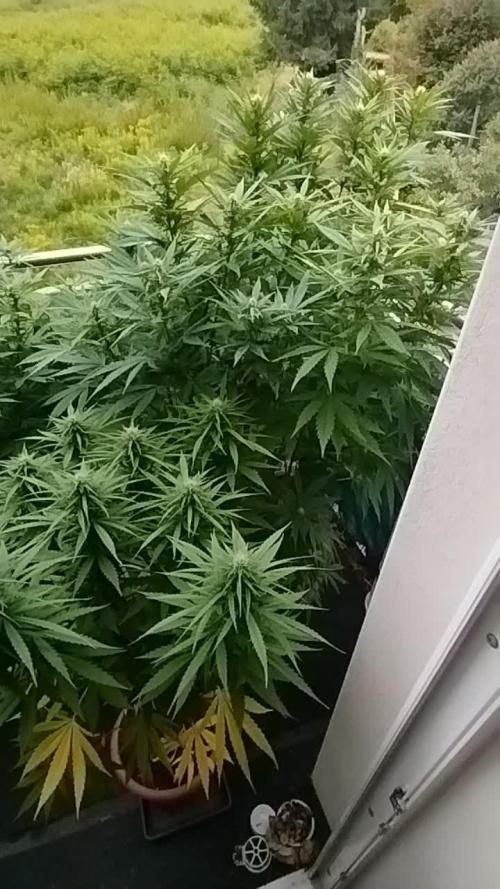
Es war eine gute Woche 👍 Milde Temperaturen und kaum Regen, dazu Wind und Sonne. Die Blüten werden dicker 🙂 die ersten unteren Fächerblätter vergilben und fallen ab. Die Larry og ist in Blütewoche 4, die AK in Blütewoche 2, Lemon in der 3.
Es läuft ziemlich gut 👍 😊 bis nächste Woche ✌️

Likes
18
Share


@TherealNICOGREEN
Follow
Er gået over alle forventninger igen fik toppet hende! Troede jeg havde fået dræbt hende grundt ph plus chok men jeg skiftede alt van ny gødning og ph 5,9 også skyllede jeg rødderne rigtigt godt tog de største blade væk:) og nu kan jeg ikke se hun har været ved at dø!/) Hydro er bare det bedre og man kan hurtigt rede sine fejl:)

Likes
8
Share


@Ms_Herbalist
Follow
Full of resin 😍 smells amazing
Curr it properly and you can smell the papaya and gassy tones

Likes
12
Share


@chrisss
Follow
Week 8 Day 50) Fed her 4ml bloom nutes plus 1 ml calmag to a half gallon plus some recharge in a separate container, she’s looking real purple n much more healthier
D51) looking good , new growth is very healthy
Day52) Fed 75% of gallon lmaoo w.e ts is then also 7 ml bloom and 4ml calmag -small Rust spots were popping up still and it was yellowing like it needed N
Day53) they got noticeably bigger I think it’s cuz of the nutes from yesterday, I didn’t want to give her them cuz her tips were so Burnt but said fuck it , also yesterday I raised the lights cuz I think it was to close
54) added fan
55) Fed 75% gallon , 1 ml calmag , 4 ml bloom
56) waiting for my shit to get plump


Likes
43
Share


@The_Northern_Skunk
Follow
Raised the height of the grow lights and highed the light output, threw all the autos into one tent for the time being as they love lfe in there over than in the cupboard! but ill get around to making the cupboard I have spare into a space to grow again. All.of the plants are doing great really, one purpe punch isnt doing to well im going to flush her then feed half the dose of nutes that i have been already feeding her. 💚🤘


Likes
2
Share


@Skinnytalls420
Follow
Start of Day 8-02/08/22 we are off to good start gonna start giving them some root juice this week maybe tomorrow. They are looking good

Likes
111
Share


@Salokin
Follow
Hi Growmies,
I feel I had a root issue, may have even been root rod. So as I saw a few of the very deeply submerged roots turning brownish and decay, I decided to generously cut away the affected areas and cleaned everything with hydrogen peroxide as good as I could and then properly rinsed the whole system.
It seems, however, like she has started a whole new set of roots that started to submerge after I started feeding the orca from plant success (can be seen in the video below). Can highly recommend this product! She has also not show any signs of stress due the suspected root issues.
Other than that she is a super pretty indica lady :) almost crazy how symmetrical she is. I have trained all main colas horizontally until the canopy had evenly opened up. Now I will let her grow towards the scrog and depending on her stretch, I will flip her at some point towards the middle or end of next week.
Here is the code that’ll give you 20% in Zamnesia‘s online store, just input ZAMMIGD2023 at checkout.
Thanks for stepping by and until next week!

Likes
9
Share


Likes
84
Share


@Mrs_Larimar
Follow
Friday, 2021-06-25
Definitely the last Week of Flower for her, soon Harvest will come
And she stands now under the VIPARSPECTRA XS-2000
Light is on 75 Percent, to get used to... because the Lights are very Powerful
and I dont want to burn// stress her in her last Days
Leaves are discoloring, all Pistils are Orange/ brown
Trichomes are all Milky and afew Amber ones
Tomorrow she gets agood drink with " Clean Fruits" to help her devour the Nutrient-Remainings
Shopping Link for the LIghts:
Amazon US:
XS1000 10% off: it10mlarimar http://yx-8.cn/0y-6
XS1500 5% off: it15mlarimar http://yx-8.cn/0yA
XS2000 5% off: it20mlarimar http://yx-8.cn/0y2Y
XS4000 5% off: it40mlarimar http://yx-8.cn/0y5k
Amazon Canada
XS1000 10% off: it10mlarimar https://amzn.to/38udUVe
XS1500 5% off: it15mlarimar https://amzn.to/3esVUyr
XS2000 5% off: it20mlarimar https://amzn.to/3l5zAfg
XS4000 5% off: it40mlarimar https://amzn.to/3l7k5Uj


Processing
Likes
17
Share


@ConradThePeaceful
Follow
10/25 23 days from sprout. All are looking great. Going to wait another week before I start feeding.
10/26 Watered. Probably going to trim some fan leaves before the next watering.
10/27 Few are starting to flower. Switched from MH bulb to HPS.
10/29 Watered. Going to start Fox Farms food at a quarter strength next watering.

Likes
11
Share


@russrahl
Follow
A month in now to flowering and all is still good. Stretch has stopped and the 2nd net is on about 1 foot above the first. I would have liked to have done a bit more defoliation earlier on in flowering but it was a busy few week. Still kept her on the lower side for nutrients and notice the one plant that got locked out earlier in the month was not as pretty as the rest and showing signs of deficiency still on her leaves but the buds are developing normal like the others, bigger even maybe...lol all in all it’s still looking good at this point. Cheers 💨

Processing
Likes
4
Share


@TheBiggestLittleFarmer
Follow
She is really taking off now. I topped her this week realizing it was probably a little late. Currently I am growing in a 2x2x5ft grow tent but will hopefully upgrade to a 4x4x6.6ft grow tent soon. With this strain being mostly sativa i will likely out grow this tent quick.


Likes
29
Share


@Rko41
Follow
2 plantes aux extrémités souffre peut-être d’un surengraissage! A voir je vais arroser à l’eau clair avec juste du pk!


Likes
77
Share


@DogDoctorOfficial
Follow
Week 10 Flower — The Beauty Before the Finish
This week marks a very special chapter in the Eternity Grow Cup. As we approach harvest, the garden is simply glowing with beauty. Every corner, every canopy, every branch tells a story — and this week, I’ve taken the time to slow down and capture that story as best I can through the lens of my camera.
All the photos you’ll see in this update were taken with care and intention. I use my Sony camera in full manual focus mode, and I don’t just snap and go — I spend time with each plant, each angle, waiting for that perfect moment when everything aligns. These are not just photos to document — they’re my attempt to reflect the feeling of the room, the energy of the grow, and the soul of each plant.
Just like with the videos, I don’t shoot randomly and decide later. I record what matters, and what I record, I use. It keeps me focused, organized, and deeply connected to the process — and I believe it helps me tell the story more clearly, whether through stills or moving pictures.
All five Runtz phenos are finishing beautifully. Each one expressing unique traits, but all carrying the same stunning quality — dense, clean, colorful, resin-rich flowers that fill the room with pride. This garden is finishing spotless, and I couldn’t be happier.
This week’s YouTube episode will reflect that beauty. If you’re seeing this here on GrowDiaries, I highly recommend checking it out in full 4K once it’s live — there are moments that simply can’t be translated in photos alone, even though I try my best. But for those who love the details, the full spread of pictures is right here, as always.
t this point in flower, the girls are not eating — they’re just drinking clean water with nothing but System Clean in the reservoir, at a rate of 0.25 ml per liter. This is part of a gentle, prolonged flush phase I like to implement, giving the plants a chance to metabolize and fade naturally. The goal is to promote clean, vibrant flowers that finish with optimal expression, without rushing the process. No forced flush, just time and care.
Lighting-wise, the spectrum has been tuned with precision — we’re currently running 40% on the whites, with reds and UVs at 100% to drive trichome development, resin production, and color expression in these final days. The plants are loving it — they’re soaking in the deeper wavelengths that signal the end of their life cycle and responding with a final push of energy.
And yes — we’ve been running 11 hours of light and 13 hours of darkness from the very start of flower. It’s not the usual 12/12, and it comes with its pros and cons. On the upside, it helps speed up ripening slightly, encourages more compact flower formation, and mimics the natural seasonal decline in daylight. On the flip side, it slightly reduces the overall DLI (daily light integral), so you need to ensure your PPFD and spectrum are dialed in just right to avoid sacrificing yield. For me, the trade-off is worth it — the plants are expressing themselves beautifully, finishing strong, and packing on the final magic.
Now it’s your turn — I’d love to hear from you. Which phenotype is standing out the most to you in this garden? Which one is catching your eye with its colors, its fade, its structure, or just that vibe that speaks to your soul? Is it the frost? The density? The posture? Each of these girls has her own personality, and I know many of you have been following closely — so drop a comment, let me know: which one is your favorite? Which one would you take home?
This run has officially earned the Dog Doctor Official Wax-Sealed Stamp of Approval. These genetics are beautiful — expressive, vibrant, clean. It’s been a joy to grow them, and an even greater joy to share this journey with all of you. Of course, we still have the final word coming after harvest, drying, and curing — that’s when the full picture reveals itself. But until then, based on everything we’ve seen and lived in this grow… this is the real deal.
To everyone following the journey — thank you. To the sponsors, the community, the silent observers, the passionate growers, the haters, the lovers — I see you all, and I appreciate every bit of energy you send.
This cup has been about more than just growing. It’s been about sharing. Connecting. Creating something beautiful together. And we’re almost there.
Next stop: harvest? provably yes lets see !
Growers love always 🌿❤️
DD
Genetics - Runtz https://www.zamnesia.com/6000-zamnesia-seeds-runtz-feminized.html
Nutrients - Plagron https://plagron.com/en/hobby
- Aptus Holland https://aptus-holland.com/
Controls - Trol Master https://www.trolmaster.eu/
LED - https://www.futureofgrow.com/en
LED - https://www.thinkgrowled.com
Soil - https://www.promixgardening.com/en
Germination - Cannakan https://cannakan.com/?srsltid=AfmBOopXr-inLXajXu3QFgKXCXXos4F1oEvScjMKIB5MR5dk8-GJ-F49
DOGDOCTOR 15% off
Smoking Papers - https://ziggioriginal.com/
Terpene saver - https://grovebags.com/
As always thank you all for stopping by, for the love and for it all , this journey of mine wold just not be the same without you guys, the love and support is very much appreciloved and i fell honored with you all in my life
With true love comes happiness Always believe in your self and always do things expecting nothing and with an open heart , be a giver and the universe will give back to you in ways you could not even imagine so
As always, this is shared for educational purposes, aiming to spread understanding and appreciation for this plant. The journey with nature is one of discovery, creativity, and respect. Let’s celebrate it responsibly and continue to learn and grow together!
Growers Love To you All 💚
#EternityGrowCup #RuntzHunt #GrowersLove #CannabisCommunity #AptusHolland #ProMixSoil #TrolMaster #Zamnesia #Plagron #ZiggiPapers #Grovebags