


Likes
Comments
Share


@THcHunteR23
Follow
Première signe que sa va moin bien… j’ai enlevé les feuilles atteinte de taches au maximum .j’ai attendu que le substrat soit bien sec et donner un dose d’engrais plus élevé. J’espère que ça va se reg

Likes
46
Share


@Ju_Bps
Follow
Hello my friends,
I hope all's fine for you,
For me all's good
Plant are healthy and buds biggest each day, start to see pollen 😛, and nice smeel.
I've started more than one week
Tera flore and Sugar Royal,
See you next week!
Enjoy 😎😎

Likes
42
Share


@iLoveGoodWeed
Follow
Week 11 - both ladies look amazing can't wait for the smoke.
9L Pot she is almost ready to harvest so I on next watering she will receive the final part for 7 days then flush and water for 3 days.
12L Pot she look amazing a lot of buds and she have 2 weeks left till harvest

Likes
69
Share


@DeepWaterGrower
Follow
[DAY 36] - 6/7/2022
- 29°/30° and 60% RH average;
- TS 1000 set at 75% = 112 watts and 45cm away - After bending the plant has returned to about 38cm in height;
- EC 0.9 / 1 - PH remains fixed at 6.4, no matter how much PH down I put in the solution, it will always return to 6.4 after few hours;
------------------------------------ SCROG TIME AND DEFOLIATION IN SEVERAL TIMES ------------------------------------
- 8 PM - Lights on and scrog net mounted.
The scrog net is about 25 cm (10 inches) from the clay and I have tried (at my best) to space the individual branches in the various outer squares of the net.
In the next few days I will try to better fill the free squares to try to fill the scrog net completely.
- 6 HOURS LATER - I was very rude due my inexperience. Despite that, plant seems already recovered, it is drinking and the branches are already bending to seek the light.
[DAY 37] - 7/7/2022
- Just removed some leaves under the canopy who won't get light. I did defoliation in different times due I wanted no stress the plant too much, I hope it was a good idea.
[DAY 38] - 8/7/2022
- More defoliation
- Bent branches through the net;
- Added peppermint oil on the lid to prevent insects from getting into the tent;
- Today temperature is cooler, which is why I decided to keep the light off for only an hour. I took the opportunity to give the plant more light after the stress of the last three days to allow it to recover faster. It will go to sleep directly tomorrow at 5 pm until 9 pm, as usual.
[DAY 39] - 9/7/2022
- Mounted the carbon filter;
- Tried to fix the scrog but I broke a branch;
[DAY 40] - 10/7/2022
- Today I tried to lower the net but it is harder than I thought. By now the branches are stuck in the net and I was able to do very little.
- I probably made it worse, Before the branches seemed to me better spaced and now I'm afraid of forcing my hand too much, I risk getting even worse.
For a couple of days I leave the plant alone, it's not growing so much;
- EC 1.1; PH 6.2-6.4; Still drinking about 2 l/day;
- TS 1000 set at 75% = 112 watts and 45cm away from the center of the net. The branches on the sides are going up and slowly approaching the lamp, but I don't move it higher because I want a strong light to arrive in the center to allow the lower branches to rise and reach the others. We hope well
- I am worried that I've stressed the plant too much, there are numerous branches (even recent ones) with a color tending to red / purple. I hope she recovers well and will try to stress her to a minimum in the next few days. For the first time I had to take care of the plant directly, handling the branches and defoliating. Surely someone more experienced would have done a much better job than mine. Get back soon HULK
[DAY 41] - 11/07/2022
- EC 1.3; PH 6.4 - Temp. 28° / RH: 50%;
- Today I started raising the EC from 1.1 to 1.3 and the plant reacted well.
I used the solution prepared 2 days ago with: demineralized water EC 0 / 0.4 g/L SILICATE / CAL-MAG up to 0.35 / A + B + HYDRO BOOSTER + 1/2 dose of BLOOM STIMULATOR for a total of = EC 1.3.
Having to add 2 liters to the DWC, I raised the EC of the made solution from 1.3 to 1.7 with the only addition of CAL-MAG => TOTAL EC IN DWC = 1.3.
The plant seems to react well, after 6 hours the water level has dropped and the EC dropped from 1.3 to 1.2. The plant shows to be hungry, especially for CAL-MAG. Over the next few days, I will keep EC levels well monitored and act accordingly.
- TS 1000 set at 75% = 112 watts and 45cm away from the center of the net. The branches on the sides still are going up and slowly approaching the lamp. I start to see very few leaves with yellow tips, if it continues like this, I move the lamp 5 centimeters away from the center;
- For the moment I stop with the defoliation for 10/15 days, on the advice of @SwissKush
[DAY 42] - 12/07/2022
No update. I'm fine, don't worry.
Likes
39
Share


@J_diaz420
Follow
Día 14 primer riego fertilizante vegetativo.
Día 15 riego foliar con estimulador de floración delta 9.
Día 18 riego con vegetación, floración y se cambia fotoperiodo a floración
Total días vegetativos: 18
Comienza la floración 💪👌🍀


Likes
4
Share


@MML420
Follow
Last week is starting, maybe I will keep some of the plants in 1 tent and start drying in the other tent.

Likes
12
Share


@LucasHendrik
Follow
With 33 grams on such a small plant I can't complain. I was amazed on the many hours (3) to clean the buds before curring. Several buds had rotten places because of the yellow leaves, they died and caused this problem Luckily I stopped in time and dived a little bit earlier in harvesting here highness.
Processing
Likes
142
Share


@MadeInGermany
Follow
Hey everyone :-).
The last plants were also placed in the bloom chamber kammer.
Everyone has made great progress this week 🙏🏻.
There is not much to say about this week, I think videos and pictures say more like words 🙈😎.
I wish you all a good start into the week :-) Stay healthy and let it grow 🙏🏻👍



Likes
17
Share


@Eddjack
Follow
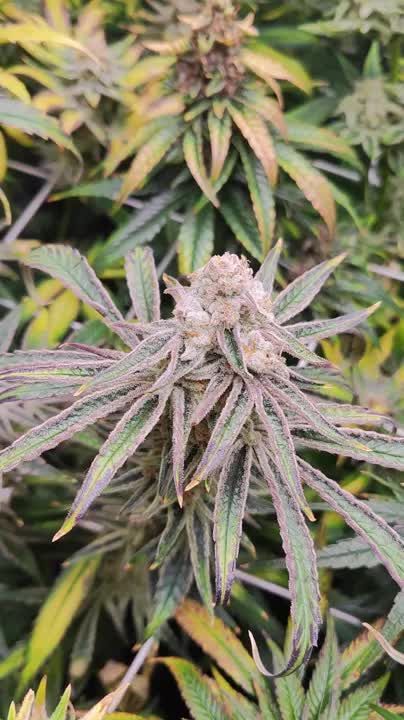
Questa settimana ho notato un abbassamento del pH del terreno ed ho fatto un flush per ristabilire la normalità, da 6700 ppm a 1750. Ora ciuccerà tutti i nutrienti correttamente o almeno spero.
Likes
16
Share

@Mohro49
Follow
I was a little lazy with pictures this week, but next week there will be many pictures for the end, including pictures of the trichomes with my microscope ✌️💚

Likes
87
Share


@Mrs_Larimar
Follow
2021-01-17
Puddin shows a lot of Floweringsites,
today she gets more supercropping and alittle defoiliation, just to give her more airiation
until now she makes moderate stretch around 15 cm new growth in common
every 3rd day she gets water with beneficals and from time to time ( once in the week) she gets a feeding with NPK
On instagram you can see more of this Project and clain nice Prizes in the Giveaways
With this Event, we want to be there for Woman in Need of Help.
And Support those ,who are less Fortunate than us.
We feel like, we are so Blessed for what we have, that we feel Obliged to give a bit back to the Community that we so dearly Love...
During the „GROW OFF FOR CHARITY“, @Weedseedsexpress will Donate 100 Euro per Month to our Charity Goal and an additional 500 euro's by the End of he Contest, if we reach at least 2000 Likes on our weekly Posts
on Instagram.
The other Companies who are Sponsoring our „ GROWOFF FOR CHARITY“
are giving us Products and Merchandise from their Companies. And they help Promote our „ Growoff“
There are coming some AUCTIONS and GIVEAWAYS for Horticultists
The „GROW OFF FOR CHARITY“ is Sponsored by:
( Named in Order of Appearance)
@weedseedsexpress
@urban_chili
@greenbuzzliquids
@Herbiesheadshop_com
@genoneeleven_nutrients
@zamnesiaxseeds
@spilffseeds
@Inseediousseeds
@sgreenlab
@viparspectraled
@cannabonsai_¬manny
·
PLS FOLLOW OUR SPONSORS!
·
LIKE AND SHARE This Posting!
·
To Reach the 2000 Likes per Week!
Likes
27
Share


@adam_pawloski87
Follow
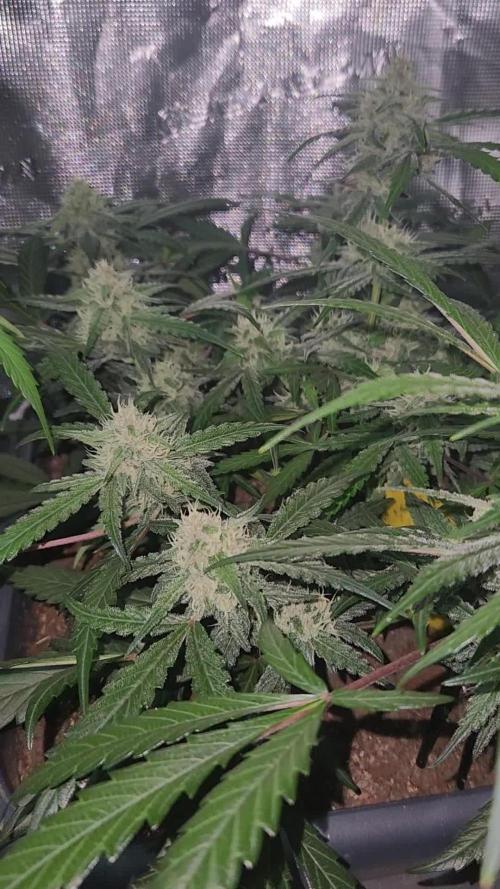
Let’s go day 43!!!! Week went real well , girls started preflower so sometime this week I will be switching up the nutrients for flowering! We are stable and looking super healthy! Can’t wait to see what these ladies do this week! Hope you all enjoy !

Likes
18
Share


@ljack494
Follow
Feeling pretty good about the grow so far if anyone thinks I should something to improve the grow let me know but I think I got under control and will continue with the feeding schedule my gsc is lookin pretty bad tho!
Processing
Likes
14
Share


@CannabisHerald
Follow
My plants are looking great!
The flowers are beginning to show more colour, and the leaves are starting to yellow. Gave them their last feeding the past week. From now on, only distilled water, if possible.
The spider mite issue is relatively under control, although they did invade two flower tops. I destroyed the webs with my garlic spray. Spraying them once a week now with the garlic concoction, and if possible, won't spray them in the last week.
Checked on the trichomes with my pocket microscope. Getting cloudy.
I have relatively warm temperatures in my tent, will look on getting a small portable cooler unit.😎
Likes
18
Share


@KushSlayer
Follow
week 5 of flowering. no problems and ladies are happy.
I put Alfa boost nutrient to laughing buddha and imperium x.
Just this month and they will be rady :)


Likes
22
Share


@ButterfliesLittleFarm
Follow
Hello Diary.
The first week of flowering on my little farm is over, so I started photographing the plants in more detail and I will now start photographing on a black background as well now that they are much more interesting and beautiful. 😍
I changed the light regime in the Box, now the plants have 4 hours of darkness and 20 hours of light.
As you can see in the photos, Fat Banana grew 72cm in the first 30 days which I would say is the average for Automatic on my Farm. Compared to Haze Berry it is slightly lower, but considering the strain, it was also to be expected.
We’ll see how much more it will grow, I hope it stays lower than 100cm. 😏
My plan is to do defoliation in a day or two. Watering has become quite difficult due to the amount of leaves and branches but I think it will come in handy to aerate them anyway.
The flowers develop nicely and there are many of them, Fat Banana is not somehow symmetrical, the branches developed differently, so it looks a little strange, but I really like it because of its naturalness.
I still add BioBizz as scheduled for the current week and add CalMag but only preventively in a smaller dose. Watering is on average every two to three days.
Another Haze Berry who keep her company on the Farm, I put in the middle and put a pot underneath to bring it closer to the light. It is now a real little jungle on the Farm so defoliation is a must.
I am satisfied with how the plants are developing, they have good conditions and I think they are enjoying my "Little Farm". 😎
Let’s take a look at what happened this week.
17/10/2020 - Day 23.
Watering and changing the light. I added BioBizz according to the schedule for the first week of flowering, I replaced Fish-Mix with Bio-Grow. I still add 1.5 ml / lit of CalMag for prevention. p.H. I dropped to 6.6 with Plagron’s Lemon Kick.
After watering I changed the light mode to 20/4.
Temp / Humidity on the farm - 25.2 degrees and 41% humidity.
20/10/2020 - Day 26.
Watering. Same procedure as three days ago. p.H - 6.5
Temp / Humidity on the farm - 26.2 degrees and 43% humidity.
22/10/2020 - Day 28.
Photographing and measuring plant height. Since the beginning of flowering, the motives for photography have doubled , so the number of photos has increased.
Temp / Humidity on the farm - 25.5 degrees and 45% humidity.
Fat Banana Auto - Day 28. - 72 cm
This is it for the first week of flowering, now I still have to do defoliation and then with pleasure follow the development of flowers. See you soon. 🙌