The Grow Awards 2026 🏆
Likes
Comments
Share
@Hortibro
Follow
Week 9 is here day 58 flowering Been feeding with PK, Fade and Cleanse now almost 2 weeks. Some maintenance stuff coming to my apartment next week so im going to chop this baby probably today i maybe have no other choice.
Likes
27
Share
3/25/2023 Week 6- Day 1 of Veg (Day 52 overall) Added my first between changes SILICA Top offs. Was worried that when you add it to pre mixed Nutes that it can make the whole thing turn into a gummy looking substance. I was ready to drain the system and start it over for the week if needed, but no issues adding it to the tank. the Silica going into the Res didn't gummy the system up, it did drop my PH by quit a bit causing me to have to bring it back in balance. 36 Gallons in the Tank Silica Add .5mil/Gal = 18Mil I topped some that needed to be topped, I defoliated some that needs to be defoliated. Since I have moved into Week 6 I have increased the light intensity up to just over 500 maxing it out for Veg Cycle. Next increase will be Week 1 of Flower. 3/26/2023 Week 6- Day 2 of Veg (Day 53 overall) All conditions looked great. Other than me not putting one of the humidifiers back right which means it didn't work last night so Humidity was lower than I like. But got the Humidifier back on it's stand correctly and it is now pumping away. With that I decided to give the plants a day off from any stresses, no topping, no FIMing, no Defoliation for today. Just some good old soaking up the light rays and the ability to get all the Nutes they would like.. 3/27/2023 Week 6- Day 3 of Veg (Day 54 overall) Looking kind of Bushy today, so I defoliated some, and topped some. 3/28/2023 Week 6- Day 4 of Veg (Day 55 overall) PH was a little lower than I like 5.74 so I added a few Mil of PH UP and brought it back up to 5.94. Not much else at this stage, just I topped a little and I defoliated a little. 3/29/2023 Week 6- Day 5 of Veg (Day 56 overall) Topped a little, Defoliated a little Watched them grow!! 3/30/2023 Week 6- Day 6 of Veg (Day 57 Overall) Main action today was breaking down my old tent and setting up a new tent and getting my second RDWC system setup and ready for clones. I Topped a little, I Defoliated some and started taking a good look at what I would like to take for clones in the coming days. I have a few bottom branches that look every promising for my clone material on each. 3/31/2023 Week 6- Day 7 of Veg (Day 58 overall) #3 is at 16" Tall #2 is at 13" Tall
Likes
2
Share
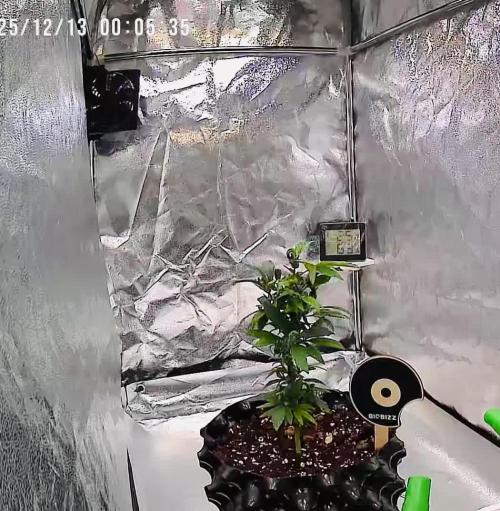
Coming up on week 5 (Veg) she has been rocking well, Light nute feed and added a humidifier temps 84 Humidity 83 - looking to transplant this mother very soon
Likes
4
Share
@Oldwied
Follow
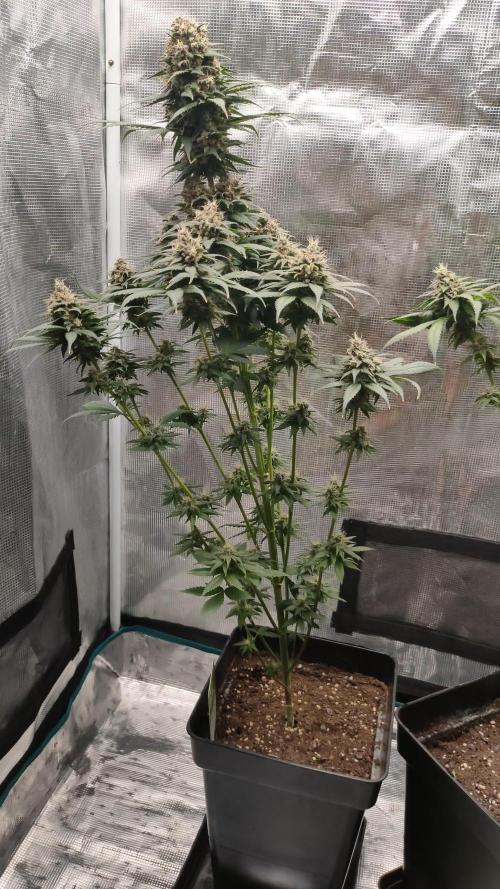
Hello flower time LST goes on. The buds starts to grow. But the lady grows very slowly. The weather is a rollercoaster drive, it starts with 40°C and ends with 18°C days over. I removed the lower weak shoots. Day 35 Photoshooting
Likes
37
Share
@Diquez
Follow
I killed 3-4 bugs around the tent and dont see anything else for the moment. Both of the Gorilla Zkittlez’s looking good and frosty and all of them except the tallest Gorilla Cookies, I think it was meant for bigger spaces :D Anyway assuming last 2 weeks before chop
Likes
52
Share
Its time to prepare for war. *Blows bagpipe* FISH SH!T THE ORGANIC SOIL CONDITIONER (used twice before and always noticed instantly) Fish Shit is a living product! It provides a complex Microbial profile that includes thousands of different species of bacteria, fungi, and protozoa. This profile is closer to a natural ecosystem than anything you will find on the market. Fish Shit helps release essential oils and terpenes which contribute to the building of a myriad of flavonoids. Flavanoids play a key role in the development of the most potent aromas and tasteful flavors of a plant and its fruit. Fish Shit contains beneficial microorganisms that help plants maximize nutrient uptake. It does this by transforming nutrients into more usable forms and keeping these nutrients in the soil longer. During photosynthesis plants naturally produce exudates (chemicals that are secreted through their roots). Through these exudates, plants can attract the types of good bacteria that are beneficial to them at different points in their growing cycle. These good bacteria cover the roots and act as a barrier to the invasion of disease-causing organisms that may harm the plant. What Are Enzymes? Before we dive headfirst into how, exactly, enzymes can benefit cannabis plants, it helps to understand a little about what these microscopic proteins do. Essentially, enzymes facilitate chemical reactions. They do so by binding with a substrate and forming or breaking molecular bonds. In this context, the substrate is the molecule upon which an enzyme acts to boost the efficiency of a reaction. •substrate /sŭb′strāt″/ •noun •The material or substance on which an enzyme acts. A surface on which an organism grows or is attached. An underlying layer; a substratum. Enzymes are proteins with complex 3D shapes that feature regions called active sites. When the substrate binds to these active sites, it forms an enzyme-substrate complex that causes a chemical reaction to take place, temporarily changing the structure of the enzyme and ultimately causing molecules to either come together or break apart. As a result, molecular products are released, and the enzyme returns to its original shape. Specific enzymes are capable of binding with certain substrates, as the substrate fits into the active site more or less via a lock-and-key principle. Although, new research suggests a more accurate theory of "induced fit", in which enzymes and substrates undergo structural changes to facilitate the reaction. If you take the human body as an example, we have an abundance of enzymes in our saliva and digestive system. These molecules bind with substrates in these regions (food particles), working to break down the food we eat into usable parts before converting them to energy. Enzymes in cannabis work in a similar way to the example highlighted above. Typically, enzymes occur in soil naturally, but if your soil mix is lacking organic material, or you're growing hydroponically, then adding enzymes directly to the substrate is crucial. By using them in cannabis growing, enzymes not only help break down essential nutrients into smaller, more readily available pieces, but they also support the digestion of dead root cells, clearing a direct path for nutrients. Overall, enzymes make it easier for your cannabis plants to absorb all the elements they need to reach their full potential. For growers, a plant that reaches its full potential means a bucketload of juicy buds come harvest. This is essential if you want to reuse a pot with old systems left over like mine. Common plant enzymes include: •Cellulase •Xylanase •Beta-glucosidase •Hemicellulase •Amidase Amino acids are a crucial, yet basic unit of protein, and they contain an amino group and a carboxylic group. They play an extensive role in the gene expression process, which includes an adjustment of protein functions that facilitate messenger RNA Nitrogen, phosphorus, and potassium are the three main pillars of nutrient solutions and fertilizers, but there are countless other nutrients that your cannabis plants need to produce the best possible harvest. Amino acids are one of them. You may have noticed that amino acids get a lot of attention from bodybuilders and other athletes. That’s because they play a key role in the synthesis of protein, which, as you probably know, is super important for sports recovery and muscle growth. Amino acids are the building blocks of protein and the foundation of both plant and animal life. But what do amino acids do for cannabis? WHY IS PROTEIN IMPORTANT FOR CANNABIS? Just like proteins are important for the human body, they are equally important for the growth and development of plants. For example, proteins help plants: •Facilitate the growth of intracellular plant structures •Promote energy generation •Stimulate metabolic processes •Facilitate the absorption and transportation of nutrients So, where do plants get these vital proteins from? Well, unlike humans, plants can’t source proteins or amino acids from other organisms. Instead, they need to create their own amino acids, and then use these to build protein. That's why gardeners, much like athletes, go wild for amino acid supplements. Amino acids help plants by… • Increasing their production of chlorophyll, which ultimately improves their ability to photosynthesize • Serving as an easily absorbable form of nitrogen • Stimulating the synthesis of key vitamins • Improving their resistance to pests and diseases • Boosting the strength of their cells Amino acids also serve as the precursors to auxins, a group of plant hormones produced in the meristems—the apex of the stems where new leaves and stems are born. Auxins play a key role in the plant, activating genes for plant growth and development by triggering a multitude of vital plant functions. In other words, they determine what its size and architecture will look like. Auxins influence the development of branches, flowers, and roots, and even help to regulate the photoperiod response of the plant. Some amino acids, like cysteine, also work together with antioxidants like glutathione to help cannabis plants deal with oxidative stress, which can be caused by high-intensity lighting, some nutrient solutions, and high levels of CO₂. Unlike humans, plants can synthesize all the amino acids they need to survive and develop properly. Unfortunately, however, amino acid synthesis is a really high-energy process, and plants may struggle to produce enough amino acids when exposed to stress. WHAT FACTORS AFFECT A PLANT’S ABILITY TO SYNTHESISE AMINO ACIDS? Any kind of stress can affect a plant’s ability to produce enough amino acids. This includes: • Drought • Temperature extremes • Poor soil health • Pests • Diseases • Poor lighting • Lack of space • Poor root health WHAT DOES ALL OF THIS MEAN FOR WEED PLANTS? If you want to push your plants to their extreme in terms of floral growth and resin production, you should look into amino acid fertilizers. By making amino acids readily available to your plants, they’ll be able to use crucial energy to grow and bloom, rather than focusing on synthesizing amino acids themselves. Game of Inches, this is another Plants can absorb amino acids via their roots and leaves. They can also benefit from amino acids during both their vegetative and flowering phases. The fastest way for plants to absorb amino acids is via their leaves. The foliar application of amino acids is believed to improve the transportation of nutrients, increase transpiration, and boost photosynthesis. Hence, I recommend feeding your plants with foliar amino acid fertilizers. When doing so, however, carefully measure the amount of fertilizer you use, as—like with any nutrient—overfeeding can damage your plants. FOLIAR FEED AND SOIL SOAK • 1 crushed queen anne carrot • Add 2 tbsp of NPK Raw powdered water-soluble cane molasses • 20ml h2o2 • 1 crushed radish • 0.25 tsp NPK Enzymes • 0.25 tsp NPK Amino Acids • 50ml coconut water ( nature's own amniotic fluid packed with amino, enzymes ) + The sound of songbirds. Onto the predators 1250 -Green Lacewings Lacewings are extremely voracious predatory insects that feed on several pests. In adulthood, it feeds on pollen and nectar. In the larval stage, it feeds on aphids, thrips, and mealybugs at all stages of growth. It can also attack spider mites in moderate quantities. It is initially an aphid predator, but very effectively controls thrips and mealybugs infestations. It is so voracious that in the absence of prey, it will feed on its congeners. Lacewings are cannibalistic if there is no food available for them. It is therefore important to introduce them into an infestation situation, and not just preventively. •congener /kŏn′jə-nər/ •noun •A member of the same kind, class, or group. •An organism belonging to the same taxonomic genus as another organism. •A thing of the same kind as. or nearly allied to, another; specifically, in botany and zoology, a plant or an animal belonging to the same genus as another or to one nearly allied. Ideal temperature 20°C – 26°C Ideal humidity 60% – 70% Predatory stage life cycle 21 days Introduction rate 4 weeks Storage Refrigerator Use Immediately Are there any specific instructions on how to use this predator? Lacewings are available on small paper cards that you can hang to plant stems. On the cards are dozens of eggs ready to hatch. There are also sterile eggs they can feed on once they have hatched before they are ready to disperse in the foliage. It is important to use them quickly upon receipt to avoid cannibalism. If you don't use them right away, you can store the cards in the refrigerator for 24 to 48 hours to prevent the eggs from hatching too quickly. Avoid storing them for longer than this or you risk losing eggs. 1250 eggs are divided into 7.5 cards, 2500 eggs on 15 cards, and 5000 on 30 cards. The application rate is one card per square meter of growing surface. Is this predator best used for preventive or curative treatments? Lacewings are used as a curative solution. Anything else I should know? Lacewing eggs hatch approximately 24-72 hours after the cards are exposed to room temperature. When they emerge, the lacewings are just 1.5-2 mm long. They are very small so they are difficult to see. Once hatched, they will stay on the cards for a few hours and then disperse in the foliage. You quickly lose sight of them if you have not witnessed the hatching. They then live in the foliage for about 3 weeks. Often, you will see them towards the end of their larval cycle. After feeding for 3 weeks, they will triple and even quadruple in size. At that point, they are easier to see. But they remain very discreet insects, it is not abnormal not to see them. Egg carcasses left behind on the cards do not disappear after the hatching has happened. It's normal to see eggs still on the cards. Visually it is very similar before and after hatching. Also, on the boxes, there are sterile ephestia eggs which are used to feed the lacewings once hatched. Not all lacewing eggs are viable either. Only a certain percentage of lacewing eggs will hatch. Once hatched, the eggs are white. You can observe this using a magnifying glass. With, 5000 Stratiolaelaps Scimitus It is used to prevent or control thrips pupae, fungus gnats larvae, and root mealybugs in the soil. It can also be used for red mites in bird farms or hen houses. The adult is about 1 mm long and is medium brown with a beige triangle on its back. Another fun fact about them is they can survive without prey. They can eat algae and plant debris. This is why they can reproduce and stay in plants for long periods. Ideal temperature 15°C – 23°C Predatory stage life cycle 18 days Introduction rate 2 weeks Storage Room temperature Use Within one week Are there any specific instructions on how to use this predator? Sprinkle directly on the growing media. They can live in all types of substrates like potting soil, coconut fiber, rock wool, cedar mulch, etc. Stratiolaelaps establish easily so they are permanently fighting pests. One introduction is generally enough unless you have an infestation. In this case, introduce them at least twice at a 2-week interval for best results. If you grow your plants in a 100% mineral substrate, it will have to be released more often since there is less organic matter than in traditional soil. Do I need to take any specific precautions? Stratiolaelaps breed in the top layer of the soil. So it is important not to disturb them in the first days following their introduction. They don't like temperatures below 8 ° C. So be sure not to introduce them in a water-saturated or cold environment. Release them 24-48 hours after your last watering. They are very sensitive to chemical acaricides and diatomaceous earth. These methods are incompatible with their use.
Likes
10
Share
@nonick123
Follow
Día 49 (24/06) Riego con 250 ml H2O pH 6,5 Día 50 (25/06) N/A Día 51 (26/06) Riego con 500 ml H20 pH 6,5 Día 52 (27/06) N/A Día 53 (28/06) Las flores empiezan a madurar. Estarán listas en unos 15 días aproximadamente Día 54 (29/06) Riego con 500 ml Té Floración de Lurpe Aplico Top Dress: 22 gramos de Tasty Flowers TD - Lurpe Solutions Día 55 (30/06) N/A 💦Nutrients by Lurpe Solutions - www.lurpenaturalsolutions.com 🌱Substrate PRO-MIX HP BACILLUS + MYCORRHIZAE - www.pthorticulture.com/en/products/pro-mix-hp-biostimulant-plus-mycorrhizae
Likes
Comments
Share
Likes
15
Share
This week went great again. The flowers are chunking up more now, filling with trichomes. The smell is amazing🤤🤤🤤! Afghan kush early harvest is impressive with chunky buds already.Pink kush has the best smell and beautiful Color’s on her leaves. They all smell great. Orange bunz smell like oranges. Lots of trichomes everywhere! These LED lights seem to be doing a great job so far. Gaia green hasn’t disappointed me yet, always heathy happy plants. I defoliated a bunch a little bit over time to make sure I didn’t run into pm or other issues. 🔥💨💚✌️🏼
Likes
7
Share
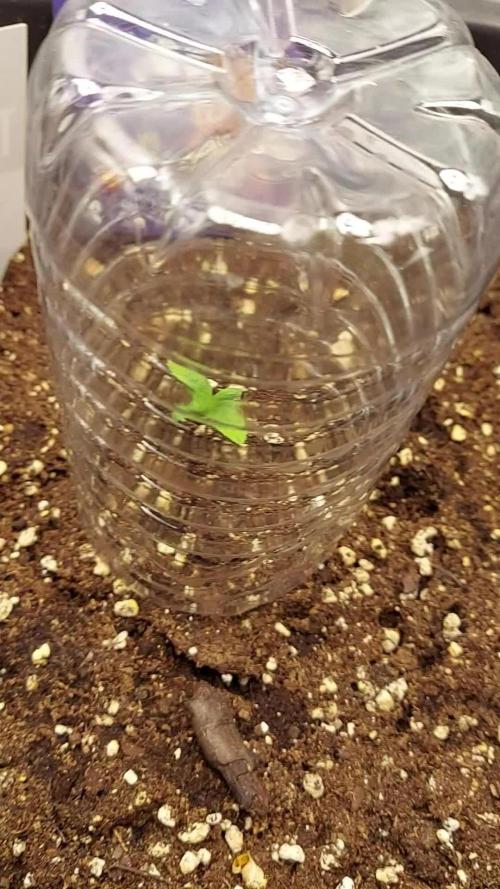
day 1 - today i got them into their pots. i wartered the soil before i put it into the pot so the moisture is equal in every corner. also i mixed in the bio grow while doing that. from now on they both will be on the balcony only. some rainy but sunny days comeing in the next week but they will like the humidity. i also dryed some coffee grinds and put them on top of the soil. works a little bit for unwanted guests i hope. day 5 - the past 2 days was a little rainy but the next seem to be way more rainy so we will be haveing a high humidity, thats nice. i hope i do note have to get them inside. until now it worked like that day 7 - still a little rainy and a little cold for may/june in the past days, so thats why they are a little slow i guess. might also be an auto thing, idk
Likes
11
Share
*Week 5 Flower 09/24* Thus far both both plants are flowering and budding nicely, Trichomes are setting in accordingly, Increase in Phosphate and Potassium nute feeds. Both plants have appeared to stop growing in height settling in at 48Inches. Top COLAS are pretty dense and the aroma coming off both of them is bright and vibrant White Hairs are starting to turn bright orange. *Week 5 Flower Mid week update - 09/28* Both plants have reached max height (48 Inches) Bud sites are filling up and have become more dense with trichomes cover through the flowered bud. 60% orange hair coverage - Nearing harvest *Week 5 Flower End week recap 09/30* Both Apple Fritter and Critical+2.0 nearing harvest Cutting back on nute feeds starting tomorrow and will increase clean water feeds Flushing will begin in a week - both will be harvested in 2 weeks.
Likes
9
Share
@Kushizlez
Follow
Harvest: Everything dried up to 347 grams + 96 grams of super high quality trim. Overall I am not too pleased with the smoke of the product. Although the bud size, bag appeal, smell and taste are pretty much all there, the shitty burn is a deal breaker for me and the majority of this weed is quite frankly useless. Another downside is while smoking I’ve found 4 seeds in an ounce from almost every strain. Light leaks? At least I learned a ton, including how to get super good burn for my next crop. I’m hoping that curing for a month or so will improve the burn but I wouldn’t really count on it. I have seen weed dried for 4 days with no cure and no flush smoke clean and not go out once. I have been told that the key to white ashes/clean burn is proper mineral content in the soil and there is tons of scientific studies on cigar ash going back 100 years. Plants grown in a medium with high levels of decomposing organic matter, phosphorus, magnesium, chlorine and heavy metal ratio tend to produce black/grey ash. Whereas plants grown in a medium with a higher ratio of trace minerals like calcium carbonate and potassium in the form of wood ash, rock dusts, oyster shell flour and lower levels of decomposing organic matter will produce a dense, uniform white ash that rarely goes out. But this is still all theory until I test it to confirm for myself a few times. My last few outdoor harvests did not improve with curing at all so I’m hoping this will be the missing link. Plain peat moss and coco clearly lack essential minerals that help burn. If said theory is correct I should find a synthetic nutrient line with more trace minerals. Makes me wonder if growing if rockwool/basalt rock could improve burn in a hydro setup. I think I did a fairly decent job for my first grow. I went wrong in a million different places but I still stuck it out and got some decent herb. Things went wrong early when I got black spot mold, nitrogen/magnesium deficiencies and powdery mildew. I corrected most of it but things didn’t get really bad until mid veg when I intentionally skipped a few feedings and defoliated quite heavily stunting the plants. I also didn’t even top or start LST until the 6-9th node which was really stupid and hurt my yield. My temperatures were all over the place from the learning curve. I was severely overwatering without realizing it. 100% peat moss is a shitty medium. I also fed way too late in flower (not what caused shitty burn). I also used synthetic nutrients in soil. Zkittlez bonsai Yield: 1.9g Smell: 7/10 - sweet, candy, berry, gassy, piney hints Bag appeal: 7/10 - slightly leafy/stemy Crystal coverage: 7.5/10 - very impressed Ash: 6/10 - flaky, mostly white/grey Fire holding: 4/10 - stays lit for 10-30 seconds Smoke: 6/10 - taste is decent, needs curing High: 6/10 - indica dom Comment: looks nice, smells nice, tastes nice, burns like shit. 43.5/70 = 62% 👎🗑️ Black Garlic #1 Yield: 53.6 Smell: 8/10 - gassy, piney, earthy, skunky Bag appeal: 7/10 - slightly leafy/stemy Crystal coverage: 7.5/10 - very impressed Ash: 8/10 - thick, uniform white ash Fire holding: 7.510 - stays lit for 45+ sec Smoke: 7.5/10 - taste is good until the end High: 7/10 - sativa dom Comment: looks nice, smells nice, tastes nice, burns great but quite leafy. 52.5/70 = 75% 👍🔥 Black Garlic #2 Yield: 42.3 Smell: 7/10 - woody, earthy, tea Bag appeal: 6.5/10 - slightly leafy/stemy Crystal coverage: 7/10 - impressed Ash: 6/10 - flaky, mostly white/grey Fire holding: 4/10 - stays lit for 10-30 seconds Smoke: 6/10 - taste is decent, needs curing High: 8/10 - sativa dom Comment: looks nice, smells nice, tastes nice, burns like shit. 44.5/70 = 63% 👎🗑️ Zkittlez Yield: 39.4 Smell: 7/10 - sweet, candy, berry, gassy, piney hints Bag appeal: 6.5/10 - slightly leafy/stemy Crystal coverage: 7.5/10 - very impressed Ash: 8/10 - thick, uniform white ashes Fire holding: 8/10 - stays lit for seconds Smoke: 7.5/10 - taste is decent, needs curing High: 7/10 - indica dom Comment: looks nice, smells nice, tastes nice, burns great but smalls didn’t fill out. 51.5/70 = 73% 👍🔥 Blackberry Breath #1 Yield: 57.5 Smell: 9/10 - sweet, grape, berry, gassy, earthy, hashy Bag appeal: 8.5/10 - dense, sparkly buds Crystal coverage: 9/10 - super impressed Ash: 5/10 - flaky, mostly grey/blackish Fire holding: 4/10 - stays lit for 10-30 seconds Smoke: 5/10 - tastes like chalky shit High: 6/10 - indica dom Comment: looks amazing, smells amazing, tastes like shit, burns like shit. 46.5/70 = 66% 👎🗑️ Blackberry Breath #2 Yield: 76.1g Smell: 6/10 - musky, tea, berry, herbal Bag appeal: 8/10 - slightly leafy/stemy Crystal coverage: 7.5/10 - very impressed Ash: 5/10 - flaky, mostly grey/black Fire holding: 4/10 - stays lit for 10-30 seconds Smoke: 5/10 - taste is shit High: 6/10 - indica dom Comment: looks nice, smells shitty, tastes shitty, burns like shit. 41.5/70 = 59% 👎🗑️ Slurricane #4 Yield: 34.5g Smell: 8.5/10 - gassy, deep piney, fuel, earthy, Bag appeal: 8.510 - slightly leafy/stemy Crystal coverage: 7.510 - impressed Ash: 6/10 - flaky, mostly white/grey Fire holding: 4/10 - stays lit for 10-30 seconds Smoke: 6/10 - taste is decent High: 6/10 - indica dom Comment: looks amazing, smells amazing, tastes nice, burns like shit. 46.5/70 = 66% 👎🗑️ Badazz OG Cheese Yield: 43.5g Smell: 6.5/10 - musty, woody, cheesy, piney hints Bag appeal: 6/10 - slightly leafy/stemy Crystal coverage: 6/10 - very impressed Ash: 5/10 - flaky, mostly white/grey Fire holding: 4/10 - stays lit for 10-30 seconds Smoke: 6/10 - taste is decent High: 6/10 - sativa dom Comment: looks like shit, smells decent, tastes decent, burns like shit. 39.5/70 = 56% 👎🗑️
Likes
1
Share
So far flowering has been going extremely well. The plant in the back that had deficiency 2 week ago is now bigger then the one in the front. And The one in the front (the one i topped)is growing nice and even across with alot of bud site.
Likes
13
Share
@40Plug
Follow
Whats up everbody, the plants turned into flower and looking great so far. The scOG is doing its work. Love it. SOG needs so much effort, more than just 2 or 3 Plants. Thats insane. I hope its worth it.
Likes
2
Share
@PapaTerps
Follow
Blue Zushi - Dutch Passion Day 96 - Watered with 3 litres of RO tap water, with defined nutrients, pH'd to 6.3. She required extensive defoliation this week, to allow more light to reach the lower bud sites. She is bulking really well and is probably just about finished, so I'm expecting her to begin the maturity process now 👍🏻
Likes
125
Share
🍊 🍋 🍮 🍭 🍊 🍋 🍮 🍭 🍊 🍋 🍮 🍭 🍊 🍋 🍮 🍭 Welcome to week 6, dear friends!! 😘 She's perfect!! 😍😍😍 DAY 36 Watered with 1ml A+B und 0,5ml C4 💧 DAY 38 Watered with 1,5ml A+B und 0,5ml C4 💧 DAY 40 Watered with 1,5ml A+B und 0,5ml C4 💧 DAY 42 Watered with BioEnhancer 0.5g/L 💧 Thanks, everybody!! 💚 💚 💚 Grower love!!! 😘🙏 🌱 _________________________________________________________________________________ SETUP: ° Zelsius 60x60 cm (2x2ft) ° Light Greenception GC4 128W 4 Cluster OSRAM + CREE LEDs (380, 455, 630, 660, 720, 760nm) 6400k (cold-white to cover the basic load during the growth) 2100k (warm-white to cover the basic load during the blossom) The module groups can be switched individual as follows: ⬤ Module I: growth 1x 32 watt ⬤ Module II: full spectrum: 2x32 watt ⬤ Module III: Bloom: 1x 32 watt ⬤ Module I is optimized for the growth phase. A relatively high amount of blue and white support a dense growth. ⬤ Module II suits for the growth as well as blooming phase. Optimal plant light full spectrum. ⬤ Module III is optimized for the bloom. A high portion of red and an additional infrared push. ° 2x 5W Fans ° custom 320/270 cm³/h exhaust fan & Carbon Active Granulate 240cm³/h ° Mills Nutrients, Green Buzz Nutrients Shouts go out to my sponsors @GreenBuzzNutrients, thanks so much for your support! ❤️ If anyone would like to try their amazing organic products, use code GD42025 for generous 25% discount (for orders of minimum 75€) ✨ https://greenbuzznutrients.com/ ° tap water EC 0,26uS upgraded to EC 0,5 with PlantMagic MagneCal - pH 8, nutrient solution downgraded to pH 6,5 with Advanced Hydroponics Minus Bloom ° from week 4 in the same container Aptus Enzym+ once a week ° Biobizz Lightmix 🍊 🍋 🍮 🍭 🍊 🍋 🍮 🍭 🍊 🍋 🍮 🍭 🍊 🍋 🍮 🍭
Likes
13
Share
Hola a todos, al fin comenzó el periodo de engorda, ya van 3 días en las que la planta dejo de espigar, esta semana aumenté la dosis de PK a 0.7 ml/l, ajuste un par de ramas para dejarlas bajo el foco, los cogollos ya están repletos de tricomas (adjunto fotos), la próxima semana ya estaremos viendo cogollos mejor formados, ya debo comenzar a pensar en mantener la humedad a raya, he notado puntos de estrés en zonas de más luz, la planta esta consumiendo más agua así que aumente la cantidad de riegos diarios (170ml cada 3 horas). Hasta la próxima!