Likes
Comments
Share
A lot of removing leaves and checking for humidity Trouble or bug infestations, but Up Till now she hast been perfekt. Hope to get Up to 300-400g Out of our combined efforts. Can definitly recommend this strain for Outdoor growing in middle to northern Europe
Likes
4
Share
@Jabbamo
Follow
_______________________________________________________ Mo. 9.3. - 3 Liter pro Pflanze gegossen (ca. 200ml Drain) 1,2 ml / Liter "Calmag" 1,0 ml / Liter "Bio Grow" 3,0 ml / Liter "Bio Bloom" 1,0 ml / Liter "Top Max" Ph 6,3 / 600 qqm _______________________________________________________ Di. 10.3. - Luftentfeuchter AN ( 55% / Auto / low ) _______________________________________________________
Likes
19
Share
@creichs
Follow
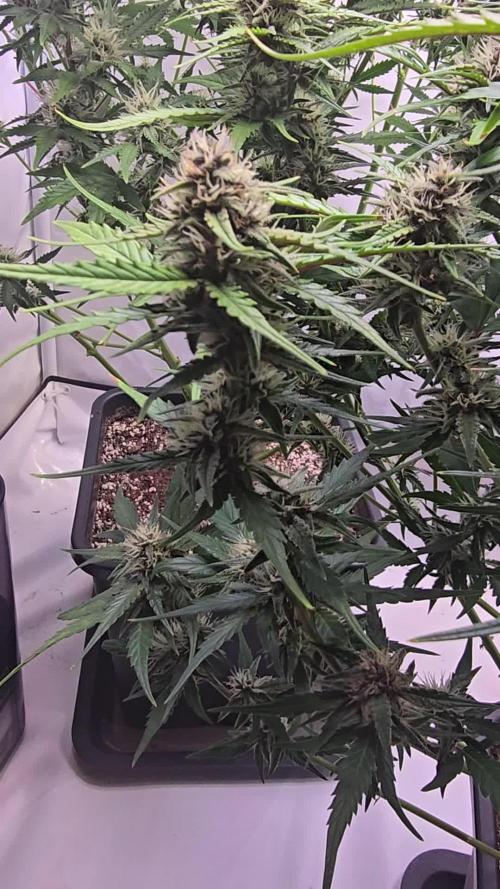
buds are coming along nicely excited to see all the colas starting plants been doing nice haven't been having any issues got rid of the older fan leaves at the end of the week
Likes
9
Share
@Headies
Follow
So I had a few issue. I over watered early on, took them out the seed tray early, started feeding them a week or two late, no humidifier yet but they recovered well.
Likes
14
Share
@Kakui
Follow
15 Noviembre: -Hoy se instaló el sistema de riego "Drip to Waste" que me permitirá hacer riego de precisión, con protocolo "Crop Steering". -Se instalaron sensores de humedad de suelo, para saber cuándo y cuánto regar, el sistema manda datos de humedad de suelo, temperatura y humedad ambiente, etc vía internet a mi celular. -Mañana se comienza con el primer riego de precisión. 17 Noviembre: Segundo día de riego automático, 3.0EC y 5.9pH, las plantas crecen a buen ritmo, las raíces ya están saliendo por los orificios de drenaje a 2 días de transplantadas. 20 Noviembre: Se realizó una pequeña defoliacion de las hojas tipo abanico muy grandes.
Likes
12
Share
The babies 😍 have a beautiful look and colors, they seem quite filled with resin. Now the drying phase of 15 days begins after which I will complete the trimming and weigh it. By eye I can say that it will be about 100gr per plant
Likes
74
Share
@Mr_Maes
Follow
Nothing but colas on all 3 this is going to be a big harvest. Another 2 or 3 weeks max.
Likes
33
Share
@Rollex420
Follow
22-05-21 (Day 8) Today begins a new week for the Kosher Cake. I must say that it has a very rapid growth.. Maybe it will be that I am not used to growing autoflowers and therefore for me it is as if it were a new thing, being used to growing only photoperiodic plants.. 🤷‍♂️🏻😇 I am very curious to see what she will have to give .. As always, see you at the next update! 😎 Happy growing to all you guys ☮️💚 23-05-21 (Day 9) Today, bio-grow (0.7ml/2L) has been added to start giving sugars and vitamins to the plant essential for the initial phase of vegetative growth. Much love fam! ☮️💚 24-05-21 Day 10 She’s starting to grow some new shoots on her main stem, Now it is starting to take shape. 👏🏻☺️ Stay blessed fam, much love! ☮️💚 30-05-21 Day 16 The girl is growing at her best, I'm sorry to have to move her outside in the future..😕 She seems to really like her environment where she is living now. I started with a slight LST in order to let the light penetrate also in the lower branches.. Thanks to all of you for your support! ☮️💚
Likes
15
Share
Green Goblin had a bit of a rough start – unfortunately, one of the main stems snapped. 😕 Because of that, she’s grown a little wild and uneven. But overall, she’s doing well! 🌱 Her growth is slightly slower than the others, but she’s definitely holding her own. 🇺🇲 WEEK 7 -------------------------- 🔧 This week included: Lots of LST training Defoliation to improve light penetration Only watered with plain water, no pH adjustment strictly following the BioTabs schedule 💨 The smell is starting to develop nicely very promising! 💡 I’m planning to switch to 12/12 next week and send her into flowering as well. Curious to see how she performs in the next phase! 🌸🕛 🇩🇪 Woche 7 ------------------------- Die Green Goblin hatte es nicht ganz so leicht einer der Hauptriebe ist leider abgebrochen. 😕 Dadurch ist die Pflanze etwas ungleich und wild gewachsen. Trotzdem macht sie sich gut! 🌱 Das Wachstum ist minimal langsamer als bei den anderen, aber im Gesamtbild steht sie ihnen in nichts nach. 🔧 Diese Woche wurde einiges gemacht: Viel LST-Training Entlaubung zur besseren Lichtverteilung Nur mit Wasser gegossen – ganz ohne Anpassung, streng nach dem BioTabs-Schema 💨 Der Geruch entwickelt sich ebenfalls sehr gut vielversprechend! 💡 Auch bei ihr werde ich voraussichtlich nächste Woche auf 12/12 umstellen und damit die Blüte einleiten. Bin gespannt, wie sie sich in der nächsten Phase schlägt! 🌸🕛
Likes
18
Share
Green light is radiation with wavelengths between 520 and 560 nm and it affects photosynthesis, plant height, and flowering. Plants reflect green light and this is why they appear green to our eyes. As a result, some growers think that plants don’t use green wavelengths, but they actually do! In fact, only around 5 – 10% of green light is reflected from leaves and the rest (90 – 95 %) is absorbed or transmitted to lower leaves [1]. Green wavelengths get used in photosynthesis. Chlorophyll pigments absorb small amounts of green wavelengths. Light that doesn’t get absorbed is transmitted to leaves that are shaded out from direct light. This means that leaves at the bottom of the canopy get more green light than leaves at the top. A high proportion of green wavelengths compared to other colors tells lower leaves that they are being shaded out, so they are able to react accordingly. Lower leaves may react by opening or closing their stomata or growing longer stems that help the leaves reach brighter light [1, 2, 3]. When it comes to growing cannabis, many cultivators are interested in the quality of light used for the flowering stage. In many plants, flowering is regulated by two main photoreceptors: cryptochrome and phytochrome. Both photoreceptors primarily respond to blue light but can also respond to green, although to a lesser extent. Green can accelerate the start of flowering in several species (although cannabis has yet to be tested) [1, 4, 5]. However, once flowering has begun, it’s important to provide plants with a “full spectrum” light that has high amounts of blue and red light, and moderate amounts of green, in order for photosynthesis to be optimized. Green light mediates seed germination in some species. Seeds use green wavelengths to decide whether the environment is good for germination. Shade environments are enriched in green relative to red and blue light, so a plant can tell if it is shady or sunny. A seed that senses a shaded environment may stay dormant to avoid poor growing conditions [1]. Some examples of plant species where researchers have documented this response are: ryegrass (a grass that grows in tufts) and Chondrilla (a plant related to dandelion) [1, 6]. Although green wavelengths generally tell plants NOT to germinate, there are some exceptions! Surprisingly, green wavelengths can stimulate seed germination in some species like Aeschynomene, Tephrosia, Solidago, Cyrtopodium, and Atriplex [1, 6, 7]. Of course, light is not the only factor affecting seed germination – it’s a combination of many factors, such as soil moisture, soil type, temperature, photoperiod, and light quality. When combined with red and blue light, green can really enhance plant growth [1, 8]. However, too much green light (more than 50% of the total light) can actually reduce plant growth [8]. Based on the most current research, the ideal ratio of green, red, and blue light is thought to be around 1:2:1 for green:blue:red [9]. When choosing a horticultural light, choose one that has high amounts of blue and red light and moderate amounts of green and other colors of light. Not many studies can be found about the effect of green light on cannabis growth or metabolism. However, if one reads carefully, there are clues and data available even from the very early papers. Mahlberg and Hemphill (1983) used colored filters in their study to alter the sunlight spectrum and study green light among others. They concluded that the green filter, which makes the environment green by cutting other wavelengths out, reduced the THC concentration significantly compared to the daylight control treatment. It has been demonstrated that green color can reduce secondary metabolite activity with other species as well. For example, the addition of green to a light spectrum decreases anthocyanin concentration in lettuce (Zhang and Folta 2012). If green light only reverses the biosynthesis of some secondary metabolites, then why put green light into a growth spectrum at all? Well, there are a couple of good reasons. One is that green penetrates leaf layers effectively. Conversely red and blue light is almost completely absorbed by the first leaf layer. Green travels through the first, second, and even third layers effectively (Figure 2). Lower leaf layers can utilize green light in photosynthesis and therefore produce yields as well. Even though a green light-specific photoreceptor has not yet been found, it is known that green light has effects independent from the cryptochrome but then again, also cryptochrome-dependent ones, just like blue light. It is known that green light in low light intensity conditions can enhance far red stimulating secondary metabolite production in microgreens and then again, counteracts the production of these compounds in high-intensity light conditions (Kim et al. 2004). In many cases, green light promoted physiological changes in plants that are opposite to the actions of blue light. In the study by Kim et al. blue light-induced anthocyanin accumulation was inhibited by green light. In another study it has been found that blue light promotes stomatal opening whereas green light promotes stomatal closure (Frechilla et al. 2000). Blue light inhibits the early stem elongation in the seedling stage whereas green light promotes it (Folta 2004). Also, blue light results in flowering induction, and green light inhibits it (Banerjee et al., 2007). As you can see, green light works very closely with blue light, and therefore not only the amount of these two wavelengths separately is important but also the ratio (Blue: Green) between these two in the designed spectrum. Furthermore, green light has been found to affect the elongation of petioles and upward leaf reorientation with the model plant Arabidopsis thaliana both of which are a sign of shade avoidance symptoms (Zhang et al. 2011) and also gene expression in the same plant (Dhingra et al. 2006). As mentioned before, green light produces shade avoidance symptoms which are quite intuitive if you consider the natural conditions where the plants grow. Not all the green light is reflected from the highest canopy leaves in nature but a lot of it (50-90%) has been estimated to penetrate the upper leaves at the plant level ((Terashima et al., 2009; Nishio, 2000). For the plant growing in the understory of the forest green light is a signal for the plant of being in the shade of a bigger plant. Then again, the plants growing under unobstructed sunlight can take advantage of the green photons that can more easily penetrate the upper leaves than the red and blue photons. From the photosynthetic pigments in higher plants, chlorophyll is crucial for plant growth. Dissolved chlorophyll and absorb maximally in the red (λ600–700 nm) and blue (λ400–500 nm) regions of the spectrum and not as easily in the green (λ500–600 nm) regions. Up to 80% of all green light is thought to be transmitted through the chloroplast (Terashima et al., 2009) and this allows more green photons to pass deeper into the leaf mesophyll layer than red and blue photons. When the green light is scattered in the vertical leaf profile its journey is lengthened and therefore photons have a higher chance of hitting and being absorbed by chloroplasts on their passage through the leaf to the lower leaves of the plant. Photons of PPFD (photosynthetic photon flux density) are captured by chlorophyll causing an excitation of an electron to enter a higher energy state in which the energy is immediately passed on to the neighboring chlorophyll molecule by resonance transfer or released to the electron transport chain (PSII and PSI). Despite the low extinction coefficient of chlorophyll in the green 500–600 nm region it needs to be noted that the absorbance can be significant if the pigment (chlorophyll) concentration in the leaf is high enough. The research available clearly shows that plants use green wavelengths to promote higher biomass and yield (photosynthetic activity), and that it is a crucial signal for long-term developmental and short-term dynamic acclimation (Blue:Green ratio) to the environment. It should not be dismissed but studied more because it brings more opportunities to control plant gene expression and physiology in plant production. REFERENCES Banerjee R., Schleicher E., Meier S. Viana R. M., Pokorny R., Ahmad M., Bittl R., Batschauer. 2007. The signaling state of Arabidopsis cryptochrome 2 contains flavin semiquinone. The Journal of Biological Chemistry 282, 14916–14922. Dhingra, A., Bies, D. H., Lehner, K. R., and Folta, K. M. 2006. Green light adjusts the plastic transcriptome during early photomorphogenic development. Plant Physiol. 142, 1256-1266. Folta, K. M. 2004. Green light stimulates early stem elongation, antagonizing light-mediated growth inhibition. Plant Physiol. 135, 1407-1416. Frechilla, S., Talbott, L. D., Bogomolmi, R. A., and Zeiger, E. 2000. Reversal of blue light -stimulated stomatal opening by green light. Plant Cell Physiol. 41, 171-176. Kim, H.H., Goins, G. D., Wheeler, R. M., and Sager, J. C. 2004.Green-light supplementation for enhanced lettuce growth under red- and blue-light emitting diodes. HortScience 39, 1617-1622. Nishio, J.N. 2000. Why are higher plants green? Evolution of the higher plant photosynthetic pigment complement. Plant Cell and Environment 23, 539–548. Terashima I., Fujita T., Inoue T., Chow W.S., Oguchi R. 2009. Green light drives leaf photosynthesis more efficiently than red light in strong white light: revisiting the enigmatic question of why leaves are green. Plant & Cell Physiology 50, 684–697. Zhang, T., Maruhnich, S. A., and Folta, K. M. 2011. Green light induces shade avoidance symptoms. Plant Physiol. 157, 1528-156. Wang, Y. & Folta, K. M. Contributions of green light to plant growth and development. Am. J. Bot. 100, 70–78 (2013). Zhang, T. & Folta, K. M. Green light signaling and adaptive response. Plant Signal. Behav. 7, 75–78 (2012). Johkan, M. et al. Blue light-emitting diode light irradiation of seedlings improves seedling quality and growth after transplanting in red leaf lettuce. HortScience 45, 1809–1814 (2010). Kasajima, S., et al. Effect of Light Quality on Developmental Rate of Wheat under Continuous Light at a Constant Temperature. Plant Prod. Sci. 10, 286–291 (2007). Banerjee, R. et al. The signaling state of Arabidopsis cryptochrome 2 contains flavin semiquinone. J. Biol. Chem. 282, 14916–14922 (2007). Goggin, D. E. & Steadman, K. J. Blue and green are frequently seen: responses of seeds to short- and mid-wavelength light. Seed Sci. Res. 22, 27–35 (2012). Mandák, B. & Pyšek, P. The effects of light quality, nitrate concentration and presence of bracteoles on germination of different fruit types in the heterocarpous Atriplex sagittata. J. Ecol. 89, 149–158 (2001). Darko, E. et al. Photosynthesis under artificial light: the shift in primary and secondary metabolism. Philos. Trans. R. Soc. B Biol. Sci. 369 (2014). Lu, N. et al. Effects of Supplemental Lighting with Light-Emitting Diodes (LEDs) on Tomato Yield and Quality of Single-Truss Tomato Plants Grown at High Planting Density. Environ. Control Biol. 50, 63–74 (2012).
Likes
10
Share
Likes
15
Share
SHE IS BEAUTIFULL... BIG Seedbank gave us a real pearl... She is very strong very resistant to changing conditions... Smells amazing... Nice Sativa Domninance... I am very proud of her... hope it goes good untill the end... fingers crossed...
Likes
97
Share
@AsNoriu
Follow
Day 106. Trim jaiiiiiilllllllll !!!! First done, think it could reach my record 240. Insane quality. 4 rows of solid buds hanging .... Next one .... Both finally finished and honestly, that's my plants to be proud of !!! Day 114. All is done, no doubts its my best grow. Happy Growing !!!
Likes
13
Share
@BigDaddyK
Follow
Watered today ( Monday ) 5L of solution then 3 L of plain water to lower the runoff down from 2.8 to 2.3 (EC) , had a defoliate to open out the branches a bit , smells very naughty... Thursday - Watered 5 litres of 2 ml per litre Terra bloom caught runoff at 1.8 EC
Likes
18
Share
@Wilmer
Follow
Being not expert with autos I can't complain about 190g in 3 months. I'm smoking and trying a bit , it's still a bit fresh so the taste is still developing and I will update this comment when weed it's cured. The high for the moment is light but nice, it's take your mind and not your body, very relaxing and smooth 👽👽
Likes
6
Share
Sehr heftiger Stretch durch den zu hohen Lampenabstand. Mal schauen wie es sich entwickelt.
Likes
20
Share
Day 42 The plants are showing steady growth and good health. The structure is filling out nicely, with strong branches and vibrant green leaves. Stretching has started, indicating the transition into the early flowering stage. The canopy is even and well-balanced, and new shoots are developing quickly. I’ll continue monitoring light height and nutrient levels to support smooth growth as flowering progresses. So far, everything looks on track for a healthy bloom phase ahead.
Likes
2
Share
Doy comienzo al SoG de OG 24K de Bsf 🌱🧐 Hace frío en Santiago de 🇨🇱 pero en cuarentena nada mejor que plantar. Estas son 12 og 24k en macetas de 3lt de momento aunque serán las 12 macetas de 11 o 7 lt. Esperando que hagan una buena raíz, las tendremos 4 semanas en 3lt y luego transplante. Quedo atento a comentarios y sugerencias, es primera vez que tiro 12 en un metro. 🤠😲🤭
Likes
30
Share
@Hashy
Follow
******************************************** Week 9 flowering (flower week 3) ******************************************** Light cycle=12/12 Light Power=180w 75% Extractor controller settings High temp= Day 26c, Night 20c Low temp= c Temp step=0c High Rh= Day 50%, Night 55% Low Rh= % Rh step=0% Speed max=10 Speed min=2 Smart controller settings (during lights on). Lights on=9.00am Top fan on=+22.5c Top fan off=-22.0c Dehumidifier on=+50% and -26c Dehumidifier off=-50% or +26c Smart controller settings (during lights off). Lights off=9.00pm Dehumidifier on=+55% and -20c Dehumidifier off=-55% or +20c VPD aim=0.6-1.6 DLI aim=30-45 EC aim=0.2-2.0 PH aim=6.0-6.5 NPK(14.3/7.2/25) 💧💧💧💧💧💧💧💧💧💧💧💧💧💧💧💧 Method= Autofeed 6 drippers. Feed=Flower Nutes. Neutralise=0.1ml/L Bloom=4.0ml/L Roots=0.2ml/L Silicon=1.0ml/L Calmag=0.5ml/L Boost=2.0ml/L Volume=12L Easy Ph down= 0.125ml/L Ec=1.75 PH=6.4/6.4 Runs=17 Run times=4min (276ml each) Gap times=16min Total runtime=68mins (5.0L each) Total flowrate= 138ml/min (69ml/min each) Auto start time=10.00am Auto stop time=3.24pm 💧💧💧💧💧💧💧💧💧💧💧💧💧💧💧💧 ******************************************** ******************************************** 📅14/7/24 Sunday (day 57, day 15 flower) 📋H=89cm D=20cm Dli=69.8 Ppfd=1616 12/12 Raised light. Lowered power to 180w H=89cm D=26cm Dli=44.5 Ppfd=1029 12/12 📅15/7/24 Monday (day 58, day 16 flower) 📋 it's getting warm again. 📅16/7/24 Tuesday (day 59, day 17 flower) 📋 Small defoliation lower growth. 💧 Method= automatic Feed=Nutes flower Volume=12L Ec=1.75 PH=6.4/6.4 Volume left=3.5L Volume used=8.5L (125ml/min) Volume each=4.25L (62.5ml/min) Runoff. Total runoff=0.2L Ec=2.6 PH=/6.4 Feed=manually @4.50pm Run time=4 mins Feed=manually @6.00pm Run time=4 mins Feed manually @7.00pm Run time=4mins. Volume left=1.5L Volume used=10.5L (142ml/min) Volume each=5.25L (71ml/min) Runoff. Extra runoff=0.35L Ec=3.0 PH=/6.5 💧 📅17/7/24 Wednesday (day 60, day 18 flower) 📋 H=98cm D=17cm Dli=70.8 Ppfd=1638 12/12 HST 📅18/7/24 Thursday (day 61, day 19 flower) 📋HST snapped a cola. Defoliation. 📅19/7/24 Friday (day 62, day 20 flower) 📋H=98cm D=22cm Dli=62.5 Ppfd=1446 12/12 Reduced power to 155w H=98cm D=22cm Dli=50.4 Ppfd=1168 12/12 Went away 💧 Method= automatic Feed=Nutes flower (next weeks feed) Volume=12L Ec=2.1 PH=6.7/6.8 Volume left=3L Volume used=9L (125ml/min) Volume each=4.5L (62.5ml/min) Runoff. Total runoff=0L Ec= PH=/ Feed=manually @4.30pm 1.5L Runoff. Extra runoff=2L Ec=4.3 PH=/5.9 💧 📅20/7/24 Saturday (day 63, day 21 flower) 📋 away ******************************************** Weekly roundup. 📋 she stretched a further 15cm this week and I had to apply Hst because of the limited height in the tent, the light is about 1cm away from the roof of the tent. Had a few accidents with the Hst. She's looking good. I was a bit rushed going away as its last minute so 🤞 my automated stuff works. Take it easy. Back soon. ********************************************