The Grow Awards 2026 🏆 








Likes
Comments
Share


Likes
5
Share
@Wenz004
Follow
experiment explanation see week1
So this week again my plagron/aptus plant rocks the tent
Both toropinanas in different living soils dont have enough power grow and especially the stretch (phosporus)...they just dont have enough food in soil and compost tea (once a week) only water and compost tea as well as the special ingredients in soil...are just not enough for great results...maybe with special top dresses like build a soil is selling expensively...i thing living soil is money making machine...some tell just the living soil and water...thats definitely a fairy tale...
the smell is a bit better...but I dont expect really better smoke...as this is my experience from my last experiment
lets go forward to the next week


Likes
55
Share
@Natrona
Follow
Blue Cheese F1 automatic
Week 6 2/9-15
The Cheese gals are in full flower, the buds are puffing out and stacking. I even see some lower buds connecting to the upper buds and some pistils are turning brown. There is some smell when I open the tent. The F1 genetics are reflected in that these 2 plants are almost identical.
I don’t see much difference in their growth so far using the different mediums. Soil and soil/coco blend. Maybe harvest will show a difference in yield from each one. Time will tell.
On 2/13 I did major defoliation on my Cheese gals.
I removed all large fan leaves and any leaves shading bud sites. Initially, I thought this would be my last defoliation, however I have heard that 1) they continue to grow new leaves until day 20 of flower and 2) there must be enough foliage on the plant to photosynthesize energy. Well, I hope I left enough leaves for energy to keep bulking up the buds. Stretching has slowed down. Both girls grew only an inch and now 17 inches. This is only the end of flower week 2.
Controller is set to flower. I add 2 gallons of water to the T700 humidifier daily to keep the VPD in line.
2/9 & 11 4 gal fed 2 liter each nutrients added at ½ of recommended amount. Making 4 gallons since I have 2 pots of carrots and a Dill in the back.
Bloom Juice 45ml
Plant Juice 75 ml
Royal Rush 15 ml
Power bud 15ml
Green sensation 7.5ml
Recharge 2.5ml/gal
4 ml
Cal Mag
5
Ppm 333
Ph 7.02
Temp 66
2/13 5 gal
Bloom Juice 60ml
Plant Juice 60 ml
Royal Rush 20 ml
Power bud 20ml
Green sensation 10ml
Recharge 2.5ml/gal
4 ml
Cal Mag
25
Ppm 538
Ph 6.6
Temp 66
Your likes and comments are appreciated. Thanks for stopping by.
Growers love 💚🌿
💫Natrona💫

Likes
19
Share
@BB_US
Follow
Ladies are really showing their flowers this week and damn they look sexy af. Already starting to get their frost on too. 💚🌿

Likes
20
Share
@DreamIT
Follow
Sponsored by:
🎆ANESIA SEEDS🎆-💡VIPARSPECTRA💡-💐GREEN BUZZ LIQUIDS💐-🛠️WEDRYER🛠️
29/9 it was a tough month for me but I'm back in charge. We are almost at the end of the cycle and the flowers begin to be large and the pistils begin to color.
__________________________________________
Personal advertising (contains affiliate links)
__________________________________________
🦄 The varieties of Anesia seeds all have an extremely high content of THC and cannabinoids. They were bred specifically for the effect and therefore find wide applications for medical purposes as well.
✅https://bit.ly/Anesiaseeds_
__________________________________________
Did you know that Green Buzz Liquids fertilizers are 100% vegan? A complete line of products ready to give the best to each of your plants! Visit the site and see my journals to see how they work 🦄
🤯 And with the code "dreami t" you will immediately receive a 15% discount on your purchases
✅https: //bit.ly/GreenBuzzLiquidsPro
__________________________________________
👀 Are you looking for a good lamp to start with? 👀
🌞Viparspectra has something more than the others, take a look at their site.
⏩ Use "GDVIP" for an extra discount on amazon or "DREAMIT3" for an extra 5 %% discount
👀 Search for it on Amazon
✅Amazon USA: https://amzn.to/30xSTVq
✅Amazon Canada: https://amzn.to/38udUVe
✅Viparspectra UE: bit.ly/ViparspectraUE
✅Viparspectra USA: bit.ly/ViparspectraUS
______________________________________________
🌈 Tired of blowing on your weed hoping it dries quickly? Check out the Wedryer website! You will find a well-made accessory that will help your weed dry in just 8-10 days without the annoying risk of finding mold or other annoyances! (no affiliate links)
✅https: //bit.ly/Wedryer_
______________________________________________
📷🥇Follow the best photos on Instagram 🥇📷
https://www.instagram.com/dreamit420/
Backup
https://www.instagram.com/dreamit4200/
🔻🔻Leave a comment with your opinion if you pass by here🔻🔻
🤟🦄💚 Thank you and good growth 💚🦄🤟

Likes
Comments
Share


Likes
26
Share
@PatriciaGant
Follow
Dane, We all should help one another.
Human beings are like that.
We should live by each other’s happiness - not by each other’s misery.
We don’t want to hate and despise one another, share the Joint.
And mother earth is rich and can provide for everyone.
We can Grow enough Happiness, In this paradise, there is room for everyone.
We only exist to bring joy into the world and The way of life can be free and beautiful,
but we have lost the way.
Grow High and Give the world A smile.
At the end we own nothing more then all our memories, lets make them amazing for everyone,
nothing to loose only everything to win.
A last kiss goodby, a second one, softer and long as a sign, that you are woth it.
That Everyone worth who loved and give.
Enought Hippie Talk, now have a nice day and an even better grow, thx for watching by.
((From Seed 🌱
((From Clone 🌿
week report:
(36 got her own tent now so big she becomes
Processing
Likes
8
Share
@eldruida_lamota
Follow
Esa familia, ya estamos de vuelta, y es que me sorprende en primer lugar la intensidad de luz y lo bien que crece cada ejemplar, no da casi calor así que para el verano irá de lujo.
Nuestras candi caramelo acaban de terminar su 3 semana y es que pronto trasplantaremos a macetas de 7L, controlamos la temperatura, y la humedad la tenemos algo baja pero sin problema alguno, estás candy caramelo de Zambezaseeds están comportándose muy bien en interior, pronto cambiaremos el ciclo a 12/12 , en nada pediremos la tierra y al lío.
Www.mars-hydro.com
web: http://bit.ly/2uJAjgy
ts600: http://bit.ly/3cnv0Ev
code: an420
La semana que viene más y mejor buenos humos fumetillas

Likes
8
Share
@Kindbudz
Follow
This was the most beautiful grow I have done to date. There were a few mistakes I made along the way, like not defoliating enough and some over topping but I still highly impressed with the results. Looking forward to growing this again.

Likes
16
Share
@Plantinator
Follow
So far everything is going smoothly.
Last week I installed a 10L reservoir which supplies enough feed for 3 days approximately. It helps a lot.
Likes
51
Share
@nonick123
Follow
Día 92 (20/01) CBD Auto 20:1 #1 - Reviso los tricomas, y a pesar de tener muchos pistilos blancos, detecto un 50% de tricomas nublados / 50% tricomas transparentes
La cosecha se acerca para este monstruo!
Día 93 (21/01) CBD Auto 20:1 #1 - Los cogollos siguen engordando! Never ending lady!
Día 94 (22/01) CBD Auto 20:1 #1 - Los cogollos siguen y siguen engordando. Increible!
Día 95 (23/01) CBD Auto 20:1 #1 - Cada día pistilos nuevos y mayor densidad! 😍💥
Día 96 (24/01) CBD Auto 20:1 #1 - Se acerca la cosecha
Día 97 (25/01) CBD Auto 20:1 #1 - Reviso los tricomas: 49% transparentes, 50% nublados y 1% ambar.
La senescencia general de la planta con muchas hojas amarillas y el estado de los tricomas me llevan a la cosecha!
Día 98 (26/01) CBD Auto 20:1 #1 - Cosecha! 😍💥💨😁
Un viaje apasionante con esta monstruosa planta que ha crecido hasta 1,60 metros tras Supercropping en dos ocasiones, LST en incontables veces, Lollypopping en 2 ocasiones, varias defoliaciones...
Hubiera sido increible tener en tierra madre (suelo) o en una maceta de 21 litros en exterior...
Cogollos estilo sativa, no muy gruesos pero si densos y con forma de bate de beisbol, que en ningún momento paran de formar más y más pistilos nuevos! 💥
El color de los tricomas y la senescencia general de planta nos indica que ya está lista después de 98 días desde germinación
Desprende un olor muy tropical, dulce, como una mezcla de papaya y mango, con un toque picante de fondo
Esperemos a ver con que perfil terpenico nos sorprende después del secado y curado!
Unos colores verde lima durante toda la fase de floración que ha ido mutando a morado en las puntas de los cogollos conforme se produce la senescencia
Esperando a probarla para el efecto 😁
Likes
11
Share
@Ferelite
Follow
Harvested #2, 40/60 amber to cloudy trichome ratio, couldn't weigh wet
25/10/24 - Harvested #1, 50/50 amber to cloudy trichome ratio
Haven't weighed #2 final dry weight yet, still in the process of trimming
#2 final dry weight: 273.9g, just under 10 ounces.
02/11/24 - #1 is dry, haven't had time to trim, in jars until I have time. Estimate #1 will yield more then #2
#1 final dry weight: 351.8g, 12.5 ounces
625.7g total off both plants
#2 has better bag appeal, smell is very floral and piney. #1 is not as nice looking in appearance but takes the win for smell, has a strong skunk smell, get a whiff of cat piss whenever the jars are opened as well. Was very prevalent in the final week of flower, kept thinking the cats had got into the room and peed somewhere.
Overall happy with the results.

Likes
43
Share
@Indica_Jones
Follow
Anfang der woche wurden die Babys mit 10 Liter Wasser ohne Dünger gegossen der PH betrug 6,5 und sie haben direkt angefangen zu mängeln ! habe draufhin mit der vollen Dosis Hesi Chema gedüngt und sie haben sich rasch erholt ! heute (Samstag) habe ich das Licht auf 12/12 umgestellt mal sehen wie sie sich in der Vorblüte machen :) ich jedenfalls bin gespannt und wirklich Stolz dass ich wieder mein ganzes ScrOGnetz mit Trieben füllen konnte.

Likes
44
Share
@Natrona
Follow
Straw-Lectric Lemonade
W6 12/14-20
Important dates
11/9 Germination
11/25 Transplant to 1.5 gal,
12/1 Topped, Pinned and removed 2 large center leaves
12/5 Repositioned pins and removed lowest fan leaves
12/16 Topped 4 tops on each plant topped the cut with manuka honey and pinned the tallest limbs. Cadillac1 got her first topping.
Nutrients:
12/16 1.5 ltr
Aptus Regulator 1.5ml
Aptus startbooster 2.5ml
Fora micro 5ml/g
Flora grow 5ml/g
Grow Time 5ml/g
Plant Juice 2 TBSP/g
6.32ph, 825ppm, 60.9
12/19 Pics 1.5ltr
Aptus Regulator 1.5ml
Calmag 2.5ml/g
Recharge 2.5ml/g
5.71ph, 310ppm, 64f
The Strawberry’s received 1.5 liters 2 times on 12/13 &19.
12/16 On 12/16 after harvesting apricots, I had to move Cadillac1 off the shelving unit and put her on lower crate. She is as tall as the other plants positioned on the top shelf. I topped Cadillac1 but since she is asymmetrical, I don’t think topping will create 2 tops. Time will tell.
All the girls bounced back after the topping.
Strawberry Cadillac #1 27” #2 18.5“
Strawberry Trop Cherry #1 18” #2 13”
Straw-Lectric Lemonade #1 15” #2 14
Happy Holidays
Stay green, growers love 💚🌿
💫Natrona💫


Likes
4
Share
@The_Projexx
Follow
Welcome to week 5! Things are progressing along as some plants have started to display sex. I've removed some of the males that have shown themselves so far as we aren't looking to breed this run. Going to let them veg for this week and then I will be flipping the lights to get the flowering cycle started.
Huge shout outs go to @MarsHydroLED for allowing me to grow with their kick ass gear!
Huge huge shout outs go to all my followers and to the people who stop into the diary alike! Keep on inspiring.
-The Projexx
Day#29 Ladies are growing along and recovering nicely from the topping , Watered 1.5L from the bottom.
Day#30 Plants seem to be doing ok from the water increase. Things moving along nicely
Day#31 Pictures N/A. Plants are growing along remove 2 males
Day#32 Watered 1.5L from the bottom , Plants arent very happy. I think the issues is i'm not waiting long enough between waterings. I will have to practice the technique more for now I may go back to top watering.
Day#33 Pictures. N/A.Top fed 3.5 L each at 550PPM I knew I wasnt giving them enough water. Things are about to change heavy duty now
Day#34 Pictures. N/A Plants are ridiculously happy now. Im going to cut away all the dying leaves and flip the lights.
Day#35 Pictures N/A Last day of veg for this project. Im excited to see what these plants do in flower!
Recap: Things where ruff at the start of the week but by the end we were rocking and rolling again and ready for flower! Wont be long now till we see some real action!
Likes
30
Share
@Grower_Of_Persia
Follow
week intel:
we had some dear guests of family from foreign country to meet again after years so i had to make some free space for their stuff therefore girls are going to be gusts too for a week in their neighbors home :D some times unpredicted things happen you must be ready to change at any time , so i moved some and chopped off weak ones
stresses :
E.C stress around 1.2 3 times per week
feeding:
replaced b-52 with Bloom base nutrient
i feed them 3 times this week with this order :
day 1 : i feed them high with base nutrients(calcium & micros (half dose) + Bloom) about 631 ppm - 1.2 e.c to cause a little stress.
day 3 : i feed them high dose of Top-Max + Bloom Base nutrient around 600 ppm - 1.2 e.c to let them recover a little but not fully recover still a little stress will caused.
day 5 : i feed them high dose of Feeding Booster around 630 ppm - 1.2 e.c to cause stress this last week
guide of the week :
we are in the final phases of this run , i'm happy about quality but depressed about quantity :D
Likes
15
Share
@tsf_homegrow
Follow
🇩🇪
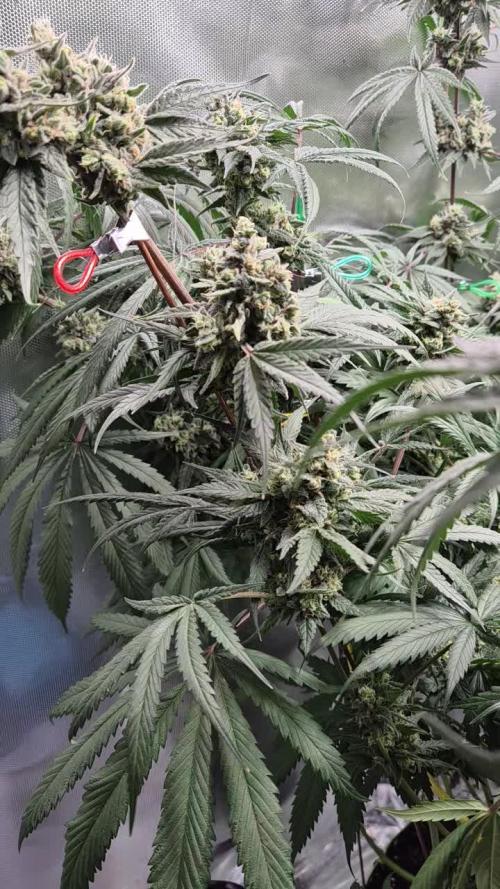
31.1. mal wieder in Form gebracht und einige Triebe entfernt die nächsten Wochen werd ich alle Triebe versuchen auf eine Höhe zu bringen. Und ich muss vermutlich etwas höher mit der Dünger Dosis langsam zeigen sich ein paar Defizite. Aber das sollte sich mit der Zeit regeln. Happy growing💛✌️
🇬🇧
1.31. I've shaped it again and removed some shoots. Over the next few weeks, I'll try to get all the shoots to the same height. And I'll probably need to increase the fertilizer dose a bit; some deficiencies are slowly becoming apparent. But that should sort itself out over time.
Happy growing💛✌️

Likes
3
Share
@Passx
Follow
The plant is in his last phase of flowering and after this week I'm stopping giving nutrients to it, The plants looks good, the older leaves are turning yellow and the pistils are 40% brown,