


Likes
Comments
Share


Likes
13
Share


@FlavoursUk
Follow
First day of week 4 flower day 22-
Took some shots of a few bud sites, that are looking well and that should start to frost up pretty heavy once in full gear. Increasing the EC slightly 1.6/1.7 around 800ppm for those that don't know. Trying not to overfeed but get to the sweet spot of tlwhat the plants want and require. Respectfully it is my first run with this strain and Breeder but nothing but good things so far.
I managed to take some clones so that I can push the strain better the next run and incase I get a special pheno! But so far so good. The buds should start to go through a fattening period once the flower stretch is completely out the way. Will be back to report and show some more pics/videos as the week goes on.
Stay tuned and follow my youtube and Instagram on my growdiaries profile

Likes
8
Share


@Budking420
Follow
Shes really coming a long small hiccup with either over or under watering. I'd say both despite the ac infinity self watering bases. I just wasnt sure how much water to give on top so I may have overdone it. All in all shes looking super frosty and smells amazing beautiful colors. I'm eagerly looking forward to toking on this one. Few more weeks at most I'd say she should be done. Check back next week to see just how fast she buds & remember its 4:20 somewhere!!!!!!
Likes
16
Share


@Dreamz_In_Green
Follow
Cruise control.
Her drinking is slowing and she is not asking for anything.
Just plain Watering on Tuesday and Friday...
Literally that's it.
😁
Included is a little video right before lights on.
Oh and I harvested the Pineapple glue Auto ... 😎
Thank you all for looking.
Happy growing.
Note* In the Nutrients section, it has the craft Blend listed.
It's just to satisfy the Diaries 😟 face during update.
No nutrients were added this week.


Likes
Comments
Share


@weedismalifebra
Follow
Not a big flower but great yield and crazy smell, easy to grow and beautiful colors

Likes
2
Share


@CalGonJim
Follow
11/4 130am Lights up to 77 watts 4.3 grams Maxi-Grow powder this week. Using mix from last week. Will probably switch to Bloom by Wed.
11/5 12am Canopy Creations LST things are great resistance training builds huge branches!!!
They are amazing. 10am growing fast and big after today’s watering!!!
Garlic muffin and fatso have the thickest branches that I’ve ever seen the side branches are thicker than what I got when I was growing in bigger containers so these nutrients and the soil and this light wattage seems to be a good formula I have to save this and work on it And stressing with the Canopy Creations has doubled the diameter of the branches that I have been stressing. Just great results.
11/6 Galic is the strongest so far her branches are THICK, a perfect 4 cola grow. Each of the 4 branches are as thick as the main stem on my first few tries at this.
12am They were all dry gave water probably last week using Grow switching to Bloom nutrients. Extremely strong plants from Seedsman!!!! When I finally got them going I found using Maxi-Grow & Rapid Start made a huge difference!!! Only Rapid Start for the first week.
11/7 1am GM & CA are huge now!!
lights up 89W as the leaves fold up a little for the heat I will raise them an inch or so. 1pm did water today. They are starting to flower
11/8 12:30am Switched to Bloom nutrients yesterday after the last feeding with Grow they all went to sleep right away after that and are waking up now with flowers forming. I will use 4grams Bloom, 0.4 Purpinator, 0.5 Rapid Start, 0.4 Silica, 0.4 Cal/Mag. Silica causes fluctuations in pH.
2am Galic is a MONSTER, and Seedsman is out of them. Fatso is next for size. I can not believe how huge the branches are this technique of 4 colas in a small 1 gallon container. These plants will be perfect for this
9am LST crazy day!!! I have never been able to train the small set of first branches that come off the first node on plants before until seedsmen Faso and garlic🤩🤩🤩🤩🤩🤩🤩🤩😍😍😍😍😍😍😍😍😍😍😍😍
11/9 1am flowering I might have to split them up into 2 tents they are all getting bigger than I thought they could, this is just great! after 20 fails I think im getting this small grow style worked out.
1:30pm moved the RSQ's into tent 3. Tent 2 not big enough but I'll make it work. Once I harvest the plants from the 🎃 Halloween All the Darkness grow it will be easier. Galic & Fatso by Seedman are HUGE very thick branches, thick side branches responds to training extremely well. Strongest F1's!


Likes
17
Share


@ScouseCityLX
Follow
End of week 4 marking around the half way point as both strains both have 8-9 week flower periods. Runtz Muffin #1 already looks like it's going to have more of a longer airy bud structure compared to the others


Likes
28
Share


@Solarcradle
Follow
Lots of growth through days 17 to 21. I consider day one at time of sprout.
Tops height was 5.20" on day 19.. prior to applying LST. Height is no longer relevant when using LST. I'm hoping for height after I LST the plant around the bowl of the 5 gallon pot, just before bloom. Considering this is an Amnesia XXL auto strain that runs around 10-12 weeks, I am hoping for a longer vegetative period to allow for more vertical growth. Lights moved to a distance of 22" from tops on Day 19, after LST.
Day 18-19 HST/LST Height 3"
Day 20 a topping and pruned approximately 7 leaves
Day 21 lights moved back to 18"
Day 21 Height 4.25"
Water PH 5.85-6.2 through Week 3

Likes
1
Share

@all_about_420
Follow
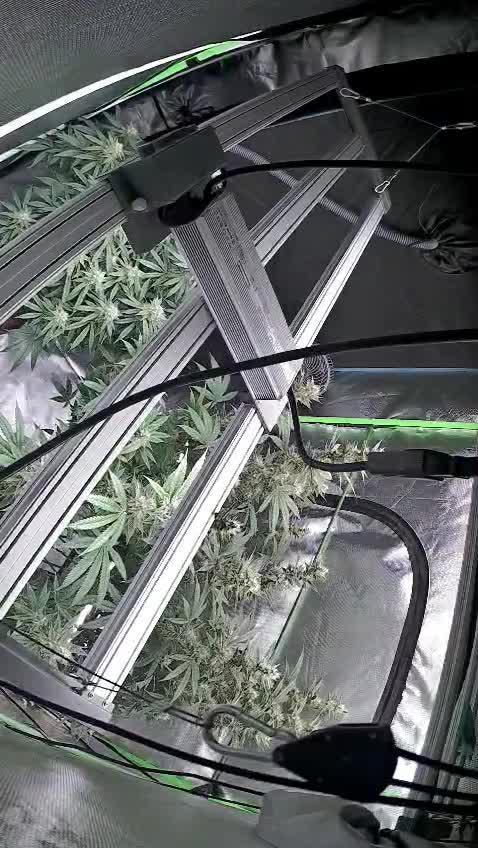
Ein kleines Highlight rettet das Logbuch dieser Woche: Ein 17-sekündiges Zeitraffer-Video dokumentiert die Tage meiner Abwesenheit. Während im ersten Teil primär die RS11 im Fokus steht, lässt sich im zweiten Abschnitt die Entwicklung dieser Lady hervorragend nachvollziehen. Das Bildmaterial offenbart jedoch auch die prognostizierte Schwachstelle. Die langen, grazilen Blütenstränge beginnen unter dem zunehmenden Gewicht der Blütenbildung nach und nach umzukippen und lehnen sich bereits deutlich gegen die Zeltwand. Der Babysitter hat in dieser Hinsicht leider nicht eingegriffen, sodass die Stabilisierung der Traphouse Genetics nun ganz oben auf der To-Do-Liste für meine Rückkehr steht. Die Harz- und Blütenproduktion läuft ungeachtet dessen auf Hochtouren weiter.
Likes
12
Share


@Growgirl1114
Follow
Stronger and stronger everyday, looks like this girl went into flower last night, so exciting ✌️🌱✌️

Likes
10
Share


@Lew420
Follow
She is a good size now, hopefully I get another week or two of stacking before she starts to swell

Likes
38
Share

@Brujha77
Follow
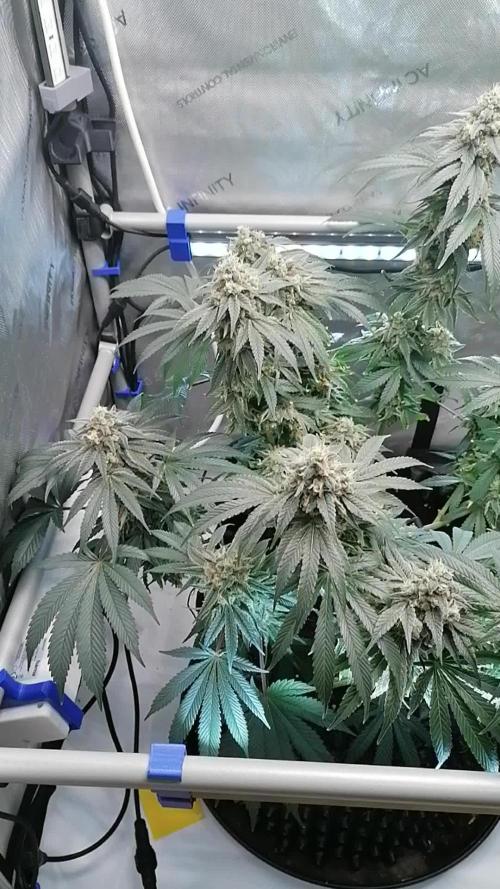
Start Woche 7 Blüte.
Heute gab's für beide nochmals 2l Wasser mit 20ml/l GreenBull. (die 20g BioBloom warn wohl etwas zu viel. An beiden etwas verbrannte Spitzen🙄 🙄)
Sonst heißt es warten.
Buds schwellen langsam an und die beiden fangen an leicht zu faden.
Bis auf den einen Trieb letzte Woche an #1 auch keine weiteren pollensäcke zu finden🤞 🤞 🤞
Tag 45 Blüte
Die Buds entwickeln sich richtig gut.
Riechen beide wieder wirklich schön nach Kirsche/Roten Früchten und der Trichombesatz schaut auch wieder richt gut aus😋 🥀

Likes
21
Share


@Cali_Grown_420
Follow
Day 78, I switched plant #2 to an all PK diet with FloraFlex Full Tilt. She’ll take up the whole 3.5 gals of nutes by Wednesday. I’m then going to begin my 3 day flush Wednesday evening. And I will chop her on Saturday evening.
I also took a little sample nug off plant #2 just want to compare non-flushed to flushed weed. Also see how much they shrink in size.
Day 79, Plant #2 is on schedule to start flush in 2 days. And I will give her the chop this coming weekend. Going to try a ice flush using frozen water bottles to see if I can help bring out more color.
The other plants #1 and #3 are still a two weeks or so away from being chopped.
Day 81, started the 3 day flush on Plant #2. And took some more photo shots of her buds and a 360° view video.
Day 84, Plant #2 got the chop. Wet weight, before light trim and removing large stems is 760 grams!!! I will update once they finish drying, and then again once I finish the trim and about to jar them for cure.
Plants #1 & #3 are still flowering, probably another week or two before they are ready to be chopped.
Likes
67
Share


@AsNoriu
Follow
Day 63. She is going down, my fastest ever big healthy plant. Looking at first waves 3 numbers, I think it's not even 2 ounces plant, it's f@cking THREE !!! ;))))))))))))
Day 71. One to jars another for trim jail. Busy day ...
Day 72. After small delay, she went down ;)
Day 82. Straight to vacuum sacs, but she was really great !
Happy Growing !!!


Likes
79
Share


@DogDoctorOfficial
Follow
Greetings, fellow cultivators! Welcome to the Week 7 Report on our magnificent Epsilon F1, where the journey of green greatness continues to unfold with each passing day. Prepare yourselves for a detailed and immersive exploration of our botanical wonder as we delve deep into the heart of her flourishing beauty.
Let's begin with a momentous decision: the Day 21 Flower Defoliation. With careful consideration and a keen eye for detail, I embarked on this transformative journey, gently removing select fan leaves to allow for increased light penetration and airflow. It's like giving our Epsilon F1 a botanical makeover, revealing her true splendor beneath the foliage canopy. This strategic pruning ensures that every bud site receives the attention it deserves, setting the stage for a bountiful harvest of epic proportions.
But that's not all! As we bid farewell to the defoliation process, it's time to release all the bindings and restraints that were used to guide and train our green goddess throughout her growth journey. With a sense of liberation and pride, I untangle each tie, allowing our Epsilon F1 to stretch her leafy limbs and reach for the heavens. It's like setting a bird free from its cage, unleashing her full potential to soar to new heights of botanical glory.
Now, let's talk about the environment. The TrolMaster controls have been instrumental in maintaining the perfect climate for our Epsilon F1's growth and development. From temperature and humidity to light and CO2 levels, these precision instruments ensure that our green queen receives the optimal conditions for flourishing. It's like conducting a symphony of growth, orchestrating each element to harmonize in perfect unity.
And of course, we cannot forget the nourishment that sustains our botanical masterpiece. The Aptus Holland nutrients continue to be the lifeblood of our grow space, providing a balanced diet of essential macro and micronutrients. From the Micromix Soil to the Substrate Buffer Powder and All-in-One Pellet, each component plays a vital role in nurturing our plant to perfection.
But let us not overlook the unsung heroes behind the scenes. Shout-outs to Royal Queen Seeds for bestowing upon us the genetic marvel that is the Epsilon F1, a testament to their dedication to excellence in breeding. To Aptus Holland, our main sponsor, whose unwavering support and innovative nutrients have propelled our grow to new heights of success. To TrolMaster, for providing the tools that empower us to create the optimal growing environment for our plants. And to Grow Diaries, the platform and community that fosters collaboration, knowledge-sharing, and camaraderie among growers worldwide.
As we bid adieu to Week 7, let us revel in the glory of our Epsilon F1's progress and look forward with anticipation to the weeks ahead. Happy growing, dear readers, and may your gardens be forever green!
Genetics -Epsilon F1 @rqs_esp @royalqueenseedssp @rqsglobal
Food - @aptusholland @aptus_world @aptus_es @aptus_portugal @aptusbrasil @aptusplanttechaus @aptus_thailand @aptusplanttechnz @aptususa_official
LES @lumatekeu
Controls - @trolmaster.eu @trolmaster.agro @trolmaster.support
As always thank you all for stopping by, for the love and for it all , this journey of mine wold just not be the same without you guys, the love and support is very much appreciated and i fell honored and blessed with you all in my life
With true love comes happiness , Always believe in your self and always do things expecting nothing and with an open heart , be a giver the universe will give back to you in ways you could not even imagine so
#aptus #aptusplanttech #aptusgang #aptusfamily #aptustrueplantscience #inbalancewithnature #trueplantscience #rqs #ApoloMission #MoonHarvestAdventure #playwithlego #lego #legotime #legovideo #tothemoonandback
More info and complete updates from all my adventures can be found Link in the profile description
Friendly reminder all you see here is pure research and for educational purposes only
Growers Love To you All
Likes
80
Share


@RickJames_Mcdank
Follow
As soon as she is dried aftyer 10 to 14 days I will provide more info on this train. 😎
****UPDATE****
So she cured for 10 to 13 days. man she smells so sweet.
The effect is good its a clear cerebrale high. Good for in the morning and you wont get lazy or slow.00
Likes
11
Share


@CrushedCana
Follow
Esta semana fue muy difícil para la planta pues me intentaron quemar la planta agregando jabón y le hice por 5 dias lavado de raiz y la dejé en sombra para recuperarla
Processing
Likes
9
Share


@GanjaThings
Follow
Continued growth, feeding every 3 days as soil dries out. Nice growth spurts noted and apical dominance broken via LST as limbs/new growth reach skyward. Minor fan leaf removal to permit light saturation and airflow to lower areas. Getting a little crowded! We will let the canopy grow towards the light another inch or 2 with minor LST adjustments or at 2 weeks from now (which ever happens first,) before we will make the decision to flip to flower cycle. Feeding 3/5 gallon per plant about every 3 days.