


Likes
Comments
Share


@Mrs_Larimar
Follow
2024-10-18
The le Plants do a super job.
spreading the semen into the feale Flowers
absolutely extiting
BE a Breeder", is one of Doctor´s Choices Motto.
Regular Seeds Seeds germinate- A backcross from Chronic Ryder_
BREEDER INFO
LEGEND We’re so proud of our latest drop - Chronic Ryder regular - as it results from a hardworking breeding process. We used an original Chronic male plant from Serious Seeds and backcrossed it with our Chronic Ryder from Sasha The Joint Doctor’s private collection to receive the Chronic Fast F1 BX Regular. By crossing 2 Chronic Ryder F3 lines, L1 and L2 from the same parents, we have created a new hybrid line. Well, it seems like it should be an F4 hybrid, but it's incorrect to name so. This process is called interline breeding, which means the cross of 2 lines. This cross allowed us, over several generations, to get a fully automatic Chronic Ryder that predominates its parents by 25% in key characteristics. Chronic Ryder is also available in feminized variety. GROWING Chronic Ryder regular shows the best performance of parents’ heritage. It grows into a uniform and compact plant that rarely exceeds 1m in height. Thanks to its compact size it is better grown in small spaces, terraces, and balconies and is quite suitable for stealth growing. The plant forms a single huge central bud cola with few side branches. Fatty and frosty buds will be ready to harvest in 70-75 days from germination. You’ll be truly surprised how big and dense buds are - the nice and fruity smell adds extra pleasure. The short growing period and strong resistance are other strong points of the strain. Chronic Ryder regular would be a great choice for growing outdoors with short summers - you’ll get your guaranteed high-quality yield in any case. Be ready to harvest up to 500 g/m2 indoors and 50-100 g per plant outdoors. TASTE and EFFECT Chronic Ryder regular has a nice taste - fruity and citrus tones complement one another, giving an unforgettable aftertaste. The effect is mild and doesn’t hit you like a hammer - the perfect choice for novice smokers. It brings balanced high and stone effects. Thanks to it, Chronic Ryder is a good smoke that calms your body, giving a strong body relaxation for a long time. CHARACTERISTICS Autoflowering: Yes Type: Regular | Autoflowering Room: Indoor | Outdoor | Greenhouse Genotype: Hybrid Genetics: (Serious Seeds) Chronic BX Chronic Ryder Finish time: 70-75 days from seed Indoor: Productivity: 500 g/m2 Height: 60 - 80 cm Outdoor: Productivity: 50-100 g/plant Height: 60 - 80 cm THC: High Flavour: Citrus | fruity | apricot Effect: Balanced high and stone | daytime | giggly

Processing
Likes
43
Share


@Master_weeda
Follow
Bonjour à tous les padawans et maîtres jedis
Stretch 18cm!!!!!!
Jour77 arrosage avec 2 litres d'eau ph6.3
Jour80 defoliation pour que les buds puissent prendre la lumière, j'ajoute 3 grammes de feeding biobloom greenhouse en griffant la terre et j'arrose avec 2 litres d'eau ph6.3
Jour82 j'ajoute 3 grammes de feeding biobloom greenhouse en griffant la terre et j'arrose avec 2 litres d'eau ph6.3

Likes
3
Share


@sunnykuyall
Follow
08 - 14 May 2023 - Germination Week
15 - 21 May 2023 - Veg week 1
22 - 28 May 2023 - Veg week 2
29 - 04 June 2023 - Veg week 3
05 - 11 June 2023 - Veg week 4
12 - 18 June 2023 - Veg week 5 - Final Veg
19 - 25 june 2023 - Flowering week 1
26 - 2 july 2023 - Flowering week 2


Likes
28
Share


@MadeInGermany
Follow
Hey everyone ☺️.
It gets more beautiful from week to week 😍👍.
I have them all this week Sprayed again properly with neem oil in the veggie phase ☺️.
There have been no trips for 2 weeks, but prevention is better 😀.
Because of the neem oil, the plants look very dark and shiny, which I really like when they shimmer like that 😝.
I didn't do any training these days, that will be done again the next few days 👌.
it was watered twice this week with around 0.6 l per plant.
The Ph / Ec measuring device was also recalibrated.
Otherwise there is nothing to report for this week and we'll see you again with the next update ☺️👍.
I wish you and your families a Merry Christmas 😊.
Stay healthy and let it grow 🍀
You can buy this Strain at :
https://www.royalqueenseeds.de/feminisierte-hanfsamen/220-pineapple-kush.html
Type:
Pineapple Kush
☝️🏼
Genetics:
Pineapple x O.G. Kush
👍
Vega lamp:
2 x Todogrow Led
Quantum Board 100 W
💡
Bloom Lamp :
2 x Todogrow Led
Cxb 3590 COB 3500 K 205W
💡💡☝️🏼
Soil :
Canna Coco Professional +
☝️🏼
Fertilizer:
Royal Queen Seeds Easy Boost Organic
☝️🏼🌱
Water:
Osmosis water mixed with normal water (24 hours stale that the chlorine evaporates) to 0.2 EC. Add Cal / Mag to 0.4 Ec Ph with Organic Ph - to 5.5 - 5.8 .


Likes
166
Share


@iMeus
Follow
Hello friends! I know I'm a bit late with the update so here's what I got so far :)
~Progress Report~
The seedlings have responded well to the nutes so far except for the WW, which seems to be more temperamental than the other girls.
I'm holding back on the nutes for the WW till she stabilizes. So far the majority are doing well. No pest so far, I'll be on the look out for em, little buggers. Will be re-potting next week if root development is solid. Much love,
Meus <3
~other~
* Light nutes every 4-6 days [PH'd @ 6.2-6.5]
* Mykos, Orca, Recharge dosed water wo/nutes [PH'd @ 6.2-6.5]
~update (day 19)~
I had to toss my bottle of Voodoo Juice, got all moldy and smelled like rotten eggs even though I only had it for just over a month... If any of you have used this before is that normal? Anyways moving on, 4 of the girls are re-potted in Foxfarm Ocean Blend soil, so no more nutes for while. The 2 Purple Urkle's are staying downsized a bit longer, need to get more pots. I will update with pictures on the 4th kickin off week 3. If you have any questions or tips shoot me a pm or comment below!
Thank you and see you soon :)

Likes
62
Share


@Reyden
Follow
Purtroppo le 4 gorilla 🦍 hanno delle carenze importanti e anche dei moscerini che girano nella terra e nelle radici, penso siano i moscerini dei funghi e se tengo le piante senza annaffiare più tempo loro soffrono perché gli piace l umidità e materiale organico di cui nutrirsi, ho sbagliato due settimane fa a preparare quella soluzione forse un ambiente troppo dolce gli ha richiamati…spero di non avere ancora più danni ormai le piante


Likes
16
Share


@Chocolopeison
Follow
Eh estado desconectado pero aquí va algo más de estas nenas, aun las tengo en periodo de vegetación. Lo que si esta semana logramos instalar la carpa correspondiente para estas nenas así que estamos esperando a llenar la carpa y poder pasar a floración. La estructura habla por si sola, aun no le hago amarres correspondientes ya que estoy esperando que me lleguen los soportes y poder darle más vigor del que ya tiene con el apoyo.
Estamos probando cannaboost via folear 3 veces por día 2 ml x litro. lo vamos a utilizar hasta el día 21 de floración y comenzamos vía riego. quiero comprobar diferencias ya que todos mis cultivos tengo que probar alguna cosa nueva ya sea estilo de alimentación o lo que sea.
Siempre dispuesto a resolver cualquier duda me pueden encontrar en instagram @chocolopeison
Saludos


Likes
1
Share


@Ultraviolet_
Follow
Remember that, however you are played, or by whom, your soul is in your keeping alone. Even though those who presume to play you be kings or men of power, when you stand before God, you cannot say, 'But I was told by others to do thus,' or that virtue was not convenient at the time. This will not suffice. Remember that.
Day:18
84°F and 65% RH (VPD) for the vegetative stage. Approximately 1.15kPa(assuming leaf temperature is about 2°F cooler than the air), which falls right into the ideal vegetative sweet spot (0.8kPa to 1.2kPa). At 1.15kPa, plants can draw water and nutrients efficiently without risking stress or wilting. It keeps the leaf pores (stomata) open, allowing for ideal carbon dioxide intake and maximizing vegetative growth. VPD is determined by the leaf's temperature, not just the ambient air. Because leaves usually run 1° to 3°F cooler than room air under bright grow lights, my actual VPD will be slightly lower, closer to the 1.0kPa mark. As she transitions from vegetative growth to flowering, one can gradually lower the humidity (to around 45–60%) and drop temperatures slightly to prevent disease from settling inside dense buds when they appear.
Night:6
At 70°F and 60% relative humidity, Vapor Pressure Deficit (VPD) is 0.86 kPa. This is right on the cusp of whats optimal for the vegetative stage. During the nighttime, plants generally close their stomata and undergo cellular respiration rather than photosynthesis. Transpiration slows to a near stop, making VPD less critical at night than during the day. However, maintaining a nighttime VPD between 0.8 and 1.0 kPa is highly beneficial in that it ensures the air is dry enough to prevent powdery mildew or bud rot, but moist enough to keep the plant from undergoing unnecessary stress. This range keeps the environment comfortable for cellular processes and prevents large atmospheric swings. Keeping it all flowing.
(Not pushing them yet, these are photoperiods)
The optimal soil (root zone) temperature for cellular root respiration and nutrient uptake in cannabis is between 68F & 72F This narrow range balances biological energy production (cellular respiration) with the dissolved oxygen levels in the soil, maximizing plant growth and health. Warmer soils hold significantly less dissolved oxygen. When soil temperature exceeds 74F oxygen depletion occurs, inhibiting cellular respiration almost entirely, At 68-72F root cells generate optimal adenosine triphosphate (ATP) via respiration to power root-tip elongation and the active transport of water and nutrients.
Too Hot (Above 78F) Root respiration increases, demanding more oxygen, while the water's oxygen-carrying capacity drops. This creates a prime environment for anaerobic pathogens and Pythium (root rot).
Too Cold (Below 60F) Root metabolism and cellular respiration slow to a crawl. This severely impairs nutrient and water absorption, leading to yellowing, wilting, and phosphorus deficiencies.
A lot depends on whether it's automatic or photoperiod; with photoperiod, there is not as much of a need to push "hard" as the real countdown only begins once the flower is initiated. Automatics, on the other hand, the chronological "clock" begins ticking the moment the seed germinates. It is of critical importance that the seedling growth gets off to the races, understanding that early growth is like compound interest, which will pay off come harvest. This reality is why getting autoflowers "off to the races" early on yields such exponential benefits. The "compound interest" is directly related to the surface area of the leaves. Larger, faster-growing seedlings process more light and build bigger root networks early on, which translates into an explosion of vertical and lateral growth during their short vegetative window.
The margins for error are so thin with autoflowers; this early-stage momentum depends on several critical practices. Seedlings exposed to increased atmospheric CO2 levels early in life will develop at an increased rate. To effectively "extend" or optimize the capacity of Photosystem II (PSII) for increased photosynthetic efficiency. In standard oxygenic photosynthesis, Photosystem II (PSII) is naturally limited to the red-light spectrum, peaking at 680nm. Extending its light-harvesting capacity past 700nm into the far-red region requires bypassing the natural limits of standard chlorophyll a. Adding 730 nm (far-red) LEDs alongside standard red/blue lights has been shown to increase canopy photosynthesis by 20–30% in several crops by acting synergistically with shorter wavelengths. However, the limitation is that excessive, pure IR/Far-red light (without accompanying red light) can trigger the "shade avoidance response," causing plants to grow tall, weak, and spindly rather than robust. Utilizing infrared light (specifically the 700-750 nm far-red range) is a viable method to boost photosynthetic efficiency. It acts as a bridge to allow PSII to utilize a broader spectrum of light, breaking the traditional 700 nm barrier. UVR8-mediated signaling (often in conjunction with CRY proteins) triggers protective mechanisms that maintain the stability of the photosynthetic apparatus (including LHCII and reaction center proteins), thus ensuring that the efficiency of Photosystem II remains higher in UV-B-exposed plants compared to plants lacking this receptor. ΦPSII indictates the rate of electron transfer from water to plastoquinone, which drives the production of ATP and NADPH. There is a close link between ΦPSII and the true rate of CO2 fixation (Φ*co2).
ETR stands for Electron Transport Rate. It measures the speed at which electrons are moved through the thylakoid membranes in a plant's chloroplasts during the light-dependent reactions of photosynthesis. Infrared light (particularly Near-Infrared or NIR) improves cellular energy by interacting directly with the electron transport chain (ETC) in mitochondria. This process boosts adenosine triphosphate production, which acts as a metabolic coefficient multiplier by accelerating enzyme activity dramatically.
Extend then multiply.
Far-Red photons interact with plant photoreceptors to accelerate the plant’s biological "clock" or trigger a shade-avoidance response. Autoflowers don't use the plant's biological clock, although the IR will initiate a shade avoidance and make them stretchy. You can just add equal measures of 660nm-680nm to negate the shade avoidance effect. Replacing nights' "darkness" with a combination of IR+ and 660nm. Because autoflowers don't require a dark period to flower, many growers just blast them with light. 18/6 24/0. However, this ignores the plant's metabolic rhythms, where daytime photosynthesis (light reactions) must be perfectly balanced with nighttime carbon fixation and assimilation (Calvin cycle) to avoid bottlenecking plant development. Cellular respiration is a 24/7 process, but it can only function while the plant has the free oxidative capacity to do so. A 100% photosynthetically active leaf cannot perform cellular respiration. The viral trend of defoliation of every leaf that isn't "getting enough light" is of great detriment overall, putting 100% of the cellular respiratory "workload" and responsibility on the 0/4/6 hours of darkness in sub-optimal conditions for enzymatic activity. Photosynthesis captures nearly 100% of the initial energy as carbon, while cellular respiration is the process that unlocks 90% of that captured energy into usable ATP so the plant can use it. Respiration is considered roughly 30% to 40% efficient. It captures enough of the potential energy in glucose to synthesize around 30 to 38 ATP molecules per glucose molecule. The remaining 60% to 70% of the energy in the sugar is not captured in ATP; instead, it naturally escapes into the environment as heat, which helps regulate plant temperature. In plants, the primary enzymes of the Electron Transport Chain (ETC) and the ATP synthase complexes are typically adapted to function optimally in warmer temperatures (roughly 25°C to 35°C depending on the specific plant strain). As temperatures rise within this physiological range, molecular collisions increase, speeding up respiration and ATP production. The cannabis plant has a branched respiratory pathway. During heat or cold stress, plants activate Alternative Oxidase (AOX). AOX burns sugars to dissipate energy as heat rather than coupling it to ATP production. This pathway actually functions optimally at elevated temperatures to help protect the cell from the damaging build-up of Reactive Oxygen Species (ROS) during heat stress. Enzyme activity generally scales with heat; there is a strict biological limit. If canopy temperatures in a grow room exceed 40°C, the enzymes and their supporting lipid membranes lose stability. Not saying you need to go crazy, just optimize nights the same as we optimize days.
Phosphorus is the driving force behind early seedling development. It acts as the "energy hub" of the plant, directly driving cell division, robust root growth, and the creation of DNA. Without an adequate, easily accessible supply early on, the plant's overall growth potential and final yield can suffer permanently.
E=MC2 looks like a simple multiplication problem; it describes a fundamental physical truth: mass and energy are the same thing. The equation doesn't just calculate a value; it reveals that mass is effectively "congealed" energy. Energy is just numbers. Energy isn't a physical "substance" you can hold or touch. It is essentially an abstract, calculated number that we assign to a system to predict how it will change, interact, or move. A numerical label we attach to matter to track how it behaves. Because the universe runs on laws of symmetry (specifically, that the laws of physics don't change over time), a single global number must be conserved. We call that number "energy".
We don't grow; we facilitate energy conversion.
How well a seedling grows is essentially down to how much knowledge one can acquire to increase the level of conversion to occur. Applying knowledge effectively requires intuition, which comes from hands-on experience. A seasoned stoner learns to read subtle signs—like a slight change in leaf turgor (stiffness), subtle color shifts, or the specific texture of the soil—before a textbook diagnosis can be made. Ultimately, growing is the application of botanical science blended with active observation. Knowledge dictates your potential, but adaptability and attentiveness to the plant's immediate environment determine your results.
1.618 nature mathematically optimizes quantum energy transfer and light absorption efficiency within the photosynthetic machinery, as it naturally dictates energy scaling hierarchies and resonance dynamics. External vibration or electromagnetic wave that perfectly matches a plant's natural frequency directly influences plant growth. Low-frequency sound waves and targeted electromagnetic fields stimulate cellular processes and boost photosynthetic efficiency
Does it produce better yields?
How long is a piece of string? As long as you cut it. But isssss the juice worth the squeeze? The quantum framework of the IVM seems to think so. Good enough for the quantum firmware, good enough for the DNA software. Genetics are not dictated; they are expressed; the rate of that expression is dictated by the environment in which growth occurs.
Quantum Coherence in Photosynthesis occurs When a photon of sunlight strikes a leaf, the energy it carries must travel to a reaction center to be converted into chemical energy. This process operates at nearly 100% efficiency. If the energy moved in a traditional "bunching" or random hopping manner, a large portion of it would be lost as heat. Instead, plants utilize quantum superposition. The energy particle (exciton) doesn't just take one path; it exists in a wave state and explores multiple pathways simultaneously. It essentially "chooses" the most efficient route to the reaction center simultaneously. Research shows that molecular vibrations and the specific network arrangements of chlorophyll molecules (like the naturally evolved Chlorophyll A & B ratios) actively protect against energy overflow, optimizing light capture across different light intensities. Enzymes are the biological catalysts that speed up chemical reactions within a plant's cells, allowing them to grow, metabolize, and repair. Rather than relying solely on the classical kinetic energy of molecules colliding, plants use quantum tunneling. Subatomic particles like electrons and protons (hydrogen ions) can literally "teleport" through energy barriers that they normally wouldn’t have the energy to climb over. This makes vital metabolic reactions happen far faster than classical physics could ever explain.
Chloryphyll b has peak absorption at 460nm (Blue) and at 647nm(Red). If we take the blue peak wavelength 460nm and a UV-B, UVR8 peak absorption wavelength 285nm, Tryptophan-285 (W285) Sensing protein. 460/285=1.618 Φ If we take chlorypyhll b's Red absorption peak 647nm and a UV-A of 400nm, we get 647/400=1.618 Φ. "Structure of light". The cryptochrome photoreceptor (CRY) is a UV-A/blue light receptor that shares this dual sensitivity with several other biological structures and functions, including significant sequence similarity and a common evolutionary ancestor with DNA photolyase enzymes. These are light-activated enzymes that use blue/UV-A light to repair DNA damage caused by UV-B radiation in plants. Synergistic. But Shhh, it's a secret.
Effective quantum efficiency of photosystem II, often denoted as ΦPSII, represents the proportion of light absorbed by Photosystem II (ΦPSII) that is actually used in photosynthetic electron transport. It is a key indicator of how efficiently a plant is using light for photosynthesis, as opposed to losing it as heat or fluorescence. ΦPSII (effective quantum yield of photosystem II) functions primarily as a "multiplier" (a coefficient of efficiency) rather than an additive factor when estimating the overall photosynthetic electron transport rate (ETR). Multipliers are considered far more beneficial than additions because they generate exponential growth, leverage existing resources to their full potential, and create sustainable, self-multiplying capacity, rather than just incremental, linear increases. This fascinating observation is rooted in the intersection of subatomic geometry, fractal scaling, and quantum dynamics. In specific molecular arrangements—such as in conjugated polymer networks or biomolecular architectures—the Golden Ratio (PHI) naturally dictates energy scaling hierarchies and resonance dynamics. Mathematically tied to the fine-structure constant, which defines the strength of the electromagnetic interaction. The Golden Ratio can be mapped geometrically as the Golden Angle (137.5 degrees) in atomic structures, linking the charge of the electron to fundamental quantum constants like Planck's constant.
Electromagnetic.
The Golden Angle (137.5): This angle is derived from the Golden Ratio (1.618). It is the smaller of two angles created when a circle is divided such that the ratio of the arcs equals the Golden Ratio.


Likes
4
Share

@GoodTimesOrganics
Follow
Hi liebe Community and Welcome Back! 💚
Weiter geht's im Vergleichsgrow!
Bio Tabs NL. vs. Weedefix (Stuttgart/ Germany)
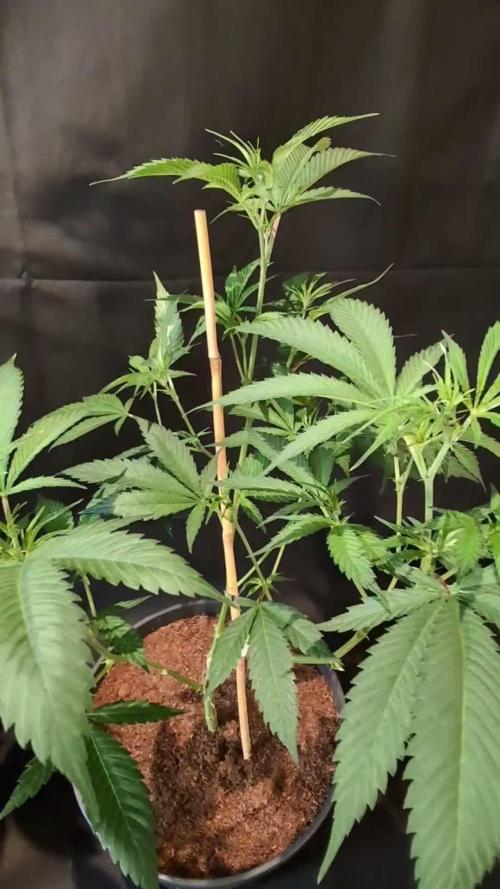
Hier im Bio Tabs NL Grow haben wir nun nach Tag 35 des Einpflanzens eine Höhe von 53 cm Erreicht.
Die Triebe bilden sich schön und akkurat aus.
Die Blattfarbe ist im Bio Tabs Grow mit einem tieferen etwas dunkleren Grün zu beobachten, im Wuchsverhalten lässt sich ein etwas moderater es Wachstum beobachten. Weniger Buschig mit schlankeren Seitentrieben.
Leider ist mir ein Seitentrieb abgebrochen, daher habe ich der Fairness wegen, bei der anderen Pflanze auch einen Seitentrieb an der gleichen Stelle entfernt.
Diese Woche, habe ich mit Wasser und 5ml Orgatrex (Melasse mit Pflanzenextrakten) gegossen.
Und es zeichnet sich ein immer stärker werdendes Aroma ab.
An nächster Woche, wird es Zeit die Pflanzen in die Blüte zu schicken.
Die Bedingungen im Growschrank sind Top!
—————
🌞 Temp: 21
🌚 Temp: 18°C bis 19°C
💨 RH: 58%
VPD: 0,75 kPa
💡ppfd: 330 mpm
—————


Likes
133
Share


@DutchFarmer
Follow
5x5 Grow Ac Infinity Self-Watering Base Grow & Geakbeast Pro Seedsmans & Barneys Farm Veg to Flower Episode 1
Join our discord for free giveaways! 🎉 🔥 🎁
https://discord.gg/VMu6rH4a7V
Video available here 📹
https://www.youtube.com/watch?v=46gvz1lCoSg
Ac Infinity Grow 5x5
Firstly like to apologise the length its taken to edit the video and get it uploaded and the quality scaling is way off. I've had few issue's with the new camera i'm using.
Video is to demonstrate my growing technique and utilising the Ac infinity equipment & results using the famous Geakbeast Pro. Unfortunately there isn't any audio, on the next couple videos ill be commentating along and explaining all named brands i personally use and i recommend below i have given explanation...
Episode 2 will have a new line of genetics.
Solfire Gardens
Square Genetics
Exotic Genetics
Humboldt
Grow Diaries
Dutchfarmer
🎉 🔥 🎁 Discord Community 🎉 🔥 🎁
(Friendly Community & Free Help & Support)
https://discord.gg/VMu6rH4a7V
Growing Equipment and supplies
Geakbeast Pro
ACINFINITY T series Inline Fans
ACINFINITY CLOUDRAY S6, Clip Fan 6
ACINFINITY Tent 5x5
ACINFINITY Carbon Filter 4 Inch
ACINFINITY 5Gal Pots
ACINFINITY Self Watering Pots
ACINFINITY Scrog Trellis Net
Nutrients
Canna Coco
Full Range including Boost
Medium
Coco Perlite
Strains
Amnesia Fast Flowering
Barneys Liberty Haze
Barneys G13 Haze
PH Pen
Aperha PC60
Likes
12
Share


@Seymour_buds
Follow
girls are growing well. changed water change out cycle to replacing 1/3 of entire resevoir every 3 days. The theory is that i will be able to transition changes to nutrients slowly to identify any changes to the girls.
one girl showing sign of what i believe to be calcium deficiency.(picture attached)

Likes
24
Share

@CampaCavallo
Follow
4ª Settimana di Fioritura 💐💐💐💐
👁️: ma che bello veder crescere la nostra sticky broccoli 💧🥦 😍!
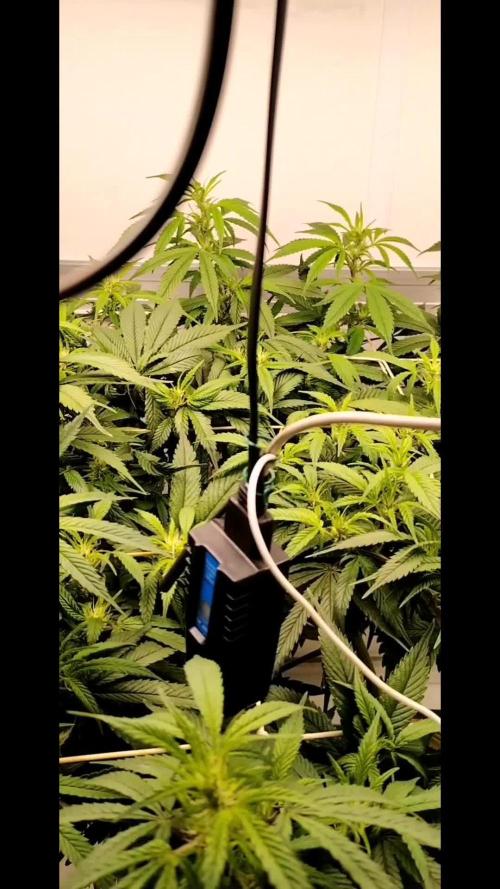
Il training sotto la rete è quasi terminato ed ora la ragazza si può dedicare a far crescere i suoi fiorellini innevati 💖
⛽: in aggiunta al nostro succo di base di Advanced nutrients ph perfect , abbiamo iniziato a darle l'oro verde! GREEN SENSATION, questo è il tuo momento👍🏻 vaiii! 💜💚Grazie PLAGRON 💚💜
🎵: un ringraziamento speciale a M2O, Roberto Molinaro


Likes
22
Share


@CanarianGrow92
Follow
Wonderful tangerine smell, all strains are looking and smelling more or less the same, some buds are a bit bigger and some other showed some more stretching when we switched to flower but in general wonderful strain, lets see if the buds taste as good as they smell 😜
Week 4 already! We start to see a small nutrients deficiency, time to add some more organic stuff, i didn't applied too much so it seems it was food for 4 weeks, great as i dont want to give too much nutrients, I heard that organic nutrients gives a better taste and avoid salt accumulation in the roots, i always have been a typical grower using bottles but lets see, at the moment very happy, buds are looking good, i do need to add some sugars I think 🤔

Likes
65
Share


@Dendegrow
Follow
Woche 4 bricht an und es läuft hervorragend! Die Orange Sherbet bekommt diese Woche frischen Boden: eine Mischung aus Bio-bizz All-Mix und Greenhouse-Feeding, perfekt für die letzten Vegetationswochen und blüte. Zudem hat sich die Orange Sherbet sehr gut mit dem Backhefe-Buttermilch-Melasse-Experiment entwickelt, was zu einem starken CO2-Anstieg auf bis zu 1500 ppm geführt hat. 💨 Ich bin gespannt, wie sie sich in der neuen Umgebung entwickeln wird. Auf der anderen Seite explodieren die Frozen Black Cherries förmlich in der Hydroponik! 🌱 Die Entwicklung ist beeindruckend, und ich könnte nicht zufriedener sein mit ihrem Fortschritt. Die Blütephase rückt näher, und ich bin gespannt, wie sich alles weiterentwickelt! Ich halte euch auf dem Laufenden! 🚀
Week 4 is here, and things are going great! The Orange Sherbet is getting new soil this week—a blend of Bio-Beth All-Mix and Greenhouse-Feeding, setting her up perfectly for the final weeks of vegetation and . Additionally, the Orange Sherbet has responded well to the back yeast-buttermilk-molasses experiment, resulting in a significant CO2 increase of up to 1500 ppm. 💨 I'm excited to see how she adapts to her new environment. Meanwhile, the Frozen Black Cherries are absolutely thriving in hydro! 🌱 Their growth has been phenomenal, and I couldn't be more impressed with their progress. The flowering phase is getting closer, and I can't wait to see how everything unfolds! I'll keep you updated! 🚀
Likes
8
Share


@trichomhunter
Follow
After 48 hours of darkness, the time had come and the Purple Lemonade were ready for harvest. Since she reacted very well to the training and grew with enough space between the buds, I decided to dry upside down.
Dry weight and smoke report follow after curing. Stay tuned...
