


Likes
Comments
Share


@braxat420
Follow
Chugging right along, the buds on this one are miniscule compared to the pot-mate's. Makes me wonder if it's a slower genetic, or just a low yielder. No top feeding again, except for the Tropicana Cookies is the 1 gal. 12 hrs 45 minutes on.

Likes
9
Share


@Hempcules
Follow
WEEK 8 (Day50-56)
Week No. 8 went quite smoothly.
One of the plants still has a slight deficiency due to the intense light, while the other has stretched way too aggressively. At one point, it was almost 15 cm taller than its neighbor, which I didn’t like at all. So, I took a rather bold approach. Using supercropping, I brought the plant back to approximately the same height as the others. I bent the shoots and stabilized them in the new position using plastic training clips and some tape. This was done just before the photos were taken, so they don’t look their best at the moment. However, I’m confident it will work out well.
Other than that, I haven’t changed much. The lighting remains at 24 hours, and I slightly increased the amount of fertilizer again.

Processing
Likes
4
Share


@Skillgrower
Follow
Semana 6 quinto dia, as mais pequenas um pouco atrasasdas em relação mas nada de grave simplemente atrasou devido ao stress!
Boa semana no geral cheiro forte, muitos tricomas, as mais pequenas estao super frosty!
Ultima semana a levar big bud no inicio da proxima vou intoduzir o over drive na maior para dar um ultimo pump antes do flush!
Ancioso que chegue a hora para sentir os fumos destas meninas 🤤🤪

Likes
33
Share


@iLoveGoodWeed
Follow
She is in flowering stage. So far she is growing very nicely and no issue with her. She should stretch this week much more


Likes
37
Share


@Smoking_Joe_Frasier
Follow
Week 3: Adapting and Thriving
Transplanting to Larger Pots
This week, I transplanted the plants into 11-liter fabric pots filled with Plagron coco coir mixed with perlite (70/30). The small pots were already root-bound. It's often said that a plant will stop growing when the taproot reaches the bottom of the pot. Personally, I think this is nonsense, but we'll see. This transplant provides them with more space for root development and better aeration, promoting healthier growth.
Growth Observations
The plants are showing significant growth, with vibrant green leaves and sturdy stems. The increased light exposure from the greenhouse setup is clearly benefiting them. Their resilience is impressive, and they appear to be adapting well to their environment.
Feeding and Watering
As the coco mix dries out, I am preparing for their next feeding. Following the Terra Aquatica Tripart feeding chart, I have increased the nutrient solution to an EC of 1.0 mS/cm. This should provide them with the necessary nutrients without the risk of nutrient burn, especially for autoflowering strains. I will not go higher than this concentration to ensure their safety.
Improved Weather Conditions
The weather has improved significantly, with very little rain and temperatures ranging between 19°C and 22°C for the next few days. This stable weather is ideal for the plants, providing them with consistent conditions to continue their healthy growth.
Daily Care Routine
My daily routine includes checking the plants in the morning and evening, adjusting the greenhouse openings as needed, and monitoring the moisture level of the coco mix. This consistent care helps me stay on top of any changes and address them promptly.
Looking Forward
As we progress into the third week, I am excited to see how the plants continue to develop in their new, larger pots with the adjusted nutrient levels. The combination of a controlled environment, balanced nutrition, and diligent care is setting a strong foundation for their growth.
Update on 11.06.2024
Today, I fed my plants for the second time this week. During this feeding, I adjusted the nutrient amount for the vegetative phase (2/3 of the recommended amount from Terra Aquatica):
CalMag: 2 ml/l (Starting EC before adding nutrients: 0.45 mS/cm)
Grow: 1.2 ml/l
Bloom: 0.8 ml/l
Micro: 0.4 ml/l
EC: 1,166 ms/cm (536 ppm PPM-500/TDM)
PH: 5,83
The plants were watered with approximately 20% drain.
Stay tuned for more updates as we continue this journey.
Likes
1
Share

@Organic_G
Follow
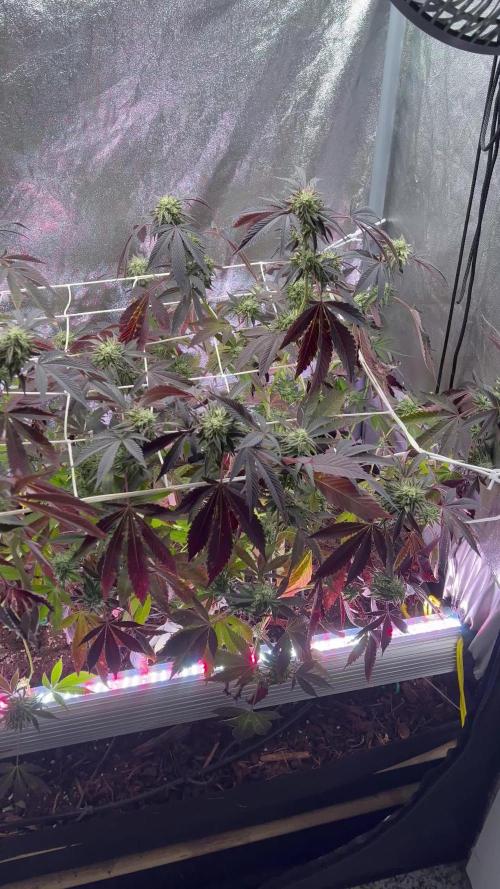
Absolut ungewohnt das Zelt mit so abgemargerten Pflanzen zu sehen 🤣🤣🤣
Die Ladys von draußen sind endlich nach innen gezogen für den restlichen Blüte Schub.
Sehen wie Crackys aus im vergleich zu den den davor drin waren 🤣

Likes
6
Share


@JBOrganix
Follow
Super burnt lol. Ooops I'll still finish her off and hope for the best. Should still be some decent smoke 👌
For sure a shame she's a bigger girl too.
Processing
Likes
3
Share


@iamdiddy
Follow
great strain ,shee is happy all time..love this pheno and great genetiks of cours of barney farms ,
after couple days this gorilla gous oudoors ))🍀🍀✌️🧐🌄❤️💯🙌🏼

Likes
21
Share


@puffin_ganja
Follow
I ended up running these plants a total of 60 days. Topped each plant 2-3 times. Once flipped to flower the plant does not stretch much. The final product is dense, sticky, frosty buds with a fruit punch and piney gas aroma. Yield for this pheno is above average, but I highly recommend trying to get a top in every trellis hole to get maximum yield. Overall I pulled a little over 3lbs off of 16 plants.
Notes:
Room size: I'm not sure what to put as grow room size below... room was 8x8x6.7
Gram per watt: Gram per watt per plant doesn't seem to be the best measure in my opinion as it would encourage you to grow fewer plants with longer veg times to get the same yield. Unless I'm missing something?
The actual power draw from the wall for each light is = 355watts per 315 LEC x 4 = 1420 watts in Flower.
The yield was 1380 grams which makes the total Gram/Watt ration = 0.9718
***Sorry for the shitty pics... my phone camera is still shit right now and these are all the pics I could get at the moment.


Likes
7
Share


@WeedBerry
Follow
So overall I've learnt that the nutrients that I've been using was not how I should of been using them and I've learnt about lst and hst its coming to the end of this plant and my next one I'll fix the mistakes I made I'm just waiting to flush the plants and it should be ready

Likes
114
Share


@TheFoxFarmer
Follow
Week 8 Flower
The last week of flush for these two. They were taken down on Day 56, after a 16 Day flush. I think Twin2 could have finished at 7 weeks, but of course I hadn't planned for this, or I would have flushed sooner. So she was taken to the originally planned 8 weeks. Twin2 has also foxtailed quite a bit, from only slightly higher temps and also because she's having a last attempt at catching any pollen in order to reproduce. Although the pots were slightly damp still when I harvested, it is best to take them down when they're dry. The only reason I didn't, was because I knew I'd be too busy the next day, and there were plants in veg that were desperate to be thrown into the flower tent! The pics do make them look wetter than they were though.
Their fan leaves were taken off and they were each hung in seperate boxes, where they'll dry as slowly as possible for between 6-10 days. I dont suffer with very high humidity, so I'm able to do this without any issues. When I feel it is too humid, I simply burp the box for the first day or 2 once a day.
The slower the dry the better the buds will taste/smell. Once she's dry enough she'll be trimmed and jarred for curing.
It's going to be a pretty tough one for keeper pheno! They both have similar but very different smells. By that I mean, they both smell very floral and sweet, but T2 smells extra sweet (although definitely not as dense). That doesn't mean T1 doesn't smell just as nice. Hers buds are thicker and more dense, so even though I've favourited T2 in the pics, I think I'm leaning towards T1 still. But in all honesty it's still down to dry weight and the taste test! This can all be looked forward to in the harvest update!
It's been a seriously fun diary with these two twins. I'm definitely glad I separated them. Do you think you'll attempt to separate them after seeing my experience? Please let me know!
Thanks for following and happy growing! 🐺

Likes
16
Share


@osmrducks
Follow
Day 15: Plants looking healthy as can be! I didn't make a rack for the lights but I got em in. Looks jankie, but I think its gonna work. 🙏
Day 16: Trying to work out kinks in my grow. Since I put the other 2 lights in, I'm now battling the heat and humidity. Switch the fans around. Got the cold air coming in down low. Will feed them in the morning.
Day 17: The girls were showing signs of being thirsty this morning for sure! They received their first drain to waste watering. They will be getting some additional nutes on the next feeding (AN B-52, AN Sensizyme, AN CalMag Extra).
Day 18: Looking amazing today! I tried my hand at a little LST. Wish the girls luck.!! 🙏 Tomorrow is the official 2 week mark from breaking ground. So, not sure. I've got the humidity finally dialed in at around 50-55% and the temp around 78°. Also gave them another drink as they were already dry about 1.5" down??
Day 19: This is the official 2 week mark. I think I stressed the girls pretty good yesterday, but they look to be recovered today. Should start seeing good growth in the day to follow. Will just be tucking a leaf here and there for a bit. I will being doing a straight water feed next with Great White.
Day 20: Nothing new to report other than found 2 leaves that had some yellow mottling. I added Sensizyme, Recharge, and Great White to this feeding. Did not do drain to waste. Just watered the outside perimeter. PPM was 260 at 5.8 ph.
Day 21: NO MORE NUTES for these girls! Tips on a couple of em are turning yellow!!! Stupid me. Over watering and giving too many nutes.


Likes
39
Share


@GrowWiththeBro
Follow
Fed both on Day 46.
The Caramel cream likes to EAT!
R/O is high again. I’ll monitor again during the week to see if this is an issue.
Day 50: ph water feed w/ calimagic.
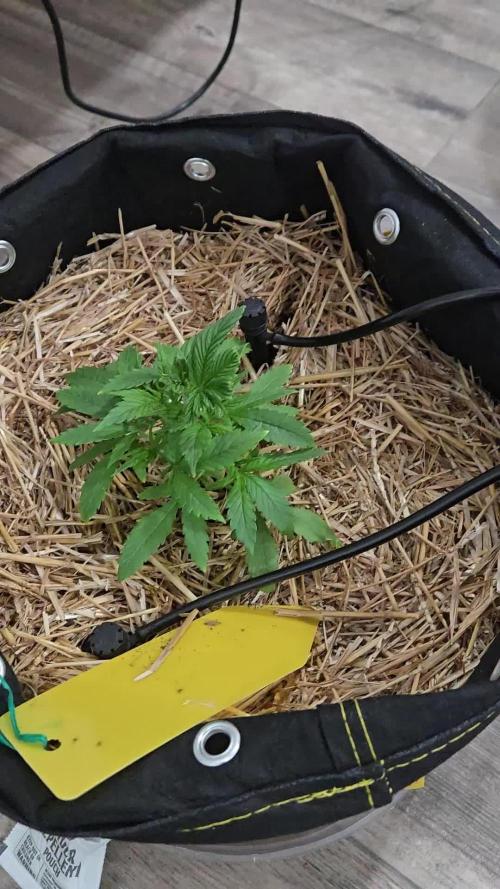
Moved into larger tent to prepare for flowering soon.
Added additional lighting as well flowering.
Grow on.


Likes
Comments
Share

Likes
87
Share


@RastaGrow
Follow
It is a very cool strain :) It is a bit difficult to raise, it likes the best conditions which unfortunately I can not create. Lighting betrayed me the most. The worst light bulbs that exist in the world folks are Quantum

Likes
6
Share

@Luxengrow
Follow
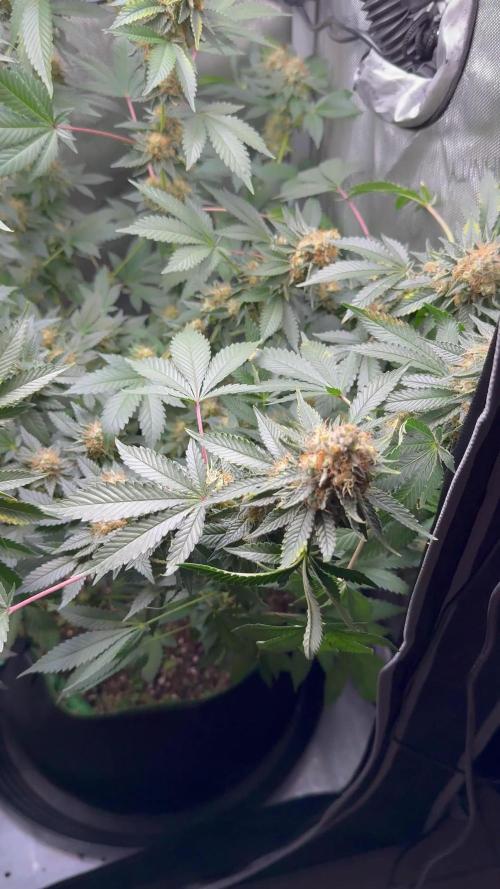
Nearing close to the end. Really regret not using the scrog net as they’re struggling to hold themselves up as they go through their final swellings on the buds. Smell has changed and has a candy sweet at the moment starting to come througH


