The Grow Awards 2026 🏆
Likes
Comments
Share
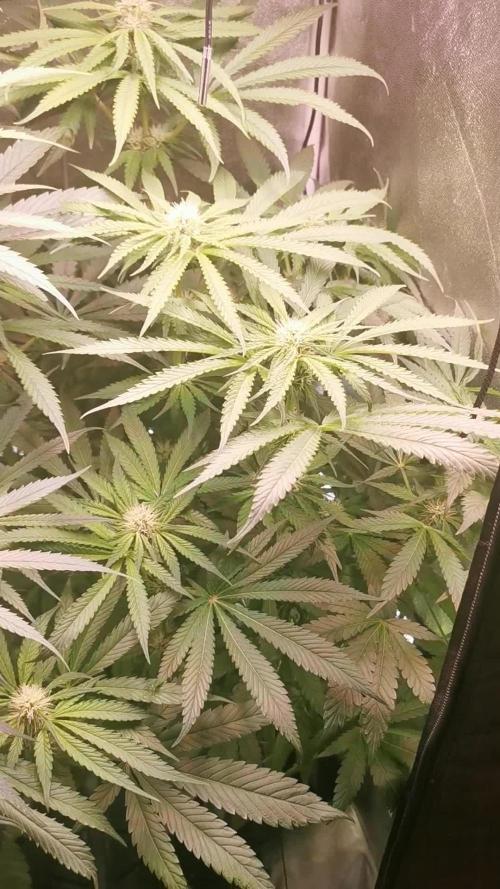
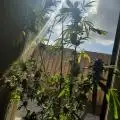
Yoooooo. Hope you’re all good. Some great photos and even a video for you all this week. And as you will see from those, she really starting to thicken up. Just how I like my women - thick and smelling of weed, ha ha. How long left, who knows??? But I just hope to be snaffling bare ounces off this baddie. The smell she is kicking off now is beaut as well. Can’t wait to get smoking this. The root system is looking crazy too. So much root it fills the pot. You can barely see the water in the pot for all the roots. Have great weeks everyone. Wu-Tang lyric of the week time……. “As the world turns, I spread like germ. Bless the globe with the pestilence, the hard headed never learn.” - Method Man on the track Triumph.
Likes
18
Share
hi friends farm, did you have a good Easter? we made a decent harvest that left me quite satisfied even if I had to collect a little earlier because of my absence at home but this did not ruin the work 🤪🤪🤪🤪😎😎
Likes
24
Share
@Stinkfox
Follow
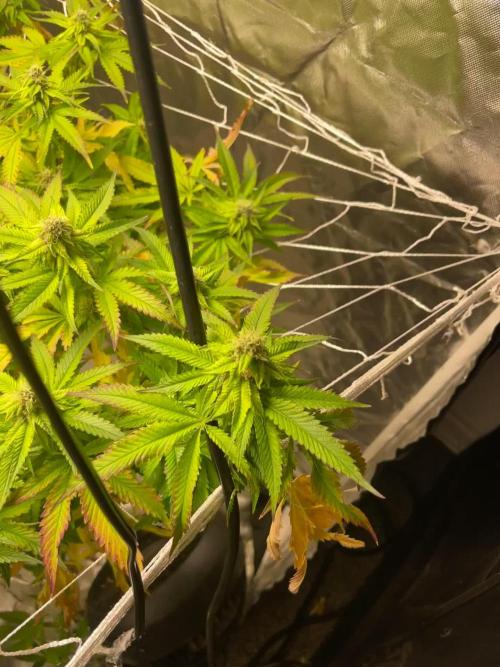
She’s bulking up and putting on frost. I added a bit of Cha-Ching to her food this week. Soon I’ll be flushing and waiting. I can’t wait and will be sampling early. Heehee!
Likes
4
Share
En la 4ta semana aumentamos la dosis del fertilizante para crecimiento, regulamos su p.h en 6.0 e hicimos una poda apical en el 4to nodo de cada una de las plantas.
Likes
40
Share
While we're not huge on autoflower plants, this one turned out really nice, not a huge yield, maybe just over an Oz dry but her bag appeal can't be beat.. we may actually grow this strain again but probably outdoors, our autos always seem to preform better in the garden. Thanks for reading and happy growing everyone
Processing
Likes
9
Share
@Luv2Grow
Follow
Day 92 - Starting week 14 and this is by far the longest any strain I’ve grown has gone and I’m hoping she’ll be ready by the end of week 15. Debating on if I should start the nutes back up but not sure if that’ll do anything for her. Day 93 - Nothing much to update today but she will be needing some water tomorrow. All the leaves are being sucked dry but just don’t see the pistils starting to die off yet, all are still bright white. Gonna check the trichs tomorrow before feeding and maybe trichs will show she’s almost done. Worried I started flushing too soon. Day 94 - Gave her another 2 gallons of water pH’d to 6.6 today. Other than that I just removed quite a bit of leaves but still haven’t done a heavy defoliation yet. I’ll probably take care of that tomorrow since most of them are yellowed up now. A lot of milky trichs in there but still a ton of clear so still has some time left. Day 95 - Nothing much new today, just monitoring her trichs even though she still has a ton of white pistils. She does have quite a few milky but most clear overall. Day 96 - Nothing new to report today. All is looking good, just not sure when she’s gonna finish up. Not seeing any signs of the pistils dying off so gonna keep letting her go but still only giving her plain pH’d water. Day 97 - She still seems to be going strong. Gave her two gallons of pH’d water today. Really hoping I start seeing the pistils shrivel up soon. There’s a lot more milky trichs but still quite a bit of clear. Hoping she’ll be finishing up in the next two weeks. Day 98 - End of week 14 and still going strong. Nothing much I can say right now but I’m gonna keep giving her water until she finishes up. Looks like some of her pistils might finally be starting to shrivel up so may have two weeks left.
Likes
5
Share
These two Boofy's were harvested on the 73rd day.
Likes
6
Share
@colla69
Follow
Going well Added some Plagron PK 13-14 for good measure Will start adding Plagron green sensation next week with res change.
Likes
48
Share
@Regenwurm
Follow
Durch die hohe Temperatur und die Entwicklung der buds haben die Ladies grossen Durst . Diese Woche die Damen 3 mal mit voller düngedosis nach Plan von Green Buzz gegossen . Nachts ca 23 Grad/ Tags 26 Grad. Luftfeuchtigkeit bei relativ konstant 50%. Also Klima gut. Bei einer der Ladies habe ich einen Anteil von ca. 50 % Coco dort die doppelte Menge calmag wie oben bei dem Dünger angegeben . Die Blattfarbe der beiden Pflanzen ist nun durch die Erhöhung von calmag bei der Coco Pflanze gleich . PH Wert Gieß und Drain diese Woche nicht geprüft, blattfarbe ist dunkler geworden nächste Woche wird mal wieder durchgespült mit einer light düngemischung . Hier habe ich den ec gemessen der aktuell mit ca 1-1,2-1,3 ganz gut ist. Ich halte mich nun an den düngeplan von Greenbuzz der mit seinen Mengen aktuell gut funktioniert. Ich hoffe es ist der richtige Weg . Die Damen sehen beide gut aus. Entlaubung durchgeführt um dem Licht in den weg in die Mitte der Pflanze zu ermöglichen. Lichtstärke der Lampe auf 92 % bei einem Abstand von 40 cm. Düngezugabe 3 mal in dieser Woche.
Likes
23
Share
Espectacular aroma a dulce!!!!!!! 😍😋😋
Likes
4
Share
@lotero
Follow
Las amnesia están malitas. Ns exactamente por qué es. El único fallo que creo haber cometido ha sido regar de más, supurando por abajo un par de veces. He regado cada 4-5 días (muy poco) así q ns si el sustrato está muy compacto y por eso no traga ni como airearlo
Likes
22
Share
Day 22 Le piante stanno bene e tra qualche giorno farò cambio mh/hps Ci vediamo settimana prossima 🖐️
Likes
19
Share
@DrLaggis
Follow
🌱 Start: 17.07. 🌱 Hello everyone! This is my very first grow and I'm thrilled to share every step with you! 🎉 I'd appreciate any tips you might have to help me achieve the best results! 😊 Equipment: I've geared up with an Indoor Grow Kit from MarsHydro along with some BioBizz supplements to ensure my plants get the best care. 🌿 🌼 Seeds: I opted for Fast Buds seeds after hearing great things about them. They were delivered super fast—just two days! I’m particularly excited to test the Grapefruit strain. 🚀 I've begun soaking the seeds and setting up my space. Eagerly awaiting the transition to the next stage in a day or two! 🌱 📅 Update: 19.07. My Grapefruit seeds sprouted 1-2 cm within just 1.5 days! 🌱 It’s often recommended that autoflowers be planted directly into their final home, so I'm following that advice. I'm working on improving the air circulation in my tent to ensure the best environment for growth. 🌬️ I'm currently using 0.2L cups with big holes over the sprouts to maintain higher humidity during their initial two weeks. 💧 🎉 UPDATE 22.07. - THEY ARE ALIVE 🎉 My Grapefruit sprouted on 20.07., and I'm overjoyed to soon share photos and a video of my little green buddy! 📸🎥 PS: My plant enjoys 2 hours of chill jazz music every day! HAHA 🎷🎶
Likes
20
Share
After 65 days of flowering I took the ladies down. They have alot of trichomes and even some drops of oil coming out of the leaves. They are now drying.
Likes
10
Share
Voltage, also known as electric pressure, electric tension, or (electric) potential difference, is the difference in electric potential between two points. In a static electric field, it corresponds to the work needed per unit of charge to move a test charge between the two points. In the International System of Units (SI), the derived unit for voltage is named volt. The voltage between points can be caused by the build-up of electric charge (e.g., a capacitor), and from an electromotive force (e.g., electromagnetic induction in generators, inductors, and transformers). On a macroscopic scale, a potential difference can be caused by electrochemical processes (e.g., cells and batteries), the pressure-induced piezoelectric effect, and the thermoelectric effect. Since it is the difference in electric potential, it is a physical scalar quantity. A voltmeter can be used to measure the voltage between two points in a system. Often a common reference potential such as the ground of the system is used as one of the points. A voltage can represent either a source of energy or the loss, dissipation, or storage of energy. Dropping the temps will slightly raise the humidity, air holds less % water the colder it is. Lights on 25-35rh% the same water content will spike to 50rh% + at night just by dropping the temps. At night all the juice photosynthesis has been storing up is mashed and mixed up to make all the goodies we need for bud, water is used to transport all these things everywhere, like little solvent transport devices, once a nutrient/protein has been delivered to destination the plant needs to get rid of all this excess water molecules it was using to transport. The only solution at night is to spit it back out into the air at night. During the peak of flower, this can catch a grower unaware, with a 4x4 full tent it can be a challenge to control all that moisture exhaust overnight especially if you're really pushing the limits. We live in a water world, above or below, our misconception is we live on dry land, we don't live in less watery conditions than above or below. We fit into a very narrow band of moisture that just so happens to be full of lots of air and everything else required for life. Got my first full whiff of the smell of purple lemonade, always surprises me how accurately the smell fits names, the dominant terpenes in the Purple Lemonade weed strain are carene, linalool, limonene, and myrcene. Carene gives this strain its sweet, citrus flavor and some woody notes, whereas the linalool I recognize so well from Granddaddy Purp. Myrcene has been shown to have sedative qualities while bringing musky, earthy elements to the flavor profile. Trichome production started to ramp up, and the plant that grew taller/closer to UV showed noticeably thicker coatings. The taller plant shows slight yellowing of lower leaves, and the smaller plant is green and lush but the buds are slightly less progressed, interesting. I super-cropped the main stem of the tall one just over a week ago (clean). I expected it to be the one slightly behind in development. The plant has roughly 10-15% "Total resources" that it keeps in case emergencies arise. Reserves if you will. My rationale behind breaking anything goes hand in hand with slowing things down as production is lost due to the time it takes to repair damage. I recall watching a YouTube video, where a curly hair gentleman would super crop in a manner to damage but not disrupt using a twisting method, using fingers and thumbs placing them close together one goes clockwise other counter clock this varies a lot depending on the thickness of stem but what you wait for is a tiny snap, it may take several rolls to weaken if walls are tough I found. No snapping or bending of the stem, you want just to fracture it but not puncture this way the xylem and phloem channels remain flowing,the damage is repaired almost instantly and the 10-15% is dispatched with very little repair time. Everything in the general vicinity of the stress will now grow stronger so as to prevent further similar damage. This is why I had expected the tall one to lag behind in development once I had cropped it but low and behold it worked and the tall one has slightly more developed buds. The effects of birdsong on plant life may at first glance be far-fetched. Nigh on ten years ago an article appeared in Nexus Magazine on the discovery or invention of a method of growing plants using bird sounds. Christopher Bird and Peter Tompkins describe the development of Dan Carlson’s Sonic Bloom in their book The Secret Life of Plants. Many others have, it seems, recognized the role of birdsong in the growth of plants, and influenced or directly helped Carlson to develop his invention. Dan Carlson’s desire to see that no one need be hungry through shortage of food sought to understand the optimum growth of plants. He discovered that plants also feed from ‘the top down’ as well as the roots. Underneath all leaves are pores called stomata which open to take in nutrients and moisture from the air. Carlson’s observation that the more bird life there is on the farm, the more abundant is plant life, has been echoed by farmers throughout history, except in modern times. Where there is little bird life, plants are stunted, and dwarfed. Nature has the birds sing at dawn and dusk, which dilates the stomata, and so feeds the plants. One can immediately see the importance of trees. The development of Sonic Bloom was to create birdsong, which is played to the plants, while a foliar nutrient is sprayed onto the plants at the same time as they are being stimulated by the sound, to enhance their growth. This method produced fantastic results in the amount of abundantly nutritious produce from one plant, often in poor soils and in drought conditions. Carlson showed that the breathing leaves of plants are the source of the nutrient intake for growth. This of course is also true for humans—the breath is food. We shall discourse on this on another occasion. Plants transfer nutrients to the soil via this breathing, and Carlson showed that his plants improved the soil and helped earthworms proliferate. The secret of Sonic Bloom was the development of the music of the same frequency as the dawn chorus of the birds. With the help of a Minneapolis music teacher, Michael Holtz, a cassette was prepared. It seems that both birds and plants found Indian melodies called ragas delightfully suitable. This is actually quite profound, although the American farmers, especially women, who had to endure this music whilst it was played to the plants, found it irritating. Holtz found the “Spring” movement of Vivaldi’s The Four Seasons appropriate and concludes: “I realized that Vivaldi, in his day, must have known all about birdsong, which he tried to imitate in his long violin passages. Holtz, it is related by the authors Bird and Tompkins, also realized that the violin music dominant in “Spring” reflected Johann Sebastian Bach’s violin sonatas broadcast by the Ottawa University researchers to a wheat field, which had obtained remarkable crops with 66 percent greater yield than average, with larger and heavier seeds. Accordingly, Holtz selected Bach’s E-major concerto for violin for inclusion on the tape. “I chose that particular concerto,” explained Holtz, “because it has many repetitions but varying notes. Bach was such a musical genius he could change his harmonic rhythm at nearly every other beat, with his chords going from E to B to G-sharp and so on, whereas Vivaldi would frequently keep to one chord for as long as four measures. That is why Bach is considered the greatest composer that ever lived. I chose Bach’s string concerto, rather than his more popular organ music, because the timbre of the violin, and its harmonic structure, is far richer than that of the organ. Birdsong has long been loved but also studied with reference to the musical scale and harmonics. As Holtz deepened his study he said, “I began to feel that God had created the birds for more than just freely flying about and warbling. Their very singing must somehow be intimately linked to the mysteries of seed germination and plant growth. The spring season down on the farms is much more silent than ever before. DDT killed off many birds and others never seem to have taken their place. Who knows what magical effect a bird like the wood thrush might have on its environment, singing three separate notes all at the same time, warbling two of them and sustaining the others. Tree and bird life are essential to Earth's existence, which Carlson, Holtz, and others have shown, but indeed others see and feel. “Plants”, says Steiner, “can only be understood when considered in connection with all that is circling, weaving, and living around them. In spring and autumn, when swallows produce vibrations as they flock in a body of air, causing currents with their wing beats, these and birdsong, have a powerful effect on the flowering and fruiting of plants. Remove the winged creatures, Steiner warns, and there would be stunting of vegetation. Nothing more needs to be added here. It has been said that you cannot hurt the humblest creature or disturb the smallest pebble without your action having a reaction upon something else...You cannot think of an evil thought, no matter how private, without it having an effect upon somebody else. Whatsoever you do in life sets up some form of resonance. When I say the morning chorus of the birds awakens the earth I mean that the characteristic song of the birds sets in motion a series of vibrations which react upon other forms of life. Remember, the soil of the earth is full of living microorganisms. The plants are also living organisms. You, yourselves, are living organisms. Now, this is the beauty and wonder of it all—when one aspect of nature has been moved into a state of resonance it immediately relays its vibrational motion to something else. So when I say the dawn chorus awakens the earth I literally mean what I say. I do not suggest that the earth would come to a standstill without the bird song, but I do mean that life on earth would be sluggish and ineffectual without that first instigating outburst of vibrational power poured forth at just the right pitch and tone to set off a chain effect. I know some of you will say, what happens in those parts of the world where there are no birds? Well, what does happen? Very little, I assure you. The hot deserts and the polar regions where there are few, if any, birds are not renowned for their wonders of nature. It is as though they are asleep. Nothing grows, few things live. Little resonates and there is a great stillness over everything. You see, that outburst of sound just before dawn is like the little lever that works the bigger lever which turns the wheel which moves the machine…and so on. Never underestimate small things. Animals are blessed with instantaneous and unthought-out wisdom. They are in direct contact with God and they act and live as though they are fully aware of it. Men are also in contact with God, but most of them act as though they have never heard of God because they are largely veiled from their divine center by their own thinking minds of which they are so proud.
Processing
Likes
4
Share
Likes
9
Share
Likes
3
Share
Really starting to take off. Hoping they settle out but I am off on vacation next week gonna let them run while I'm gone to test my setup. Wish them luck! Just worried about humidity.
Likes
2
Share