


Likes
Comments
Share


@Big_Rade_SCLA
Follow
This is it. The chop. Cut down the remaining plants this week (3 total). The trichs were around 30-50% amber. It really just depended on the branch I checked. Some nugs were almost 100% caramelized while others were like 20% amber. That was the goal for the remaining plants. This has been a great season.
The Season
This season went really (s)well. Nothing extraordinary other than I opted to use BT for the first time. I applied b.t. twice after I noticed caterpillars were starting to increase on the daily. They still appeared, but the damage was minimized. The 2 things that I made a mistake on was probably (1)not having the right size container for the first up-pot. I should've just placed the plants in slightly larger containers immediately. (2)Tropic orange didn't like getting moved around the garden when in flowering. I can't make this up. I noticed that I had them in the North side of the garden--i moved them 10 feet south in the first week of flowering and they got a little sad looking. Just weird. The plant that I didn't move did not experience that effect. Now it's documented. 😂
The Grow
I grew 5 plants to the end in fabric containers. All seeds were Tropic Orange from Equilibrium Genetics. All seeds germinated. I gave a 6th plant to a buddy who had to harvest early due to rodents starting to eat his flowers. Of the 5: 2 were placed in 30 gallon containers solo, 2 together in a 30 gallon container also LSTd, and 1 plant was grown in a 45 gallon container with pineapple, chilli, and thyme companion plants(this one had purple flowers also--1st time I see that they purp on cold nights).
LST
I experimented with LST a bit more. I was told by a fellow grower that what I missed was the pinch after the pin. That I should've topped the plants that were pinned down to get the yield up. At first I was like nah, but then it makes sense. Maybe I'll try it next time. I forgot to ask around when I should top also. More to learn about this technique on my end.
Watering
I finally got my trigger finger under control. No root rot this season. Summer still amazes me in the peak water consumed (about 3x the normal). The summer peak coincides with the flowering and a couple of weeks later the watering decreases to about 1/3 of the water.
Amendments
I only amended the soil about 5x this season. I think I added kelp meal like 3x and a combo of bud candy and overdrive 2x. The soil I used was also amended initially.
Flowers
The flowers were great. Gassy to fruity smell. Even got a hint of mango peel and orange peel. The last few plants smelled amazingly pungent. Letting them go longer also increases the potency in the aroma and the resin production. These nugs are more stickier than those from a few weeks ago. I think I got hash fingers from touching the stems and a few leaves too much earlier, this plant is resi-nous for sure.
Harvest
Plant 1 (short, bushy, purple and orangey leaf tips, sour diesel/Tropicana cookie lookin, had to hold the branches up, grew like 50" in a 30 gallon fabric pot with chilli companion plant)- OCT 7 chop all white trichromes with some amber here and there (~1 lb)
Plant 2 (tall, but started the shortest, not bushy at all, very sativa dom hybrid looking, dark green leaves that looked maple leafy when young, very little foliage in general, but nugs were dense, turned purple, smell like a fruit smoothie of sorts, always stayed strong but required some support at the end, 62" in a 45 gallon pot with chilli,thyme, and pineapple companion plants) - Oct 7 chop all white trichromes very little amber (~1 lb)

Likes
18
Share

@HanzzCZ
Follow
What’s uppp! 🖖
D101/DF66 🌼
The girls have been ripening on their own for the last 11 days. Dad had a business trip and completely messed things up from a distance. 😅 The girls got an unplanned one-time watering of 45 L. That watering was supposed to last them 12 days. 😂
Luckily, when I got back, everything was still perfectly fine! 😎 The tops are already showing amber fields. 💎
Over the next few days, the final DEFO ✂️ and HARVEST will take place! ? 🍾🔥
Good luck and happy growing! ✌️🍀
____________________________________________
Servus! 🖖
Den 101 | 66 Den květu. 🌼 Holky dozrávaly posledních 11 dní sami. Taťka měl pracovni cestu a celé to na dálku podělal. 😅 Holky dostali neplánovanou jednorázovou zálivku 45l. Tato zálivka měla pokrýt 12 dni 😂
Naštěstí po návratu, všechno cajk! 😎 vršky už jsou jantarová pole. 💎 Následující dny bude probíhat finální DEFO ✂️ a SEKYRO! Sekyra ? 🍾🔥
Ať se daří! ✌️🍀


Likes
14
Share


@b_deal
Follow
This week was amazing guys. I literally watched the buds getting fat day by day. I am still feeding with a similar program and adding Aptus Regulator once per week to boost silica and some other minerals like molybdenum and boron. I'm flowering my plants in a hot environment with CO2 boost. PPFD is high to support these settings and thankfully my the pots aren't getting hot. No fungus gnats or any other pests, no root rot and bad smell. Everything is perfectly neat and buds are exploding. My expectations from this harvest is really high and I'll keep adding CO2 for another week.
Some fellow growers asked for CO2 and PPFD measurements. I am sharing these information on this week's pictures. I got my CO2 meter fixed and I tested the CO2 PPM in different places of the canopy. Typical value for this grow tent with this CO2 setup is around 1100-1350. Temperature is fluctuating between 28-31 and the average PPFD on the bud sites is 1100 micro moles.
I'm sharing CO2 measurements right under the fan, where you expect it to show the lowest value. Then I'll also share the CO2 PPM value coming out from the air pipe, which is normally attached to the grill of the fan. Direct output is now around 5500PPM and in the first two days, the meter shows 10000PPM which is the max value that it can reads. This bucket yeast CO2 reactor lasts for four days and I'm refreshing the mixture twice a week. This is huge CO2 with a fairly low cost compared to propane burners or CO2 tubes.
Edit: I refreshed the CO2 bucket today and got you guys a video of the direct output. The system is outputting more than 10000PPM of CO2 and the meter can't measure it for the first two days. This CO2 method is a killer one for tent grows. Very low cost for very high CO2 concentrations.
Hope these information helps. Happy growing 💪


Likes
5
Share


@ReggaeShark_420
Follow
Day 60 for naughty OG. Showing some colours on the top nugs. The temp is getting real now at some nights, but doesn’t bother this girl. She’s starting to show some booty and they are dense. Giving here some filthy nutes this week to get those nugs ripping. Real happy with her and looking forward to rap her in a joint

Processing
Likes
18
Share


@desijones
Follow
The ladies have completely stopped the stretch and are starting to shoot out a tone of frost on the Gorilla Zkittlez.


Likes
126
Share


@WhiteWidow
Follow
Day 1 , week 5.
As i was going trough the tent i said their names so raise the volume.
Remo chemo is absolute beast so far..


Likes
18
Share


@TheItalianGrower
Follow
Hi guys, in the middle of this week I changed my 400w HPS to a 600w one. I also added another 600w HPS to give more light to the plants in these last 10 days of vegetative growth. So now i use 2 600w HPS.
So far everything has been fine. Plants begin to stretch after the stress of cutting.
If you know any good nourishment for the flowering phase, I listen to you, thank you.
Stay tuned 🦍😎

Likes
14
Share


@LokalGrenz
Follow
Had some humidity issues been watering with spring water until I get something to filter the tap water
Jan.8th amnesia haze 1 got bit taller so I did some more LST


Likes
92
Share


@Cannibalgardens
Follow
Well to say I am happy about this girl would be a understatement . She was so good and even though I neglected her for a while she was so good to me with the harvest . The team at dinafem have outdone them selves with this strain I had hot, humid,wet ass conditions for a month and she was strongest plant out doors I had .. Very resilient and good for that kind of climate Canadian wet weather she was the queen and I will grow her again ...The thing is if I had taken better care of her lack of time she was out of the way ,then the amount I would have right now would be crazy next year I'll try again lol cheers and thanks canna family so much follow along on instagram @cannibal19888
Processing
Likes
12
Share


@jennamontana
Follow
Growbox 100x100x200 cm // 900W VIPARSPECTRA LED // Biobizz light mix // 185m3 exhaust air system // FAN 40W
1-3 days // Germination and Planting into 0,5l Cups of Biobizz light mix
DAY 1 Plants coming out doing well


Likes
1
Share
@Wizardgreen317
Follow
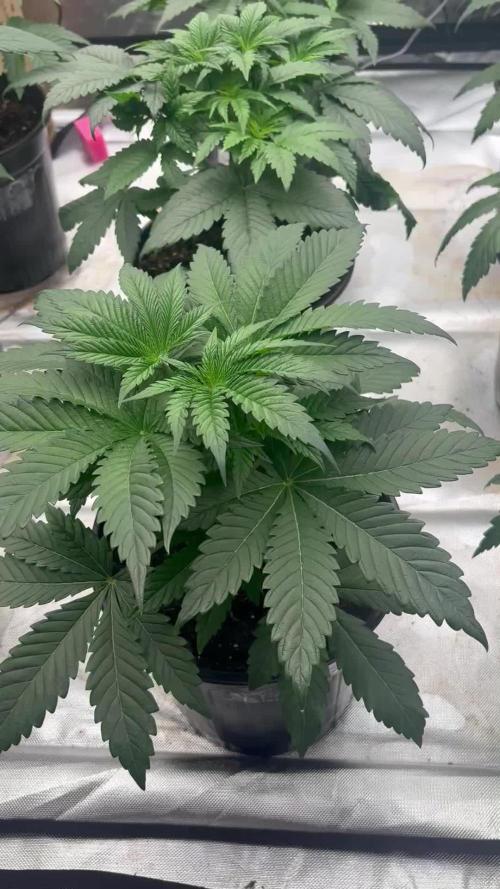
Well to my eyes growing so perfectly and they haven’t did anything specific but grow evenly, Barney’s farm never really fails these are great so yeah plants are growing fast as veg goes on leaning there side branches is coming around and growing evenly with me topping it . So yeah let go cherry poppers I hope I can get some all purple type or even a purple pinkish tips that would be dope .. but yeah hope and wishful thinking doesn’t hurt. But yeah these are doing the best as a group and one of the best in the grow also


Likes
39
Share


@valiotoro
Follow
Hello everyone week 5 of flower has passed for this Cinderella Jack auto 👸🏼
For the feeding schedule i stopped feeding Power Roots and Pure Zym and started feeding Green Sensation 0,7ml/l
Mars hydro FC-E6500 power 85%
have a great day and wish you all happy growing 😎

Likes
16
Share


@Ganjagrandaddy
Follow
Day 43 flowering today. She is still looking rough from the calmag issue but is doing ok in general. Her buds are still forming nicely but lack of anything takes its toll . she smells sweet/skunky at the moment but her nugs are solid now. so sad i fucked up on her with the cal mag miss. She looks close to being done now so will be watching her trichs. come on girl bulk up.
Processing
Likes
7
Share


@Dralph87
Follow
Getting slightly confused on how quickly RC#1 has grown! I'm looking at other diaries and these look about 2 weeks ahead! RC#2 is a little behind but should be at this level in a week. I'll add more pics this week.
No issues atall this week, I check in the morning, water in the evening. That's it... for a first grow this has been a breeze.
28.08 (day 52)
RC#2 seems to of picked up some pace again. I'm wondering if some defoliation shocked her for a few days. I think RC#1 has about 2.5 weeks left
01.03 (day 54)
Both have had alot of defoliation this weekend as I could see the humidity has started to creep up slightly. No issues atall. All of the girls (x7) are now on bloom nutrients.
RC#1 has been tappered down on nutrients as it's quite possible she will be ready to chop in less than 2 weeks, still amazed how far she is ahead of RC#2 who is only just really starting to properly show formation of flowers, so I'm guessing she will go the full 10-12 weeks.
Overall I'm impressed with the RQS seeds, grow has been easy based on I only graduated from my YouTube masters degree in growing in 3 weeks! Lol.
Likes
58
Share


@biggreens420
Follow
Going into flush this week for 2 week shes fattend up nicely and begun maturing ph water at 6.0 with terpinator thanks for reading happy growing guys

Likes
21
Share


@Cogollo_eu
Follow
(Encontrarás la traducción a "Español" en la última parte de la descripción)
07/September/2018: (Photo 1)
09/September/2018: (Photo 2)
Foliar application of Neem oil, Potassium Soap MIX with organic insecticide (Tec-Forte) to combat Trips and white flies. I sprayed 1 l of water with 5 ml N.Oil + 5 ml P.Soap and 0.2 ml of Tec-Forte @ 9 P.H.
12/September/2018: (Photo 3, 4, 5, 6, 7 & 8)
I created some red circles in the 5th photo to remark some of the insect evidences, most of them are from Trips and White flies, but there are also from another insects, here the link to the High-res image -> https://growdiaries.s3-accelerate.amazonaws.com/static/post/photo/15048/621594_fb-auto-girl-scout-cookies-outdoorsfastbudsgirl-scout-cookies.jpg
** WEEK 5 EXACT WATERING CALENDAR **
07/09/18 - 1.5 l of water + All "PREVIOUS WEEK nutrients" (- Bud Ignitor) @ 6.4PH & 0.95 E.C.
08/09/18 - Drought
09/09/18 - 1 l of water + Bud Ignitor @ 6.4PH
10/09/18 - 1.7 l of water + All week nutrients @ 6.4PH & 1.20 E.C.
11/09/18 - Drought
12/09/18 - 1.5 l of water + "*Half dose" of all (Advanced Nutrients) week nutrients @ 6.4PH
13/09/18 - Drought
----------- ESPAÑOL ------------
07/Septiembre/2018: (Foto 1)
09/Septiembre/2018: (Foto 2)
Aplicación foliar de Aceite de Neem y Jabón Potásico con (Tec-Forte) para combatir Trips y mosca blanca. He echado 1 litro de agua con 5 ml de Aceite de Neem, 5 ml de Jabón Potásico y 0,2 ml de Tec-Forte @ 9 P.H.
12/Septiembre/2018: (Foto 3, 4, 5, 6, 7 & 8)
He creado círculos rojos en la foto 5, alrededor de alguna de las marcas que han dejado los insectos en las hojas. Mayoritariamente son de mosca blanca y trips, pero también hay de otros insectos. Os dejo aquí el link a la foto en alta resolución -> https://growdiaries.s3-accelerate.amazonaws.com/static/post/photo/15048/621594_fb-auto-girl-scout-cookies-outdoorsfastbudsgirl-scout-cookies.jpg
** SEMANA 5 CALENDARIO DE RIEGO EXACTO **
07/08/18 - 1,5 l de agua + Nutrientes de la "SEMANA ANTERIOR" (- Bud Ignitor) @ 6,4PH & 0,95 E.C.
08/09/18 - Sequía
09/09/18 - 1 l de agua + Bud Ignitor @ 6,4PH
10/09/18 - 1,7 l de agua + Nutrientes de la semana @ 6,4PH & 1,20 E.C.
11/09/18 - Sequía
12/09/18 - 1,5 l de agua + "Media dosis" de los nutrientes (Advanced Nutrients) de la semana @ 6,4PH
13/09/18 - Sequía