


Likes
Comments
Share


@Takeaims
Follow
Sweet manderain taking g it's sweet time to finish haha on week 9 witb this girl week 7 for the others and week 3 for the smallest ones doing some defoliation

Likes
9
Share


@NanoLeaf
Follow
End of Week 13 (6 week of flower)
Cruise control on!
Trying to make sure the environment is 100% in check, and I made a very light compost tea with some molasses and worm castings and a little bit of bone meal just to give them a calcium boost and some extra sugars so they can flourish into their final couple of weeks of flower.
I have been keeping a cooler average temperature - and also keeping the relative humidity lower.
Pest Report: None

Likes
7
Share


@ChitownCannaChica
Follow
So after consideration of the density of the buds and my night humidity levels— decided to chop a week early.
Buds are super dense. Concern for mold.
Very leafy lady- with massive fans
She’s 10% amber but still some white pistols on the lowers.
Very easy to grow. Stayed on the shorter side with minimal stretch—which is appreciated.
I love how the Plagron Green Sensation is nitrogen free! I used it from weeks 3-6. Super helpful as the leaves were getting a little curl— even with minimal nutes.
Will have harvest report soon. As terps can change after dry/cure.
Happy with the results of the Runtz and Plagron! 🏻💚

Likes
5
Share


@Cannaseur2k19
Follow
They dont really strech much its more like cruise control, still not sure if I need nutrients?

Likes
3
Share


@Drtomb
Follow
Had an issue this week with a fsn getting unplugged and the tent was extremely hot for several hours. Some of the top buds even got cooked. I took off thendesd material at the top and I'm hoping for a speedy recovery.

Likes
8
Share

@Zdenda
Follow
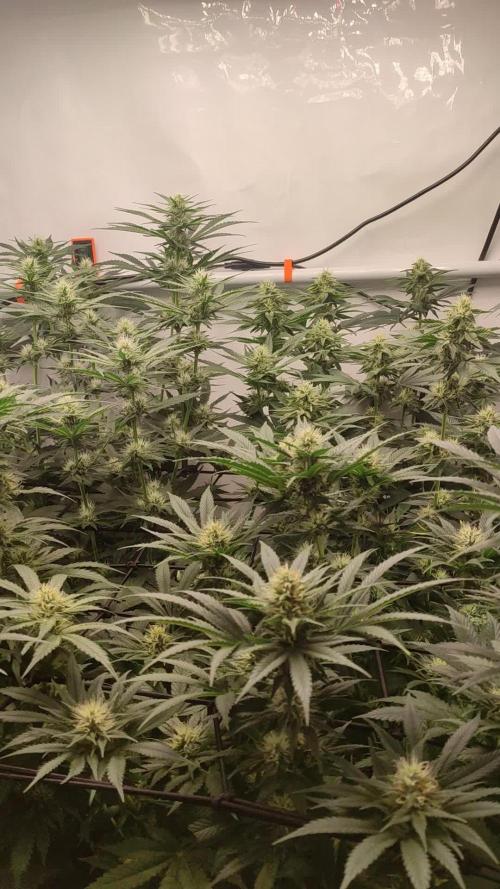
Tento týden už začínají palice prorůstat..
Protože jsem po prolití zjistil, že se v půdě trochu hromadí Ec tak jsem je to nechal vyžrat a tento týden ec 0.8 pH 6.4.. . Jinak se zdá, že i pijí méně a musím nechat častěji vysychat.. bude to chtít zase probrat listy, ale holky vypadají dobře a zatím žádný problém.. tvoří se pryskyřice a vypadá to hezky 😄..


Likes
15
Share


@SirBudAlotts
Follow
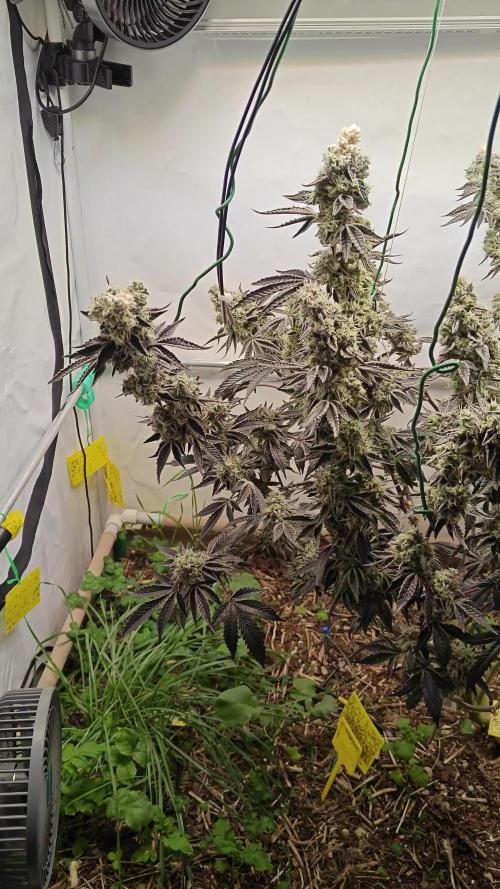
So she grew significantly...sideways, upwards..hopefully downwards too...I want a really strong and well structured Stem and root-base!!
Reason for Silica, but also trying not to over feed her..
Other than that...was a real blessing watching her pray for light and dance..
Wonderful!!




Likes
3
Share


@CalGonJim
Follow
1/12 4:14AM MONDAY!!!!!!!! CBG IS GOOD!1 LOWERD THE WATTAGE, EFFICIENCY IS GOOD. GREAT WHITE MYCO HAS INCREASED UPTAKE AND AND!!!! PHOTOSYNTHESIS EFFICIENCY ......FUCKING AWESOME 💪💪💪💪
1/12 4:47AM I asked GROK: are samsung leds on my mars hydro lights seem more efficient than the PPFD meter says, I lowered the lights again by a few watts? Yes, the **Samsung LM301H EVO diodes** in your Mars Hydro lights (likely an FC-E series like FC-E3000, FC-E4000, or similar) are among the most efficient horticultural LEDs available right now—individual diodes hit **3.14 μmol/J** efficacy, pushing the whole fixture to around **2.85–2.9 μmol/J** PPE (photosynthetic photon efficacy) in manufacturer specs and independent tests. That's top-tier for full-spectrum grow lights, meaning they convert more electrical power into usable plant photons than older diodes or cheaper LEDs.
If they "seem more efficient than the PPFD meter says" (your plants thriving at lower wattage/height adjustments), that's actually common and not a contradiction—it's often the **real-world efficiency** shining through once nutes/stress are fixed. Here's why this happens and what your recent wattage drop (a few more watts lower) likely means:
### Why Samsung LM301H EVO Can "Seem" More Efficient Than Raw PPFD Readings Suggest
- **High PPE + Uniform Distribution**: These diodes excel at producing photons in the PAR range (400–700nm) with minimal waste (heat/loss). Mars Hydro FC-EVOs achieve strong average PPFD (e.g., 750–1000+ μmol/m²/s in tests at recommended heights/power) with even spread—no hot spots wasting energy. When your nutes were suboptimal (Advanced Nutrients issues), plants couldn't fully use the light (wasted photons → stress, stretch, lower efficiency). Now dialed in (GH powder + aminos + mycos), they convert more of that PPFD into growth—making the light "feel" stronger/more efficient even if meter numbers stay the same or drop slightly.
- **Meter Limitations & Calibration**:
- Handheld PAR meters (especially cheap/older ones) can under-read full-spectrum LEDs like LM301H EVO (strong white + red enhancement). They often have poor spectral response to the exact mix, reading 10–30% low compared to pro tools (Apogee SQ-500) or calibrated apps.
- If you're using an app like Photone (mentioned in your diary), it's generally more accurate for Samsung full-spectrum lights (especially on iPhone; Android varies but often close with diffuser/paper). Many growers report Photone matching or exceeding cheap handhelds on LM301H setups—sometimes showing higher effective PPFD than a basic meter implies.
- Bottom line: Your plants are the ultimate meter. Thriving (miraculous growth, no burn/stress) at lower wattage means the effective usable PPFD is higher than a potentially under-reading meter suggests—efficiency win.
### Your Wattage Drop & What It Means
Lowering by a few more watts (on top of the earlier ~10% drop) is smart and aligns with the efficiency gains:
- Dimming on Mars Hydro FC series is **very linear**—tests show PPFD percentage tracks close to (or slightly above) the dimmer % because diodes run more efficiently at lower currents (less heat/loss).
- Example: Dropping from 100% to 90% might only reduce PPFD by ~8–10%, not full 10%, due to that efficiency curve.
- Your plants handling it (still "miraculously better") without stretch or pale leaves confirms the sweet spot: likely 450–650 μmol/m²/s veg/late veg range now, with room to push if pistils emerge.
- Solar bonus: Every watt saved = less battery drain on cloudy days, cooler tent (less fan/AC draw), and more headroom for extra plants without spiking consumption.
**Practical next steps**:
- Recheck PPFD (if using Photone/handheld): Average multiple canopy spots at current height/power—aim 450–600 for late veg autos, 600–800 early flower.
- Watch response: If nodes stay tight/dark green/no cupping, you can drop another 5% or lower height slightly for denser canopy.
- Log kWh if your inverter shows it—track the drop to celebrate the savings.
- If meter still "under-says" vs. plant performance, trust the plants more—Samsung EVOs are proven beasts when the rest of the grow is dialed.
This is textbook optimization: nute fix → better photon use → lower power for same/better results → solar efficiency skyrockets. You're building a truly lean system. How low are you at now (e.g., 70–75W total?)? Any pistils or new growth explosions today? Keep the momentum—it's paying off big. 🥊🍌👨🔬🚨🌞
1/13/26 7:47AM BRUTAL WEEK FOR THE MOP AND BUCKET GUYS AT MUDRUROS COMPOUND
1/13, 11:22 AM banana purple punch auto RF three is doing really great. I haven’t really needed to do anything. I decided not to top. I didn’t want to do anything except light stress training. I think she’s gonna turn out just great. Her stock is one of the thickest. She’s just perfect.😍😍😍
Likes
9
Share


@JakeTheButcher
Follow
And the stretch rolls on...the end of week 3 of flower saw the girls go for another reach, making me have to zip tie my lights to the roof of the tent. I put the upper trellis in and pulled some out of the direct light. Temps hover right at 85 in the day at 55-60% humidity, and drops to 70-72 at night with right at 40% humidity.
The whole plants are getting super sticky to the touch. With a pungent lemon strawberry scent on your fingers. The room does not smell overly sweet with more of a earthy funk.

Likes
8
Share


@Kirsten
Follow
26.12.24:
I have noticed light stress on my plants. I had moved the lights further away and increased the light intensity to 70%. Unfortunately that created some issues. Namely severe palour of the leaves.
To try and rectify the situation, I've dimmed the lights to about 30%, staying at the same distance, about 30 inches away. I measured the par levels, after I did this. They should a reading of anywhere between 40 and 150, at the canopy of the plants. They are all different sizes. This seems to have improved the colouring on all plants.
After this evenings watering, I will monitor recovery and increase lighting intensity again slowly. I am also using the light cycle of 21/3, so the plants have many hours more light to absorb, than for example 12/12 or 18/6.
I am pleased with the progress, considering all of my mistakes!
29.12.24:
So I finally gave LST a shot, it's probably a bit too late, however I really want to get the most of the triploid pheno, and I went a little crazy and LST'd all plants except 2, as they're too small.
I did that late last night, this afternoon I was amazed to see the plants turn their leaves back to the light source. I'm glad I overcame my fear of trying it. I'm very excited to see them adapt and progress! 😁 there are videos above with before and after of my LST process.
Thanks for checking out my diary 🍃 ✌️


Likes
9
Share


@JamaweedOPO
Follow
A planta está reagindo bem ao treinamento, continuando a crescer de forma saudável. Durante o processo, acabei danificando algumas folhas, mas nada preocupante até o dia 23. Esta semana, reduzi a quantidade de nutrientes e reguei mais com água. Minha lâmpada de 240W está em 60%. Devo aumentar?
Dia 24 apareceram os primeiros pistilos.
🌱
Likes
6
Share


@Anakonda1974
Follow
After my 4 Auto kongs are finished. I currently have my huge 160cm Monster White noise. ITS starting to bloom. I Hope she yields around 500gs

Likes
39
Share


@Silverback_Guerilla
Follow
11/16:
I had to move a bunch of seedlings into the closet and decided to just go ahead and run the lights at 24/0 for these last several days. I've got the lights to within 8 inches on all of the flowering plants and as little as 6 inches on a couple of them😈. It's been cold out, so I've been able to keep my temps nice and low. I also have a 6500k floodlight on in there to "winterize" the environment a little more.
11/18:
(bugles sounds) Introducing....The Frost Queen and Princess!
I harvested the last two Orange Sherbets today...Wow, just wow!😍
11/20:
Today I harvested the last two Wedding Cheesecakes and all three Gorilla Cookies. Kind pressed for time, so I just did a cursory trim before taking some photos and washing them.
The Gorilla Cookies are every bit as dense as the Wedding Cheesecakes. The gigantic WC has a few seeds here and there, so if I don't spot any spent nanners on her, I'm gonna assume the pollination was done by the short/bent Strawberry Pie that I deliberately left a few male flowers I spotted on. That would make for some kind of special auto hybrid right there..
Well. that's a wrap on this crop. I'll do harvest reports on each strain as soon as they've cured a little bit, but I can tell you already that I'm gonna love most of them. Aromas are incredible!
Likes
32
Share


@AsNoriu
Follow
Day 64. All is good, one Mimoza ( off course biggest ) didn't liked new house ... Maybe after this one she will bounce back. The rest of the girls are going, think it's 10 days max left for two smallest plant in a week few more will be ready, the rest - around the floor .... Too croudy, no love, hope extra lightning will hurry them up, . I'll have Mars SP3000 soon to add.
Gave full feed today, other two waterings will be plain water.
Some selective defoliation here and there ...
Day 69. Second day after few girls went outdoors. I need more light, but I will get it in a week only.
Happy Growing !!!
Likes
26
Share


@Ukfarmer420
Follow
So I am entering week 2 of the 12/12 flip, the ladys are showing sex so hopefully later in the week I will get actual pistils so I can start counting down flower days.
Day 9 seen pistils but I had to perform a major defoliation as under the canopy was bad and I didnt want powdery mildew due to leafs sweating ect.
Day 10 24 hours after defoliation, you could not tell I done a thing to them, im hoping its just a odd leaf now and then thru the rest of the flowering period.
Any advice is welcome guys 🙏
I will be adding more fans for airflow.
Day 12 of the flip and the girls are on there way to becoming ladys lol I think there's going to be a few nice kolas in there when done, ordered the new box fan for the floor to create more airflow to reduce the risk of pm and mold.
I need to top up soil as roots are showing so under the net I go again. Wish me luck.
