


Likes
Comments
Share


@ArtisticGrown
Follow
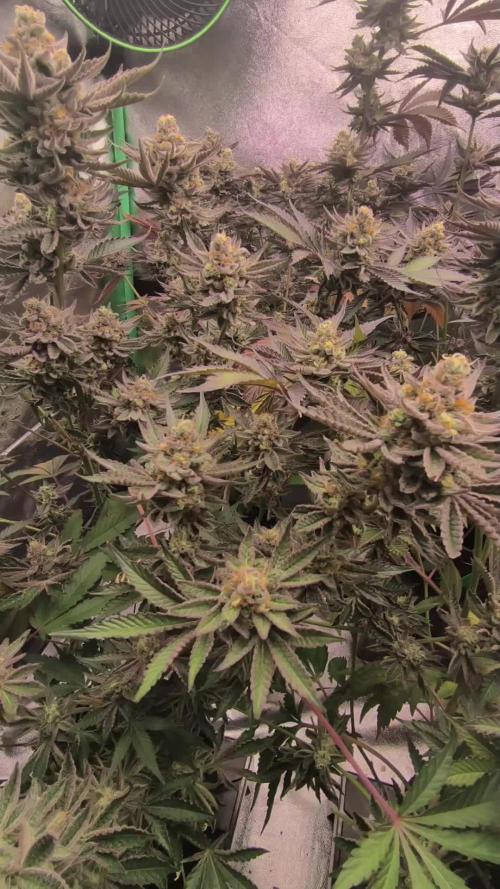
This week has been great.I'm glad that I was able to pull the plant when I needed to. The weather out here isn't always the best coming towards the end of October. How ever i handle it the best we can. What ive learned to do is wet trim before hang dry. Heres some phots of these glossing nugs. Iknkw ill lose a bitin water weight but im happy none the less. Fire 🔥
This has been a great grow, I learned a lot from Growing out here in new mexico. It was amazing to be able to train these plants 4 into one using training techniques. LST, HST, Defolation & topping all play a roll. It is fun to learn and sharpen my skills.
I hope everyone enjoys my diary.
Thank you so much Divine seeds. I appreciate the free seeds and the friendly community competition 👌
There's a lot of good growers outthere and I wanna learn from all. Much love ❤️ I'll be back with a smoke review soon


Likes
3
Share

@Jessi576
Follow
👉 Week 9 Bloom👈
👉01.05.2026 - 07.05.2026👈
👉 Days bloom: 57-63👈
The end is near !
This is my most beautiful grow for me, until now. Very beautiful nuggets and very few leaves.


Likes
110
Share


@SlowpokeFuegobud
Follow
💜 💚 😍🥤💜💜 💚 😍🥤💜💜 💚 😍🥤💜💜 💚 😍🥤💜💜 💚 😍🥤💜
Dear growmies, welcome to week 13 which only has 2 days!! ❤️
This was the most spiritual grow ever! 💜🙏On day 1 of flowering week 8 she started to throw out bananas, and I took that as a discreet sign that she is finished. 😅 Magically just right. ✨
So happy with this! I will miss her! Can't wait for the smoke report. 😍
Thanks @Fast_Buds for your awesome genetics, growing Fastbuds is always a bit like riding a ferris wheel! Woohooo!! 😜 🙏 💚
Thanks to my sponsors @Green_Buzz_Nutrients, their nutes never ever let me down!! Check out my diaries on how well they work! 💚 😘 In case you want to give them a try, you can find a generous discount code in the setup description further down the road ⬇️
You can find more brand hot updates on my IG, where I share real time events from my growroom, don't miss this! 😝
_______________________________________________________________________
Purple Lemonade FF
As refreshing as cold lemonade on a hot Summer day. 🌞
• Quench your thirst. Just as good as lemonade on a hot Summer day.
• The gentle giant. Up to 550 g/m2 of gorgeous pinkish-purple buds.
• Refreshing for the mind and body. The ideal all-day strain with a perfectly balanced effect.
• Sweet n’ sour terps. Mouth-puckering lemon flavors that’ll hypnotize your taste buds.
• Properly purple. The perfect choice for purple hash and extractions. As refreshing as cold lemonade on a hot Summer day.
Arising from a cross between purple and citrus Cali genetics, Purple Lemonade FF (Fast Flowering) offers a complex high made up of perfectly balanced cerebral and body effects that are ideal for daytime use. Expect an extremely enjoyable high that boosts your mood while deeply relaxing your whole body and getting
rid of muscle pain. This meticulous cross produces up to 550 g/m2 of some of the most beautiful purple buds, with pinkish and reddish hues that will catch everyone’s attention. The beautiful purple buds are ready for harvest in 7-8 weeks and come hand-in-hand with unbelievably sugary citrus terps that are just as refreshing as a cold lemonade on a hot Summer day. It’s the ideal variety for the sweet-tooth stoner seeking strains that deliver both in quality and quantity of resin.
Bud Description 🦔
Purple Lemonade FF grows chunky, spade-shaped buds that boast a whole range of pinkish-purple hues with rich, dark orange pistils shooting out of every direction. This variety stands out for the, oftentimes, lilac trichomes that give them a gorgeous pink tint and make for outstanding purple concentrates. The buds give off a delicious tart lemon aroma that reveals a sweeter, more fruity scent as you break the buds open. Definitely a must for flavor chasers and those looking for pungent terpene profiles.
Smoke Reports 💨
Purple Lemonade FF offers an effect that’s just as unique as the flavor. Expect a potent uplifting high that gives you that energy boost you need to get things done while 100% happy and stress-free. The effect gradually transforms into a wave that works its way along the limbs and through the muscles, deeply relaxing your body and putting you in the right mindset to go through a busy day with a huge smile on your face. This is an excellent all-day smoke as it not only increases energy but can also help combat chronic pain, migraine and stress.
Plant Appearance 💄
This feminized photoperiod variety develops a thick and strong structure, growing a medium-sized main cola with multiple shorter side branches, typical of hybrid strains. Purple Lemonade FF develops fairly short internodal spacing with gorgeous purple buds growing stacked on top of each other, making it the perfect choice for growers of all levels looking to get lots and lots of top-shelf purple weed, as this variety can produce up to 550 g/m2 in a 7-8 week flower cycle.
Grow Tips 🤓
This is a super fast feminized photoperiod version that takes approximately 7-8 weeks to flower with a 5-week vegetation cycle,, this means you can have faster harvests by shortening the veg cycle or have a longer veg cycle for bigger yields. Purple Lemonade FF (Fast Flowering) makes for a great candidate for growers of all levels as it’s a vigorous strain that will thrive with basic maintenance both indoors and outdoors. This is a resin powerhouse so make sure to have your trim bin close by as all the resinous sugar leaves will make for the most mouth- watering hash and extracts.
Flavor 😋
Expect a long-lasting citrus zest that taste just like it smells. Purple Lemonade FF reeks of a delicious blend of sweet fruits and tart citrus that’ll make your mouth water. On the inhale, expect sour flavors that taste just like lemon candy with hints of orange and a really subtle earthy background. And on the exhale, the citrus flavors open up, giving place to a more sugary berry fruitiness that leaves your whole mouth tasting like an extremely sweet weed-infused lemonade.
https://2fast4buds.com/seeds/purple-lemonade-fast-flowering
_______________________________________________________________
Setup:
140x70x200 cm Spiderfarmer tent
2x Monkey 16W fans (not oscillating)
1x Secret Jardin 30W
1x box fan 50W oscillating (on lowest level)
LED
Full Spectrum 320W AGLEX AGL-320W-MA
5,6 kg
foldable, dimmable
864 pieces Samsung LH301H
864umol/s
2,7umol/J
full spectrum white
RED 660nm
IR 740nm
wavelength range 380-780nm
covering 3x4ft
Green Buzz Nutrients https://greenbuzzliquids.com/
❗ Use code GD42025 for generous 25% discount (for orders of minimum 75€)
Biobizz Lightmix
coco
wormcastings
perlite
Carbon Active Granulate Filter 125/360 cm³/h
PrimaKlima exhaust EC 125-400/240 cm³/h

Likes
2
Share


@ShinWeed
Follow
.
🌱 Tag 21 – Eine Woche voller Experimente
Drei Wochen alt. Eigentlich der Zeitpunkt, an dem junge Pflanzen einfach gemütlich wachsen, Wurzeln bilden und jeden Tag ein bisschen größer werden. In unserem Fall wurde daraus allerdings eine kleine Wissenschaftsshow mit mehreren unerwarteten Wendungen.
Die Woche begann mit unserer ersten Düngung. Für uns war das Neuland und für unseren Gärtner offenbar auch. Nach vielen Jahren mit organischem Dünger musste er erst lernen, dass mineralische Nährstoffe nicht erst gemütlich auf ihre Freigabe warten, sondern sofort verfügbar sind. Das führte dazu, dass wir etwas früher gefüttert wurden, als es eigentlich nötig gewesen wäre.
Zusätzlich gab es noch ein paar weitere Überraschungen:
Der pH-Wert lief zeitweise nicht ganz wie geplant.
📦 Statt pH- wurde versehentlich pH+ geliefert.
🔄 Bei der ersten Nährstoffmischung wurden Grow A und Bloom A vertauscht.
🌱 Die Düngung begann etwas früher als optimal.
Man könnte sagen, unser Gärtner hat diese Woche sehr viel gelernt. Wir Pflanzen nennen das lieber „praktische Feldforschung“.
Zum Glück blieb es bei kleineren Problemen. Zwar waren wir zwischenzeitlich nicht immer ganz begeistert von den Mischungen im Tank, aber insgesamt konnten wir weiter wachsen und neue Blätter bilden. Wirklich dramatisch wurde es nie.
Unser Wassertank lief die ganze Woche durchgehend. Da er allerdings mehrfach neu angesetzt wurde, weiß inzwischen niemand mehr so genau, wie viel Wasser wir tatsächlich verbraucht haben. Die Buchhaltung wurde wohl von einer Zimmerpflanze geführt.
Folgende Nährstoffe kamen diese Woche zum Einsatz:
Bittersalz: 0,5 g/L
🌿 Grow A + B
? Silica
⚡ Multi Total
Für die nächste Mischung wird das Bittersalz bereits auf 0,3 g/L reduziert. Wieder etwas dazugelernt.
Nicht ganz ohne Zwischenfälle verlief die Woche für Pflanze #2. Bei einer kleinen Pflegeaktion wurde einer ihrer Triebe versehentlich angeknackst. Für einen kurzen Moment sah es so aus, als hätte sie beschlossen, den Dienst zu quittieren.
Zum Glück stellte sich der Schaden als weniger schlimm heraus als zunächst befürchtet. Der Trieb blieb erhalten und kämpft sich weiter durch. Pflanzen sind manchmal erstaunlich widerstandsfähig. Während Menschen bei kleinen Verletzungen häufig erst einmal das Internet nach ihren Symptomen durchsuchen, reparieren wir einfach unser Gewebe und wachsen weiter.
Trotz aller kleinen Stolpersteine wachsen wir weiterhin ordentlich weiter. Unsere Blätter werden größer, unsere Stämme kräftiger und unter der Erde arbeiten die Wurzeln vermutlich längst an ihrem eigenen Ausbauprojekt.
Im Vergleich zur letzten Woche sehen wir inzwischen deutlich erwachsener aus. Noch sind wir jung, aber langsam entwickeln wir uns zu richtigen Pflanzen und nicht mehr nur zu besonders ehrgeizigen Keimlingen.
Nächste Woche hoffen wir auf etwas weniger Experimente im Nährstofftank und etwas mehr Routine. Andererseits wäre das Leben als Pflanze vielleicht auch langweilig, wenn immer alles perfekt laufen würde. 🌿
👨🌾 Gärtner:
Diese Woche lief nicht alles nach Plan, aber dafür habe ich wahrscheinlich mehr gelernt als in den ersten beiden Wochen zusammen. Der größte Unterschied zu meinen bisherigen Grows war der Wechsel von organischem auf mineralischen Dünger. Beim nächsten Durchgang werde ich deutlich später mit der Düngung beginnen, vermutlich erst Ende Woche 3.
Die größte Erkenntnis war, wie schnell mineralische Nährstoffe wirken und wie wichtig ein sauber eingestellter pH-Wert ist. Mit organischem Dünger hatte ich viele dieser Effekte nie direkt bemerkt, weil die Nährstoffe deutlich langsamer verfügbar werden.
Zusätzlich sorgte eine falsche Lieferung für etwas Chaos. Statt pH- kam zunächst pH+ an, wodurch die Wasseraufbereitung deutlich komplizierter wurde als geplant. Inzwischen ist das Problem aber gelöst und zukünftige Mischungen sollten deutlich entspannter verlaufen.
Fehler gehören dazu, besonders wenn man neue Methoden ausprobiert. Wichtig ist am Ende, daraus zu lernen und die Pflanzen genau zu beobachten.
Bisher haben sie mir zum Glück alle Fehler teils verziehen. 🌱
p.s. neue LST Haken!
Likes
6
Share


@CadillacGreen_420
Follow
Week 13 – Ripening is now progressing slowly, as I had expected, due to my choice to provide a light stimulus that isn’t too intense but rather gentler. From flowering until now I’ve maintained 30 DLI and a steady 470 PAR.
In this run, the goal has been to keep the resin thick and sticky. Humidity has been kept between 57–62% max. My lamp is an Omega Pro 300W, which I’m currently running 37% (111 W).
This strategy seems to be working well: resin production has been abundant, and on this point—and not only this one—I’ve completely fallen in love with Gorilla Cookies.
The aroma is exquisite, and the resin… the flowers are covered in ointment-like resin.
The macro shots of the trichomes still don’t show any amber heads, so I believe harvest is probably about 10–15 days away. 🍮🤤
I think I’ll grow only Gorilla in the next run! 🦍👀
P.SThe leaf discoloration happened very quickly! The previous photos are from yesterday when it was still green — today it looks like this. Really interesting
Likes
3
Share


@420Junglist
Follow
So the mainline is going great about ready to give the branches another topping. Hoping for 10-12 tops when done. My VPD is spot on and running a 800-900 PPM and 700 to 900 μmol/m²/s.for my lightning
Likes
7
Share


@Jardineiro_Br
Follow
Agora sem aplicações de técnicas, apenas fertilizantes e água, para que a energia da planta seja usada nos botões, quero ver lindos botões, densos e resinados . Por enquanto estou bem satisfeito com o resultado, essas próximas 3 semanas , acredito, serão decisivas para definir um boa produção.
Likes
200
Share


@Ferenc
Follow
Day 72, 21st of November 2020:
Hi! Wao this is what I can say and luckily stoppe streching....
All LST has been removed as the plants remain the same so no need to keep them in "chains".
Those Original Sensible girls 3 of them (Gelato, Runtz Gum, Do-Si-Dos OG)went crazy, except Black Ghost OG she did not strech much typical little indica lady. And the THC crystals alrady on the leaves on the Runtz Gum and Do-Si-Dos OG just simply beautiful.
Buds are coming getting thick they are gorgeous only I can see some some sort of deficiency on Do-Si-Dos OG a bit on some leaves.
The fertilization schedula isnthe same every 2nd day and happens with the mix and ratio above.
Wedding Gelato is beautiful also I hope the nice purple colour will come out as well in late flowering stage. :)
The lamp is on 11.30 min and off 12.30 min.
Last week was 15 min longer light cycle....
So every week 15 min shorter light cycle until the 5th week. So far -30 min. It switches on at 6 am and off at 17.30 pm.


Likes
16
Share


@grow_prophet
Follow
Chopped on day 58! She smells like a bowl of Fruity Pebbles and Sprite, SO GOOD!

Likes
2
Share

@Bizarrr
Follow
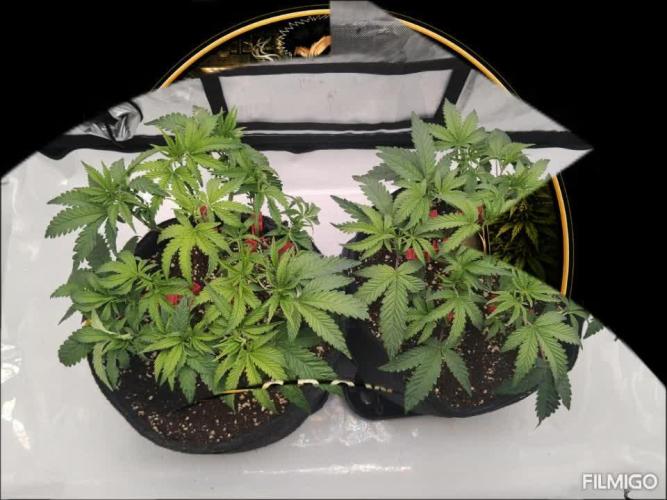
Po dlouhé době hlášení. Nic se nějak nedelo.Nějaký ten trénink proběhl a nakonec bylo rozhodnuto že v boxu zůstanou jen dvě nejsilnější ať mají dostatek místa a světla. Sám jsem zvědavý jak to 2 oproti 3 kytkam co bylo ve stanu minule vyplní. Zálivka postupně zvedána,teď už jedu cca 4L s malým výtokem. Proběhla defoliace a bude se přepínat na 12/12 a začneme přidávat hnojení na květ. Teď už report každý týden jak holky rostou a jak se jim daří. Hodně štěstí všem,ať to roste ?


Likes
1
Share


@crudblowersanonymous
Follow
Plants began showing pre-flowers this week, officially the start of flowering.

Likes
33
Share


@TickleToast
Follow
Signs of swelling, & smell is picking up.
Lots of nice-looking colas between these 3 gals.
-Need to start bringing up my defoliations / canopy a little bit. More bottom larf than preferred, and it just forces me to pull them later anyway.
~~~~~~~~~~
Questions & Feedback are welcomed, feel free to message me!
Thanks for stopping by growmies! 🤙🤙🤙🙏🙏🙏

Likes
11
Share


@Liamp1603
Follow
This grow cycle was one of my best from start to finish I had 5 females 4 of which were brilliant all shown colour all fruity gassy and amazing only the one was bland and green in colour and smelt different really good nug atructure but the smell wasn't there for me ... this is around my fifth grow and I'll be running these strains again to get it down to one pheno of these genetics

Likes
7
Share


@Cannabotanica
Follow
Pour cette 20ème semaine, le SCROG explose littéralement. La nappe de fleurs canopée + sous canopée fait bien 25-30cm d'épaisseur. J'ai compté une centaine de têtes sur moins de 20cm2. Les fleurs sont enormes et commence a resiner pour la AK Skunk (landrace). Tres beau SCROG

Likes
2
Share


@Altitonans_Fulmen
Follow
For most crops, a slightly acidic soil pH between 6.0 and 6.8 is ideal because it optimizes nutrient availability. When soil pH rises above 7.0 (alkaline), the concentration of hydrogen ions H+ drops significantly, and they are replaced by calcium, magnesium, or sodium ions on the clay colloid exchange sites. To naturally lower alkaline soil pH, you can add organic matter (carbon-rich materials), which produces weak organic acids as it decomposes. Maintaining this slightly acidic range stimulates a highly active, diverse microbial community; these microbes decompose organic matter and release carbon dioxide CO2, which plants absorb through their roots and leaves to boost photosynthesis and sugar production. Furthermore, the added organic carbon acts like a sponge, drastically improving the soil's water-holding capacity.
While soil biological activity does involve cellular electron transport, electrical conductivity (EC) in soil is actually a measure of dissolved mineral salts, not a voltage carried by individual microbes. Soil microorganisms secrete organic acids and chelate metallic and non-metallic minerals, transforming locked-up inorganic compounds into bioavailable organic complexes. Unlike harsh synthetic fertilizers that can dehydrate soil life in high concentrations, these naturally chelated nutrients safely nourish the plant, creating a thriving, self-sustaining ecosystem where plants can efficiently synthesize their own food.
Metal-based: Could include elements like iron, manganese, copper, or zinc, which are essential nutrients for plants but can exist in forms not readily accessible.
Non-metal-based: Examples like calcium carbonate, phosphate, or sulfur are also important for plant growth and potentially serve as building blocks for the organic salt.
Chelation in a plant medium is a chemical process where a chelating agent, a negatively charged organic compound, binds to positively charged metal ions, like iron, zinc, and manganese. This forms a stable, soluble complex that protects the micronutrient from becoming unavailable to the plant in the soil or solution. The chelate complex is then more easily absorbed by the plant's roots, preventing nutrient deficiency, improving nutrient uptake, and enhancing plant growth. Chelation is similar to how microorganisms create organic salts, as both involve using organic molecules to bind with metal ions, but chelation specifically forms ring-like structures, or chelates, while the "organic salts" of microorganisms primarily refer to metal-complexed low molecular weight organic acids like gluconic acid. Microorganisms use this process to solubilize soil phosphates by chelating cations such as iron (Fe) and calcium (Ca), increasing their availability.
Added sugars stimulate soil microbial activity, but directly applying sugar, especially in viscous form, can be tricky to dilute. Adding to the soil is generally not a beneficial practice for the plant itself and is not a substitute for fertilizer. While beneficial microbes can be encouraged by the sugar, harmful ones may also be stimulated, and the added sugar is a poor source of essential plant nutrients. Sugar in soil acts as a food source for microbes, but its effects on plants vary significantly with the sugar's form and concentration: simple sugars like glucose can quickly boost microbial activity and nutrient release. But scavenge A LOT of oxygen in the process, precious oxygen. Overly high concentrations of any sugar can attract pests, cause root rot by disrupting osmotic balance, and lead to detrimental fungal growth. If you are one who likes warm tropical high rh, dead already. Beneficial, absolutely, but only to those who don't run out of oxygen. Blackstrap is mostly glucose, iirc regular molasses is mostly sucrose. Sugars, especially sucrose, act as signaling molecules that interact with plant hormones and regulate gene expression, which are critical for triggering the floral transition. When sucrose is added to the growth medium significantly influences its effect on floral transition.
Probably wouldn't bother with blackstrap given its higher glucose content. Microbes in the soil consume the sugar and, in the process, draw nitrogen from the soil, which is the same nutrient the plant needs. Glucose is not an oxygen scavenger itself, but it acts as a substrate for the glucose oxidase (GOx) enzyme, effectively removing oxygen from a system. Regular molasses (powdered if you can), as soon as she flips to flower or a week before, the wrong form of sugar can delay flower, or worse. Wrong quantity, not great either. The timing of sucrose application is crucial. It was more complicated than I gave it credit for, that's for sure. When a medium's carbon-to-nitrogen (C:N) ratio reaches 24:1, it signifies an optimal balance for soil microbes to thrive, leading to efficient decomposition and nutrient cycling. At this ratio, soil microorganisms have enough nitrogen for their metabolic needs, allowing them to break down organic matter and release vital nutrients like phosphorus and zinc for plants. Exceeding this ratio results in slower decomposition and nitrogen immobilization, while a ratio below 24:1 leads to faster breakdown and excess nitrogen availability.
Carbon and nitrogen are two elements in soils and are required by most biology for energy. Carbon and nitrogen occur in the soil as both organic and inorganic forms. The inorganic carbon in the soil has minimal effect on soil biochemical activity, whereas the organic forms of carbon are essential for biological activity. Inorganic carbon in the soil is primarily present as carbonates, whereas organic carbon is present in many forms, including live and dead plant materials and microorganisms; some are more labile and therefore can be easily decomposed, such as sugars, amino acids, and root exudates, while others are more recalcitrant, such as lignin, humin, and humic acids. Soil nitrogen is mostly present in organic forms (usually more than 95 % of the total soil nitrogen), but also in inorganic forms, such as nitrate and ammonium. Soil biology prefers a certain ratio of carbon to nitrogen (C:N). Amino acids make up proteins and are one of the nitrogen-containing compounds in the soil that are essential for biological energy. The C:N ratio of soil microbes is about 10:1, whereas the preferred C:N ratio of their food is 24:1 (USDA Natural Resource Conservation Service 2011). Soil bacteria (3-10:1 C:N ratio) generally have a lower C:N ratio than soil fungi (4-18:1 C:N ratio) (Hoorman & Islam 2010; Zhang and Elser 2017). It is also important to mention that the ratio of carbon to other nutrients, such as sulfur (S) and phosphorous (P) also are relevant to determine net mineralization/immobilization. For example, plant material with C:S ratio smaller than 200:1 will promote mineralization of sulfate, while C:S ratio higher than 400:1 will promote immobilization (Scherer 2001).
In soil science and microbiology, the C:S ratio helps determine whether sulfur will be released (mineralized) or tied up (immobilized) by microorganisms.
A carbon-to-sulfur (C:S) ratio smaller than 200:1 promotes the mineralization of sulfate, when the C:S ratio is low, it indicates that the organic matter decomposing in the soil is rich in sulfur relative to carbon. Microorganisms require both carbon and sulfur for their metabolic processes. With an excess of sulfur, microbes take what they need and release the surplus sulfur into the soil as plant-available sulfate
A carbon-to-sulfur (C:S) ratio higher than 400:1 will promote the immobilization of sulfur from the soil. This occurs because when high-carbon, low-sulfur materials (like sawdust) are added to soil, microbes consume the carbon and pull sulfur from the soil to meet their nutritional needs, temporarily making it unavailable to plants.
200:1 C:S 400:1: In this range, both mineralization and immobilization can occur simultaneously, making the net availability of sulfur less predictable.
This dynamic is similar to how the carbon-to-nitrogen (C:N) ratio regulates the availability of nitrogen in soil. Just as microbes need a certain amount of nitrogen to process carbon, they also require a balanced amount of sulfur. Both mineralization and immobilization are driven by the metabolic needs of the soil's microbial population.
Sulfur is crucial for protein synthesis. A balanced ratio is particularly important in relation to nitrogen (N), as plants need adequate sulfur to efficiently use nitrogen. A severely imbalanced C:S ratio can hinder the efficient use of nitrogen, as seen in trials where adding nitrogen without balancing sulfur levels actually lowered crop yields.
Maintaining a balanced carbon-to-sulfur (C:S) ratio is highly beneficial for plant growth, but this happens indirectly by regulating soil microbial activity. Unlike the C:N ratio, which is widely discussed for its direct effect on nutrient availability, the C:S ratio determines whether sulfur in the soil's organic matter is released (mineralized) or temporarily locked up (immobilized).
Glucose will hinder oxygenation more than sucrose in a solution because glucose is consumed faster and has a higher oxygen demand, leading to a more rapid decrease in oxygen levels. When cells respire, they use oxygen to break down glucose, and this process requires more oxygen for glucose than for sucrose because sucrose must first be broken down into glucose and fructose before it can be metabolized.
In a growth medium, glucose is a more immediate and universal signaling molecule for unicellular and multicellular organisms because it is directly used for energy and triggers a rapid gene expression response. In contrast, sucrose primarily acts as a signaling molecule in plants to regulate specific developmental processes by being transported or broken down, which can be a more complex and slower signaling process.
Critical stuff.
Processing
Likes
73
Share


@Andres
Follow
she has a strong smell ... it takes a couple of weeks to enjoy ... she continues to fatten those buds ... a smell of mint and feels the smell of indoca to wood and earth ....