


Likes
Comments
Share


@inversi0n
Follow
Hello, growers!
3) I changed the solution at the middle of the week
4) Decided to FIM this grow and see, where it goes. And it was very hard to do it,since new level didn't formed yet, but i didn't want to wait longer
7)By the end of week leaves showed nutrient, will fix.
I suggest P

Likes
8
Share


@LokalGrenz
Follow
Used real growers recharge for the first time as directed with RO water
Day 13 first watering with RO water ph to 6.3


Likes
85
Share


@Tropicannibis_Todd
Follow
Start of day 49 ...... Nov 27 Start of week 7 ........ 23 DAYS INTO FLOWERING
Check out the full grow video on latest weekly update
Super Exceptional Growth Daily
Still adjusting LST when needed and leaf tucking.......
Water Only when needed but its drinking more every otherday and adjusting lights when needed......
Rain Water Only .......
( DAY 54 AND IT SHOWS ZERO DEFICIENCIES ) IM ALSO DOING VERY LITTLE, SLIGHT DEFOLIATION
( DAY 49 AND RESIN PRODUCTION HAS STARTED )
( DAY 54 AND ALL IS GOOD , THERE FATTING UP )
I hope you enjoy my growlog...


Likes
28
Share


@Commander_Keen
Follow
Tag 17 seit Beginn der Zeitumstellung. Der Stretch ist noch nicht abgeschlossen aber es sieht schon ganz gut aus. Da werden einige Triebe Potential haben. Morgen wird mit 2g Bloom Topdress nachgelegt. Erste Mischung zu Start der Blüte war mit 3g / L. Ich gehe von 9-10 Wochen für die Blüte aus.
Der Magnesium Mangel bei der Notorious THC scheint gestoppt zu sein. Ich habe Bittersalz mit 0,5g /L gegeben.
Silic Rock ist schon länger nicht mehr dabei. Da muss ich mehr auf dem PH Wert achten, für diesen Lauf pausiere ich damit.
Bemerkenswert ist bei der Garlic Budder, dass direkt Trichome erscheinen. Dazu diese interessante purple Farbe.
Ich habe keinerlei Ahnung vom Stecklinge schneiden, aber ich überlege das zu probieren. Am Ende der Woche wird eh alles kräftig entlaubt.
Ist die Frage womit die Stecklinge beleuchten? Eine Q1W wäre noch vorhanden....
Wünsche einen guten Start in die Woche.
Edit 17.02.
Eine Nahaufnahme der Garlic Budder hinzugefügt. Ich habe noch nie so eine purple Blüten Entwicklung direkt ab Start gesehen. Interessant.
Und dann noch Bilder der Blueberry Muffin aus dem kleinen Zelt. Läuft ganz gut, ist alles irgendwie kleiner, ist komplett neu für mich.

Likes
27
Share


@Wicked_Stix
Follow
Shes about 6 inches from the light. Probably going to shorten the legs on the stand so the top buds dont get fried too bad. Already getting some yellowing from the light. Dutch buckets in a 5 ft tent ain't a great idea. Buds aren't stacking up very fat so far but building some trichomes. Just keeping the reservoir full and the water pumping.
Likes
119
Share


@DogDoctorOfficial
Follow
Let's dive into the third-week update for our resilient Jelousy, the star of our Power Buds journey. This week is nothing short of a pivotal phase in the life of our green darling, so fasten your seat-belts, and let's embark on this exciting chapter together.
Jelousy, our leafy companion, has truly come into her own during this transformative period. Those five-fingered leaves are now the epitome of lushness and vigor. It's as if she's been to the botanical spa, indulging in a little photosynthesis and chlorophyll rejuvenation. The importance of this phase cannot be overstated. You see, during the third week, our plant transitions from her infantile vegetative state into the budding and flowering phase. It's the botanical equivalent of a caterpillar becoming a butterfly.
Nutrient-wise, we've continued our faithful partnership with Plagron Sugar Royal at a steady 1ml per liter. It's like providing our green champion with the secret recipe to success, ensuring she gets the nourishment she needs to thrive.
Now, let's break it down a bit. In this critical phase, our plant is busy laying the foundation for her flowering stage. It's during this time that she's prepping herself to produce those coveted, resinous buds that we all dream about. This phase is marked by a shift in priorities, as Jelousy begins to direct her energy toward developing flowers and, ultimately, a bountiful harvest.
Before we sign off, it's imperative to extend our profound gratitude to the benevolent Zamnesia and Plagron for their unwavering support in making this Power Buds journey possible. Their expertise and generosity are the wind beneath our green wings.
A hearty shout-out to the incredible Grow Diaries community, the heart and soul of this fantastic adventure. Your knowledge and camaraderie keep our spirits high.
To all fellow contestants and growers, may your plants continue to flourish, and your dreams of a magnificent harvest come true. Here's to a week of growth, transformation, and a dash of humor as we journey through the Power Buds contest. Stay green, stay inspired, and keep watching those dreams bloom!
As always, thank you all for stopping by, for the love and for it all. This journey of mine would just not be the same without you guys. The love and support are very much appreciated, and I feel honored and blessed with you all in my life !!!
With true love comes happiness. Always believe in yourself and always do things expecting nothing in return, with an open heart. Be a giver, and the universe will respond in ways you can’t even dream of .
Friendly reminder: all you see here is pure research and for educational purposes only.
Genetics - Jelousy @Zamnesia
Nutrients @Plagron
Light - @viparspectra P2000
Room size - 3x3 - 0,9x0,9

Likes
30
Share

@Momentum
Follow
Moderator - Words Remain (Video)
mir ist das gras ausgegangen, wurde vorzeitig geköpft. die anderen 2 autos laufen weiter

Likes
17
Share


@mrbigbong
Follow
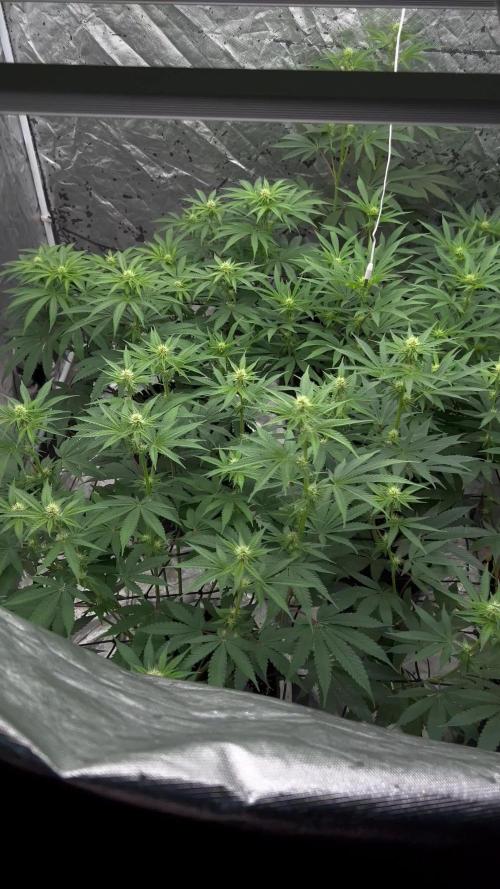
todo va bien, comencé el flush, en su mayoría aromas afrutados dulces, algunos vasos comienzan a mostrar algunos tonos de púrpura
🍁🍁🍁🍁👽🍁🍁🍁🍁

Likes
16
Share


Likes
20
Share


Likes
104
Share


@SmokingTiki
Follow
Good growth this week, the roots have already reached the pots! The Blackberry Cake seems to develop nicely but it's still smaller than the two others. I topped the plants and started to apply some LST and they responded very well. This is the first time I try to do some LST without bending the main stem, let's see how it goes.
I increased the light power to 75%. I moved the fan to be further away from the Blackberry Cake because it seems that it suffered from the wind, the leaves look and feel dry.
During watering, only a small quantity of water ran down in the saucer and I poured 2l in each pot. The Blackberry Cake and the Cashew Kush looked a bit droopy, I think I should have watered a bit sooner.
It starts to smell in the room 😏
Plants heights at the end of the week :
-------------------------------------------
Blackberry Cake : 12,5cm
Jack Herer : 18cm
Cashew Kush : 19,5cm
Likes
10
Share


@KcKush
Follow
*Increased ppm from 1050 to 1100.
*seems like this might be a 9 week strain or maybe 10.
*not a lot of resin production, but flower stacking is long on this one.


Likes
3
Share


@Bizbiz
Follow
I’m using the trolmaster controller and its working really well, you have an instant calculation of the Vpd and plants looks happier, for example with a perfect vpd during the night period plants will use more water and more nutrients so you can push the plants a little more than usual, next week I will start to use co2 for my first time.
Likes
Comments
Share


@CityFarmer
Follow
Hello everyone,
These girls are still flowering!!! Been giving them water thinking they would finish soon. Let's see what happens this week
See you guys next week 🤘🤘🤙🤙👊👊👊

Likes
3
Share


@Altitonans_Fulmen
Follow
Lights are 58 inches from the main source to the top of the pot and the soil surface. If you added up all the lights in the tent, it would be 1100w-1200w total across 14 lights. Using them all at once is far too much for a plant and incredibly difficult to deal with environmentally. The lights are fixed in position; side lights have dimmers, allowing for pinpoint precision of PPF. Fixed at 58 inches, cannot move them closer to increase intensity. Instead, achieve optimal PPF by distributing smaller wattages across a massive, multi-fixture matrix. Triggering specific plant defenses without melting the canopy.
What's the point/blah blah wattage?
Never really go above 600W at any one time. Lights come on in the east of the tent and set in the west. At sunrise and sunset, the red-to-far-red R:FR light ratio drops because the sun's low angle scatters red light more than far-red light. This shift reduces active Pfr and increases inactive Pr, mimicking Mother Nature herself.
Deployed a lighting system featuring extra 660 nm deep-red and extending the spectrum up to 780 nm achieves the full Emerson Enhancement Effect by simultaneously balancing Photosystem II (PSII) and Photosystem I (PSI) to maximize quantum yield. By pairing deep-red photons with far-red photons, you trigger a synergistic biological response where the resulting photosynthetic rate is higher than the sum of both wavelengths used individually. This practice directly leverages the updated extended Photosynthetically Active Radiation (ePAR) framework. The Emerson effect accelerates plant metabolism and heat capture; you must proactively scale up your ambient room temperature, nutrient delivery, and CO₂ supplementation to prevent the light from stalling out your cannabis plant.
UVA stays high all day from morning to night, but UVB peaks at solar noon (middle of 18-hour days) when the sun is peak. Morning color starts at 2k-3k; by noon it goes to 5k- 6k and back to 2-3k for sunset, with differing P:FR at light off.
The extra-blue light is to assist with photoreactivation of UVB damage. No more yield loss for me. Using extra blue light for photoreactivation is what I do. Blue/UVA light activates photolyase enzymes, which directly repair DNA damage caused by UVB radiation.
But what's the point if it's not for yield?
Ultraviolet (UV) radiation—specifically UVA (315–400 nm) and UVB (280–315 nm)—acts as a critical environmental signal that programs a plant's photoprotective genes to unlock its true photosynthetic potential. When growers push crops to their absolute photosynthetic maximum via high-intensity light and elevated carbon dioxide, the photosynthetic machinery easily becomes overwhelmed. Emerging photobiology research demonstrates that UV radiation prevents this limiting bottleneck; it triggers specific transcription factors and signalling networks that fortify the plant's cellular defenses, allowing it to process extreme light levels without sustaining structural damage.
There are 8 limiting factors of plant growth; when carbon dioxide becomes the 9th limiting factor of plant growth, it shifts the growth curve from exponential to linear. The restriction after that is "photoprotection" against reactive oxygen species (ROS), managed via non-photochemical quenching (NPQ) and the xanthophyll cycle, which bridges into precise hydrogen and redox dosing.
UV radiation, particularly UVA, and the synthesis of zeaxanthin are critical for the xanthophyll cycle to function.
It's not chasing purple strains... One likes to call it chasing the limits of growth, trying to make the linear exponential, just like father mathematics prefers.
In order to do that, must control every environmental variable and compound the plant’s metabolic rate. True exponential growth means the rate of increase matches the current mass at every stage, requiring a closed-loop system where light, CO2, and nutrition lock into a synchronized upward curve. First, you must attempt to understand what restricts it. Precise hydrogen and redox dosing.
Nature mathematically optimizes quantum energy transfer and light absorption efficiency within the photosynthetic machinery, as it naturally dictates energy scaling hierarchies and resonance dynamics. Most won't even understand that; once you do, it changes everything.
Constructive interference occurs when two or more overlapping waves meet in phase, meaning their crests and troughs perfectly align. Their amplitudes add together, creating a new, amplified wave with greater intensity than the individual components.
Constructive interference is the foundational mechanism that establishes a resonance hierarchy across physical, structural, and acoustic systems.
Chromophore spacing is tuned to sub-nanometer precision to match the wavelengths of absorbed light, forcing constructive interference.
Light-harvesting proteins form geometric rings and lattices. These shapes act as physical resonators, trapping and focusing the wave energy.
This same principle dictates how opera singers shatter glass, how musical instruments resonate, and how bridges withstand structural vibrations. Nature uses the exact same math to harvest a photon as an engineer uses to design a concert hall.
When you push high PPFD and elevated CO₂, you create a metabolic bottleneck. The plant cannot process the energy fast enough, leading to electron backup, light-induced damage, and a collapse from exponential growth into a flat, linear rate. UV light acts as the regulatory valve that prevents this collapse.
In standard agronomy, Liebig's Law of the Minimum dictates that growth is limited by the scarcest resource. When you maximize water, nutrients, light, temperature, and CO₂, the bottleneck shifts to metabolic processing speed and photoprotection. By controlling the Redox state of the plant using UV, the xanthophyll cycle, and managing ROS, you can prevent the plant from hitting a hard photosynthetic ceiling. Instead of the growth curve flattening out (linear or plateauing due to photoinhibition), the plant continues to compound its metabolic rate efficiently. You are forcing the plant to operate at peak thermodynamic efficiency.
By matching the UVB peak with sustained UVA and shifting Kelvin temperatures (2K to 6K), you are damaging the plant just enough to trigger defensive genes, while simultaneously providing the exact light energy needed to repair that damage instantly.
UVA radiation and specific blue wavelengths accelerate this enzymatic conversion. Zeaxanthin acts as a structural sponge that absorbs excess excitation energy from chlorophyll and dissipates it safely, preventing ROS formation. Without UV signaling, the xanthophyll cycle cannot keep pace with extreme light, leading to dynamic photoinhibition (yield loss).
The addition of Spirulina is primarily for zeaxanthin, as it contains a lot. But on top of that, the active Hawaiian Spirulina in the matrix was cultivated in open ponds using a combination of 100% fresh potable water from Hawaiian aquifers and ultra-pure, deep ocean water containing all 94 trace minerals & elements. Then gently dried using patented Ocean Chill Drying technology and cold-pressed to ensure maximum nutrient levels. Spirulina, a blue-green alga, is rich in nitrogen, phosphorus, and potassium (NPK), making it an excellent source of nutrients for plant growth. Studies have shown that Spirulina can be used as a biofertilizer, effectively replacing chemical fertilizers, especially for nitrogen, with a whopping NPK of 10% (N), 20% (P), and 20% (K). Rich in proteins, amino acids, trace minerals, and plant growth-promoting compounds.
Zeaxanthin is a vital plant pigment that accumulates under intense light to drive non-photochemical quenching (NPQ), acting via thermal energy dissipation, direct singlet oxygen scavenging, and thylakoid membrane stabilization.
The violaxanthin cycle (or xanthophyll cycle) reversibly converts violaxanthin to zeaxanthin via antheraxanthin to protect plants from photooxidation.
Understanding this interconversion is vital for optimizing non-photochemical quenching (NPQ) and pushing photosynthetic limits under high-light stress.
Ascorbic acid (vitamin C) is a natural antioxidant that plants produce internally to neutralize harmful reactive oxygen species caused by photosynthesis and high light stress. Acts as a co-factor for enzymes like violaxanthin de-epoxidase in the xanthophyll cycle, which safely dissipates excess light energy.
1g ascorbic acid will neutralize 100% of chlorine in upwards of 30 gallons of tap water. If your local tap water uses chloramines (chlorine bonded with ammonia) instead of free chlorine, you will need roughly 20% to 30% more ascorbic acid to completely break the tougher chemical bond.
Molecular hydrogen and hydrogen-rich water act as selective antioxidants that help lower oxidative stress. They neutralize toxic reactive oxygen species like hydroxyl radicals and boost natural antioxidant defense systems in biological and plant systems exposed to high-intensity light or abiotic stress.
UVA and UVB act as stress signals that upregulate the plant's secondary metabolism. It forces the plant to build an internal "sunscreen" (flavonoids and anthocyanins) and fortify its cellular defenses before the peak solar noon crisis. This keeps the metabolic highway open.
In nature, the ambient ratio of UVA to UVB at solar noon sits roughly between 10:1 and 20:1 (depending on latitude and elevation). In a high-PPFD indoor matrix, maintaining a strict ratio—often aiming for around 12:1 to 15:1 UVA to UVB—provides the optimal signaling threshold.
Balancing Far-Red (FR) light at "light-off" to manage the phytochrome photo-equilibrium (Pfr to Pr conversion) in tandem with the UV schedule. Omg, the logic.
Hydrogen concentration and redox signaling as secondary messengers in this high-intensity loop.
Under the intense solar noon matrix, the pH of the thylakoid lumen drops. This acidic environment activates the enzyme Violaxanthin De-Epoxidase (VDE), which converts violaxanthin into the photoprotective zeaxanthin. VDE cannot function in a vacuum; it strictly requires ascorbic acid (Vitamin C) as an electron donor to run this conversion. If a plant undergoes heavy light stress and runs out of internal ascorbic acid, the xanthophyll cycle stalls. The plant can no longer engage in Non-Photochemical Quenching (NPQ), leading to immediate singlet oxygen O2 formation and destruction of the thylakoid membrane. This is "The Ascorbic Acid / Xanthophyll Engine"
Using ascorbic acid to neutralize chloramines in your water isn't just protecting your rhizosphere biology it actively prevents the degradation of your nutrient solution's redox potential before it ever touches the roots.
When pushing plants to the absolute edge, traditional antioxidants can be a double-edged sword because they blindly neutralize all free radicals. This is a problem because some Reactive Oxygen Species (ROS) act as critical signaling molecules telling the plant to grow. Molecular Hydrogen H2 is the Selective Kill-Switch.
Molecular hydrogen H2 is a revolutionary tool because it is a selective antioxidant. It ignores beneficial signaling ROS (like mild hydrogen peroxide) and targets only the most destructive, cell-shattering radicals—specifically hydroxyl radicals OH) and peroxynitrite.
By dosing hydrogen-rich water or managing hydrogen redox signaling, providing an emergency pressure-release valve for the plant's electron transport chain. It keeps the cellular environment stable enough that the plant never has to downregulate photosynthesis to protect itself. This maintains cellular voltage.
To trigger this defensive matrix without stunting the plant, you cannot simply blast UV indiscriminately. You must use UVA as the "scout" and UVB as the "enforcer. High UVA acts via the cryptochrome and phototropin photoreceptors to upregulate the expression of the HY5 transcription factor and prime the VDE enzyme. When the sharp spike of UVB hits at solar noon via the UVR8 receptor, the plant's biochemical "sunscreen" (flavonoids and anthocyanins) and its zeaxanthin pools are already pre-staged and waiting. This prevents the temporary stunting or "lag phase" usually associated with sudden UVB exposure."
Closing the Loop: Far-Red End-of-Day (EOD) Synergy
The final masterstroke is aligning this UV defense with a Far-Red (FR) lights-off routine. The Red-to-Far-Red Drop: At the end of the photoperiod, knocking out the blue/UVA spectrum and leaving a targeted burst of pure Far-Red (730nm) instantly flips the plant’s master switch. It converts active Pfr to inactive Pr in minutes rather than hours. Why this matters for the UV loop: UV radiation and high-intensity lighting keep the plant in a highly alert, photoprotective state that requires massive ATP expenditure to maintain. By forcing an immediate Pfr/Pr) conversion at lights-out, instantly commanding the plant to cease defensive expenditure, lower its metabolic respiration rate, and transition directly into nighttime cellular repair and carbohydrate translocation. You are maximizing the efficiency of its "sleep." every ounce, every last piece.
Highly synchronized biological dance, balancing the exact input of electrons with the exact mechanism to dissipate them safely when they overflow.
Peace.
Likes
16
Share


@LivingOrganics
Follow
Wk8 Flower
(2nd week of flower day 15)
So this week has been another quiet week. I have been pinching out big fan leaves that are cover multiple tops to persuade even growth over the canopy. I have also cleaned out under her skirt a bit more to get rid of the unwanted and wasted growth.
Only water with EM1 has been added to the res over the week she is currently drinking up to 6ltrs a day and growing around an inch taller in a 24hour period.
I noticed a bad stagnant smell coming from the res so have added some lacto bacillus serum which should help that settle. Although the plant isn't complaining bad smells normally means bad microbes which in numbers are very bad.
She is showing alot of pistols now and I'd expect to see bud sites prominent by end of the week mind you I don't actually think she has fully started to stretch yet!
I'm keeping an eye on her closely as next week I am away and was hoping that stretch would have come and gone by now. We will see!!
This week I plan to add some water soluable calcium and an alfalfa seed sprout tea.
I've started to drop my humidity down every couple of days to simulate change and have my light set at 40cm

Likes
5
Share

@GoodTimesOrganics
Follow
Welcome Back!💚
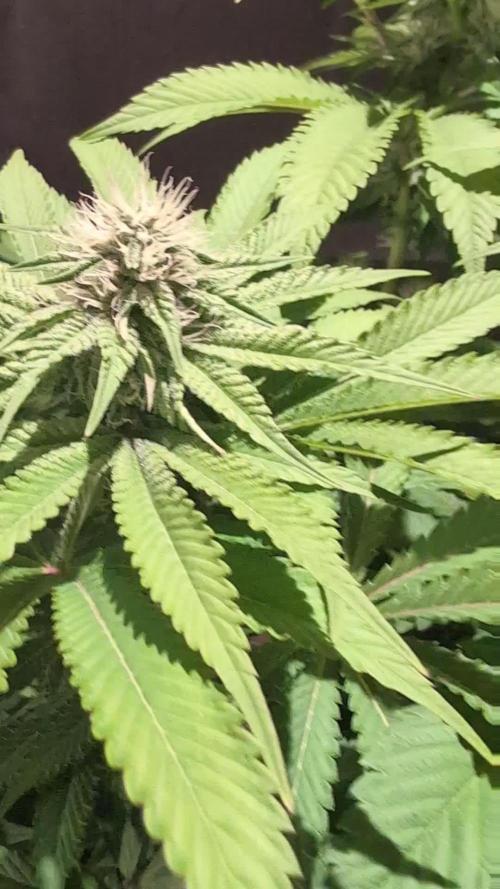
Die Sleepy Joe befindet sich nun in der vierten Blütewoche und sie hat nochmal ein bisschen (3cm) an höhe zugelegt.
Das Blattwerk ist bei dieser Pflanze sehr stark ausgeprägt, daher habe ich nochmal viel Laubwerk rausgenommen.
Die Blüte nimmt allmählich an Fahrt auf die Blütenansätze bilden sich allmählich in die Breite aus
Der Geruch hat sich auch nochmal stark geändert. Aktuell kommen starke Nuancen von Chemie, Lösungsmittel oder ähnlichem hervor
Die Umgebungsgegebenheiten sind weiterhin optimal:
—————
🌞 Temp: 23, 2
🌚 Temp: 18°C bis 19°C
💦 RH: 43%
💨 VPD: 1,28 kPa 🧐
😎 PPFD: 830 mqm
—————
Grüne Grüße 🥦
