


Likes
Comments
Share


@BoboLacetti
Follow
I was able to learn a lot again and am very grateful for it!
USE THE AIRPOD ON THE RIGHT WAY!! :)



Processing
Likes
16
Share


@Andres
Follow
I still have to wait for about 8 weeks, I believe in the open air ... they already have a smell of fruit and forest ... with one of them has nutrients from the biobizz tripack ... because it had a lack of nutrients ... a measure 40 cm and the ptra is around 1.70 ... waiting for the fattening of buds

Likes
10
Share


@Roscio99
Follow
hello beautiful ones, they managed to enter flowering!! everything is going smoothly apart from a few insects... I think it's normal when you do them outdoors. They have been flowering for a week and continue to grow every day! DAJE ROMA DAJE
Likes
3
Share


@zulya
Follow
premiére plantation de ma vie, nouveaux challlenge ^^
départ de la germination :)
petit godet de esay start,( https://www.royalqueenseeds.fr/growing/162-easy-start.html ) seed germinator de royal queen seed. dans une petite chambre afin de maintenir le 90% d'HR. avec un fond d'eau le reste de l'activateur dans lequel il fallait submerger. Les godets,sont surelevé légérement afin de ne pas les noyer. Départ en lune ascendante nouvelle lune en 19 en gémeaux : il me semble que ce n'est pas si favorable que ça ... on verras :)
germination a 7 jours ... j'ai presque eu peur XD. La tige n'est pas encore sortie de son godet. aération de la chambre une fois par jour pour en cvhanger l'air. ^^

Likes
53
Share


@Hempy_The_Kid
Follow
08/03/22 watered with Recharge. Plant is looking very nice.
Ladybug 🐞 porno 😆🤣


Likes
3
Share


@julian100614
Follow
Subiendo como la espuma 🔥🔥
La planta esta empezando a formar múltiples brotes y puntas de muy buen aspecto y color 💪
Aplicamos los nutrientes de forma moderada y poco a poco para no sobrecargar a la planta ya que lleva muy buen camino 👌
Bajamos un 5% la HR y la temperatura la mantenemos como siempre 😉
Hemos sacado del armario el humificador porque con las propias hojas ya crean la humedad justa para su que esten comodas.

Likes
14
Share


@Hempface86
Follow
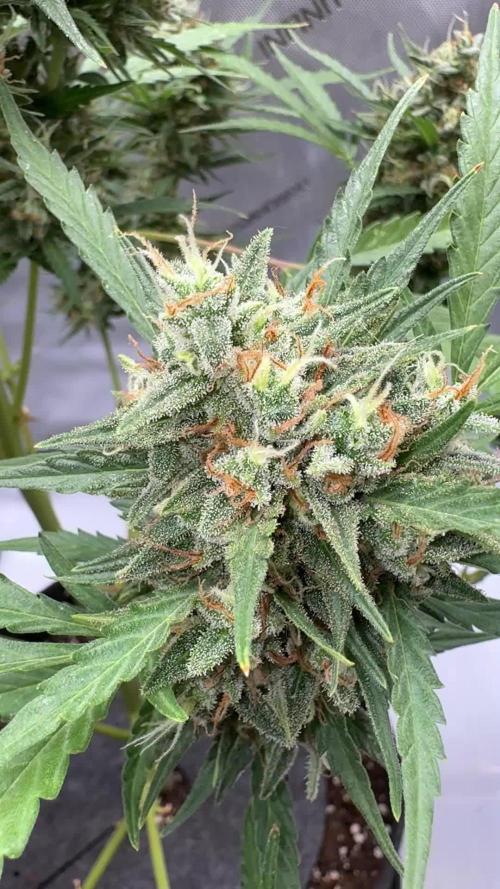
Day 68 and as you can see she's finally getting some decent trichome production and she is starting to smell in a good way.. this autoflower must have a decent amount of ruderalis in it as the site says we're looking at 14% THC which is on the low end but as we know it's not always about the numbers .. Sensible Seeds thank you again for this grow and guys if you want a certain strain that you can't find I can guarantee you they got it they are one of the biggest warehouses / seed banks that I've come across and they have great deals on bulk seeds of name brand breeders.. hope all is doing well God bless happy growing and everyone have a Happy Thanksgiving 🦃
https://www.sensibleseeds.com/

Likes
10
Share

@Gamfin
Follow
// Day 91
She is getting there. The buds ware not fattening up as much as I wanted to but her trichomes are almost all cloudy and a very low minority is amber. So I guess I give her 2-3 more days and cut her down on friday or saturday. This time I try out the bro science: Befor cutting, I'll let her stay in the dark for 48h. So maybe I turn off the lights tomorrow until friday and chop her down.
The bro science hypothesis is that the not ending darkness will give her a last stress which boosts trichome production.
|| Edit: I‘m not here for bro science, so I am not doing that shit
// Day 94
I chopped her down today. Since I need to do a bud wash (spider mites, outdoor grow), I can't hang the plant whole. So I cut the stems into as big pieces as possible and washed them with deluted hydrogenperoxide. I hanged them into the tent and try to dry them as long as possible.

Likes
3
Share

@Fyno_TH
Follow
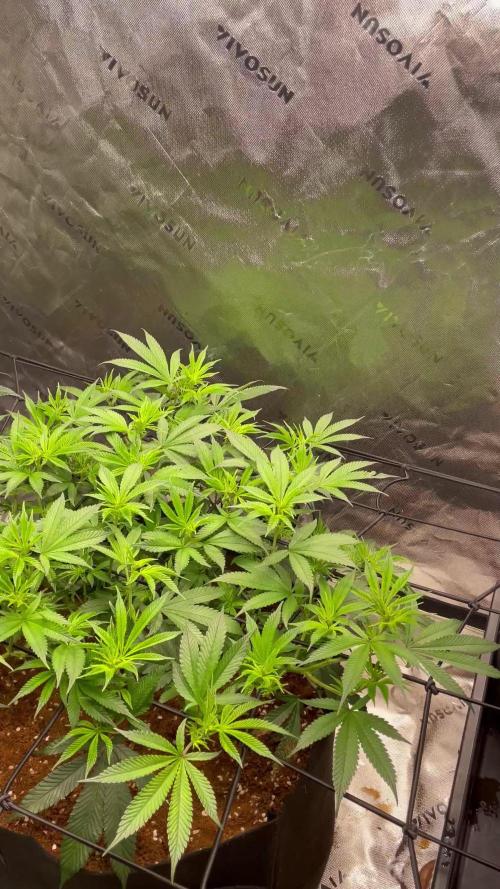
Week 5 update 🌱🔥 — the tent is looking full and healthy!
Main plant is wide and strong after topping + LST, really starting to show her structure. The second plant is still smaller but holding steady, pushing new growth and showing good recovery 💪.
Feed mix this week: Corex + Eldex + Terra + CalMag + Bud Candy + Mira + Terpinator (~1400 ppm @ pH 6.0). Watering to 10–20% runoff each time keeps the coco clean and roots thriving.
Temps holding steady around 27 °C with RH 60–70% 🌬️. Leaves are praying hard under the Spider Farmer G3000 with no signs of stress or burn.
💡 Grower Tip (for Thailand growers 🇹🇭): If an RO system isn’t convenient, you can use the local street purified water machines (1-1.5L = 1 Baht). Cheap and clean enough for coco grows without the heavy tap water ppm.

Likes
82
Share


@BigBadLion
Follow
Hey guys! 👏
Hope everyone is doing well! This week was interesting. I made a small flush because I wanted to know how much salt my plants had in the soil (considering I've fed my plants with a lot of nutrients the past few weeks) aaaaand the results were quite interesting! They obviously had tons of salts! Here are the results of the runoff water:
Falco
5.94 pH
1139 ppm (2278 us/m)
Max
5.85 pH
2352 ppm (4704 us/m)
Roko
5.64 pH
2453 ppm (4906 us/m)
Boomer
5.72 pH
1765 ppm (3530 us/m)
Surprisingly enough the plants that had the "worst" runoff values were the plants who had the most foliage and their leaves were the greenest. The pH "loss" of all the plants was also within the expected margin so that's good! 👌 The buds look beautiful and I also noticed some of the plant leaves are starting to turn purple 😍 the smell is also getting stronger and it's quite citric, I love it!
Anyway, that's all for now. Thanks for reading! 🙌
Likes
5
Share


@TheChronicHunter
Follow
This is a pretty casual diary — just tracking for my own purposes mostly.
Been trying some new strategies to increase temperature and humidity in the tent.
She’s just flipping over to flower now — I wasn’t sure weather I would top the plant... but I decided to this one time just in the edge of flower — didn’t want to do it earlier to avoid inducing flower

Likes
31
Share


@ELBICNIVNI
Follow
growing this strain was super easy, but for some reason i had 5 seeds and i wanted to germinate another 2 and i followed the germination process 420 fast buds has on the web and unfortunately from 5 seeds just 1 germinated. which you can see in this diary. the buds are not that fat like on the amnezia, some of them are a little airy (i think the reason for that is that i had too many branches and too little air circulation and light penetration - next ones if i will do again this strain is going to be with less branches), but they smell strong and they get you really high lol


Likes
23
Share


@adam_pawloski87
Follow
Today is day 71 for these ladies and they are doing just amazing! Stacking up densely with a Very sweet smell , I still get hints of vanilla ! Not to much longer to go these girls few more weeks an they should be done! Stay tuned for next week ! ✌️


Likes
34
Share


@HomeGrowHeaven
Follow
We chopped down the plants. Now they hang out to dry in the tent.
The Trichs looked very good. Some milky, some amber, hardly any clear. Just the way I want it. The popcorn buds were rather milky. So we have more of a couchlock effect on the head buds and the maximum THC on the popcorns. I'm really looking forward to the taste💚

Likes
58
Share


@MadeInGermany
Follow
Info:
Unfortunately, I had to find out that my account is used for fake pages in social media.
I am only active here on growdiaries.
I am not on facebook instagram twitter etc All accounts except this one are fake.
Hi everyone :-) .
The seedling has developed well so far :-)
Nice thick leaves like the last phenotype of the banana.
I trained her for the first time this week (topping).
It was poured twice this week with 1l each (for nutrients, see nutrient table).
The tent was cleaned and the lady's health was checked.
Have fun with the update.
Let it grow.
You can buy this Nutrients at :
https://greenbuzzliquids.com/en/shop/
With the discount code: Made_in_Germany you get a discount of 15% on all products from an order value of 100 euros.
You can buy this Strain at :
www.Zamnesia.com
Type:
Banana
☝️🏼
Genetics:
OG Kush x unkown
👍
Vega lamp:
2 x Todogrow Led
Quantum Board 100 W
💡
Bloom Lamp :
2 x Todogrow Led
Cxb 3590 COB 3500 K 205W
💡💡☝️🏼
Soil :
Canna Coco Professional +
☝️🏼
Nutrients :
Green Buzz Liquids :
Organic Grow Liquid
Organic Bloom Liquid
Organic more PK
More Roots
Fast Buds
Humic Acid Plus
Growzyme Big Fruits
Clean Fruits
Cal / Mag
Organic Ph - Pulver
☝️🏼🌱
Water:
Osmosis water mixed with normal water (24 hours stale that the chlorine evaporates) to 0.2 EC. Add Cal / Mag to 0.4 Ec Ph with Organic Ph - to 5.5 - 5.8 .
Likes
11
Share


@XoticGROW666
Follow
Happy week for this plant.. she got so bushy i had to give her heavy trim shave. Speed recovery and she will bounce back and like she neva had a TRIM

Likes
12
Share


@Trickybis82
Follow
Hello again,
Like I said on my other diary, we are on the last week of Flushing this beauty too! And considering the damage she went through i cannot wait to smoke her. Ca8se simply didn't think she would pull through.
Fingers crossed on this final strech
Peace ✌️ ☮️ and love growmies

Likes
6
Share


@Jack_Greenstalk
Follow
smell is strong now. sour 76 has a range of citrus, number 1 is lemon dominated with fuel scent underneath. number 2 has a smell super similar to tangie! seeing sour 76 parent is cali sour d (cali orange x sour d x mexican sativa) cross to 76 afghan it makes sense to me it has reminiscent smell to tangie (cali orange x skunk 1 [mexican sativa x afghan indica x colombian sativa]) very similar parent lineages there! havin smoke test both, sour 76 is much more heavy handed high! plants finish at 66 days this run. at this point I gave last main feeds before tapering nutes back lower for week 8 and then flush week 9