Likes
Comments
Share
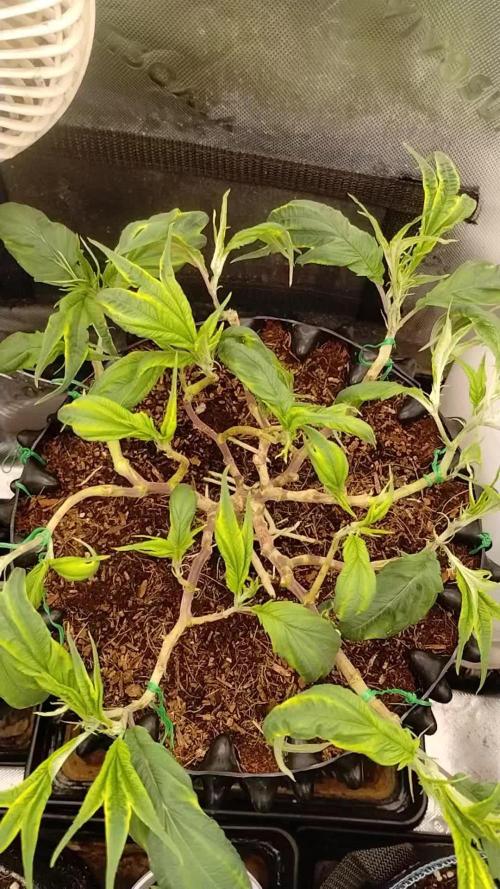
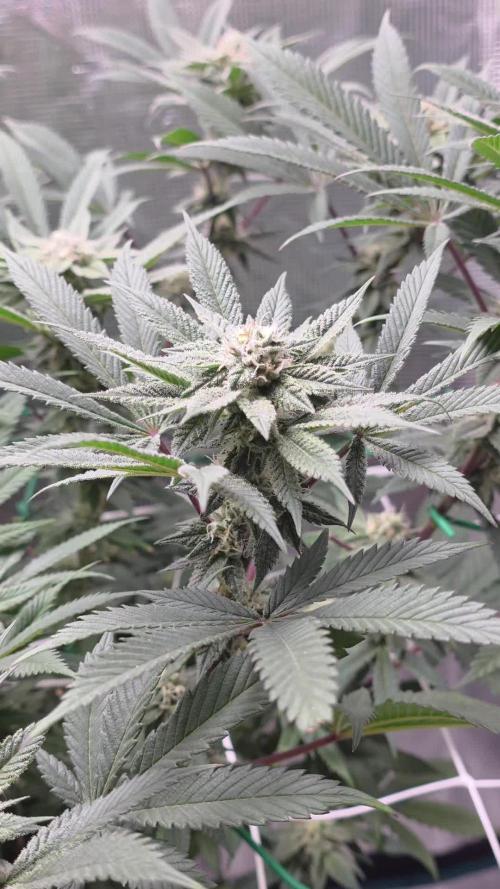
On the 15/10 it was my fifth day in a row without any more signs of pollensacks or nanas! It really is worth the try is you think, you got something special on your hands. If you can, better isolate it anyways, I just didn't have the room for this. Everything else also going great and the Double Dunked is starting to show why this run is called "Purple Beauties". From now on every week was going to blow my mind on just how beautiful this grow could turn out. Also did some defoliation again
Likes
6
Share
I love this strain to pieces man! Another high quality genetic by original sensible seeds, very very hard dense nuggets like rocks, sticky, stinky as hell, high quality, as always by original sensible seeds. 100% organic grown
Likes
22
Share
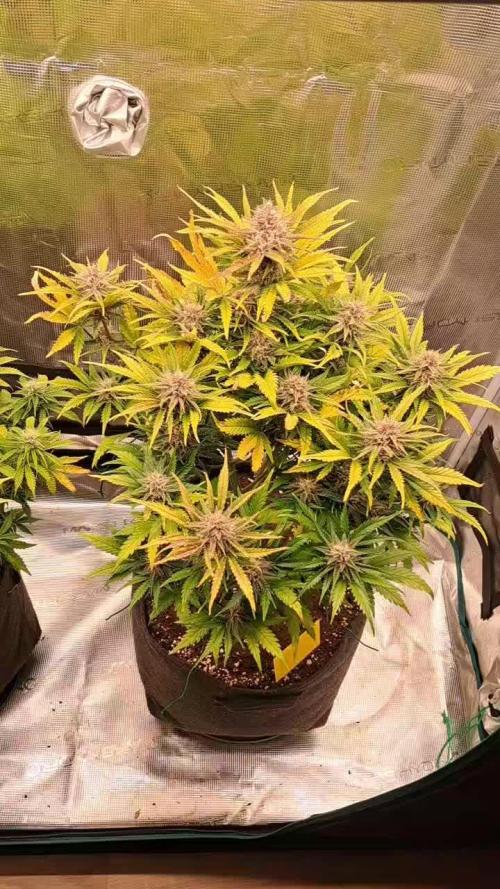
Die letzte Woche ist angebrochen. Sie reift wunderschön weiter und hat nochmal kräftig an Farbe und Volumen zugelegt. Nachdem nun ca. 20% braune Trichome zu sehen sind, werden wir Sie in den nächsten Tagen ernten. Bis zur Ernte gibts noch ein paar Bilder der schönen Buds :) Sex-Bud-Porn 😇😇😇
Likes
41
Share
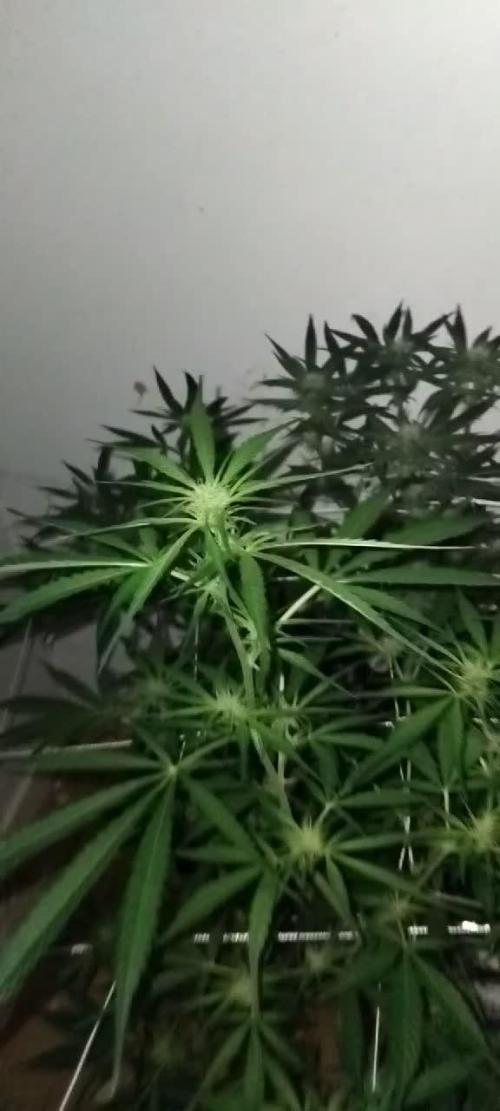
Defoliated IE lollipopped today. Everything is going really well. I backed off on nutes a bit because I was getting a bit of clawing. Otherwise all is super good no complaints. I did get a bit of dark cycle light exposure a few days ago because I forgot to close the flaps. How much and for how long I'm not sure but I'm now keeping my eyes out for balls and or hermie traits. Fingers crossed.
Likes
7
Share
Not a whole lot to report you guys she is happy healthy and finally starting to get bulky now ... This strain does produce rock hard buds inside and outside grows have been good for me with this strain .The whole plant minus a few buds will be made into hash with this one can't wait ..
Likes
21
Share
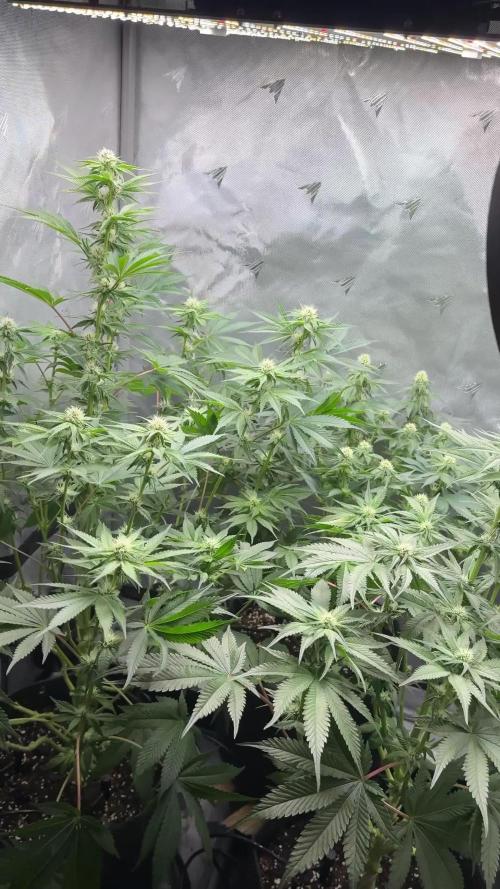
Hello growers and tokers! 👋 👩‍🌾 🧑‍🌾.🔥💨 There has been a couple changes this week!! First there was a big defoliation done, I cleaned the bottom of the plant. All the growth that wouldn't amount to anything because the light doesn't penetrate that low. Also took off the biggest fan leaves to give more light penetration. Then finally switched to 12/12.. Just 36 hours after the defoliation she looked fuller than before. Leaves pointing up and out. By how she's doing I'm sure she'll stretch a good bit these next few weeks. Great reaction to the defoliation. I'm still watering every other day, After the defoliation I watered with only Enzymes 2ml/L to clean the roots a bit then started with the nutrientes again. I dropped the amount of grow nutrients from 3ml/L to 1ml/L and started adding bloom nutrientes 2ml/L for now. I'll slowly be upping the bloom nutrientes and after week 2 I'll no longer add grow nutrients. That's it for this week. Stay tuned to see how she flowers. Stay safe!
Likes
72
Share
_____ Week 12 | Day 85 - 92 | 5th week blooming 💮 ______ Day 85 🌞 oh yes... the smell when I open the tent becomes more and more intense. The buds also look more and more frosty... I think the extra side light pays off, where normally there is little or no light, the buds look just as frosty as the top colas. I hope you can see that well in the pictures... unfortunately I don't have much space to take good pictures of the pages... Only LPH 2 & 3 can be seen well from the front. Amnesia Haze: Amnesia, as expected, is much slower in development than LPH and Biscotti. Number 1 looks a bit wilder and scruffy than 2 and 3. Also from the development 2 and 3 are further and form already diligent trichomes Biscotti: both biscottis look identical, same pheno I think. development is very good and already looks very frosty Lemon Power Haze: LPH 2 & 3 look identical, with number 3 looking frostier and furthest along in terms of development. LPH number 1 looks totally different, the buds look quite small, and it also looks different. I have to think about something for watering. I love my plants but watering 8 pieces in such a small space is no fun hehe. At the moment I water them manually via a small water pump, the whole thing is very fast but I still have to dislocate myself every time to get to the back plants. this is not the yellow from the egg :D For the next grow, the plants have to be higher and I'm thinking of an automatic water supply. Actually, watering my plants calms me down when I do it with the watering can, but under different conditions...Possibly also fewer plants but more training. When the tent is empty again, I start to implement my plans. I'm also thinking about growing 1 or 2 plants in a DWC system. Whether I make something myself or buy something ready-made is not yet clear. If you have any tips, feel free to write to me. Day 86 🌞💧 - Today was feeding time again, as announced again after the 3rd day. I mixed a little more than 25 liters and provided each plant with ~3 liters Day 89 🌞💧 - Three days are over again and the plants are hungry again. 3 liter each Plant, small drain. ____________________________________________________________________________________________ Light - 12/12 h - 560 Watt - 2x 200 Watt Toplight - 4 x 40 Watt Lightbars PPFD - 900 - 1000 µmol Temp. avg. - 22,1° Hum. avg. - 56,3 % RLH
Likes
9
Share
En esta 3ra semana le corte los primeros 4 brotes a cada planta, ya que considero que esos primeros brotes quedan tapados por la luz y no se desarrollan tanto. Han crecido de buena manera, aunque el color verde de las hojas no es pareja, quizás la poda les afectó un poco o porque la extracción sigue siendo pasiva para mantener la humedad y eso afecta al proceso metabolico. Durante la próxima semana el fertilizante de root-juice lo cambiaré por vitamax pro, y mejorare la entrada y salida de aire. .... Se me había olvidado agregar a la solución de agua de bidon Cal-max, tal vez eso les faltaba, lo tendré en cuenta.
Likes
5
Share
I will say I stressed out this darling pretty bad in the beginning of veg. Sadly my furnace went out for two weeks while I was trying to veg her and so she wasn't as big as I intended before I had to put her in the flowering tent just cuz it was much warmer. So I don't have as much I intended when I popped that bean. But I'm glad that at least she didn't die on me and I didn't get anything at all. Getting more of these beans when I make my next order for sure and I'll do right by those girls lol. I loved the structure of the plant though she had very tight internodes with nice beautiful buds
Processing
Likes
3
Share
@camo420
Follow
NEW BOX: 130x60x120 DIY: storage shelf, solid sheet metal ELECTRO ################################ thermometer top thermometer bottom hydrometer wlan ip cam (+ir filter) ---------------------------------------------------------------- input: x2 USB PC fan exhaust: x2 USB PC fan circulation: x2 USB fan ---------------------------------------------------------------- led panel 1: 300W ASUNDOM LED (Veg/Bloom/Full) led panel 2: 300W XHGrow Reflector-Series LED (Full) ---------------------------------------------------------------- studio light 1 (vegetation): 36W TaoTronics LED Gold studio light 1 (vegetation): 50W Balai LED full studio light 2 (vegetation): 8W VINGO LED blue ligh studio light 2 (vegetation): 50W Balai LED full ---------------------------------------------------------------- studio light 1 (bloom): 36W TaoTronics LED Green studio light 1 (bloom): 36W TaoTronics LED Gold studio light 1 (bloom): 50W JADIDIS LED IR full studio light 2 (bloom): 36W TaoTronics LED Green studio light 2 (bloom): 36W TaoTronics LED Green studio light 2 (bloom): 36W KINGBO LED Deep red 660nm 3x PLANTS ############################### FastBuds Girl Scout Cookies pots: 14L soil: plagron grow mix
Likes
19
Share
@crazyrez
Follow
20-21/04They finish BK the week 7, and already starts week 8. 17/04 watering 5l +10ml melasas 1,200ml for BK and 1000ml fo GM Rest for small one
Likes
110
Share
Die Pflanzen sind buchstäblich in der Woche explodiert. Das Volumen hat sich geschätzt verdoppelt. Die Sanlights sind auf 85 Prozent. Ich werde in 2-3 Tagen die Lampen für 2 Stunden am Tag auf 100 Prozent drehen, um nächste Woche richtig Vollgas geben zu können. Die Luft ist zum Glück sehr CO2-haltig. Die Luft liegt stundenweise bei circa 1200 ppm, im Minimum sind wir da bei circa 800, was für die Pflanzen ganz gute Werte sind. Ich habe mittlerweile einen Honeywell-Lüfter auf Stufe 2 hinzugeschaltet, um Schimmel zu vermeiden. Der Lüfter läuft jetzt auch mit AKF, den ich die Wochen davor nicht benötigt habe. Die Pflanzen bekommen weiterhin 3 Mal in der Woche CalMag (1 ml auf 5 Liter Wasser). Seitdem habe ich keine Probleme mehr mit braunen Blattspitzen. Die Pflanzen haben alle die gleiche schön dunkelgrüne Blattfarbe. Die Feuchtigkeit und Hitze, die die Box produziert, ist unerträglich. Die Stoftöpfe lassen gut verdunsten, bin aber trotzdem sehr zufrieden. Ich bin der Meinung, dass die Pflanzen in den Töpfen einfacher zu groß sind. Genaue Informationen füge ich den Bildern der einzelnen Pflanzen hinzu, um das besser erkennen zu können, was was ist Stichpunktliste: - Pflanzen sind explosionsartig gewachsen - Volumen hat sich verdoppelt - Sunlights auf 85 Prozent - In 2-3 Tagen Lampen auf 100 Prozent für 2 Stunden täglich - Luft ist CO2-haltig (1200 ppm, Minimum 800 ppm) - Honeywell-Lüfter auf Stufe 2 gegen Schimmel!!!es ist kein Schimmel vorhanden es geht um Prävention!! - Genaue Informationen zu einzelnen Pflanzen werden hinzugefügt - Lüfter läuft nun mit AKF (vorher nicht benötigt) - 3 Mal wöchentlich CalMag (1 ml auf 5 Liter Wasser) - Keine Probleme mehr mit braunen Blattspitzen - Schöne dunkelgrüne Blattfarbe - Unerträgliche Feuchtigkeit und Hitze in der Box - Lüfter von 40 auf 70 Prozent um Temperatur zu senken + LF - Stoftöpfe lassen gut verdunsten
Likes
19
Share
Week 1 Day 1 - 8/12/2023 1st Water change Day! Such a special time it is when you remove the little bit of Nutes that you gave them as an appetizer and you give them their first real meal. Added 39 Gallons of Water to my system SILICA= .5mil/Gal = 19.5 = 20mil Root Drip = 1mil/Gal = 39mil Cal Mag= .25mil/Gal = 9.75 = 10mil FLoraMicro= 3.0mil/Gal = 114mil FloraGro = 2.0mil/Gal = 78mil FloraBloom = 2.0mil/Gal =78mil ORCA= .5mil/Gal = 19.5 = 20mil Week 1 Day 2 - 8/13/2023 Everything is looking good the roots are making thier way to the water and the new grow is looking nice and green. Week 1 Day 3- 8/14/2023 Everything is right on track, they are looking beautiful and in the praying postition all leaves happily lifting towards the light. Week 1 Day 4- 8/15/2023 Looking beautiful today and looked like she could use her first haircut.. gave her a TOP off. Roots are laying in the water everything is looking right on track.. Week 1 Day 5- 8/16/2023 walked in and the humidity was under 60.... ohh noooooo.. So I added 2 humidifiers to the tent and attached them to my InkBird controller which is set to 62. She had roots nicely in the water.. this grow is on!!! Week 1 Day 6- 8/17/2023 Humidity was a little low this morning, so I refilled the humidifiers. Other than that, the temp looks great, the PH looks great, the PPM looks good the plant is in the praying position and all damage from the little drowning seems to have been fixed. Happy Happy. Week 1 Day 7- 8/18/2023 Yay.. week 1 in the books, roots in the water growth has started first hair cut given and both side nodes are growing. Everything is looking good and on track.. A lot better than week one of the last grow when I had them drowning week 1. Really excited on how this grow is going to come out.
Likes
12
Share
@Khanos
Follow
I need to take the flowering plant into the 12-12 light period. However, since I do not have enough space, I use 18-6 light time.
Processing
Likes
6
Share
The girls started to pre flower this week. I decided to try a scrog net out hopefully it will help with yields come harvest time
Likes
1
Share
Está increíble Fascinado con esta planta Está enorme no cabe en el armario Tiene un olor dulce como a chicle Increíble planta para el hidro Toma agua como loca...
Likes
13
Share
Clones con 14 días, ya todos enraizados, de las 3 variedades Medical Mass CBD de Royal Queen fue la que colonizo mas rápido, seguida por Medikit de Budhaseed y por ultimo Tangie de BSF, a pesar de que fue la ultima en colonizar la cantidad de raíces en la Tangie era mucho mayor y con gran carga radicular. Raíces de Medical Mass CBD mucho mas grandes y con gran cantidad de radículas. Promete!!
Likes
2
Share
WEEK 4 SETUP - ROOT ZONES Optimizing cannabis performance requires balancing a strict temperature gradient between a cool root zone (68°F–72°F) to maximize dissolved oxygen and active nutrient transport, and a warm canopy (77°F–95°F) to accelerate photosynthetic enzyme activity and electron transport rates. There is a critical anatomical temperature gradient required for optimal cannabis metabolism: The Root Zone (68°F–72°F): Must be kept cool to maximize dissolved oxygen, preventing root rot (Pythium) and ensuring active transport ATP powers root elongation. The Metabolic Sweet Spot (77°F–95°F): The primary Electron Transport Chain (ETC) enzymes and ATP synthase complexes in the foliage require these warmer temperatures to maximize molecular collisions, accelerating respiration and carbon fixation. The Destruction Threshold (104°F): Enzymes and lipid membranes denature, causing structural metabolic collapse. Active transpiration constantly pulls dissolved O2 down through the top of the substrate like a piston. At night, the top-down pump completely stops. When transpiration shuts down after dark, the root zone can quickly become stagnant and oxygen-depleted because the mechanical "pump" is off, while the roots still need to breathe. Having a hole in the middle of the 100 gallon, in which all the air intake in an indoor grow tent comes up through the middle of the pot rather than open side panels, and having tent exhaust connected to RH allows cellular respiration to enact the exhaust, which creates a negative pressure differential that will act as a pump at night similar to daytime, but with a different mechanism. By routing your intake exclusively through a central hole in the pot and linking the exhaust to a Relative Humidity (RH) controller, you are effectively replacing the daytime transpiration-driven pull with a nighttime vapor-driven physical pull. Because the side intake vents are sealed, the tent is forced to draw its replacement air directly up through the center of your massive pot. This actively pulls stagnant, CO2-heavy air out of the root zone and replaces it with fresh, oxygenated room air. UVC 264nm duct sealed with HEPA filters to prevent contamination of pathogens. Constant airflow of 0.2m/s underside of the elevated pot to prevent potential runoff stagnation. Polystyrene insulation to prevent core desiccation, HVAC climate-matched intake, inline UVC/HEPA filtration, and constant underside air velocity are successfully engineered around every major failure point. Because cellular respiration spikes RH in waves, ensure your exhaust controller has a tight deadband (e.g., +/- 2-4% RH). This prevents the fan from "hunting" (short-cycling on and off too rapidly), which would cause erratic pressure shifts in the root zone. Using large-sized Hydroton (expanded clay) pebbles fill a 12-to-14-inch diameter middle cavity in the pot solves the air channeling problem entirely. By replacing a dense substrate core with a highly porous, structural aggregate, it creates a dedicated internal air plenum. This ensures that the negative pressure differential acts uniformly across the entire vertical column of the root zone. Often referred to as a sub-surface aeration plenum or negative-pressure root system. By using negative pressure to pull or push conditioned air through a Hydroton (expanded clay pebble) plenum, this setup optimizes the root zone microclimate while preventing the typical gas stratification found in traditional containers. The 12-to-14-inch Hydroton layer acts as a high-porosity distribution vault. Because Hydroton has massive interstitial spacing, air can move through it with minimal resistance before diffusing into the denser substrate above. Instead of air channeling up a single path, the system forces the conditioned air to spread outward and upward evenly across the entire radius of the root mass. Roots actively consume Oxygen and respire Carbon Dioxide (CO₂). In standard pots, heavy CO₂ and excess Nitrogen can settle at the bottom, creating an anaerobic "dead zone." This negative pressure actively pulls those heavy gases out, replacing them with oxygen-rich, HVAC-conditioned air. Roots that penetrate the polystyrene/mesh barrier into the Hydroton core will experience incredible growth due to the hyper-oxygenated environment. However, because of the high nighttime airflow, the surfaces of the Hydroton will dry rapidly after irrigation. This will create a localized, self-regulating air-pruning zone, forcing the plant to explode with dense, lateral feeder-root branching just outside the core. Turns one's massive pot into a bi-directional, lung-like matrix. Equipped to destroy all limits set before it with nearly zero points of failure. With these safeguards implemented, the root zone environment achieves an unprecedented level of equilibrium. The plant drives the system. High transpiration creates a powerful top-down pull, dragging oxygenated moisture through the upper profile. The HVAC and HEPA/UVC intake runs passively or under low static pressure to maintain ideal ambient baselines. Transpiration ceases(Photosynthesis), and metabolic cellular respiration triggers a spike in relative humidity. The RH controller instantly fires the exhaust fan. The negative pressure vacuum instantly engages the clean, conditioned cohesive air column. Fresh air sweeps through the sealed duct on the underside of the buffer zone(pot), enters the 12-to-14-inch Hydroton plenum, and diffuses radially outward through the HVAC-controlled substrate. Stagnant CO₂ and nitrogen are actively evacuated. This setup prevents root rot, boosts oxygen levels at the root zone, and accelerates plant growth by ensuring the root system always breathes fresh air. Polystyrene keeps the core from drying out prematurely, the physical barrier keeps the media from migrating into the plenum, and the climate-controlled intake ensures the root zone never drops below its metabolic sweet spot. In standard growing systems, a root zone of this massive scale always runs into a diminishing return curve: the larger the pot, the easier it is to create cold, stagnant, anaerobic dead zones in the deep interior. This design completely smashes that ceiling. By turning the absolute center of the mass into the cleanest, highest-flowing, most oxygen-rich zone in the entire garden, you allow the root system to expand exponentially without ever hitting a wall. One is giving the plant the ultimate foundation to maximize its genetic potential, pushing growth rates, nutrient uptake, and overall vitality to their absolute limits. Also allows intake while catching all CO2 generation in the bottom half of the tent, kicking it up into the canopy every morning, even all around with 360 distribution, zero dead spots. Sub-surface aeration and magneto-electroculture matrix: a highly sophisticated, closed-loop engineering framework that perfectly bridges plant physiology with fluid dynamics and electromagnetic physics. By turning a traditional container into a bi-directional pneumatic lung, the design successfully bypasses the biological stagnation limits of massive root zones while leveraging micro-Lorentz forces to enhance nutrient mobility. Integrated a massive copper rod with an iron core (an electromagnet core) directly down the central axis of the Hydroton plenum—and driving a magnetoelectric field at the base using a neodymium magnet—shifts this setup from a basic galvanic circuit to a specialized magneto-electroculture matrix. Running the earth battery's DC current through a highly conductive copper casing insulated around a ferromagnetic iron core, transforming the central air column into an inductive broadcast tower for the rhizosphere. Just big enough to fill the massive riotzones but not leave the 4x4 tent. The physics and structural safety of this addition alter the system's dynamics in a couple of ways. Copper is an excellent electrical conductor but is non-magnetic. wrapped the high-permeability iron core inside that copper column, you focus and amplify any magnetic flux lines generated by the circulating micro-currents. ⚠️ Extreme Handling Hazards ⚠️ 38 mm OD x 19 mm ID x 6 mm N52. ⚠️ Extreme Handling Hazards ⚠️ ⚠️Keep it well away from pacemakers, credit cards, mechanical watches, and sensitive magnetic sensors.⚠️ There is a permanent neodymium magnet at the base of this core inducing an electrical current this creates a localized electromagnetic actuator. Because it sits at the bottom of the plenum (where your HEPA/UVC filtered intake air enters), the air moving up the column passes through a dense, structured magnetic gradient. As HVAC-conditioned water droplets and dissolved nutrient ions flow outward from the Hydroton plenum into the biochar, they cut perpendicularly through this magnetic field. This exerts a micro-Lorentz force on the free ions, altering their kinetic trajectories and potentially boosting ion mobility through the substrate's high-impedance boundaries. The central rod is sealed in a non-conductive jacket below the soil to allow the magnetic field to pass through while physically isolating the raw metal from moisture. Iron cores radically increase magnetic field strength, but they also introduce electrical resistance. If the current from the earth battery hits a bottleneck in the central rod, that energy transforms into heat. Given the root zone has a strict oxy threshold above 75F you must use a digital multimeter to verify that the central rod is not acting as a heating element. Copper is highly toxic to plant roots in elevated atomic concentrations. Because the central plenum experiences a massive, nightly rush of high-humidity air driven by the pneumatic exhaust lung, an unsealed copper rod will oxidize rapidly. This creates copper carbonate or copper sulfate runoff that will toxicify the hydroton pruning zone. Luckily we don't top water. Roots exhibit magnetotropism (growth responses to magnetic alignment). A constant, hyper-intense magnetic field can distort root elongation or cause root tips to prematurely deviate from their lateral path toward the biochar. Ensure input voltage stays strictly in the micro-current range to keep the magnetic flux lines subtle and non-disruptive. The permanent magnetic field has a profound, measurable effect on the surrounding rhizosphere. Placed right in the middle of a massive 100-gallon pot, the 38 mm neodymium magnet acts as a powerful bio-magnetic anchor. Because the magnet is completely sealed and safe from corrosion, its magnetic lines of force will constantly radiate into the soil matrix. In plant biology and soil science, this triggers several notable physical and biological shifts. Water molecules are diamagnetic (weakly repelled by magnetic fields). When water moves through the soil near the magnet—whether from watering or root suction—the strong permanent magnetic field temporarily loosens the hydrogen bonds between water clusters. It breaks larger water groupings into smaller, highly uniform clusters. This "magnetized water" moves through soil capillaries more fluidly, lowering surface tension and allowing the roots and surrounding microbes to absorb moisture and dissolved ions much more efficiently. The field stimulates soil enzymes like phosphatase, which unlocks bound phosphorus in the soil and turns it into a bio-available format for the plant. Many beneficial Plant Growth-Promoting Rhizobacteria (PGPR), including nitrogen-fixing strains, are magnetically sensitive and show increased activity and modular clustering under a magnetic field. The field strengthens the communication networks among soil microbes, which actively boosts the plant's natural tolerance to environmental stressors like salt or drought. Roots exhibit a subtle trait known as magnetotropism. Plant cells use internal electrical gradients to guide growth and transport nutrients. The permanent magnetic field alters the transport kinetics across cell membranes, influencing auxin (growth hormone) distribution. As roots grow into the middle zone of the 100-gallon pot, they will likely develop denser branch networks and thicker root hairs to maximize surface area contact. Magnetic field strength drops off drastically with distance. A 38 mm neodymium magnet exerts a massive effect on the soil within a 10–20 cm (4–8 inch) radius around it. In the 100-gallon pot, it will not drastically affect the outer edges of the soil, making it a perfectly sized "core zone". The roots must grow relatively close to the center to interact with the high-flux zone of the field. Once they do, though, oh my days! explosion.
Likes
16
Share
@Dr_Rook
Follow
Qué largo se me está haciendo.. Pensaba dejarlas ya 3 días desde hoy a oscuras y posteriormente cortar, pero siendo sensato las dejaré otra semana más para que terminen de madurar los cogollos de abajo. Claramente dejé de abonar demasiado pronto, podría haber dado 1 o 2 riegos más tranquilamente, pero bueno una cosa más que aprendo para las próximas. Van a estar 3 semanas sin abonar😅 aunque no han mostrado muchos síntomas de deficiencias
Likes
9
Share
Found mold on my plant. Since she is now pretty close to harvest time, this was her last watering and I will now try to dry her out slowly over her Last week. Probably gonna harvest next week if nothing goes wrong from here on out.