


Likes
Comments
Share


@CannabisKhan
Follow
Plants were watered on day 4 of week 9, as follows:
Lucy: 1 gallon water, pH: 6.27, Height: 22 in.
Herbert: 1.25 gallons water, pH: 5.77, Height: 24.5 in.
***Both fed nutrients - 5 ml/.5 gal BioVega (3% N, 1% Phosphate, 5% Soluble Potash), 7 ml/.5 gal BioBoost (1% Phosphate), and 1 ml/.5 gal BioRhizotonic (0.6% Soluble Potash)
Plants were watered on day 5 of week 9, as follows:
Thin Mint Sr: 1 gallon water, pH: 6.76, Height: 20 in.
Thin Mint Jr: 1 gallon water, pH: 6.50, Height: 19.5 in
Notes: Thin Mint Jr has nutrient burn and so was NOT fed nutrients today. Thin Mint Sr was fed nutrients at 50% strength 2.5 ml/.5 gal BioVega (3% N, 1% Phosphate, 5% Soluble Potash), 4 ml/.5 gal BioBoost (1% Phosphate), and 0.5 ml/.5 gal BioRhizotonic (0.6% Soluble Potash) (both plants still in nutrient distress - in process of recovery but have some new growth that is greener so improvement is being observed; slowly but surely!)
***Plants ideally would have been transitioned to the flowering phase this week, but due to nutrient deficiencies and nutrient burn on Thin Mint Jr., we are holding off on this transition for 1 week to give the plants a chance to recover from stress.

Processing
Likes
5
Share


Likes
5
Share


@Misterindoor
Follow
Esta semana pasa a floracion y continua la estimulacion con delta 9 y mañana cambia el fotoperiodo a 12 /12


Likes
6
Share


@DOOBS_N_BREWS
Follow
Fast BUDS OH YAH! excited to see these leaves growing . Going to teke it easy with her for the next few weeks.
Day 10- Had to get a humidifier because my RH is to low. Leafs are dry but she's looking healthy to me!
Day 12- Growth is on pace and she's looking happy with her new humidifier . RH is up to 45% and temp is at a constant 80F . Life is good for this young one.
Day 13- Notice the leaves on the third node growing are misshaped on this one. interesting.

Likes
171
Share


@Roberts
Follow
Pineapple Express auto from Amsterdam marijuana seeds has germinated, and sprouted. Is looking great. I am unsure when roots will make it to the reservoir, but I would imagine it won't take long. 🤞 my mix is not too strong. First time around. Nothing new to report beyond that. She is being grow in a spider farmer 2.3x2.3x61 tent. With 4 inch inline smart controller extraction fan. Powered by a SE3000 which just got bumped to 45 percent yesterday. To purchase these items there is links below. Thank you again AMS, and Spider farmer.
Thank you grow diaries community for the likes, follows, and subscriptions on my YouTube. I greatly appreciate the support, and happy growing 🌱🌱🌱
To purchase a SE3000 please follow appropriate link
https://amzn.to/3jwCTO7
US:https://amzn.to/396hXXb
CA:https://amzn.to/3ol4oK4
DE:https://amzn.to/3q15SJT
UK:https://amzn.to/2L7NVKN
AU:https://amzn.to/3pZD6ZQ
FR:https://amzn.to/2Xkomsi
IT:https://amzn.to/3nk7A7h
Link for 3x3 tent: https://www.amazon.com/dp/B083K89FFJ
Link for 4" inline fan: https://www.amazon.com/dp/B08S7BKS3Q
Discount code on amazon: saveurcash

Likes
5
Share


@Hempcules
Follow
WEEK 9 (DAY 64-70)
This week, my plants have significantly increased in volume. The buds are abundant, firm, and smell very sweet. Thanks to mainlining, they've become small and compact, now consisting almost entirely of flowers.
For the past few weeks, I've switched to 24-hour lighting to avoid climate fluctuations and speed up the flowering process. So far, this has proven very effective. The plants are growing at a high speed, and I think I'll be harvesting in two weeks at the latest.
I've set my lights to 700 PPFD. While this gives me a rather high DLI (Daily Light Integral), the plants don't seem to mind so far.
Due to the high temperatures and strong growth, I have to water at least every 24 hours. I'm currently alternating nutrients with Biobizz and Plagron Green Sensation.
Last week, I defoliated the plants again to ensure good air circulation around the buds and to direct all energy towards flower production.
Thanks to the high transpiration rates, I'm managing to keep the room's humidity just under 60%. It's not optimal, but I think it will work out.
With this code, you will receive a 20% discount on your next Zamnesia order:
ZAMMIGROW2024

Likes
22
Share


@Ultraviolet
Follow
In 1995, scientists placed human DNA inside a sealed, air tight tube with photons. Without the DNA, the photons arranged themselves in a random scattered pattern, but when the DNA was inserted, the photons formed an alignment.
Are there metaphysical, multidimensional aspects to our DNA? Have we just begun to understand what DNA is and what it represents?
Vladimir Poponin is a well known Russian scientist who in 1995, with his colleagues, including biophysicist Peter Gariaev, conducted a very interesting experiment during their time at the Russian Academy of Sciences. In their paper (P.P. Gariaev and V.P. Poponin. Vacuum DNA phantom effect in vitro and its possible rational explanation. Nanobiology 1995 (in press)), Poponin states, in the introduction of the report, that, “We believe this discovery has tremendous significance for the explanation and deeper understanding of the mechanisms underlying subtle energy phenomena including many of the observed alternative healing phenomena.”
Why did he feel this way? We will get to that.
Poponin and Gariaev tested the behaviour of DNA on photons, little tiny bits of matter, in the “quantum” that our world is made up of. They put photons into a tube specially designed to simulate a vacuum, just like the vacuum of space. With no air inside, they inserted the photons as they wanted to see what they did and how they behaved. The photons were distributed in a way that was completely unordered and random, scattered all over the container. This of course was what the team of researchers expected.
Next, samples of human DNA were placed inside the tube with the photons, and what happened next is what’s truly mysterious. The photons reacted to the DNA, and changed their pattern and formed a specific alignment. In the presence of living material, the human DNA, the photons organized! This signified that the DNA was clearly having a direct influence over the photons. It’s one of many examples hypothesizing that something within us has a direct affect on the physical material matter outside of us. This experiment was repeated and confirmed, and it was further observed that human DNA has a direct affect on the quantum ‘stuff’ that our world is made up of. Fascinating to say the least.
The Next Big Surprise
The next big surprise was observed when the researchers removed the DNA from the container. The scientists assumed that the photons would simply return to their original scattered state, but this didn’t happen. Instead, the photons remained ordered as if the DNA were still in the tube. Poponin described the light as behaving “surprisingly and counter-intuitively.”
The researchers hypothesized and were “forced to accept the working hypothesis that some new field structure is being excited.” Is there something being left behind? Something in non-physical form? This experiment tells us that DNA is communicating with the ‘stuff’ our world is made of, and that there is some sort of invisible field that exists. Perhaps DNA represents a place of storage and communications to the past? To the future? To others in the universe who have left their mark, so to speak. Who knows.
Quantum Physics and Consciousness
Nobel laureate of the twentieth century Richard Feynman once said, with regards to quantum mechanics, “we choose to examine a phenomenon which is impossible, absolutely impossible, to explain in any classical way, and which has in it the heart of quantum mechanics. In reality, it contains the only mystery.”
Another great quote that comes to mind anytime the world of science dives deep into the mysterious world of quantum physics:
There seems to be a deep concern that the whole field will be tarnished by studying a phenomenon that is tainted by its association with superstition, spiritualism and magic. Protecting against this possibility sometimes seems more important than encouraging scientific exploration or protecting academic freedom. But this may be changing.” – Cassandra Vieten, PhD and President/CEO at the Institute of Noetic Sciences.
The reason why the association with superstition, spiritualism and magic mentioned in the quote above exists when it comes to examining certain phenomenon is simply because the observed phenomenon is unexplainable. But it’s important to remember, just because something is unexplainable does not mean that it’s not real, it simply means we don’t fully understand it yet. Academia has a long history of rejecting phenomenon, that’s clearly real, yet simply unexplainable.
Quantum physics clearly has a strong connection to consciousness and metaphysical phenomenon. Max Planck, a physicist who originated quantum theory, regarded consciousness as “fundamental,” and matter as “derivative from consciousness.” He said that “we cannot get behind consciousness. Everything that we talk about, everything that we regard as existing, postulates consciousness.”
This has been demonstrated quite clearly by multiple experiments, like the quantum double slit experiment.
A paper published in the peer-reviewed journal Physics Essays by Dean Radin, PhD, explains how this experiment has been used multiple times to explore the role of consciousness in shaping the nature of physical reality.
In this experiment, a double-slit optical system was used to test the possible role of consciousness in the collapse of the quantum wave-function. Photons were shot through two slits, in multiple different ways. The study found that factors associated with consciousness “significantly” correlated in predicted ways with perturbations in the double slit interference pattern. In this experiment, tiny bits of matter (photons, electrons, or any atomic-sized object) are shot towards a screen that has two slits in it. On the other side of the screen, a high-tech video camera records where each photon lands. When scientists close one slit, the camera will show us an expected pattern, as seen in the video below. But when both slits are opened, an “interference pattern” emerges — they begin to act like waves.
You can refer to the actual study to find out more about that if you want to see a visual demonstration of the quantum double slit experiment. The point is, consciousness changes the behaviour of the particles.
“Observation not only disturbs what has to be measured, they produce it. We compel the electron to assume a definite position. We ourselves produce the results of the measurement.”
The study cited above points out that “factors associated with consciousness, such as meditation experience, electrocortical markers of focused attention, and psychological factors including openness and absorption, significantly correlated in predicted ways with perturbations in the double-slit interference pattern. The results appear to be consistent with a consciousness-related interpretation of the quantum measurement problem.”
The Takeaway
DNA is fascinating, and it’s probably the least understood part of our biology. There are definitely interesting metaphysical non-material aspects to our DNA, and changes to our DNA can come as a result of our thoughts, feelings, and emotions alone. HeartMath researchers have shown that physical aspects of DNA strands could be influenced by human intention. The article, Modulation of DNA Conformation by Heart-Focused Intention – McCraty, Atkinson, Tomasino, 2003 – describes experiments that achieved such results.

Likes
9
Share


@fanofCalvert
Follow
22 days of Flower done, all pots have stabilised except the Small Ghost, I don't think it is genetically 'Small' as it's cut is just as vigorous as the other clones. Never recovered as quickly from the lockout as the others I suppose.
Now, I will start slowly increasing E/C . How high I go for each plant? We shall find out together.
I have begun to lolly-pop the plants, a process I will continue to do right up to flush, If its gonna be larf it's coming off!
These plants are a lot taller than I had planned, the lockout and full recovery took longer than I expected, + days lost due to a quest for new coco. It will only cost me time in the end, and with big root systems only feeding 1 .77 sq ft of canopy after thinning, bending etc.
It should not hurt my yield. I also realise there will probably be a large, 4 or so week window for these plants finishing, I can open up the space a bit then to help finish late bloomers. (I have a UVB lamp at the ready, to Speed it up at the end.( In more ways than one?)
After more bending I will add some doses of silicone over a few days. Help repair the branches that I have Crush Bent. The silicone also toughens up the plants against Insect attack. When using Silicone I dilute before use to prevent precipitation of elements.
Day 24 -
Maltezerz This plant is most advanced into flower, plenty of resin being produced. Smell is forest fruits and berries first, then Afghan Hash with a distinct chocolate finish. If it keeps a similar flavour profile to the end and has the promised hit of THC, Wow.
Orangesicle. This plant is a lot more stretchy than French Cookie parent. (Tangie influence) The smell is powerful and a distinct Orange but a bit on the sharp synthetic side of the profile. Probably change and mellow with maturity.
Blue Sherbalato, Tons of resin with a distinct sharp citrus sherbet smell.
GTH 1, The smell is complex 'Dirty Lemon floor polish' then Diesel, then underneath a musty mushroom type smell. Not unpleasant, but not that inviting.
GTH 2 and 3 Clean fresh lemon scent very pleasant and lifting.
GTH 4 This is also dominated by a lemon scent, but different, Sticky Sweet Lemon, like Drizzle Cake, an oily thick heavy lemon aroma.
Scotts OG. This is weird, in the morning this plant smells like a custard slice, by lights out, the smell has a tinge of sour milk or yogurt to it . No hint of the Ginger and Spice of the grow phase stem rub! This plant is quite slow out of the blocks and stretched as much as the GTH's. No real resin production up to now.
Wedding Cake. Beautiful complex aroma. It smells like a Panattone with a touch of Black Hash underneath. Different to the US cut I have grew before, which was high yielding and very potent but lacked much aroma at any stage.


Likes
6
Share


@m0use
Follow
This was a sad little plant, if only the fucking birds did not eat the original plant. They are so bloody annoying.
Over all plant did ok, just the runt size is a massive let down.
Will just dry this and give it to a friend to smoke. This had a twin in terms of being a runt and that was with Rainbow Candy XL, and a few Dinamed seeds as well I found in the garden.
@GanjaFarmerSeeds, If you like the images or videos I can send you raw files that have not been shrunk and contain no watermarks, if you feel I am in the top 3 of your BDOTY Contest that is :D

Likes
9
Share


@Esoteric_growing
Follow
Plants really looking how I like, nice leaf colour, healthy and vigorous. With another two weeks of stretch left these are going to be some very big girls.
Likes
2
Share

@eldruida_lamota
Follow
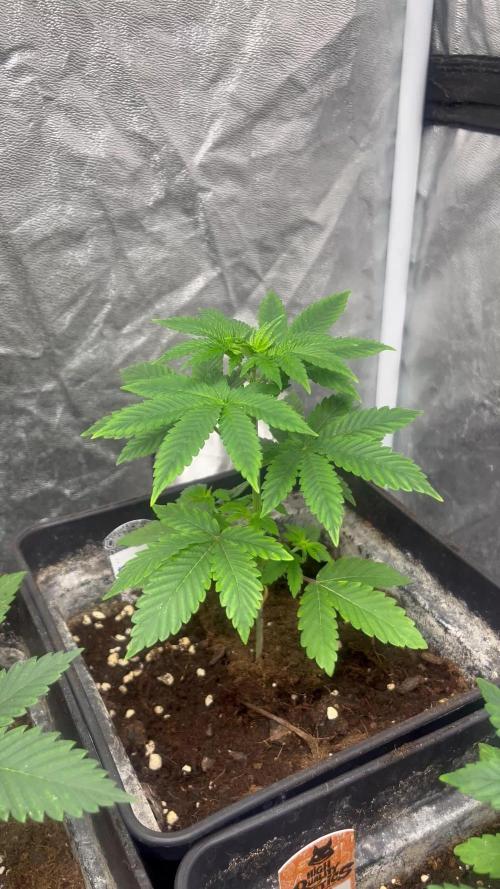
Que pasa familia, vamos con la cuarta semana de vida de estas F.U.H. feminizadas de Seedstockers.
Vamos al lío, las plantas se trasplantaron a macetas de 7 litros.
El ph se controla en 6.5, la temperatura la tenemos entre 24/22 grados y la humedad ronda el 70%.
El ciclo de crecimiento puse 20h de luz, el foco está al 50% de potencia.
Me gustaría estar más encima este cultivo pero la salud me está impidiendo un poco este 100% con el proyecto. Con suerte la semana que viene andaré mejor.
- os dejo por aquí un CÓDIGO: Eldruida
Descuento para la tienda de MARS HYDRO.
https://www.mars-hydro.com
Hasta aquí todo, Buenos humos 💨💨💨

Likes
54
Share


@DogDoctorOfficial
Follow
And this girl is on fire and in flower mode, i mean in just a few days she wen from big girl to a retarded enormous one, and she is not stoping at all, and i kind beed her to stop growing , she is way to tall for and indoor closet auto plant , go and figure this one out , i have no idea whats happening but they all are getting massive beyond expectations ever imagined , not complaining at all, just saying , i mean look at the size on this freaking monster, and at the same time look how gorgeous she looks , at least yo me she looks sexy af hihihi and now that she is in flower i can start spanking her , staring by defoliate the hell out of this cutie at some point very soon <3 <3 <3
Lets see how all goes
She keeps going and going and dont want to stop, need to defoliate asap
OMG Not STOPING and not so much time to defoliate yet …. I will i promise, i must , space is kind a getting in an SOS situation … OMG lol <3 <3 <3
As always thank you all for stoping by, for the love you guys put in the community, in to growing and it all, i am blessed to walk among all of you and am blessed with it all.
Genetics :
AUTO SOMANGO GLUE @ ADVANCED SEEDS
All info and full product details can be find in can find @
https://aptus-holland.com/
https://advancedseeds.com/
https://autopot.co.uk/
https://lumatek-lighting.com/
#aptus #aptusplanttech #aptusgang #aptusfamily #aptustrueplantscience #inbalancewithnature #trueplantscience #growerslove #dogdoctoofficial
With true love comes happiness <3 <3 <3 Always believe in your self and always do things expecting nothing in return and with an open heart , be a giver and the universe will give back to you in ways you could not even imagine so <3 <3 <3
More info and updates @
https://growdiaries.com/grower/dogdoctor
https://instagram.com/dogdoctorofficial
https://youtube.com/channel/UCR7ta4DKLFMg2xxTMr2cpIg
<3 <3 <3 Growers love to you all <3 <3 <3

Likes
16
Share


@LittleBigTrees
Follow
I underestimated there food needs but am feeding more now, its also possible that my lights are too close as its the first time using led lights 🤔?
The plants are mainly all short apart from a danceworld and a kmi-S1 that seems taller than they normally are (there are 3 going two are short and one is twice there height) onto week 5
Happy New year 😎

Likes
13
Share


Likes
3
Share


@balansa
Follow
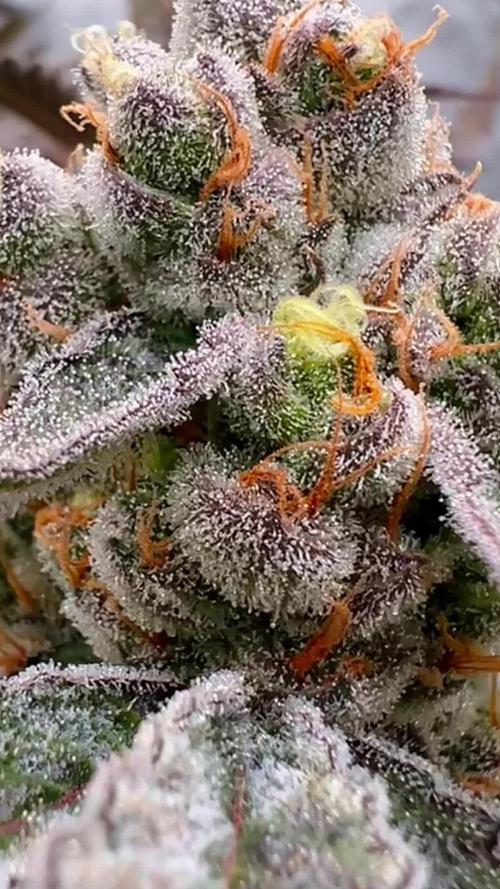
it was wonderfull i harvested about a month ago and its an amazing olant with amazing energetic high
Likes
39
Share


@Hempface86
Follow
She's looking really good after her toppings .. I'm going to continue to top every week or sofor a couple weeks. Happy growing everyone ✌️

Likes
12
Share


@Haze9
Follow
Leider habe ich zu spät angefangen zu düngen und habe sie beruflich bedingt leider 3 Tage zu spät gegossen
Habe noch mal 500 Larven bestellt und ins Zelt verbracht
Likes
7
Share

@Samsationalseeds
Follow
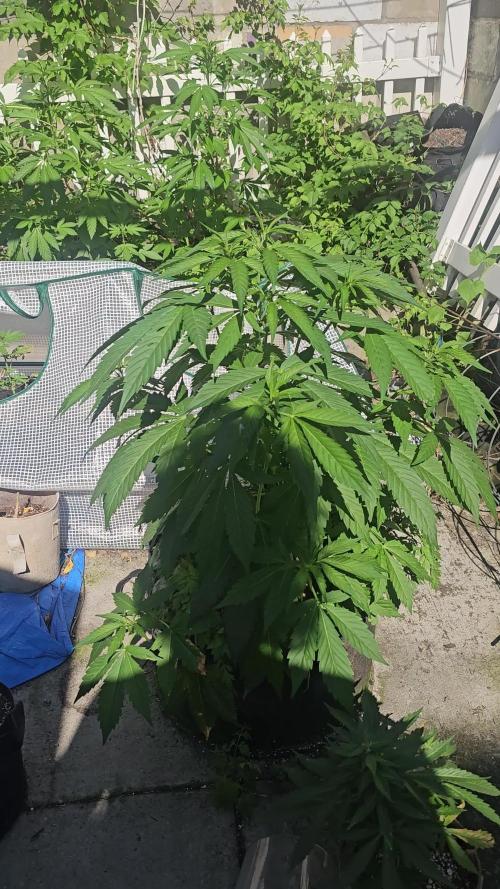
It's been a couple weeks.I'm going to update the appropriate week account
Likes
4
Share

@therealgrowmie
Follow
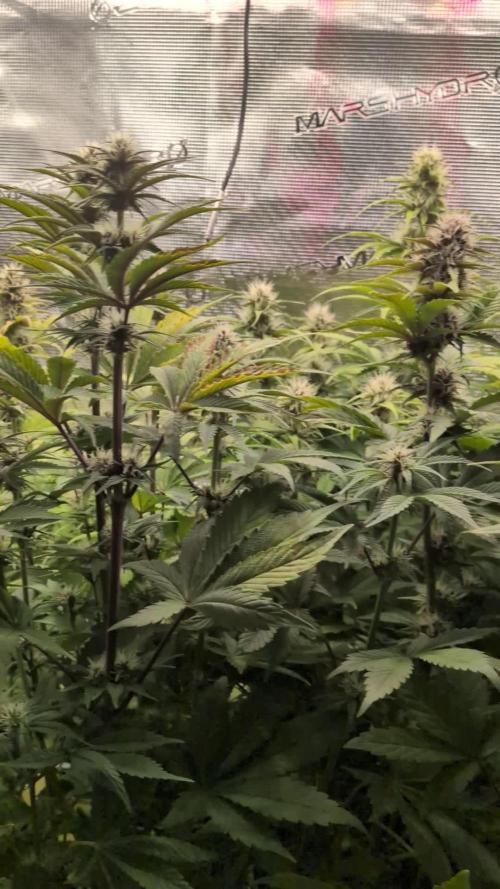
The plants are demanding way more nutrients at this stage - and unfortunately, they’re almost outgrowing the grow space 😅. We’re seeing medium-level deficiencies across the board and some mild heat stress (tacoing leaves).
To fix this, we’ll start adding fertiliser with every watering for the next 4–5 rounds and see how the new growth looks. The flowers still have the potential to become A-B-S-O-L-U-T-E-L-Y massive, so we stay calm and just feed, feed, feed! 🚀🌸
Stats so far:
💧 Watering: 1.5L every other day
💦 Humidity: ~65% RH
🌡️ Temp (lights on): 22–26°C
🌡️ Temp (lights off): 20–22°C
📈 Avg. VPD (lights on): ~1.2 kPa