Likes
Comments
Share
@BruWeed
Follow
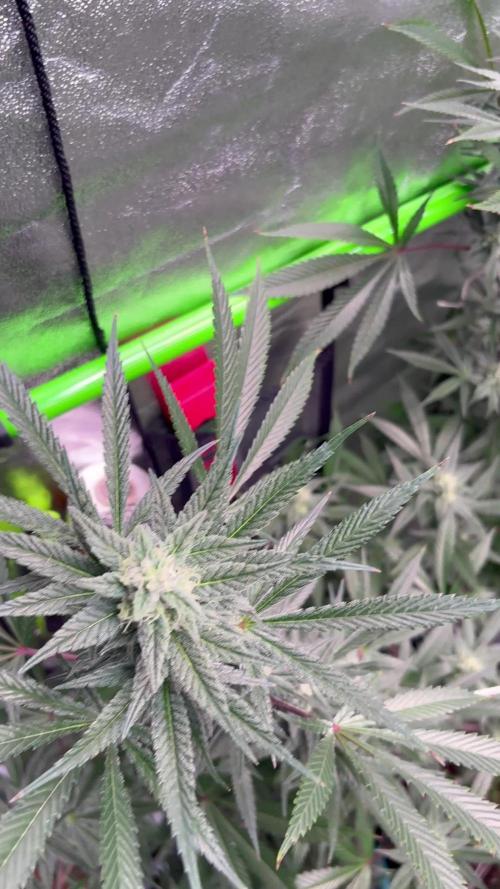
Esta semana ya realice la poda. Se encuentra en estos momentos en etapa de secado dentro de una caja especial para secados de flores que uso siempre y nunca me falla. En humedo hay 195g y utilice una lampara led de 150w en todas sus etapas. Próximamente estaré publicando cuando este en curado.
Likes
11
Share
@Mo_Powers
Follow
another week has passed and it is growing and thriving excellently. there has been a lot of sunshine and occasionally the necessary rain from above. no pistols to be seen yet
Likes
77
Share
Today the girls are 17 days old and are looking great and growing fast. I performed LST last week for the first time, i decided to get rid of the bend and let them grow upwards. Im currently bending the branches to encourage them to grow outwards. I also use the ponytailing technique. By tying the uppergrowth in a ponytail 5 hours a day you maximize the light penetration. I repeat this process 3 to 4 days in a row The girls had their first feeding of Canna Terra Vega at 0.5ml p/L and are loving it so far.
Likes
28
Share
Hello, fellow growers I thank you for having dedicated your attention to my garden and I hope that the contents are to your liking and help for your growth.
Likes
26
Share
@CannaBoy7
Follow
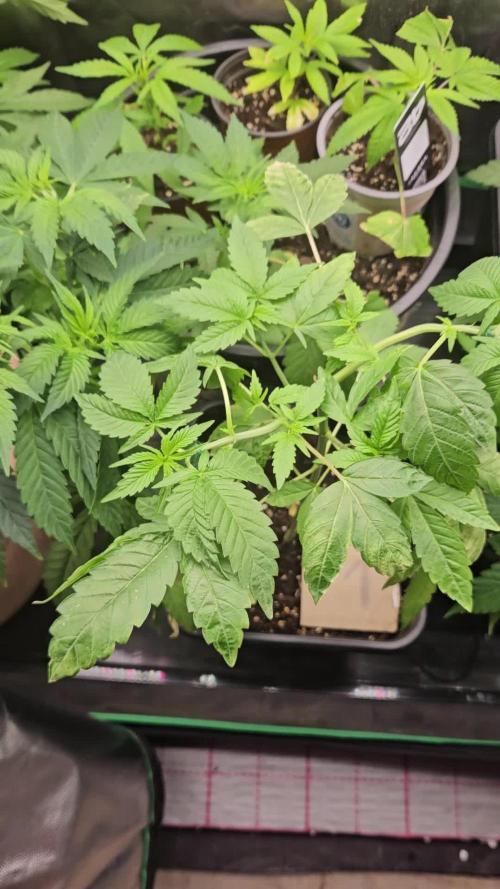
#myseed.ge #soil-N1 #mysun.ge #GROWROOM #MYSEED-GROWROOM she lies on the ground 😂 we chose LST/TOPPING
Likes
11
Share
I'm very happy with how my plants turned out and can't wait to get going again. They're now hanging in my tent so hopefully dried and ready to trim by Christmas day at the latest. I will update on weight when dried and on the smoke when cured.
Likes
34
Share
It's done...another one chopped. What a challenge this one. If you follow my grows, you know I love Royal Queen Seeds. I consistently have the best result with RQS strains, plus their services are always great. That being said I had much expectation for this Strain. What can I say... for the good point, it smells very sweet, fruity and yields giant long cola, fuuuulll of flower, very sticky and faty faty. . So densily packed that comes with some issues. First its always demanding for more K, a lot of top leaves yellowing that was hard to control. A long flower period for an auto and it suffered a lot with bud rot ( white mold, not the black one) It was a first to me. Tried everything from cutting parts to h202 direct on top of the damaged areas but with no success. That being said I've lost a lot of flower because of it and had to cut at least a week sooner than I wanted.. I will face this challenge again in a near future. The plant without the root ball weighed 1.2kg. It's drying know, so let's wait to see what we got... Overall one of the most productive plants I've tried, as one of the biggest buds I've seen in these colas. Thank you James and RQS for all the support. You guys are great and a major contribution for the cannabis world.
Likes
2
Share
@Takeaims
Follow
Coming into flower nicely a few are still a few weeks behind the others but I expect a full tent in a couple weeks
Likes
12
Share
Woche 4 ist jetzt ungefähr durch. Die Pflanzen haben weiterhin unglaublich gestretcht. Ich habe mittlerweile hinten 2 Stränge leicht runter gebunden damit die Lichtverteilung gleichmäßiger ist. Da ich die Lampe ungern noch höher hängen möchte. Aktuell gieße ich etwa alle 3-4 Tage , 30 Liter Regenwasser , nach dem Standart Düngeplan von Hesi. Ich habe keine Probleme mit Nährstoffbrand . Die 30 Liter werden im Normfallfall schon über nacht aus dem Becken weggesaugt. Ich hab bis jetzt keine Probleme mit Wurzelfäule und die Pflanzen wachsen wie bekloppt dementsprechend werde ich so weiter machen. Im video kann man unten rechts meinen großen Ventilator sehen , die Pflanze die direkt bei diesem steht ist durch den Wind so gestresst, dass sie leider nicht so gestretcht ist wie der rest. Naja ich brauch diese starke Belüftung, dementsprechend nur die harten kommn in Garten 😂
Likes
120
Share
The Harvest Prelude: After a patient wait and 48 hours of darkness, the moment arrived. The Tropical Tangie Lego Ninja, standing proudly like a silent guardian, was ready for the grand harvest. The sound of each cut echoed through the grow space, reminiscent of felling a mighty tree. The compact structure of the buds was awe-inspiring, a testament to the ninja's disciplined growth. The Lego Ninja, like a stoic warrior, was then hung upside down, beginning a two-week drying ritual. Maintaining an ambient temperature of around 21°C and a relative humidity of 60%, this slow-drying process allowed the buds to retain their essence, preserving the symphony of terpenes and cannabinoids. The trimming phase unfolded like a fragrant masterpiece. Each bud, adorned with a glistening layer of resin, transformed the trimming process into a sensory delight. The zesty aroma of oranges enveloped the room, a tangible expression of the tropical lineage. The compact buds made every snip a careful dance, revealing an abundance of frosty trichomes. The moment of reckoning arrived with the scale's unveiling. The Tropical Tangie Lego Ninja, from a single plant, bestowed upon me 309 grams of dried medicine. Each gram was a treasure trove of cannabinoids, a promise of euphoria and relief. The sheer compactness of the buds translated into a concentrated potency that left me in awe. In parallel, the clones, nurtured with equal care, showcased a fascinating divergence. A twist in the tale unfolded as the intense oranges of the mother transitioned into vibrant tangerines. This unique expression, I believe, was a testament to the clones weathering a summer heatwave differently, bringing forth a distinct personality. The clones, resilient and generous, gifted me a bountiful 549 grams of pure joy. This now my keeper of the garden, an embodiment of the Lego Ninja's legacy. The harvest dance, though familiar, carried the nuances of tangerine zest, a refreshing twist that left me eager to explore its intricacies. Both harvests shared a common thread—their resinous abundance. The trim bin, akin to a treasure chest, gleamed with golden trichomes and fragrant joy. Sticky fingers became a badge of honor, a tangible connection to the resinous richness that filled the room. Shout Outs: No harvest report is complete without expressions of gratitude. A special nod to @DutchPassion_Official for crafting the genetic marvel that is the Tropical Tangie Lego Ninja. Their expertise paved the way for this epic journey, and I tip my hat in acknowledgment. In conclusion: As the dust settles on this epic harvest saga, my heart brims with happiness and excitement. The Tropical Tangie Lego Ninja has proven itself not just as a plant but as a living masterpiece. Stay tuned for the smoke report, where we delve into the true essence of this botanical ninja's legacy. Until then, fellow cultivators, may your gardens flourish, and your harvests be as bountiful as the joy they bring. As always thank you all for stopping by, for the love and for it all , this journey of mine wold just not be the same without you guys, the love and support is very much appreciated and i fell honored and blessed with you all in my life<3 <3 <3 #aptus #aptusplanttech #aptusgang #aptusfamily #aptustrueplantscience #inbalancewithnature #trueplantscience With true love comes happiness <3 <3 <3 Always believe in your self and always do things expecting nothing and with an open heart , be a giver and the universe will give back to you in ways you could not even imagine so <3 <3 <3 Friendly reminder all you see here is pure research and for educational purposes only <3 <3 <3 Growers Love To you All <3 <3 <3 P.S- I must extend my sincerest apologies for the missing video reports. Regrettably, Grow Diaries is still facing some technical issues that are preventing me from uploading them. Rest assured, as soon as the situation is resolved, I'll share those videos to give you an even closer look at this fascinating journey. or in my case apparently GD dont let me do uploads over 100mb with is super small file if you working and editing videos , doing my best here to upload them all but GD is not making my life easy on this <3 <3 <3
Likes
2
Share
We become aware at such times of man's wonderful ability to bring seemingly unrelated elements into harmonic balance, and receive a glimpse into a world where everything exists in conscious sympathetic attunement to everything else. When we listen to a piece of music that seems to strike a beautiful chord somewhere inside us, or view a painting that simply glows with harmonic awareness well executed, we probably do not spare much time to contemplate the wonderfully intricate combination of vibrations that our sensors make it possible for us to perceive. We tend to appreciate the relationship between the parts of something by an awareness of the harmony or dissonance of the whole. This ability enables us to say "what a beautiful house!" instead of "analysis has proven that this collection of building materials exhibits certain elements of harmonic proportion." While this ability to instinctively appreciate the beauty of true harmony has an important role to play in evolution, a more analytical understanding of the laws involved can be most useful. This is especially so if we wish to create works of art where each part exists in true harmony, not only with the other part of that particular whole, but with the universe within which the creator and the created exist. Everything vibrates. From the most dense matter to the most subtle cosmic rays, everything which our senses allow our thoughts to become aware of, can be specified in terms of wavelength or frequency of vibration. These two terms define the same thing, but from different points of view. The following are the approximate wavelengths of various energy carriers: Cosmic rays 0.000,000,001 mm Gamma rays 0.000,000,1 mm X rays 0.000,500 mm Ultraviolet rays 0.003 mm Visible light 0.006 mm Infrared 0.01 mm Sound waves 1 meter Radio waves 300 meters Violet light 400 nm to 450 nm Blue light 450 nm to 500 nm Green light 500 nm to 570 nm Yellow light 570 nm to 590 nm Orange light 590 nm to 610 nm Red light 610 to 700 nm 1 nanometer (nm) = 0.000,000,1 cm = 1/10,000,000 cm If a guitar string is plucked and we hear a sound, it is not too difficult for the human mind to associate this sound with the vibration of the guitar string. With color it is quite different. It is difficult for us to conceive that the color of a substance is not an inherent property of the substance itself, but an indication picked up by our senses of that substance's ability to absorb or reflect the light which happens to be shining on it at that moment. Neither the matter nor the light is colored. What happens is that the brain learns to differentiate between the frequencies reflected or transmitted by the substance the eyes are focused on. The same thing happens with sound. When we say "Oh! Listen, they're playing my favorite song," what we really mean is: "My brain has stored within it a particular pattern of frequencies. I have compared the new information being received with this stored pattern and have deduced the answer that the two patterns are similar within certain specified tolerances." The 'pleasure' involved could have something to do with our running the pre-recorded pattern at the same time, in 'sympathy' with the new pattern as it is received. The word sympathy describes very well our ability to appreciate color and sound. It also describes the reason behind certain elements of harmony. For instance, if a substance vibrating at 100 cycles per second (tone 1) is in the proximity of another substance vibrating at 200 cycles per second (tone 2), we could perceive, if we had the right equipment, a certain sympathetic relationship between the two. We will see from this that there is a uniform doubling of the first tone seen in the second. At various points along the waves, the two are the same in amplitude. At other points, they are at opposite poles to each other. This doubled frequency has more points of similarity to the original than any other frequency except the original itself. If the equipment we had available for measuring these two frequencies was a soundboard amplifier and a pair of ears, then we would hear what would sound to us like one tone. If we had the opportunity to hear one at a time, we would hear that although they sound the same, one is higher in pitch than the other. This characteristic of 'the same but different in pitch', musicians have called the octave. Any two tones produced where one has exactly doubled the frequency of the other is called an octave. Speaking in ratios, an octave would appear then as the ratio 2:1 or 1:2, depending on whether we are talking of an octave up or down. A single note produced by almost any instrument will contain more than one wavelength or frequency. It will have a dominant frequency, the wavelength of which we would call the note's 'fundamental' or 1st harmonic. It will also have a varying number of upper harmonics, gradually fading in intensity into infinity or silence. Natural harmonics always have the same pattern of intervals between them. The interval between the 1st and 2nd harmonic is a perfect octave; between the 2nd and 3rd a perfect fifth; between the 3rd and 4th a perfect 4th; and so on, the intervals becoming smaller and smaller until they lose any relationship with the western 12 tone scale as it exists at the moment. Just as an octave has certain elements of sympathy with its fundamental, so some intervals have been noted to be more perfectly in sympathy with the fundamental than others. The ratio of the 'perfect 5th' or interval of 7 semitones, as it occurs in the harmonic series, is 3:2 or 2:3, while that of the 'perfect fourth" is 4:3 or 3:4. All the tones in the western 12 tone scale can be expressed in terms of the ratio between the upper tone and its fundamental. This would seem to be an ideal way of generating a scale from any given fundamental and several attempts have been made to do this, the Pythagorean system being probably the most well known. Although when working with a single tone instrument playing on its own, the Pythagorean formula works wonderfully well, if we had several instruments tuned this way together and asked them to play almost any western music, we would find that at times they sounded quite out of tune to each other. The lack of flexibility of the various scale systems based on the harmonic series has led to what is known as the 'tempered' scale. This uses as its primary unit of interval the ratio of the octave or 2:1. It then proceeds to divide the interval between any fundamental and its upper octave into 12 smaller intervals by applying the ratio: two to the one-twelfth power, to one (21/12:1). This equals 1.059463094, so by multiplying any frequency by this number, we will obtain the tempered semitone next up from our fundamental. We will also find that any tone twelve semitones up from any other tone, in a scale generated in this way, will have exactly double the frequency. If we took the note middle C on a piano and halved the wavelength, we would have the note C one octave above. If we halved this, we would have the C above, and so on. However, within about 6 octaves, we would find that although a 'sound' was being produced, no human ear could perceive it. If we kept on going, halving and producing upper octaves of our fundamental C, we would proceed through the infrared band, into the visible light spectrum. If we happened to be outside during the day, we would, for one octave only, see the note C with our eyes. The next octave above would already be in the ultraviolet band, and outside the eye's sensitivity range. If we can think of color as being an indication of a substance's vibratory rate or wavelength, we may begin to see a relationship that could exist between the color and sound spectrums. The logical extension of what has so far been said is that there exists a scale in the color spectrum that corresponds exactly to the scale in the sound spectrum, each color tone being an octave of the equivalent note in the sound range. This is not the end of the story but only the beginning. If we can for the moment accept that any wavelength in one band has upper and lower octave stretching out to infinity, then the next question is 'fine, but what shall we use as our fundamental? A particular color? A particular sound frequency?' The musicians among us will probably say 'A 440'. This means that the note A should vibrate at 440 Hertz, or 440 times per second. They would tell us that this is standard pitch has been adopted by most orchestras around the world; pianos are tuned to it, instruments are constructed to formulas based on it, and so to them it would probably seem the most appropriate place to begin. Some of these musicians may know of the battle that is still raging with regards to this being the standard, but few would know why A = 440 Hz was chosen except that it worked when it was set to be a suitable compromise between the many different pitches in use at the time. 432 Hz is said to be mathematically consistent with the patterns of the universe. Studies reveal that 432 Hz tuning vibrates with the universe’s golden mean PHI and unifies the properties of light, time, space, matter, gravity, and magnetism with biology, the DNA code, and consciousness. When our atoms and DNA start to resonate in harmony with the spiraling pattern of nature, our sense of connection to nature is said to be magnified. Another interesting factor to consider is that the A=432 Hz tuning correlates with the color spectrum, while the A=440 Hz is off. Audiophiles have also stated that A = 432 Hz music seems to be non-local and can fill an entire room, whereas A=440 Hz can be perceived as directional or linear in sound propagation. Once you adopt the idea that sound (or vibration in general) can have an equalizing and harmonizing effect (as well as a disturbing effect), the science of harmony can be applied to bring greater harmony into one's life or tune to specific energies. There is a form of absolute and relative harmony. Absolute harmony can, for example, be determined by the tuning of an instrument. The ancients tuned their instruments at an A of 432 Hz instead of 440 Hz - and for a good reason. There are plenty of music examples on the internet that you can listen to in order to establish the difference for yourself. Attuning the instrument to 432 Hz results in a more relaxing sound, while 440 Hz slightly tenses up the body. This is because 440 Hz is out of tune with both macro and micro cosmos. On the contrary, 432 Hz is in tune. To give an example of how this is manifested microcosmically: our breath (0,3 Hz) and our pulse (1,2 Hz) relate to the frequency of the lower octave of an A of 432 Hz (108 Hz) as 1:360 and 1:90. It is interesting to note that 432 Hz was the standard pitch of many old instruments and that it was only recently (19th and 20th century) the standard pitch was increased. This was done in order to be able to play for bigger audiences. Bigger audiences (more bodies) absorb more of the lower frequencies, so the higher pitch was more likely to “cut through”. One of the oldest instruments of the world is the bell ensemble of Yi Zeng (dated 423 BC), tuned to a standard F4 of 345 Hz, which gives an A= 432 Hz. The frequency of 345 Hz is that of the platonic year! Similarly, many old organs are tuned in A=432 as well; for example, St. Peter’s Capella Gregoriana, St. Peter’s Capella Giulia, S. Maria Maggiore in Rome. Maria Renold’s book “Intervals Scales Tones and the Concert Pitch C=128 Hz” claims conclusive evidence that 440 Hz and raising concert pitch above scientific “C” Prime=128 Hz (Concert A=432 Hz) disassociates the connection of consciousness to the body and creates anti-social conditions in humanity. The difference between concert pitch A=440 Hz and Concert A=432 Hz is only 8 cycles per second, but it is a perceptible difference of awareness in the human consciousness experience of the dream we share called existence.
Likes
112
Share
💩Holy Crap We Are Back💩 Well i had so much fun the last round , that we are going at it again 😁 So super happy to be trying this one out , can't wait😝 ..... This is my favorite strains to make hash with ..👍 Seed soaked for 24 then placed in a tub with paper towels , once it cracked and rooted , placed into its main pot 👌 👉I WISH GD HAD DISCORD SERVER SO GROWMIES COULD HAVE A PLACE TO HELP AND TALK THINGS RELATED TO GROWING .....👈 👉SO I CREATED ONE ALL YOU NEED IS TO JOIN THE GROWDIARIES DISCORD SERVER !!!!!!!!!!!👈 LINK IS 👉 https://discord.gg/zQmTHkbejs AND SEE HOW IT PLAYS OUT !!!!!!!
Likes
28
Share
12/12 from seed. Week 12 overall. Week 8 of flower. And Cosmic Noodles is doing exactly what a finisher should do. No drama. No panic. No chasing numbers. Just a massive plant, a controlled fade, and a very clear push into the final stretch. She is not limping to the finish. She is arriving with weight. ⸻ 🍜 The Final Reduction This week, everything comes out except Pure Zym. No bloom feed. No boosters. No extras. No correction bottles. No late flower chasing. Just enzymes. And time. At this point, the goal is no longer to build. The goal is to finish clean. She has already done the hard part. The bulk is there. The frost is there. The density is there. Now the plant is simply being allowed to use what she has already stored. That’s the shift this week. Less input. More observation. Less pushing. More finishing. And for a plant this far along, that is often the better move. ⸻ 🌱 Why Keep Pure Zym In Because even when feed stops, the root zone is still working. Pure Zym stays because the medium is still alive. Microbial activity does not stop just because bottles do. At this stage, enzymes still help break down residual organic matter in the root zone, keep the medium cleaner, and support a softer transition as the plant begins consuming what remains available. That matters even more when the soil is not treated like disposable media. Because it isn’t. This soil still has a second job after this run. It goes outside. It gets reused. It feeds vegetables. It stays alive. And whether it is hard science, soft biology, or just grower instinct — keeping that soil active until the end has always made sense here. Not everything needs to be sterile to be effective. Sometimes the better approach is simply not killing what is still working. ⸻ ? Living Soil, Second Life That has always been part of the rhythm. What finishes the room does not leave the cycle. It just changes jobs. Once this run is done, that soil goes back outside and keeps working somewhere else. Different crop. Same biology. Same purpose. So yes — keeping the medium active late matters. Not just for this harvest. For what comes after it too. Call it practical. Call it circular. Call it habit. Either way, dead soil has never been the goal. ⸻ 📉 EC Down, pH Up, Eyes On the Plant This is where the spreadsheet starts losing authority. EC is down. Input is nearly gone. pH has drifted upward into that 6.8–7 range. And right now, it is not being forced back down. Not because numbers do not matter. Because context matters more. At this stage, the plant is finishing. Uptake is slowing. Demand is lower. Feed has been reduced. The root zone is doing less work than it was two weeks ago. So yes — on paper, some of these numbers would make people uncomfortable. In practice? The plant looks exactly like a plant that is finishing correctly. Still drinking. Still praying. Still stacking. Still fading evenly. Still moving from top to bottom without confusion. That matters more than chasing a perfect chart in the final stretch. Room VPD is a reference. Leaf response is the truth. And this room continues to be read by plant behavior first, numbers second. As always. ⸻ 🌡️ Conditions Stay Stable Nothing changed in the room because nothing needed to. Conditions remain steady. No dramatic swings. No forced stress. No late-stage environmental tricks. The room is stable. The plant is stable. The finish is stable. And late flower stability is one of the most underrated parts of a clean finish. No heroic adjustments. No panic corrections. No reinvention in the last chapter. Just consistency. ⸻ ️ A Proper Finisher And this one is a beast. Not “good structure.” Not “nice tops.” A beast. Huge central cola. Heavy side stacking. Dense flower formation. Thick terminals. Real weight from top to bottom. This is one of those plants that stops being judged branch by branch and starts being judged as mass. Because the whole frame is carrying. She is not finishing in isolated tops. She is finishing as a full plant. That matters. The top is heavy. The mid is real. The lowers are still worthwhile. And the entire plant is moving together. That is what a complete finisher looks like. ⸻ ❄️ Frost, Density & Finish Quality And she is not just big. She is finishing properly. Dense flower. Heavy resin. Excellent frost coverage. Strong calyx development. Good terminal formation. Real weight in the hands. The important part now is that she is not only stacking size — she is finishing with quality. That is the difference between a plant that looks impressive and a plant that actually delivers. This one does both. And whether part of her gets dried or part of her gets frozen, she has already made the case for both. That decision can wait. Right now, the only job is to let her finish. ⸻ 🍂 The Fade Is Real — And It’s Everywhere The fade is already underway. And more importantly, it is happening correctly. Not isolated. Not patchy. Not confused. She is fading from top to bottom. Across the plant. Across the canopy. Across the frame. That matters. A uniform fade tells a very different story than a stressed collapse. This is not random yellowing. This is not deficiency panic. This is senescence. The plant is reallocating. The cycle is closing. The finish has started. And she is doing it evenly. That is exactly what you want to see here. ⸻ 💡 Canopy Light Matters And once again, the lesson stays the same: Canopy lighting matters. When the full frame is finishing together, it shows. When lowers stay relevant, it shows. When the plant matures with less separation between top and bottom expression, it shows. Uniform development is not an accident. Top-to-bottom consistency like this is one of the clearest arguments for proper canopy penetration when the setup allows for it. Not mandatory in every room. But when possible, absolutely worth it. This plant makes that case on her own. ⸻ 📘 Week 12, Cosmic Noodles This is what the late game should feel like. Calm. Heavy. Controlled. Predictable. Close. No overreaction. No bottle panic. No forced finish. Just a large, healthy plant using the last of what she has and moving toward the end exactly like she should. And that is all this week needed to be. ⸻ ⏭️ What Comes Next Next week should bring more fade. More color loss. Less drinking. More swelling where it still matters. And a clearer final read on timing. She may finish next week. She may ask for a little longer. Both are still on the table. What should not happen is panic. No sudden overfeeding. No late corrections. No chasing green back into a plant that is already doing what finishing plants are supposed to do. From here, the job is simple: Watch the leaves. Watch the resin. Watch the pace. Then cut when the plant says so. ⸻ 🤝 Thank You To the long-time followers. To the new ones. To the quiet readers. To the loud ones. To the skeptics. To the supporters. To the critics. To the growers who watch closely. To the ones who question everything. To the ones who simply keep showing up. To GrowDiaries. To the community. To the sponsors. To the gear. To the tools. To the genetics. To everyone following the process, whether they agree with every choice or not. Thank you. The room keeps teaching. The plants keep answering. And this one is not done speaking yet.📡 DELETED @ 1K Please stay tuned.we never quit https://www.youtube.com/@TheDogDoctorOfficial NEW 🙏 Thank you for your patience and continued support. FOR DISCOUNT CODES AND MORE JUST FOLLOW THE LINK https://website.beacons.ai/dogdoctorofficial 📲 Don’t forget to Subscribe and follow me on Instagram and YouTube @DogDoctorOfficial for exclusive content, real-time updates, and behind-the-scenes magic. We’ve got so much more coming, including transplanting and all the amazing techniques that go along with it. You won’t want to miss it. GrowDiaries Journal: https://growdiaries.com/grower/dogdoctorofficial Instagram: https://www.instagram.com/dogdoctorofficial/ YouTube: https://www.youtube.com/@dogdoctorofficial Deleted by Youtube - https://www.youtube.com/@TheDogDoctorOfficial NEW Vimeo : https://vimeo.com/dogdoctorofficial Under construction stay tuned ⸻ Explore the Gear that Powers My Grow If you’re curious about the tech I’m using, check out these links: 🔆 Lighting & Environmental Control • Future of Grow — Advanced LED lighting technology https://www.futureofgrow.com/ DISCOUNT CODE: DOG20 • Lumiflora — Under-canopy LED lighting https://lumiflorade.com/ • TrollMaster — Environmental controllers and automation gear (past collaboration) ⸻ Genetics • Zamnesia Seeds — Genetics used in this project https://www.zamnesia.com/ ⸻ 🌱 Soil, Substrates, Boosters & Root Support • Plagron — Substrates, bio mixes, and supportive products https://plagron.com/en/ ⸻ 🎒 Storage, Curing & Preservation • Grove Bags — Curing and storage solutions https://grovebags.com/ ⸻ 📸 Photography Equipment & Tools (Not sponsors, but part of my creative toolkit) • Sony A6700 • Sony full-frame macro lens + few more • Stacking photography workflow - learning • iPhone (for behind-the-scenes shots) We’ve got much more coming as we move through the grow cycles. Trust me, you won’t want to miss the next steps, let’s push the boundaries of indoor horticulture together! As always, this is shared for educational purposes, aiming to spread understanding and appreciation for this plant. Let’s celebrate it responsibly and continue to learn and grow together. With true love comes happiness. Always believe in yourself, and always do things expecting nothing and with an open heart. Be a giver, and the universe will give back in ways you could never imagine. 💚 Growers love to all 💚 📸 P.S. – The Eye Behind the Lens All photos in this diary (for now — except for the ones showing the camera, which I took with an iPhone) are taken with a Sony A6700 paired with a Sony full-frame macro lens and a few more. Photography is part of the story — it’s how we share the fine textures, the glow, and the quiet details that words can’t always capture. I’ve also started experimenting with photo stacking — a technique where multiple images, each taken at a slightly different focus point, are layered together to create one perfectly sharp image from front to back. It’s not digital enhancement or AI; it’s pure photography — a way to reveal the plant’s beauty in microscopic depth, from trichome to petal. You’ll even see a few shots of "ghost me" capturing the shots — camera, lens, setup — because every grow deserves not just to be cultivated, but documented like art. FOR DISCOUNT CODES AND MORE JUST FOLLOW THE LINK https://website.beacons.ai/dogdoctorofficial NEW DISCORD - Official Server Invite Link : https://discord.gg/ksjAkA5T74
Likes
1
Share
@Enoc3378
Follow
First time growing autos, blueberry. Buds seem small to me I know autos don’t produce like photos but is this normal? Yellow tips started on top leaves couple weeks ago. Light burn I’m sure. Still few weeks to go hopefully they will fill in.
Processing
Likes
20
Share
They are growing really well. Added a humidifier at day 9. I have a seedling in rockwool still it is growing super slow. Root still not sticking out even tho it have been in the cube for 7 days now. Im feeding very light 40% strenght. I see how light green the leafs are and thats what im going for. I will up the strenght abit the following days. I been watering almost everyday. Started the first week with 0.1 liter now upped it to 0.2 liters per plant. I had the HPS light just a bit too close to the plants so i have some very slight curling on a few of the leafs. No problem i just move the light up 5cm. So far im very pleased with the growth rate
Likes
2
Share
Sequence: A sequence is an ordered list of numbers. For example, 1, 2, 3, 4 is a sequence. Series: A series is the sum of the terms of a sequence. For example, 1 + 2 + 3 + 4 is a series. Summation: The addition, and also the resulting value, are called the "sum" or the "summation". Use summation: 207,360=9 103,680=9 51840=9 25920=9 12960=9 6480=9 3240 =9 1620=9 00=0 09=9 18=9 27=9 36=9 45=9 54=9 63=9 72=9 81=9 90=9 180=9 360=9 720=9 1440=9 2880=9 5760=9 The number 25,920 is relevant in the context of astronomical phenomena, specifically the Earth's axial precession, a cycle that takes about 25,920 years to complete as the Earth's axis "wobbles," causing the Earth to shift its orientation relative to the stars. 144x180 = 25,920 Axial Precession (Great Year): A slow wobble of Earth's axis, completing a cycle approximately every 25,920 years, causing the apparent shift of constellations over long periods. 72 Years per Degree: The 25,920-year precession cycle is divided by 360 degrees, resulting in roughly 72 years per degree (25920 / 360 = 72). The number 72 is connected to the golden ratio in pentagonal geometry. The angles of a golden triangle, an isosceles triangle where the ratio of the longer side to the shorter side is 1.618, are 36°,72° 72°. The central angle of a regular pentagon is also 72(360°/5=72°). Trigonometry: The golden ratio can be expressed using trigonometric functions of angles related to 72°, such as in the formula for the cosine of 36° or the sine of 54° The Sacred Cubit (or Royal Egyptian Cubit) is an ancient unit of measure, typically 20.6 to 25.26 inches, derived from the length of the forearm from the elbow to the tip of the middle finger. It was used to design sacred structures like the Giza Pyramids. Discovered and popularized by Slim Spurling in the 1990s, this technology involves measuring a specific length of wire—typically 20.6 inches (52.4 cm) based on measurements from the King’s Chamber of the Great Pyramid of Giza—and twisting/looping it into a "tensor ring". Within the context of Tensor Technology and sacred geometry, the Sacred Cubit is considered to create or resonate at a frequency of 144 MHz (megahertz). Proponents, such as Bruce Cathie and Jain 108, define the speed of light (c) as a "harmonic" value of 144,000 minutes of arc per grid second within a hypothetical universal grid system, rather than the standard physical constant of approximately 3x10^8m/s. •The Tetrahedron totals 720°, (7+2=9) •The Octahedron totals 1440°, (1+4+4=9) •The Cube totals 2160°, (2+1+6=9) •The Icosahedron totals 3600°, (3+6=9) •Dodecahedron totals 6480°. 6+4+8= 18 1+8=9 Unlike the standard tuning of 440 Hz, which is used in most music today, 432 Hz is said to be mathematically consistent with the patterns of the universe. It is often referred to as the “frequency of the universe” or the “miracle tone.” •The Cube (Hexahedron - earth) is 2160 degrees, 216 x 2 is 432 Everything is energy. Energy is represented by numbers. Numbers are frozen music. Music is moving sacred geometry of the Uni-verse. Here the tension comes from the interaction between spins causing them to magnetically resonate. For these interactions, we found a series (scale) of resonant notes: The first two notes show a perfect relationship with each other. Their frequencies (pitch) are in the ratio of 1.618…, which is the golden ratio famous from art and architecture. It reflects a beautiful property of the quantum system — a hidden symmetry. Actually, quite a special one called E8 by mathematicians. •The E8 structure itself has relationships to Phi (1.618). The golden ratio is the limit of the ratio of consecutive numbers in the Fibonacci sequence. The number 144, which is the 12th Fibonacci number, appears in calculations related to the 25,920-year cycle in some esoteric contexts 144°x180°=25,920° total degrees in a 64-tetrahedra structure's surface). The outer surface of a structure made from 64 tetrahedrons, often referred to as the 64 Tetrahedron Matrix or the Isotropic Vector Matrix (IVM), is composed of 144 equilateral triangles. This complex geometry is significant in sacred geometry and some unified field theories. The 64 Tetrahedron Matrix is a three-dimensional representation that is related to the two-dimensional "Flower of Life" symbol, where the arrangement of spheres around each tetrahedron creates the dense sphere-packing lattice of the Isotropic Vector Matrix. The golden ratio has been reported to appear in the overtones of magnetic resonance at the quantum scale. Some theories propose a mathematical framework where the golden ratio is central to the absorption and emission of light photons (electromagnetic energy) by electrons. This dynamic process is linked to the fine structure constant, a fundamental physical constant relating the electron's charge, Planck's constant, and the speed of light. The ratio of certain color frequencies in the visible light spectrum (e.g., infrared to green and green to ultraviolet) has been posited by some researchers to approximate the golden ratio, suggesting an underlying harmonic principle. Philosophical and theoretical frameworks suggest that the golden ratio acts as a "universal resonance constraint" for frequency in a unified mathematical model of reality and consciousness. Electromagnetic vibrations, such as those from electrons and photons, are thought by some to travel along biological structures like proteins and DNA, where the golden ratio is found in geometric patterns, suggesting a link to biological electromagnetism. The golden ratio emerges in discussions regarding quantum gravity, black hole physics, and even the potential shape of the universe (a dodecahedron based on 1.618) The geometry is considered fractal, meaning it can be scaled infinitely while maintaining its fundamental properties and structure.
Likes
260
Share
🐒 🍌 🌴🐒 🍌 🌴🐒 🍌 🌴🐒 🍌 🌴🐒 🍌 🌴🐒 🍌 🌴🐒 🍌 🌴 Welcome to week number 14!! ✨ DAY 98 Donkey was put in darkness. 🕳️ DAY 100 Donkey was harvested. 🎉 WIIIIIIIII no more sleepless nights!! 🌕 DAY 102 Found a budrot bud in the tent on the remaining Monkey, also she drinks nothing anymore.. my gut feeling says, this one has gotten too much More PK, hihi, sorry Monkey! Soooorry! 😘 Gonna harvest that one too soon then.. Thanks, my growmies for visiting and reading and commenting, I love reading your comments! Mwah! 😘 Thank you, @Kannabia, for sponsoring this grow, aaaaand for the amazing gift pack! 😍 I hope to make you proud! 🧡 Special shouts out to my fantastic sponsor @GreenBuzzNutrients! Thank you for trusting me with your awesome products, I'm a longtime fan! 💚 🙏 Green + juicy growmie hugs to my Greenbuzzers!! 😘 Get a generous discount code for their products in my set up section ⬇️ !! Grower Love everybody!!!11 💚 💚💚💚💚💚💚💚 Wishes do come true, they just take a lot of time sometimes.. ✨ __________________________________________________________________ https://www.kannabia.com/en/feminized-cannabis-seeds/monkey-grease Monkey Grease Its own personality At Kannabia Seeds we have put all our effort into bringing out our own feminized Monkey Grease, a cross between Monkey Grease x White Widow, focusing above all on giving it its own personality in flavor and aroma (frankly unmistakable) and, of course, in Highly demanded characteristics, such as high resistance to diseases and pests, and adaptability to all types of growing conditions, making it close and easy to grow to the widest possible range of growers. The result is a really powerful and versatile indica-sativa marijuana seed, with a powerful relaxing effect, ideal for those moments when you want to disconnect from the madding crowd. Cultivation of Monkey Grease Which cultivation method would be most appropriate for this variety? Good question… and one that is easy to answer. Its versatility and adaptability make it a true all-rounder, with remarkably uniform results, whether you choose SOG, SCROG, hydroponics or guerrilla growing. Moreover, we invite you to experiment and play, varying the techniques from moment to moment, and to draw your own conclusions. We are convinced that in all cases, apart from minor variations, the results will always be optimal, giving remarkable yields and in a short time. Attention should be paid to its high bud production, which can be fat, dense and heavy, although its sturdy branches are able to bear heavy loads without major problems. If you are a fan of extractions, our Monkey Grease is also optimal, given its high production of caramelised resin. If it is already amazingly productive indoors, this variety excels on its own merits outdoors, where it can easily reach 200 cm in height, and can reach between 700 and 800 grams per plant. It is therefore an easy and grateful plant, which demands little from its gardeners, making do with simple basic care, and with little or no propensity to develop diseases or mildew, or to attract pests (despite its striking aroma!). Taste and effect of Monkey Grease Our Monkey Grease stands out first and foremost because of its powerful, strong smell, which is hard to camouflage. A penetrating aroma that unfolds, in a balanced way, on the palate in the form of a wide range of spicy and sweet flavours, reminiscent of wild honey, nougat and cinnamon, and distant notes of milk chocolate. A delicious treat to be savoured calmly, without haste, as a preamble to its pleasant effect: extremely relaxing and narcotic, powerful, ideal for meditation and moments of introspection and meditation. Don’t be in a hurry with Monkey Grease. It can be your perfect ally to treat those stress and anxiety problems, but for that you must let yourself go, surrender to its charms, especially if you are inexperienced. ________________________________________________________ Setup: 140x70x200 cm Spiderfarmer tent 2x Monkey 16W fans (not oscillating) 1x box fan 50W oscillating (on lowest level) LED Full Spectrum 320W AGLEX AGL-320W-MA 5,6 kg foldable, dimmable 864 pieces Samsung LH301H 864umol/s 2,7umol/J full spectrum white + RED 660nm + IR 740nm wavelength range 380-780nm covering 3x4ft Green Buzz Nutrients https://greenbuzzliquids.com/ ❗ Use code GD42025 for generous 25% discount (for orders of minimum 75€) 💚 Plagron Growmix Can Lite Filter 125/ 400cm³/h PrimaKlima exhaust EC 125-400/240 cm³/h tab water pH 8 - EC 0,25 with Calmag to 0,5 Advanced Hydroponics pH minus Grow + Bloom to pH 6.2 💧 🐒 🍌 🌴🐒 🍌 🌴🐒 🍌 🌴🐒 🍌 🌴🐒 🍌 🌴🐒 🍌 🌴🐒 🍌 🌴
Likes
4
Share
@Ninjabuds
Follow
Week three of flower is off to an amazing start! At day 22, the ladies are looking incredibly healthy. They're praying like crazy, reaching for the light, and stacking nodes like it's their job. The buds are starting to plump up, and the trichome production is getting intense. I'm so excited to see how they develop over the next few weeks!
Likes
8
Share
@GuniGugu
Follow
- BioBizz Light Mix soil - BioBizz Nutrients used according to their schedule - stopped LST